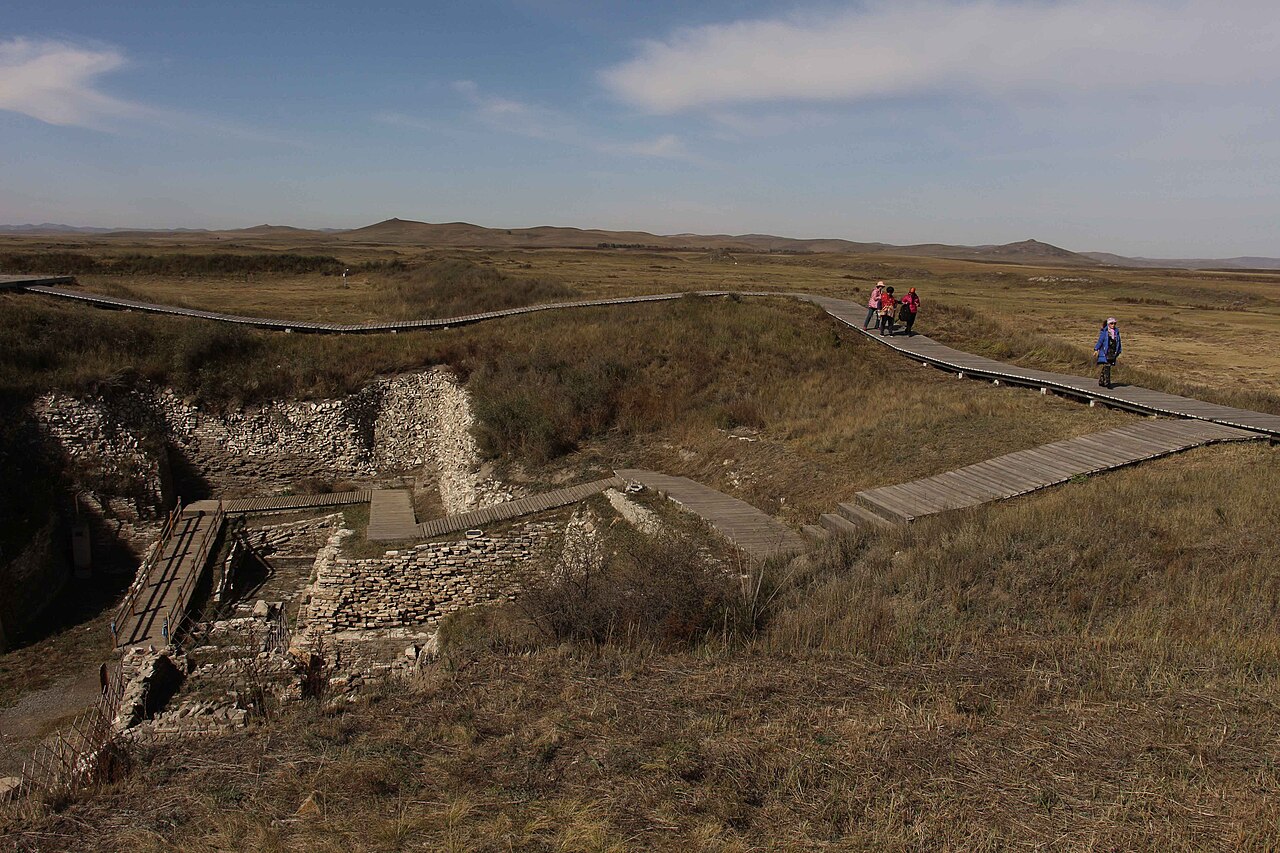
Xanadu (Shangdu), inscribed as UNESCO World Heritage in 2012, was the summer capital of Kublai Khan, founder of the Yuan dynasty, located in what is now Zhenglan Banner (Zhenglanqi), Xilingol League, Inner Mongolia Autonomous Region, at an elevation of approximately 1,280 metres on the Mongolian steppe. Kublai Khan received the Venetian travellers Niccolò and Marco Polo at Shangdu in 1275 CE; the palace whose marble reception hall could seat approximately 6,000 diners at the annual August festival was described by Marco Polo in the “Divisament dou Monde” (c. 1298 CE). The English poet Samuel Taylor Coleridge, who had never visited and had read of Shangdu only in Samuel Purchas’s 1614 abridgement of Marco Polo, claimed to have composed approximately 200 lines of the poem “Kubla Khan” upon waking from an opium-induced sleep in 1797 CE, of which he completed 54 before being interrupted by a visitor from Porlock; the poem begins “In Xanadu did Kubla Khan / A stately pleasure-dome decree.” The site today is accessible from Beijing in approximately 4 hours by road (350 km north) or 3 hours by train to Zhenglandqi followed by a 45-minute taxi.
South to Beijing: Great Wall sections and the Forbidden City Great Wall Badaling 350 km south via Beijing; Forbidden City 350 km south, 4h road or 3h train
The Great Wall of China (UNESCO 1987) was, in geographic and political terms, the southern boundary that defined what Kublai Khan’s summer capital at Shangdu was “beyond.” Shangdu is approximately 100 kilometres north of the main Ming-dynasty Great Wall line in what is now Hebei Province; the Wall in this region separates the North China Plain from the Inner Mongolian Plateau, and the steppe setting of Shangdu was chosen precisely because it was north of the frontier zone — Mongol rather than Chinese territory in landscape, culture and military logic. Kublai Khan used Shangdu as a summer residence from 1263 CE until his death in 1294 CE; the court migrated annually from the winter capital at Dadu (Beijing) northward to Shangdu between April and August, then returned south before the steppe winter. The Great Wall that tourists visit today dates primarily from the Ming dynasty (1368–1644 CE), built more than a century after Kublai Khan’s death; but earlier earthen walls on the Inner Mongolia frontier formed part of the defensive landscape within which Shangdu was positioned. The most-visited Great Wall sections from Beijing include Badaling (70 km northwest of Beijing, accessible by HSR in 1h from Beijing North Station), Mutianyu (70 km northeast, 2h by bus or taxi from downtown), Jinshanling (125 km northeast, 2.5h by car) and Simatai (110 km northeast, 2.5h). All four are within a 2-hour radius of Beijing, which sits 350 kilometres south of Shangdu; a visitor travelling from Shangdu to Beijing by road will cross or pass near the Wall at multiple points along the Zhangjiakou-Beijing highway corridor through Yanqing. The Wall’s inscribed property covers the full length of surviving structures across 15 provinces and autonomous regions; the UNESCO inscription (1987) encompasses sections from the Han-dynasty (earthen ramparts in Xinjiang and Gansu) through to the Ming-dynasty (brick-faced mountain sections in Hebei and Beijing). The Badaling section, at 1,015 metres elevation and accessible without significant hiking, receives approximately 8 million visitors annually; Jinshanling (10 km restored Wall with original tower structures, 20 km of unrestored Wall accessible beyond the restored section) is the preferred alternative for visitors seeking a less-crowded experience.
The Forbidden City, part of the Imperial Palaces of the Ming and Qing Dynasties UNESCO inscription (1987), stands in Beijing approximately 350 kilometres south of Shangdu. Kublai Khan built the winter capital of Dadu on the same Beijing site between 1267 and 1293 CE; the Mongol Dadu was demolished by the Ming dynasty after 1368 CE and replaced with the Yongle Emperor’s Forbidden City, constructed between 1406 and 1420 CE. The spatial relationship between Shangdu and Dadu/Beijing was the operating logic of the Yuan imperial court: the summer-winter capital migration was formalised, with the court’s administrative machinery splitting its year between the steppe (Shangdu, April–August) and the agricultural lowlands (Dadu/Beijing, September–March). Marco Polo describes both residences in the “Divisament dou Monde”: Shangdu’s portable cane palace (“a great Palace of Cane” that could be erected and dismantled seasonally) alongside the marble great hall for festivals, and Dadu’s larger permanent palaces with golden halls and white marble terraces. The Forbidden City visited today is the Ming replacement for Kublai’s Dadu, but it was built on approximately the same footprint; the Yongle Emperor chose to build at Beijing in part because the city’s infrastructure (walls, water supply, transport connections to the Grand Canal) had been established under Kublai Khan’s administration. The Palace Museum within the Forbidden City holds approximately 1.8 million objects including Yuan-dynasty blue-and-white porcelain produced for the Mongol court, which is among the most significant Yuan material culture surviving above ground. Beijing is 350 kilometres south of Shangdu by road (4h on National Highway G7) or approximately 3 hours by train from Zhenglandqi to Beijing Zhangjiakou Station; the high-speed rail connection via Zhangjiakou (opened 2019 for the Winter Olympics) connects to Beijing North in under 1 hour from Zhangjiakou, with Zhenglandqi to Zhangjiakou an additional 1.5 hours by conventional rail.
Southwest to southeast: Mount Wutai and Koguryo Kingdom sites Mount Wutai 600 km south, 5h road from Beijing; Koguryo sites 700 km southeast via Shenyang, 6h road
Mount Wutai (Wutai Shan), inscribed as UNESCO World Heritage in 2009, is a Buddhist sacred mountain approximately 600 kilometres south-southwest of Shangdu, in Xinzhou Prefecture of Shanxi Province; the most practical route is via Beijing (350 km south) and then west by road (230 km, 3h from Beijing to Wutai Shan). Wutai is a high plateau rising to 3,061 metres at the North Terrace (Beitai Dingding), the highest peak in Northern China outside the Tibetan Plateau region; the name means “Five Terraces,” referring to five flat-topped peaks surrounding the central basin where the main temple complexes are concentrated. The UNESCO inscription covers 39 active Buddhist monasteries within the inscribed area, containing 68 temples across the mountain complex. The connection between Wutai and Shangdu is specifically Buddhist and royal: Kublai Khan was a patron of Tibetan Buddhism (Vajrayana), having taken the Tibetan monk Drogon Chögyal Phagpa as his Imperial Preceptor (dishi) in 1258 CE; Phagpa created the Phags-pa script for the Mongol language on imperial commission. Kublai Khan funded the renovation and expansion of multiple temples at Wutai Shan, and Wutai was at that period the most important sacred mountain for both Chinese and Tibetan Buddhist traditions. The Nanchan Temple at Wutai, built in 782 CE, is the oldest surviving wooden structure in China; its main hall’s timber framework dates from the Tang dynasty and predates Kublai Khan by 500 years. The Foguang Temple, built 857 CE (also Tang dynasty), contains original Tang statues and mural paintings in situ — an extreme rarity in China, where most Tang religious art was destroyed in the 845 CE Huichang persecution of Buddhism. Wutai Shan receives approximately 1 million visitors annually, with peak season July to August; the mountain’s elevation means temperatures 10–15°C cooler than the surrounding Shanxi lowlands even in summer, making it historically popular as a summer retreat for both pilgrims and officials. Access from Beijing is by bus from Liuliqiao Bus Station (6h direct) or by HSR to Xinzhou North followed by a 2h bus to Taihuai village in the mountain basin.
The Capital Cities and Tombs of the Ancient Koguryo Kingdom, inscribed as UNESCO World Heritage in 2004, are located in Ji’an City, Jilin Province, and Huanren City, Liaoning Province, approximately 700 kilometres southeast of Shangdu; access from Beijing is by high-speed rail to Shenyang North (2.5h), then onwards by rail or road to Ji’an (4h from Shenyang). The Koguryo Kingdom (37 BCE–668 CE) was a Korean polity that at its territorial maximum controlled the northern Korean Peninsula and much of Manchuria, with its western frontier abutting what later became the northeastern territory of the Yuan dynasty. The inscribed property covers three capital city sites (Wunv (Five Women) Mountain City, Guonei City and Wandu Mountain City) and 40 royal and aristocratic tombs; the most significant individual feature is the Pyramid Tomb of the General (Janggun-chong), a stepped stone pyramid 12 metres high and 31 metres square at the base, built of granite blocks in a form parallel to Egyptian royal funerary architecture without any cultural contact. The connection between Koguryo and Shangdu is one of Yuan-dynasty geopolitical frontier history: the northeastern territories formerly controlled by the Koguryo Kingdom were incorporated into the Yuan dynasty under Kublai Khan’s administration as the Liaodong region (modern Liaoning Province). Kublai Khan used the northeastern territories as a launching point for two attempted invasions of Japan (1274 and 1281 CE), both of which failed due to typhoon destruction of the Mongol fleets; the Korean Goryeo Kingdom, then a Yuan vassal state, provided troops and shipbuilding capacity for both invasions. The Koguryo inscription includes some of the finest surviving examples of Goguryeo mural painting: the Samsilchong tomb complex contains 12 chambers decorated with ceiling paintings of the Milky Way, constellations, dragons, phoenixes and the Four Directional Gods (Blue Dragon, White Tiger, Red Vermilion Bird and Black Tortoise), executed in a style distinct from both Chinese and Japanese contemporary art traditions.
Practical information
Shangdu is not currently served by direct public transport from Beijing. The standard approach is to take the HSR from Beijing Zhangjiakou South Station (45 min from Beijing North, now served by high-speed) to Zhangjiakou North, then a conventional train to Zhenglandqi (approximately 2h), followed by a 45-minute taxi to the Shangdu ruins. Alternatively, a car hire from Beijing for an overnight trip of 350 kilometres each way is practical; the G7 expressway from Beijing to Inner Mongolia runs close to Zhangjiakou and Zhenglandqi. The ruins themselves cover approximately 25 square kilometres of open steppe; the remains are primarily earthen walls (the outer enclosure walls stand up to 5 metres high in sections), foundation platforms and scattered stone elements. There is a small site museum. The best visiting season is late June to September, when the steppe is green and temperatures are moderate (July average approximately 18°C); outside this period, the exposed plateau site is cold and windswept. Combining Shangdu with a Beijing base allows day-trip access to the main Great Wall sections (Badaling, Mutianyu) and the Forbidden City without additional overnight accommodation changes. Mount Wutai requires a separate trip of at least 2 nights from Beijing. The Koguryo sites in Ji’an are best reached as a separate journey from Shenyang.
Frequently Asked Questions
Who was Kublai Khan and why did he build a summer capital at Shangdu?
Kublai Khan (1215–1294 CE) was the fifth Great Khan of the Mongol Empire and the founder of the Yuan dynasty in China, the first non-Han dynasty to rule all of China. He was the grandson of Genghis Khan (Temujin) and the fourth son of Tolui, Genghis Khan’s youngest son and principal military heir. Kublai came to power following a civil war with his brother Ariq Böke between 1260 and 1264 CE; his victory established him as the dominant Mongol ruler but also completed a de facto division of the empire, as the western Mongol khanates (the Golden Horde in Russia, the Ilkhanate in Persia and Iraq, the Chagatai Khanate in Central Asia) increasingly operated as independent polities. Kublai chose to build Shangdu as a summer capital from 1256 CE, initially as a palace complex for his household before becoming Great Khan, for reasons that combined the Mongol tradition of seasonal migration between summer and winter pastures with the practical need to manage the heat of the North China Plain from a higher-elevation steppe location. The site on the upper Luan River in Inner Mongolia offered water, grassland for horses and sufficient elevation to be 10–15 degrees cooler than Beijing in summer. The annual court migration between Dadu (Beijing) and Shangdu became one of the logistical constants of the Yuan administration: the court moved north in April or May, with an escort that Marco Polo describes as including 10,000 white mares whose milk (airag) was reserved for the Khan and designated high-ranking families. The August festival at Shangdu — the “feast of the white mares” (Airag Ceremony) — was the major annual court ritual, intended to propitiate the sky god and ensure the prosperity of the Mongol herds. Kublai ruled from Shangdu in summer until his death in 1294 CE; his successors maintained the capital migration tradition until the Yuan dynasty fell in 1368 CE, when the Ming army captured Dadu and the last Yuan emperor fled northward to Shangdu before continuing into the Mongolian steppe.
What did Marco Polo actually see at Xanadu, and how reliable is his account?
Marco Polo’s account of Shangdu in the “Divisament dou Monde” (also known as “Il Milione,” composed approximately 1298 CE from dictation while Polo was imprisoned in Genoa) describes two distinct palace structures at the site. The first is a marble great hall within a walled compound 16 miles in circumference (“many fountains, rivers and brooks, and beautiful meadows” within the outer enclosure), where the August festival banquet could accommodate approximately 6,000 diners. The second is a portable palace made of gilded and lacquered cane rods, supported on 200 silk cords, that could be dismantled and relocated: “the whole is so arranged that it can be moved wherever the Khan may command.” Archaeological evidence from the Shangdu site supports both descriptions: the inscribed property contains clear remains of a large palace hall on a stone-faced earth platform within the inner city enclosure, and historical Chinese sources confirm the existence of seasonal structures. Whether Marco Polo personally visited Shangdu has been disputed by some historians. The Polo family arrived in China approximately 1275 CE and remained until approximately 1291 CE; the “Divisament” was composed from memory and notes approximately 7 years after Polo left China. The text contains errors of scale and chronology, and some details match Chinese historical sources closely while others cannot be verified. The mainstream scholarly consensus, expressed in the journal “Yuan Studies” and in the work of historians including Igor de Rachewiltz, accepts that Polo visited China and the Yuan court, while acknowledging that the text is a literary account shaped by its production process (oral dictation to a romance writer, Rustichello of Pisa) rather than a verbatim travel diary. The Shangdu passage is consistent with Chinese Yuan-dynasty sources on the site’s physical layout.
How did Coleridge come to write “Kubla Khan” about a place he had never visited?
Samuel Taylor Coleridge’s poem “Kubla Khan,” subtitled “A Vision in a Dream: A Fragment,” was composed in the autumn of 1797 CE at a farmhouse near Porlock in Somerset, England, and first published in 1816 CE. Coleridge’s preface to the published poem states that he had taken a prescribed quantity of an anodyne (understood to be laudanum, an opium tincture used as medicine at the period) and fallen asleep while reading Samuel Purchas’s “Purchas His Pilgrimage” (1614), which contained an abbreviated account of Shangdu drawn ultimately from Marco Polo. During approximately three hours of sleep, Coleridge claimed to have composed between 200 and 300 lines of poetry without conscious effort; on waking, he began transcribing from memory but was interrupted by a visitor described only as “a person on business from Porlock,” who detained him for an hour. On returning to his manuscript, Coleridge found that he could recall only the 54 lines that now constitute the published poem; the remainder was lost. The biographical accuracy of Coleridge’s preface has been questioned by scholars since the 19th century. The manuscript of “Kubla Khan” held at the British Library (the Crewe Manuscript, dated to approximately 1797–1800 CE) shows corrections and revisions inconsistent with a poem transcribed from a single intact vision; and Coleridge’s notebooks from the period contain no mention of the composition. The “person from Porlock” has become a proverbial figure in English literature for an unwanted interruption that interrupts creative work; the identity of the actual visitor, if any, has never been established. The Purchas passage that Coleridge was reading when he fell asleep includes the sentence “In Xandu did Cublai Can build a stately Palace, encompassing sixteen miles of plaine ground with a wall” — a direct source for the poem’s opening couplet, with the place-name and the walled enclosure both present.
Sources
- S1 — UNESCO World Heritage Centre — Site of Xanadu (Ref. 1389) — https://web.archive.org/web/20230601000000/https://whc.unesco.org/en/list/1389/
- S2 — Inner Mongolia Cultural Heritage Bureau — https://whc.unesco.org/en/list/1389/
- S3 — Kuhn, Dieter. <em>The Age of Confucian Rule: The Song Transformation of China</em>. Harvard University Press, 2009. ISBN: 978-0-674-03661-1.
Spotted an error? Write to editorial@culturalheritageonline.com and we correct it the same day.