The Ruins of Yin (Yinxu) in Anyang, northern Henan Province, were inscribed as UNESCO World Heritage in 2006, preserving the last capital of the Shang dynasty, occupied from approximately 1300 to 1046 BCE. Systematic excavations begun in 1928 have yielded more than 150,000 inscribed oracle bone fragments — turtle plastrons and ox scapulae used for royal divination — making Yin Xu the primary archive of ancient Chinese script. The site is 500 kilometres south of Beijing (2.5 hours by high-speed rail to Anyang East Station) and sits at the heart of a Central Plains UNESCO circuit that spans four provinces and more than two millennia of Chinese civilisation.
South and southeast: Historic Monuments of Dengfeng and Temple of Confucius at Qufu Dengfeng 150 km south, 2h by road or 1h HSR Zhengzhou then 1h bus; Qufu 300 km southeast, 2.5h HSR via Hebi to Qufu-Nishan Station
The Historic Monuments of Dengfeng “in the Centre of Heaven and Earth” in Henan Province, inscribed as UNESCO World Heritage in 2010, are approximately 150 kilometres south of Anyang. The most direct route is by road via the Jing-Gang–Ao Expressway through Zhengzhou (approximately 2 hours by car), or by high-speed rail from Anyang East to Zhengzhou East (approximately 40 minutes) followed by a 1-hour bus to Dengfeng from the Zhengzhou long-distance bus station. The inscription covers eight clusters of structures on and around Mount Song (Songshan), the central peak of the Chinese Five Sacred Mountains system: the Zhongyue Temple, Shaolin Temple, the Shaolin Pagoda Forest (248 brick stupas from the Tang to Qing dynasties), Huishan Temple, the Songyang Academy, Songyue Pagoda, the Taishi and Shaoshi stone watch towers, and the Zhou Observatory (Dengfeng Observatory). The Songyue Pagoda, built in 523 CE in the Northern Wei dynasty, is the oldest surviving brick pagoda in China, 40.9 metres high with twelve sides. The Dengfeng Observatory, completed in 1276–1279 CE by the astronomer Guo Shoujing under Kublai Khan, used a stone shadow scale 31.19 metres long to measure solstice shadow lengths; the measurements produced there contributed to the Shoushi calendar of 1281 CE, whose calculated tropical year of 365.2425 days is identical to the Gregorian calendar’s value adopted in Europe 301 years later. A Tang-dynasty stele at the Shaolin Temple records 13 warrior monks who assisted Li Shimin (later Emperor Taizong) in defeating the rebel Wang Shichong in 621 CE, the documentary foundation of Shaolin’s military reputation. The connection between Yin Xu and the Dengfeng monuments is rooted in Henan’s role as the continuous geographic and political centre of the Chinese world from the Shang dynasty through the Tang: the oracle bone inscriptions from Anyang document the same Central Plains geography in which Mount Song was already considered a sacred and cosmologically significant peak. Royal Shang divination questions preserved on oracle bones from Yin Xu include inquiries about the outcomes of military campaigns in directions corresponding to the cardinal mountain geography later formalised in the Wuyue system, suggesting the deep antiquity of the cosmological framework that would eventually give Dengfeng its name (“ascending to make offerings”, from Empress Wu Zetian’s 696 CE performance of the Feng and Shan sacrifices on Mount Song, the only empress in Chinese history to perform this rite).
The Temple and Cemetery of Confucius and the Kong Family Mansion in Qufu, Shandong Province, inscribed as UNESCO World Heritage in 1994, are approximately 300 kilometres southeast of Anyang. From Anyang East Station, high-speed rail to Qufu-Nishan Station on the Beijing-Shanghai line takes approximately 2.5 hours via Hebi North; a bus or taxi from Qufu-Nishan to the historic monuments takes approximately 25 minutes. The inscribed property comprises three components: the Temple of Confucius (Kong Miao), covering 16,000 square metres in nine courtyards on a north-south axis 1,120 metres long, containing the Dacheng Hall (Hall of Great Achievement, rebuilt 1724 CE by the Yongzheng Emperor) with 28 dragon-carved stone columns each carved from a single granite block; the Cemetery of Confucius (Kong Lin), a 200-hectare burial ground north of the city wall containing more than 100,000 graves spanning 2,500 years from the Han dynasty to the 20th century; and the Kong Family Mansion (Kong Fu), the residential compound of the Yansheng Duke (hereditary title for the eldest patrilineal descendant of Confucius in the direct male line, first conferred by the Song dynasty in 1055 CE), comprising 463 rooms built between the 15th and 18th centuries. The connection between Qufu and Yin Xu lies in the shared Shandong-Henan cultural zone of the Eastern Zhou period: Confucius (551–479 BCE), whose life and teaching are commemorated at Qufu, was a native of Lu (modern Shandong) who visited the Zhou royal capital at Luoyang and engaged extensively with the ritual and cultural heritage of the Central Plains, including the legacy of the Zhou dynasty that had displaced the Shang at Yin Xu in 1046 BCE. The Shang ritual bronzes and oracle bone divination practices documented at Yin Xu were the immediate cultural context from which Zhou-dynasty ritual institutions emerged; those Zhou institutions are in turn the foundation of the Confucian ritual philosophy elaborated at Qufu.
Southwest and south: Longmen Grottoes and sections of the Great Wall near Zhengzhou Longmen Grottoes 200 km southwest, 40 min HSR Zhengzhou to Luoyang Longmen; Great Wall Jinshanling 250 km south of Zhengzhou, 1h HSR to Zhengzhou then 1.5h Zhengzhou to Jinshanling
The Longmen Grottoes in Luoyang, Henan Province, inscribed as UNESCO World Heritage in 2000, are approximately 200 kilometres southwest of Anyang. The fastest route is high-speed rail from Anyang East to Zhengzhou East (approximately 40 minutes), then a second high-speed service from Zhengzhou East to Luoyang Longmen Station (approximately 40 minutes); a taxi from Luoyang Longmen Station to the grottoes entrance takes approximately 15 minutes (8 kilometres). Alternatively, direct intercity bus from Anyang to Luoyang takes approximately 2.5 hours. The Longmen Grottoes comprise approximately 2,300 caves and niches carved into the limestone cliffs of the Yi River gorge from the Northern Wei dynasty (from 494 CE, following the Northern Wei court’s relocation from Datong to Luoyang) through the Tang dynasty (eighth century CE), containing approximately 110,000 Buddhist stone sculptures ranging from 2 centimetres to 17.14 metres in height. The largest figure, the Vairocana Buddha in the Fengxian Temple cave (completed 675 CE), measures 17.14 metres high with ears of 1.9 metres; the cave was commissioned by Emperor Gaozong of Tang and his consort Wu Zetian. The stylistic evolution visible across the grottoes — from the sharp, schematic Central Asian-influenced carving of the early Northern Wei caves (Guyang Cave, begun 493 CE; Binyang Central Cave, commissioned 500 CE) to the fuller, more naturalistically modelled figures of Tang-dynasty work — corresponds to the Northern Wei court’s adoption of Chinese dress and cultural practices in 495 CE under Emperor Xiaowen. The oracle bone script documented at Yin Xu is the direct ancestor of the Chinese writing system used to label and identify the Buddhist inscriptions at Longmen; the calligraphic standard of the Longmen stele inscriptions (particularly the “Twenty Inscriptions of Longmen,” a set of Northern Wei epitaphs carved into the Guyang Cave and regarded as a distinct calligraphic school in the history of Chinese regular script) provides a direct link between the archaic script of the Shang oracle bones and the classical Chinese writing of the Buddhist period.
The Great Wall of China, inscribed as UNESCO World Heritage in 1987, is most efficiently accessed from Anyang via Zhengzhou as a rail hub. From Anyang East, high-speed rail south to Zhengzhou East takes approximately 40 minutes; from Zhengzhou, high-speed rail north to Beijing takes approximately 2 hours, and Beijing’s northern sections of the Wall (Badaling, Mutianyu, Jinshanling, Simatai) are accessible by road from Beijing in 1 to 3 hours. For travellers based in Anyang without routing through Beijing, the closer option is the Jixiangling or Jiaoshan sections of the Wall in Hebei Province, approximately 250 kilometres northeast of Anyang (approximately 3 hours by road via the Jingjin Expressway). The Jinshanling section in Hebei Province (Luanping County, 130 kilometres northeast of Beijing) is consistently documented as among the best-preserved stretches of Ming-dynasty wall, retaining 67 of its original towers across 10.5 kilometres of continuous walkable rampart. The Great Wall inscription covers the full extent of walls built from the Warring States period (fifth century BCE) through the Ming dynasty (1368–1644 CE); the oracle bones from Yin Xu contain some of the earliest Chinese documentary references to the military frontier threats from northern peoples that the Wall system was built to address, mentioning incursions from northern groups identified in Shang-period sources. The combined Anyang–Great Wall visit is most logistically practical as a Beijing-routed itinerary: travel Anyang to Beijing by HSR (2.5 hours), then access the Wall on a second day before continuing south.
Practical information
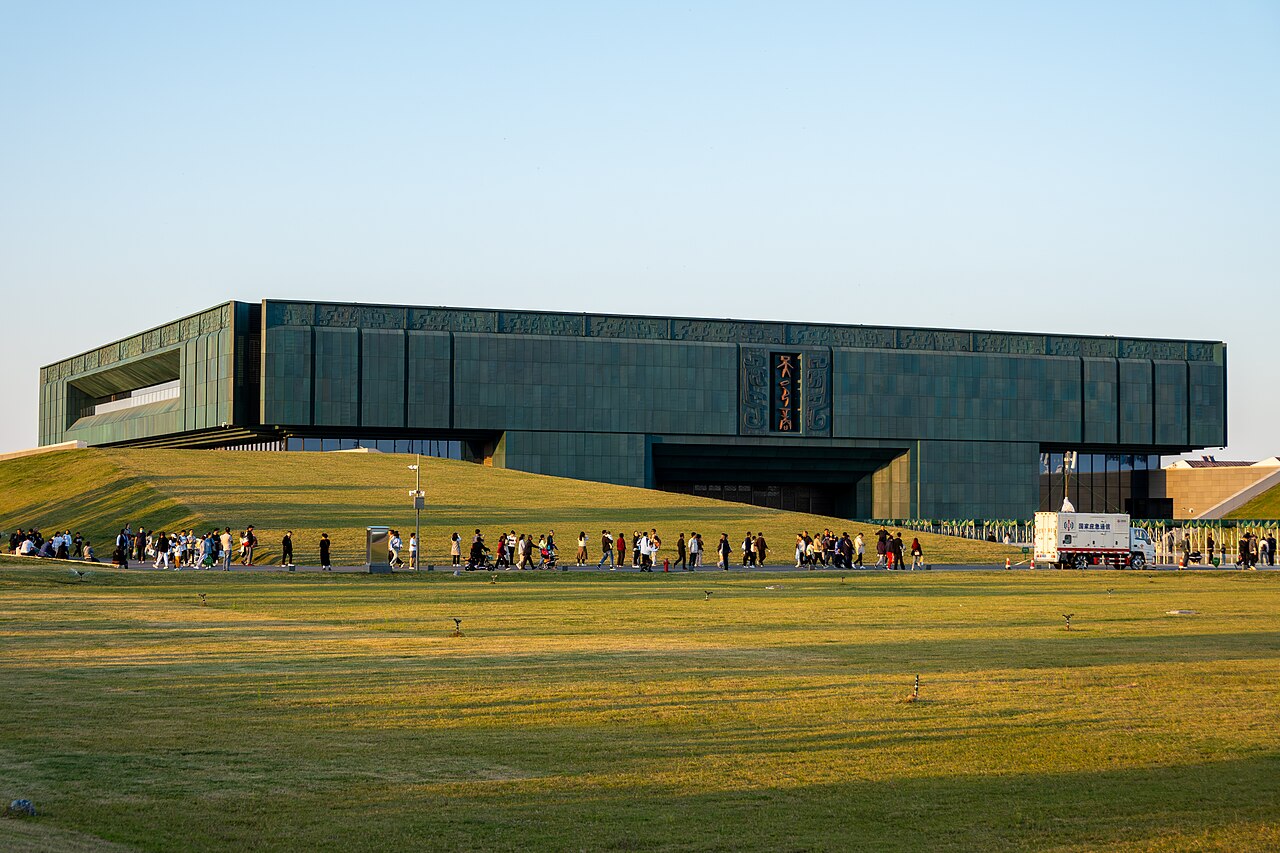
Anyang East High-Speed Railway Station is a stop on the Beijing–Guangzhou (Jing-Guang) high-speed line, with services to Beijing South (approximately 2.5 hours), Zhengzhou East (approximately 40 minutes), and connections south toward Wuhan and Guangzhou. The Yin Xu site is approximately 4 kilometres northwest of central Anyang, accessible by taxi (10 minutes, approximately 15 CNY) or by city bus. The Yinxu Museum, opened on the site in 2022 and built partly underground to avoid disturbing subsurface Bronze Age remains, displays the Oracle Bone Inscriptions Archive and the original burial of Lady Fu Hao; admission costs approximately 75 CNY and includes the museum building and the above-ground site area. The site of Fu Hao’s tomb (the only Shang royal burial found intact, excavated 1976) is in the northern part of the inscribed area; her burial goods comprised 468 bronze vessels, 775 jade objects, 6,900 cowrie shells and 130 weapons, catalogued in the 1980 excavation report published by the Institute of Archaeology of the Chinese Academy of Social Sciences. Spring (April to May) and autumn (September to October) are the most comfortable seasons; Henan summers exceed 35°C and can reach 40°C in July. Zhengzhou (40 min by HSR) is the practical base for multi-site circuits combining Anyang with Dengfeng (1h bus from Zhengzhou) and Luoyang (40 min HSR from Zhengzhou) in 2 to 3 days.
Frequently Asked Questions
What are oracle bones and why are the Yin Xu inscriptions significant for the history of Chinese writing?
Oracle bones are turtle plastrons (the flat ventral shell of a turtle) and cattle scapulae (shoulder blades) used in Shang-dynasty royal divination. The divination procedure, documented archaeologically from the Yin Xu excavations, involved applying heat to pits or notches drilled into the bone, causing it to crack; the pattern of cracks was interpreted by royal diviners (zhenren) as an answer to questions posed by the king or on his behalf. The questions covered military campaigns, weather, harvests, illness of the king and royal family members, the outcome of hunts, and ritual correctness. After the divination, the question, the diviner’s name, the date, and in many cases the result and whether the result matched the prediction were inscribed on the bone using a pointed bronze or jade stylus; the bones were then stored in archives, more than 150,000 fragments of which have been recovered from Yin Xu since 1899. The script of the oracle bone inscriptions, now called oracle bone script (jiaguwen), is the oldest form of Chinese writing for which a substantial corpus exists. It is unambiguously ancestral to the bronze inscription script (jinwen) of the Western Zhou period (1046–771 BCE), which is in turn ancestral to the seal script (zhuanshu) standardised under the Qin dynasty (221–206 BCE), from which all subsequent forms of Chinese script derive. Approximately 4,500 distinct characters have been identified in the oracle bone corpus, of which approximately 2,000 have been deciphered with reasonable scholarly consensus; the remaining 2,500 include characters for words (typically proper nouns and technical ritual terms) whose meanings have not been recovered. The significance of Yin Xu for the history of writing is therefore not merely Chinese: it provides the most detailed Bronze Age evidence anywhere in the world for how a writing system was used in the daily administrative and ritual practice of a literate state, with archives spanning multiple reigns (from approximately the reign of Wu Ding, c. 1200 BCE, through to the fall of Yin in 1046 BCE) that allow scholars to track scribal conventions, administrative practices and historical events across approximately 150 years.
Who was Fu Hao and what did her tomb reveal about women’s roles in the Shang dynasty?
Fu Hao was a consort of the Shang king Wu Ding (traditionally dated c. 1250–1192 BCE) and the only Shang royal for whom both a tomb and contemporary documentary evidence in the form of oracle bone inscriptions have survived. She is mentioned in more than 200 oracle bone inscriptions from the Yin Xu corpus, which record her leading military campaigns (including one inscription crediting her with commanding an army of 13,000 against the Qiang people to the northwest), performing major state sacrifices, receiving tribute and gifts from allied states, and acting as a military commander alongside named male generals. Her tomb, excavated in 1976 by Zheng Zhenxiang of the Institute of Archaeology, was found intact beneath the Xiaotun palace foundations within the Yin Xu site, unlike the eleven large royal tomb pits in the Xibeigang royal cemetery (which were all robbed in antiquity). The burial goods catalogued in the excavation report comprised 468 bronze vessels (including the pair of owl-form zun vessels that are now among the defining icons of Shang bronze art), 44 bronze weapons, 4 bronze mirrors, 27 knives, 590 jade objects, 63 stone objects, 5 ivory carvings, 6,900 cowrie shells (used as currency and ritual offerings), and the skeletal remains of at least 16 sacrificed humans and 6 dogs. The combination of oracle bone documentation and undisturbed tomb archaeology makes Fu Hao the single most thoroughly documented individual from the Shang period, and her military role documented in the oracle bones contradicts any simple assumption that elite women in Bronze Age China were confined to domestic or reproductive functions. The current Yinxu Museum has a reconstructed burial chamber based on the 1976 excavation data, allowing visitors to see the original spatial arrangement of the burial goods.
What is the relationship between Yin Xu and the Bronze Age archaeology of East Asia more broadly?
Yin Xu occupies a distinctive position in East Asian Bronze Age archaeology because it provides the richest single-site assemblage of bronze casting technology, royal burial practices, writing and monumental architecture from the second millennium BCE in the region. The Shang bronze foundries at Yin Xu, whose remains are distributed across the Xiaotun core area and the surrounding village areas excavated progressively since 1928, produced bronze vessels in quantities and with a technical mastery (thin-walled casting using piece-mould technique with exceptional detail in zoomorphic decoration) not matched at any other known Bronze Age site in East Asia. The Yinxu Museum’s design — a partially subterranean building in bronze-coloured cladding — is partly a response to the archaeological sensitivity of the subsurface: much of the Yin Xu core area has not yet been excavated, and ongoing archaeological work between the visitor areas continues to produce new discoveries. The 2022 excavation seasons at Yin Xu found additional royal-scale burials in previously unexplored sections of the Xibeigang cemetery zone. In the broader East Asian context, the Shang bronze-casting tradition exported through the Zhou dynasty (which conquered the Shang in 1046 BCE and inherited its bronze technology) influenced the bronze cultures of the Korean peninsula and the Japanese archipelago: the bronze mirrors, bells and weapons of the Korean Bronze Age (c. 1000–300 BCE) and the Yayoi period in Japan (c. 300 BCE–250 CE) are technologically descended from the Shang-Zhou sequence documented at Yin Xu and the subsequent Zhou sites. The oracle bone script of Yin Xu is also the ultimate ancestor of the Chinese characters adapted for writing Korean (in the idu and hanja systems) and Japanese (in the kanji system), making the Anyang archive the foundation of the written tradition shared across East Asia.
Sources
- S1 — UNESCO World Heritage Centre — Yin Xu (Ref. 1114) — https://web.archive.org/web/20230601000000/https://whc.unesco.org/en/list/1114/
- S2 — Yinxu Museum and Archaeological Site Anyang — https://whc.unesco.org/en/list/1114/
- S3 — Bahn, Paul G. <em>The Cambridge Illustrated History of Prehistoric Art</em>. Cambridge University Press, 1998. ISBN: 978-0-521-45473-5.
Spotted an error? Write to editorial@culturalheritageonline.com and we correct it the same day.