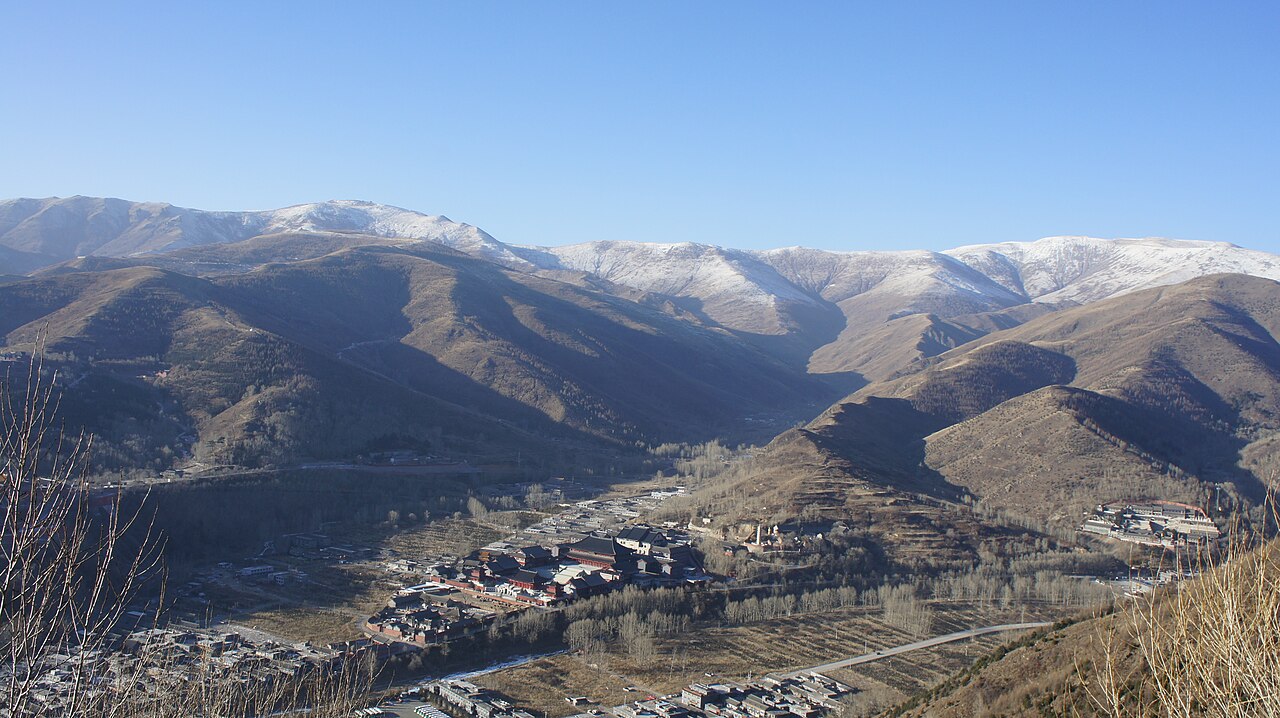
Mount Wutai (Wutaishan) in northern Shanxi Province was inscribed as a UNESCO World Heritage Site in 2009. The property covers 18,474 hectares of plateau terrain at elevations between 1,500 and 3,058 metres and contains 53 surviving monasteries, of which 12 are active. The Foguang Temple’s east main hall, dated by a beam inscription to 857 CE, is the oldest surviving timber-frame building in China; its existence was unknown to the scholarly community until 1937, when the architectural historian Liang Sicheng located it after reading references in Tang-dynasty cave paintings at Dunhuang.
Northern Shanxi: Yungang Grottoes at Datong and the origins of Chinese Buddhist art 190 km northwest, 2.5 hours by car or 2 hours by HSR to Datong
The Yungang Grottoes near Datong, inscribed as UNESCO World Heritage in 2001, are the closest major UNESCO inscription to Mount Wutai and the site where the visual programme of the Northern Wei Buddhist patronage that also shaped Wutai’s earliest structures was first established at scale. Datong is approximately 190 kilometres northwest of the Wutai plateau, reachable by car via the G5 Beijing–Kunming expressway in approximately 2 hours 30 minutes, or by high-speed rail from Wutai’s nearest rail connection at Xinzhou North to Datong in approximately 2 hours with a change. The Yungang complex, carved into Wuzhou Mountain sandstone cliffs beginning in 460 CE under the Northern Wei emperor Wenchengdi and the monk Tanyao, comprises 45 major caves and 252 cave groups containing over 51,000 stone figures, ranging from 17-metre seated Buddhas to half-centimetre decorative figures in architectural frames. The Tanyao Five Caves (Caves 16–20) are the founding works, carved to the design of Tanyao himself to commemorate the five Northern Wei emperors who preceded Wenchengdi; each cave contains a single colossal standing or seated Buddha at a scale unprecedented in Chinese art at the time, with iconographic features drawn from the Gandharan tradition of the northwest frontier transmitted through Central Asian intermediaries. The compositional model of the Yungang Buddhas—colossal single image in a high-vaulted cave, attended by bodhisattvas and apsaras in the surrounding registers—was transported to Wutai by Northern Wei imperial patronage and became the dominant paradigm for Chinese monumental Buddhist sculpture for three centuries. Cave 6 at Yungang, built approximately 480 CE, contains a narrative programme of the life of the historical Buddha Shakyamuni in relief panels running around all four walls and ascending the central pillar; it is the most complex narrative programme in early Chinese Buddhist art and provides a textual and visual framework for understanding the iconographic choices at Wutai’s later monasteries. The sandstone at Yungang weathers more rapidly than the limestone at Longmen Grottoes, and significant surface loss has occurred to exposed figure groups since the 1950s; an indoor climate-control project implemented after inscription has stabilised conditions in the most vulnerable caves. The Yungang Research Institute’s 3D laser scanning programme, begun in 2012 and ongoing, has produced millimetre-resolution records of all 45 major caves. A visit to Yungang requires four to five hours for the principal cave groups; the site is 16 kilometres west of Datong city centre, reachable by Bus 4 from Datong railway station or by taxi in approximately 25 minutes. The logical itinerary connects Wutai (Foguang Temple and the Tang-dynasty monastic ensemble) with Yungang (Northern Wei Buddhist origins) in a single Shanxi heritage journey of two days, with Datong as the overnight base and a car or bus connection between the sites.
Datong itself contains the Huayan Monastery (Huayan Si), founded in 1038 CE during the Liao dynasty on the same sacred orientation as the Tang monasteries of Wutai, and the Shanhua Monastery (Shanhua Si), also Liao, whose main hall preserves some of the most refined Liao-dynasty clay sculptures in northern China. Neither is separately UNESCO-inscribed, but both are State Protected Heritage Sites (quanguo zhongdian wenwu baohu danwei) and form a coherent thematic circuit with Yungang for any visitor studying pre-Song Buddhist architecture and sculpture in Shanxi.
Central Shanxi and the classical Chinese city: Pingyao and the Chengde connections east Pingyao 250 km south, 3 hours by car; Chengde 300 km east, 4 hours by car
The Ancient City of Pingyao, inscribed as UNESCO World Heritage in 1997, is approximately 250 kilometres south of Mount Wutai, reachable by car via the G5 expressway in approximately three hours, or by high-speed rail from Xinzhou North to Pingyao Ancient City station in approximately one hour. Pingyao is the best-preserved walled Han Chinese city in China from the Ming and Qing periods; its 6.4-kilometre city wall, rebuilt in 1370 CE during the early Ming dynasty, encloses a grid plan unchanged in its major street alignments since the Ming period and containing 3,797 structures officially classified as historically significant by the local government, of which 300 are classified as major cultural relics. The city’s outstanding historical significance derives from its role as the financial centre of China during the Qing dynasty: the Rishengchang Exchange Shop (Rishengchang Piaohao), founded in 1823 on West Main Street, was the first institution in China to issue standardised draft notes (piaohao) redeemable at branches in other cities—a function equivalent to a modern bank draft. By 1840, Pingyao-based draft banks controlled approximately 50 percent of China’s financial transactions, with branch networks extending from Guangzhou to Harbin and from Shanghai to Xinjiang. The collapse of the Shanxi banking system after the 1911 Revolution and the shift of financial power to Shanghai left Pingyao economically frozen, and the city was never modernised in the way that destroyed comparable historic centres in other Chinese cities; the inscribed property is consequently one of the most complete examples of a pre-industrial Chinese county town in existence. The county government buildings (Pingyao County Yamen), the city temple (Chenghuang Miao), the market buildings and many of the merchant courtyard houses (dayuan) retain their Qing-period fabric. The connection between Pingyao and Mount Wutai is not architectural but financial: Wutai’s monasteries were funded in part through the Shanxi banking network; the Qianlong emperor, who made multiple pilgrimages to Wutai between 1750 and 1786, passed through the Pingyao area, and the economic structure that paid for the Qing imperial patronage of Wutai’s Tibetan Buddhist temples originated in the Shanxi merchant and banking class centred on Pingyao and Qi County.
The Mountain Resort and Outlying Temples at Chengde, inscribed as UNESCO World Heritage in 1994, is approximately 300 kilometres east of Mount Wutai, reachable in approximately four hours by car via the G95 highway. Chengde’s significance in the context of a Wutai visit is direct: the Eight Outer Temples (Weiba Miao) built by the Qing emperors Kangxi and Qianlong at Chengde between 1703 and 1780 were explicitly modelled on the architectural forms of Wutai and Tibetan sacred sites, constructed to present the Qing emperors to their Mongolian and Tibetan Buddhist subjects as universal Buddhist monarchs (chakravartin). The Putuo Zongcheng Temple (1771), the largest of the Chengde outer temples at 220,000 square metres, replicates the Potala Palace in Lhasa; the Pule Temple (1766) contains a circular pavilion (Xiangyuan Pavilion) whose ceiling mandalas are among the finest examples of Tibetan Buddhist iconographic decoration in China proper. The Xumifushou Temple (1780) was built specifically to receive the Sixth Panchen Lama, Losang Palden Yeshe, when he visited Chengde to congratulate the Qianlong emperor on his 70th birthday; the emperor had previously demonstrated his command of Tibetan Buddhist practice by receiving monastic teachings at Wutai from the Third Jetsun Dampa Khutugtu. Understanding Chengde’s architecture requires understanding Wutai’s role as the primary site where the Qing emperors performed the ritual of the Buddhist universal monarch for their Mongolian and Tibetan subjects; the two sites are the field and the court expression of the same imperial religious strategy. Chengde also contains the Imperial Mountain Resort (Bishu Shanzhuang), a 5.6-square-kilometre walled imperial garden and palace complex that served as the Qing summer capital and the primary venue for receiving Mongolian and Central Asian tributary missions during the eighteenth century. The Foguang Temple at Wutai (857 CE) and the Putuo Zongcheng Temple at Chengde (1771 CE) stand at either end of a millennium of Chinese Buddhist architecture; combining them in a single itinerary reveals the full arc from Tang structural rationalism to Qing imperial theatricality. Combining Wutai, Datong/Yungang, Pingyao and Chengde into a single circuit requires approximately seven days by car, with Taiyuan as a practical base for the Shanxi portion.
The influence of Wutai’s architectural tradition on Korean and Japanese Buddhist architecture warrants mention in any proximity context even though the Seowon Korean Neo-Confucian Academies (UNESCO 2019) are geographically remote. The Foguang Temple’s 857 CE east main hall, with its seven-bay plan, double-eave hip roof, and exposed internal bracket system, is architecturally ancestral to surviving Tang-style buildings in Japan including the Toshodaiji in Nara (759 CE) and the Nishi Honganji main hall in Kyoto. Japanese monk-pilgrims including Ennin (Jikaku Daishi), who lived at Wutai for two years between 838 and 840 CE and wrote the account known as “Diary of a Pilgrimage to Tang China,” transmitted Wutai’s iconography and architectural details directly to Japan; Ennin’s account is the primary Japanese source on Tang-dynasty Chinese Buddhism and the most detailed foreign account of life in Tang China from any period.
Practical information
Mount Wutai is 240 kilometres southwest of Beijing and 130 kilometres northeast of Taiyuan. From Beijing, the most direct route is by car via the G5 expressway and the G55 Erlian–Guangzhou expressway, approximately 3 hours 30 minutes; there is no direct high-speed rail to the mountain, and the nearest HSR station is Wutai Mountain North (Wutaishanbeizhan) at Shuyu, approximately 40 kilometres from the main monastic area of Taihuai, connected by shuttle bus or taxi. From Taiyuan, the journey by bus or car is approximately 3 hours; regular long-distance buses run from Taiyuan’s long-distance bus station to Wutai.
The Wutai monastic area is centred on Taihuai village at approximately 1,700 metres elevation. The five terraces (wutai) for which the mountain is named rise to over 3,000 metres and require hiking or hired vehicle to reach; the north terrace (Beitai) at 3,058 metres is the highest point and requires five to six hours on foot from Taihuai. The Foguang Temple, which is the primary architectural reason to visit Wutai from a heritage perspective, is 35 kilometres southwest of Taihuai on a separate road; it is accessible by hired taxi or car but not by public bus, and a visit requires a half day including travel. Entry fees cover the scenic area (environmental management fee) and individual monastery admission separately; the Foguang Temple charges a separate entry fee. Summer (June to August) brings pilgrimage traffic and cooler temperatures than the lowlands; the road to Taihuai closes in winter due to snow, typically from late November to April. The best months for visiting all components—Foguang Temple, Taihuai monasteries, and hiking to a terrace—are May, June, September and early October.
Frequently Asked Questions
What makes the Foguang Temple’s 857 CE hall architecturally significant, and why was it lost to scholarship for so long?
The Foguang Temple’s east main hall (Dong Da Dian), dated by a beam inscription to the first year of the Dazhong reign period of the Tang emperor Xuanzong, corresponding to 857 CE, is the oldest surviving timber-frame structure in China. Its significance in architectural history is threefold. First, it preserves the structural system of Tang-dynasty Chinese architecture in original form: the seven-bay facade (seven intervals between columns), the double-eave hip roof (wudian ding), and the dougong bracket clusters at the tops of the columns, which are larger relative to the column diameter and beam span than in any later Chinese building—a proportion that reflects the structural logic of an architecture in which the bracket absorbed lateral earthquake stress before that role was transferred to infill walls and tie beams in the Song period. Second, the hall contains an original clay sculptural ensemble of 35 figures installed at the time of construction: a triad of Tang-dynasty Buddhist figures flanked by bodhisattvas, lokapala (guardian kings) and donor portraits, all in their original positions and retaining traces of original polychrome. Third, the hall demonstrates that a mature structural tradition existed in Tang China that Japanese architects transmitted to Japan during the same century: the Toshodaiji in Nara (759 CE, founded by the Tang monk Jianzhen) shares the same bay system, bracket proportions and roof form. The hall was “lost” to scholarship in the specific sense that Wutai’s location in northern Shanxi, poorly connected to the coastal cities where Western and twentieth-century Chinese scholarship was based, made the mountain difficult to survey systematically. The architectural historian Liang Sicheng (1901–1972) and his colleague Mo Zongjiang located the Foguang Temple in June 1937 by identifying a Tang-period painting at Dunhuang that showed a temple matching the hall’s proportions; Liang arrived at the site after the painting suggested that structures of Tang date might survive at Wutai, and confirmed the date from the beam inscription within days. The discovery was made six weeks before the Japanese army reached the area in the early stages of the Second Sino-Japanese War; Liang left Wutai as Japanese forces advanced. The broader structural system of the Foguang Temple has been extensively studied since 1937 and is now the primary primary-source reference for all reconstructions of Tang-dynasty timber-frame architecture.
Why did so many Japanese monk-pilgrims travel to Mount Wutai during the Tang dynasty, and what did they bring back to Japan?
Mount Wutai’s attraction for Japanese Buddhist pilgrims during the Tang dynasty (618–907 CE) derived from its identification in Chinese Buddhist sutras as the terrestrial residence of Mañjuśrī (Monju in Japanese), the bodhisattva of wisdom who is associated in Mahāyāna tradition with both transcendent insight and the perfection of teaching. Japanese Buddhism in the Nara and early Heian periods was organised around Chinese models, and the principal monastic schools—Kegon, Ritsu, Tendai—had direct Chinese counterparts based at or affiliated with Wutai. Japanese monks who completed study in China typically spent time at Wutai as part of their itinerary; the mountain was approximately 500 kilometres west of the Tang capital Chang’an (modern Xi’an) and accessible via the imperial road network from the Yellow River valley. The most extensively documented Japanese pilgrim is Ennin (794–864 CE), a Tendai monk who lived in China from 838 to 847 CE and spent approximately two years at Wutai studying the esoteric Buddhist ritual tradition. Ennin’s diary, the “Nittō Guhō Junrei Kōki” (Record of a Pilgrimage to China in Search of the Dharma), describes the monastic routines, festival calendars, architectural details and ritual procedures at Wutai in sufficient specificity that it remains a primary historical source for Tang Buddhist practice. Ennin brought back to Japan the ritual texts and iconographic drawings for the Tendai esoteric tradition (Taimitsu), including the fire ritual (goma), the conferral of initiatory empowerment (kanjo), and the iconographic programmes of the Five Wisdom Buddhas (Gochi Nyorai) and the thousand-armed Guanyin. These materials shaped the visual and ritual programme of Heian-period Tendai Buddhism, including the iconographic content of the major illustrated scrolls (emakimono) and the bronze ritual implements (horaku) produced in the tenth and eleventh centuries. The architectural transmission was parallel: Japanese builders who had studied at Wutai returned with drawings and dimensional conventions for Tang-style architecture that were applied in the construction and reconstruction of Japanese temples well into the Kamakura period.
How do the 53 monasteries of Mount Wutai function today, and what is the relationship between the Chinese Buddhist and Tibetan Buddhist communities on the mountain?
Of the 53 surviving monasteries at Mount Wutai, 12 are active Buddhist institutions with resident monastic communities. The active monasteries are divided between Chinese Buddhist (Han chuantong) and Tibetan Buddhist (Zangchuan) traditions; the coexistence of the two traditions at Wutai is historically specific to the mountain and reflects the Qing imperial policy of using Wutai as a site where the emperor’s dual role as patron of Chinese Buddhism and chakravartin of the Tibetan Buddhist world could be demonstrated simultaneously. The Qing emperors, beginning with Kangxi (r. 1661–1722) and continuing through Qianlong (r. 1736–1796), converted several Chinese Buddhist monasteries at Wutai to Tibetan rite during the eighteenth century and funded the construction of new Tibetan-style structures; Qianlong made five pilgrimages to Wutai and sponsored the translation of a complete Tibetan Buddhist canon (Kangyur) into Chinese during his visits. The most significant Tibetan Buddhist institution on the mountain is the Pusading (Bodhisattva Summit), originally a Chinese Buddhist monastery founded in the late fifth century and converted to Tibetan rite in 1705 CE; it housed the imperial reception facilities and was the site at which the Dalai Lama and Panchen Lama delegations were received when they came to the mountain to meet the emperor. The Chinese Buddhist institutions at Wutai, including the Xiantong Temple (Xiantong Si), the largest monastery on the mountain, and the Tayuan Temple (Tayuan Si), whose white bottle-shaped stupa (bai ta) has been the dominant visual symbol of Wutai since the Yuan dynasty, continue to function as active pilgrimage destinations drawing Han Chinese devotees. Relations between the two communities are managed by the Wutai County Buddhist Association under the overall framework of the Chinese People’s Political Consultative Conference’s Buddhist Affairs Committee. Visitors are admitted to active monastery halls during visiting hours; participation in ritual observances requires prior arrangement through the monastery.
Sources
- S1 — UNESCO World Heritage Centre — Mount Wutai (Ref. 1279) — https://web.archive.org/web/20230601000000/https://whc.unesco.org/en/list/1279/
- S2 — Mount Wutai Scenic Area Administration Shanxi — https://whc.unesco.org/en/list/1279/
- S3 — Kuhn, Dieter. <em>The Age of Confucian Rule: The Song Transformation of China</em>. Harvard University Press, 2009. ISBN: 978-0-674-03661-1.
Spotted an error? Write to editorial@culturalheritageonline.com and we correct it the same day.