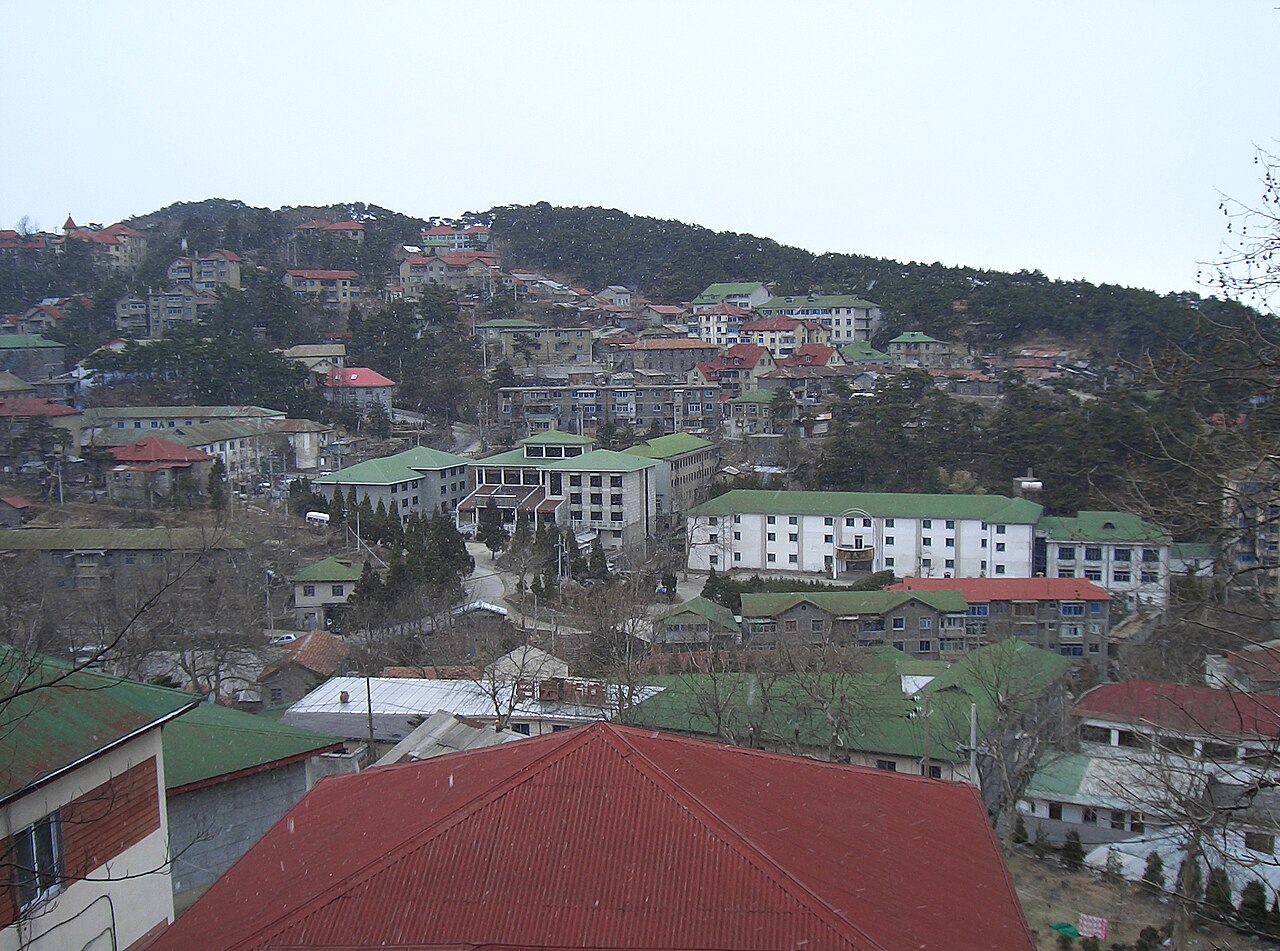
Lushan National Park in Jiujiang, Jiangxi Province, was inscribed by UNESCO in 1996 as a cultural landscape recording over 1,500 years of Chinese literary, religious, and political association concentrated on a single mountain massif rising to 1,474 metres above the Yangtze River plain. Between 1886 and 1936, European and American missionaries, diplomats, and businessmen constructed approximately 1,500 stone villas on the Guling plateau at 1,167 metres, creating a colonial resort architecture that survives largely intact. The Buddhist monk Huiyuan established the Donglin Monastery at Lushan’s base in 402 CE and founded the Pure Land school of Buddhism there — a devotional tradition that spread to Korea and Japan and remains one of the most widely practised forms of Buddhism in East Asia. In July 1959, the Lushan Conference at the Meilu Villa convened the Chinese Communist Party’s Central Committee; Marshal Peng Dehuai’s private letter criticising the Great Leap Forward was read aloud and Mao Zedong responded by denouncing Peng before the full plenary — an event that silenced internal party dissent for nearly two decades.
North and east: Nanjing and the Ming cultural corridor 350 km / 3h by HSR
The mausoleum complex of the Ming dynasty founder Zhu Yuanzhang, known as the Xiaoling Mausoleum and located on Zijin Mountain outside Nanjing, was inscribed as part of the serial property “Imperial Tombs of the Ming and Qing Dynasties” by UNESCO in 2003. Nanjing is 350 kilometres north of Jiujiang by high-speed rail — approximately three hours on the G-class services — and served as the Ming dynasty’s first capital from 1368 until the third emperor Yongle relocated the court to Beijing in 1420. The Xiaoling Mausoleum’s processional Sacred Way, lined with paired stone animal sculptures in a curved rather than straight alignment (following the contour of the hill rather than a cardinal axis, a deliberate departure from earlier Tang- and Song-dynasty tomb conventions), leads to the burial precinct where Zhu Yuanzhang and his empress are interred. The surrounding Zijin Mountain also contains the Sun Yat-sen Mausoleum, completed in 1929, which is not a UNESCO site but receives more visitors than the Xiaoling precinct and provides an important reference point for understanding the Republican-era politics that intersected with Lushan’s role as a summer conference location. Chiang Kai-shek held government conferences at Lushan throughout the 1930s, and the mountain’s transition from a Republican-era retreat to a Communist-era party conference site encapsulates the political continuity of the location irrespective of regime. A Nanjing visit pairs naturally with a Lushan excursion for travellers interested in the political history of 20th-century China, as both sites carry the physical marks of the Nationalist government, the Japanese occupation (Nanjing suffered catastrophic civilian casualties in December 1937), and the Communist consolidation of 1949.
East to Huangshan and Xidi–Hongcun; upstream to the Three Gorges 280–500 km / 3h car or upstream river
Mount Huangshan, 280 kilometres east of Jiujiang, is reachable in approximately three hours by car through Anhui Province or by a combination of rail to Jiujiang and then bus toward Jingdezhen and Huizhou. Huangshan was inscribed by UNESCO in 1990 as a mixed cultural and natural site. For a visitor based in Jiujiang or on Lushan’s Guling plateau, the practical approach runs east through the low mountains of northern Jiangxi Province before climbing into the Anhui highlands. The relationship between Lushan and Huangshan in Chinese landscape consciousness is one of complementary registers: Lushan is emphatically a mountain of human history — every peak, waterfall, and guesthouse carries a named literary or political association — while Huangshan is predominantly a mountain of natural form whose cultural significance comes primarily from its role as a subject for painters and photographers. Li Bai wrote about Lushan’s Xiuhu waterfall; Hongren painted Huangshan’s granite peaks. Both mountains appear in the same aesthetic tradition of shanshui (mountains and water) landscape practice, but they represent its two poles: the mountain as historical palimpsest, and the mountain as natural spectacle.
Xidi and Hongcun, the two Huizhou villages in Yi County, are approximately 300 kilometres east of Jiujiang — reachable in three to three and a half hours by car through southern Anhui. They were inscribed together by UNESCO in 2000. The villages’ connection to Lushan operates through shared geography: the Xin’an River system that drains the Huizhou valleys flows westward through Jiangxi Province before joining the Gan River network near Jiujiang. The merchant families of the Huizhou villages traded along these river routes, and the commercial connections between the Yangtze port towns and the inland highlands were the economic basis for the merchant wealth that built the white-walled architecture of Xidi and Hongcun. A combined circuit of Lushan, Huangshan, and the Yi County villages — travelling east from Jiujiang by car — is geographically coherent and covers approximately 600 kilometres of road distance.
The Three Gorges of the Yangtze River — Qutang, Wu, and Xiling gorges — are approximately 500 kilometres upstream from Jiujiang along the Yangtze. The Three Gorges Dam, whose reservoir filled between 2003 and 2009, has permanently altered the hydrological and visual character of the gorges by raising the water level approximately 175 metres above the original riverbed, submerging the shoreline towns and lower cliff inscriptions that made the gorges famous in Chinese landscape literature. The gorges themselves are not a UNESCO site, and the 2003 dam has removed many of the features — the trackers’ paths, the riverside temples, the low-water rock inscriptions — that appeared in classical descriptions. Cruises depart Chongqing eastbound and pass through the gorges in approximately three days before reaching Yichang, where the dam is situated. From Yichang, Jiujiang is another day’s travel downstream by river or a few hours by road and rail. The scale of hydrological change to the Yangtze upstream of Lushan is itself a significant datum for a landscape whose literary tradition extends from the Tang dynasty through to the 20th century: the river that Li Bai described from Lushan’s peaks no longer runs at the same level or carries the same shoreline.
Practical information
Lushan is accessed via Jiujiang, which has a high-speed rail station on the Nanchang–Wuhan corridor. From Nanchang (Jiangxi’s provincial capital, 130 kilometres south), G-class trains reach Jiujiang in 35 to 40 minutes. From Wuhan, the journey takes approximately one hour. From Jiujiang station, buses run to the Lushan scenic area entrance at the mountain’s northern base; from there, buses continue up the switchback road to Guling town at 1,167 metres. Private cars can also drive to Guling. The UNESCO-listed cultural landscape covers an area of 302 square kilometres; Guling town is the logistical centre, with hotels ranging from restored colonial-era villas to modern accommodation. The Meilu Villa conference site and the Lushan Museum (containing exhibition material on the colonial-era history and the 1959 conference) are walkable from the town centre. Spring and early autumn offer the most reliable clear weather; summer (July to August) is both peak season and the period when the mountain’s cooling function relative to the Yangtze plain is most legible — the temperature difference between Jiujiang and Guling on a July afternoon regularly exceeds 10 degrees Celsius, which explains exactly why the colonial residents built their villas here in the first place.
Frequently Asked Questions
Why did foreign diplomats and missionaries build villas on Lushan rather than in the cities?
The Yangtze River valley, at elevations between 20 and 100 metres above sea level, produces summer temperatures that regularly exceed 38 degrees Celsius with humidity levels that make working conditions in the treaty ports — Jiujiang was opened as a treaty port in 1861 under the Treaty of Peking — difficult for European and North American residents accustomed to temperate climates. The Guling plateau at 1,167 metres maintains summer temperatures roughly 8 to 12 degrees Celsius cooler than Jiujiang at its base, and the mountain’s cloud cover produces frequent fog that further reduces radiant heat. The first foreign resident credited with building on Guling was the British missionary Edward Little, who in 1886 leased land from local farmers and constructed a stone cottage. The Guling Land Company, formalised in 1895, organised subsequent land leasing and laid out a road grid for the plateau settlement; by 1900 the community had expanded to include Americans, Germans, French, and Russians, with consular summer offices following the residential establishment. The resulting architecture — stone construction in English, American, and Germanic vernacular styles, with deep verandas adapted to the local rainfall pattern — survives at approximately 1,200 structures of the original 1,500, making Guling the most intact colonial-era hill station in mainland China. The Japanese occupation of 1938 and subsequent Chinese Communist Party use of the plateau as a conference and military rest facility both protected the built fabric from wholesale demolition, though many interiors were altered.
What was the 1959 Lushan Conference and why is the site historically significant?
The Eighth Plenary Session of the Eighth Central Committee of the Chinese Communist Party convened at Lushan in July and August 1959, primarily to assess the results of the Great Leap Forward campaign launched the previous year. Marshal Peng Dehuai, then Defense Minister, wrote a private letter to Mao Zedong in July 1959 expressing measured concern about specific policy errors in the grain production statistics and the backyard steel furnace campaign. Mao chose to circulate the letter to the full plenary without Peng’s knowledge, framing it as a factional attack, and convened a broader session in which party members were pressed to align against Peng. Peng was removed from his posts and replaced by Lin Biao as Defense Minister. The significance of the conference extends beyond Peng’s individual fate: it established that internal policy criticism within party channels would be treated as political opposition, and it reinforced the Great Leap Forward at precisely the point when honest assessment of its failures might have allowed corrective action before the famine of 1959–1961. The Meilu Villa, a stone building constructed in 1903 and used by Chiang Kai-shek as a summer residence before 1949, was repurposed as Mao’s conference accommodation and is now open to visitors as part of the Lushan Museum complex. The conference room where the plenary sessions were held is preserved with its original furniture.
How does Lushan connect to the history of East Asian Buddhism?
The monk Huiyuan arrived at Lushan in 381 CE and established the Donglin Monastery (Eastern Grove Monastery) at the mountain’s western base in 386 CE, remaining there until his death in 416 CE. He assembled a community of 123 monks and laypeople who took a collective vow before an Amitabha Buddha image in 402 CE to be reborn in the Pure Land — the western paradise presided over by Amitabha Buddha — through devotional practice centred on the recitation of Amitabha’s name. This assembly is traditionally dated as the founding event of the Pure Land school of Buddhism. Pure Land practice, which requires no formal monastic training and is accessible to laypeople, became the most widely practised form of Buddhism in China and subsequently in Korea and Japan, where it arrived through Chinese missionary activity in the 6th to 8th centuries CE. The Jodo school in Japan — whose founder Honen (1133–1212 CE) explicitly cited Huiyuan as a patriarchal predecessor — and the Jodo Shin school founded by Shinran (1173–1263 CE) both trace their lineage to the Lushan assembly. The Donglin Monastery was destroyed and rebuilt multiple times; the current buildings date from Qing-dynasty reconstruction. A stele recording Huiyuan’s community and the 402 CE vow ceremony is preserved within the monastery complex and represents one of the primary documentary sources for the founding of a tradition that today counts hundreds of millions of practitioners in East and Southeast Asia.
Sources
- S1 — UNESCO World Heritage Centre — Lushan National Park (Ref. 778) — https://web.archive.org/web/20230601000000/https://whc.unesco.org/en/list/778/
- S2 — Lushan Scenic Area Administration — https://whc.unesco.org/en/list/778/
- S3 — Kuhn, Dieter. <em>The Age of Confucian Rule: The Song Transformation of China</em>. Harvard University Press, 2009. ISBN: 978-0-674-03661-1.
Spotted an error? Write to editorial@culturalheritageonline.com and we correct it the same day.