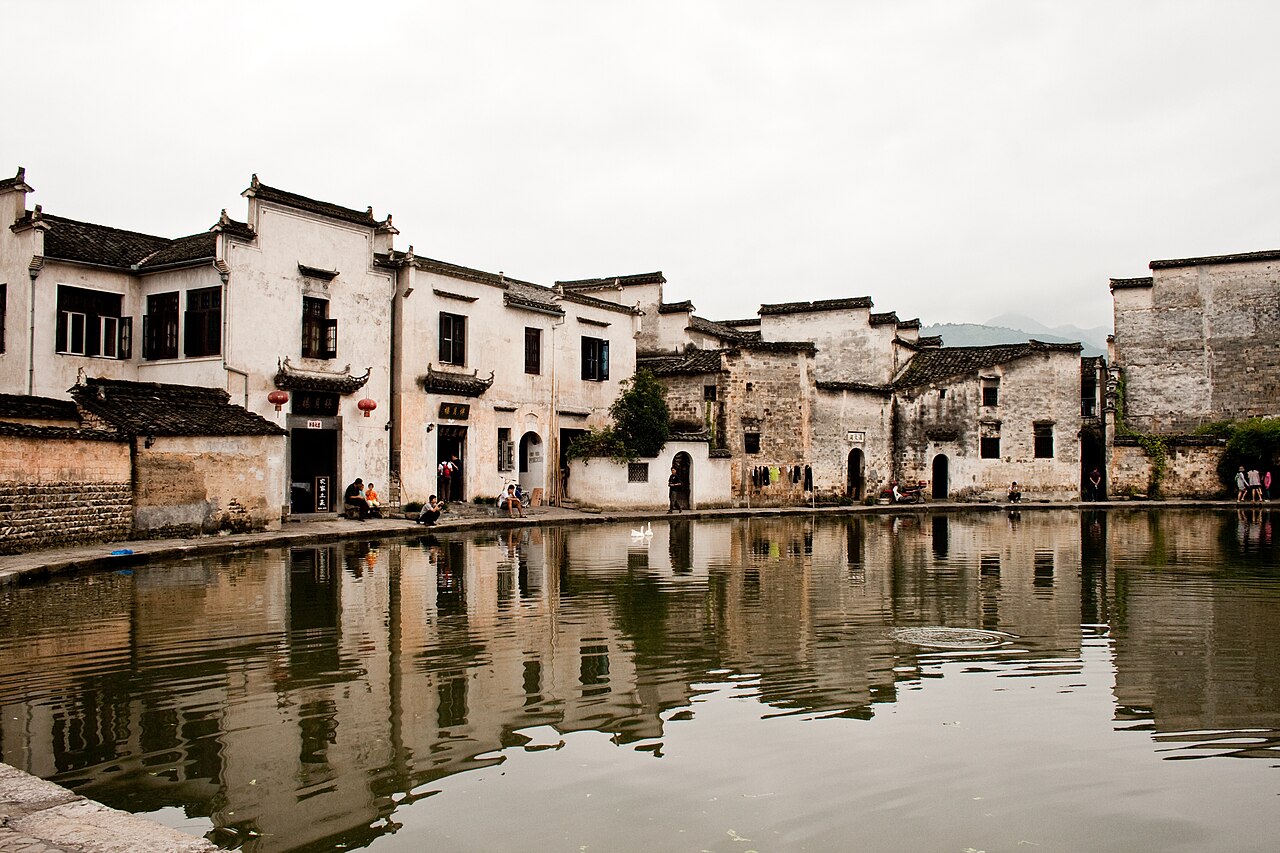
Xidi and Hongcun are two villages in Yi County, Anhui Province, listed together by UNESCO in 2000 as outstanding examples of the domestic architecture and village planning of the Ming and Qing dynasties. Hongcun’s layout follows a documented plan shaped like a recumbent ox, with a central artificial pond — the Moon Pond, constructed in 1403 — feeding a canal system that runs through every street before draining into the larger South Lake at the village’s southern edge. Xidi was founded in the 11th century by descendants of Li Ye, a son of the Tang-dynasty Emperor Zhaozong who took a merchant surname after his father’s assassination; 1,200 households still carry the Hu surname, recording 30 generations of continuous settlement.
East: Mount Huangshan and the Xin’an artistic tradition 65 km / 1.5h by bus
Mount Huangshan, 65 kilometres east of Yi County by road — roughly one and a half hours by bus from Tangkou at the mountain’s base — was inscribed by UNESCO in 1990 as a cultural and natural mixed site. The inscription covers 154 square kilometres of granite peaks, the highest reaching 1,864 metres at Lotus Peak, together with the Anhui-style architecture of the villages in the lower valleys. The mountain’s cultural significance is inseparable from the ink-wash painting tradition known as the Xin’an school, developed by a group of painters from Anhui Province during the Ming dynasty who used Huangshan’s twisted pines and cloud-wrapped peaks as their primary subject. Artists including Hongren (1610–1664) and Shitao (1642–1707) worked extensively around these mountains and in the villages at their base. Hongren’s series of Huangshan paintings, produced after the Ming collapse when he took Buddhist vows rather than serve the Qing, established a style of austere, geometrically precise brushwork that directly influenced the Eight Eccentrics of Yangzhou in the 18th century and, through them, 20th-century Chinese painters including Huang Binhong, who was born in Yi County itself in 1865. The connection between Xidi and Hongcun’s merchant prosperity and Huangshan’s painting tradition is direct: the Huizhou merchants who built these villages commissioned paintings and sponsored academies, and the mountains that made their valley famous were the same peaks their artists recorded. Visitors approaching the villages via Huangshan should note that the mountain’s scenic area requires a separate ticket from the cable car, and summit accommodation must be booked well in advance during peak season. The sunrise from the platform above Beihai Guesthouse, where clouds fill the valleys below the peaks, is the image that anchored Huangshan in Chinese visual culture before any tourist arrived.
Northeast: West Lake Hangzhou, Suzhou’s gardens, and Lushan’s political mountain 280–340 km / 3–3.5h by HSR
West Lake Cultural Landscape of Hangzhou, 280 kilometres northeast of Yi County — accessible by bus to Huangshan station and then three hours by high-speed rail — was listed by UNESCO in 2011 as a cultural landscape that has influenced garden and landscape design across East Asia for over a millennium. The inscription covers the 5.6-square-kilometre lake and its surrounding hills, temples, causeways, and islands, together with the historic core of Hangzhou that served as the Southern Song capital from 1127 to 1276 CE. The West Lake’s significance lies not only in its physical features but in the density of literary and artistic association it carries: Su Dongpo’s causeway, the Lingyin Temple, and the Leifeng Pagoda — rebuilt after its 975 CE collapse in 2002 — are all sites that appear in Chinese poetry, painting, and fiction over 1,000 years. The distance from Xidi and Hongcun is substantial enough that it requires a dedicated travel day, but the HSR network makes the journey straightforward: Huangshan North station to Hangzhou East is approximately two hours and forty minutes on the G-class services.
The Classic Gardens of Suzhou, a further 60 kilometres northeast of Hangzhou, were first inscribed in 1997 and extended in 2000. The nine gardens in the current inscription — including Zhuozheng Yuan (the Humble Administrator’s Garden, begun in 1509) and Liu Yuan (the Lingering Garden, largely reconstructed in the mid-Qing period) — were built by retired officials and merchants who applied the same aesthetic principles as Huizhou merchants did in Xidi and Hongcun: the compression of natural scenery into a constructed space, the use of framed views and borrowed scenery to make a small area feel boundless. The cultural geography connecting Huizhou merchants, Xin’an painters, Suzhou garden builders, and the literati who moved between these worlds during the Ming and Qing dynasties is one of the most coherent aesthetic networks in Chinese history. A trip that moves from Xidi and Hongcun through Huangshan to Hangzhou and Suzhou follows that network spatially.
Lushan National Park, 280 kilometres southwest of Yi County — three hours by car to Jiujiang and then a further hour by bus up the mountain — occupies a different register entirely. Listed by UNESCO in 1996, Lushan is a cultural landscape carrying one of the densest accumulations of Chinese literary and religious association of any single mountain: the Pure Land Buddhist patriarch Huiyuan established his monastery here in 402 CE; Li Bai and Bai Juyi both wrote poems about its waterfalls; and between 1886 and 1936, European and American diplomats and missionaries built approximately 1,500 stone villas on its upper slopes as a summer refuge from Yangtze Valley humidity. The Guling plateau, at 1,167 metres, contains intact streetscapes of colonial-era buildings in stone that survive largely because the mountain’s political associations after 1949 — the 1959 Lushan Conference where Mao Zedong denounced Defense Minister Peng Dehuai for criticising the Great Leap Forward — made wholesale redevelopment politically sensitive. The distance from Xidi and Hongcun makes Lushan a logical extension of a broader Yangtze cultural circuit rather than a day trip.
Practical information
The nearest major transport hub for Xidi and Hongcun is Huangshan City (formerly Tunxi), 55 kilometres from Yi County by road. Huangshan North station serves high-speed rail lines connecting to Shanghai (approximately two hours), Hangzhou (one and three-quarter hours), and Nanjing (one and a half hours). From Huangshan City, frequent buses run to Yi County; from Yi County, local buses and taxis serve both villages. Xidi and Hongcun each charge admission — tickets are sold separately. Hongcun is the larger site and receives more visitors; arriving before 08:30 allows the Moon Pond area to be seen without tour group crowding. Xidi’s Memorial Archways — three stone paifang erected in 1578, 1584, and 1641 respectively — are best photographed in the late afternoon when the light comes from the west and the relief carvings read clearly. Spring (March to May) brings rape-flower fields that have made the surrounding agricultural landscape famous in Chinese photography, but also fog and rain; October offers more stable weather and lower visitor numbers. Both villages contain family-run guest houses in restored Qing-period buildings; rooms in the old core book up on weekends throughout the year.
Frequently Asked Questions
What makes the layout of Hongcun village unusual compared to other Chinese historic villages?
Hongcun’s water management system sets it apart from every comparable Huizhou village. The village sits on a slight slope descending south toward South Lake, and the entire settlement was designed — according to local records attributed to a Feng Shui geomancer engaged by the Wang clan in the early 15th century — to channel water from the Leigang Stream through an artificial western canal, into the central Moon Pond, and then through a network of channels running along the base of every building before draining into South Lake. This system had practical functions: fire protection, household water supply, and summer cooling. The Moon Pond — 4,000 square metres in area, constructed in 1403 — gives the village its visual centre and the reflected-facade photographs that have made Hongcun recognisable. The ox metaphor applied to Hongcun’s shape appears in local chronicles and describes the overall footprint: the Leigang hill to the north as the ox’s head, two trees on the hill as its horns, the four stone bridges at the village perimeter as hooves, and the water system as the alimentary canal. Whether this reading was retrospectively applied to an existing layout or guided the original design is unclear from surviving documents. What is unambiguous is that the water channels remain functional, which is itself remarkable given the 600-year age of the basic infrastructure.
Did painters actually live in Xidi and Hongcun, or is the artistic connection primarily to Mount Huangshan?
The connection runs through the broader Huizhou merchant economy rather than through direct residence in the two villages. The Xin’an school painters of the late Ming and early Qing — Hongren, Cheng Sui, Zha Shibiao, and Sun Yi — were from Huizhou Prefecture, the administrative region that encompassed Yi County and the surrounding mountain valleys. Many were from merchant families who had made fortunes in the salt and timber trades and invested in painting academies, book printing, and ink-stone production (She County, adjacent to Yi County, produced the She inkstone, one of the four classical Chinese scholar stones). Hongren himself was from Shexian County. The painters worked in Huangshan’s peaks and also in the villages and valley towns of the region; Hongcun and Xidi appear in some landscape backgrounds. The more specific artistic connection to the two villages came later, in the late 20th century, when Chinese art school painters and photography students began arriving in the 1980s — roughly two decades before the UNESCO listing in 2000 and the mass tourism that followed. By the mid-1990s, the villages had become the primary location for Chinese ink-wash landscape painting workshops, a function they still serve, with painters setting up along the Moon Pond causeway at dawn throughout the spring and autumn seasons.
How difficult is it to combine Xidi and Hongcun with a Mount Huangshan visit?
The combination is straightforward in terms of distance — 65 kilometres separates Yi County from Tangkou, the access town at Huangshan’s eastern base — but it requires careful sequencing because Huangshan demands significant physical effort. The mountain has two main cable car access points; without a cable car, the climb from the eastern steps takes three to four hours. Most visitors spend one night on the summit at the Beihai or Xihai Mountain Hotels to catch the sunrise, then descend on the second morning. A practical itinerary puts Huangshan first (two days), then descends to Tangkou and takes a bus to Yi County for two days in the villages. This sequencing avoids the physical letdown of visiting the villages before the strenuous mountain. Huangshan North station is the rail connection point for both destinations. Bus frequency between Tangkou and Yi County is adequate during daylight hours; the last bus typically runs around 17:30. During Golden Week national holidays (1–7 October), Huangshan’s summit accommodation requires advance booking of two to three months, and visitor numbers at Hongcun can reach 10,000 per day — a figure the Moon Pond area was not designed to absorb gracefully. The shoulder season of late April, when the lower valley rape flowers are fading and summit crowds have thinned, offers the most comfortable combination visit.
Sources
- S1 — UNESCO World Heritage Centre — Ancient Villages in Southern Anhui – Xidi and Hongcun (Ref. 1002) — https://web.archive.org/web/20230601000000/https://whc.unesco.org/en/list/1002/
- S2 — Huangshan Heritage Management Committee — https://whc.unesco.org/en/list/1002/
- S3 — Kuhn, Dieter. <em>The Age of Confucian Rule: The Song Transformation of China</em>. Harvard University Press, 2009. ISBN: 978-0-674-03661-1.
Spotted an error? Write to editorial@culturalheritageonline.com and we correct it the same day.