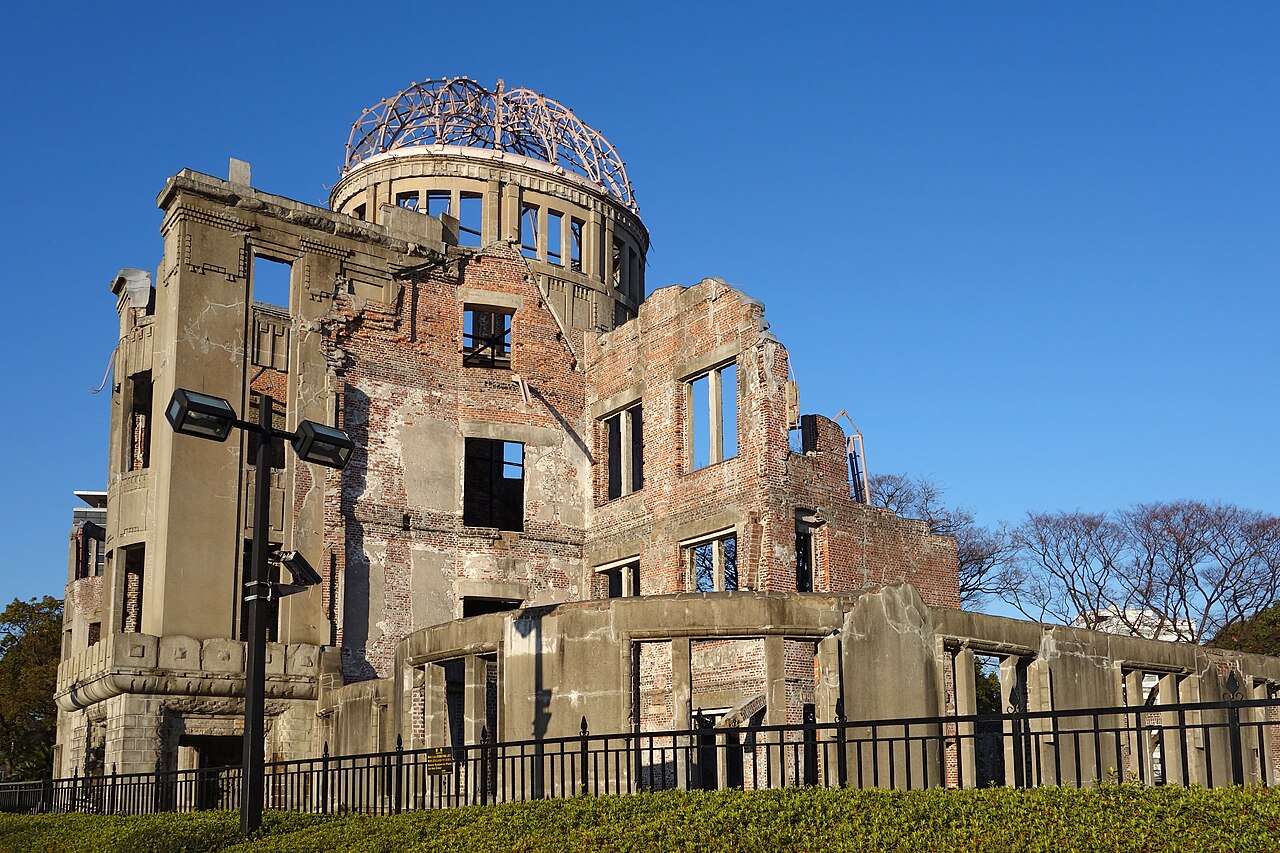
The Hiroshima Peace Memorial — known as the Genbaku Dome or Atomic Bomb Dome — is the preserved ruin of the Hiroshima Prefectural Industrial Promotion Hall, the only structure that remained standing in the immediate vicinity of the hypocenter of the first nuclear weapon ever detonated on a populated city. The building, designed by Czech architect Jan Letzel and completed in 1915, stood approximately 160 metres from the point directly beneath the bomb’s detonation on 6 August 1945. UNESCO inscribed it as a World Heritage Site in 1996, making it one of the most recent and most contested inscriptions on the Japanese list.
The Building That Survived Because the Blast Came From Above Naka-ku, Hiroshima city centre
Jan Letzel completed the Hiroshima Prefectural Industrial Promotion Hall in 1915 at the address 1-10 Otemachi, Naka-ku. It was a three-storey brick and stone structure with a central iron-framed dome, built in the European Renaissance revival style common to public buildings of the Meiji and Taisho eras. The hall served as a commercial exhibition space for Hiroshima Prefecture’s industries and attracted large crowds to its displays of regional products and manufacturing output. By the summer of 1945 it had been repurposed for wartime administrative functions and housed approximately 30 people on the morning of 6 August.
At 08:15 Japan Standard Time on 6 August 1945, the B-29 Enola Gay released the uranium gun-type bomb designated “Little Boy” — mass 4,400 kilograms, yield approximately 15 kilotons TNT equivalent — which detonated at an altitude of approximately 600 metres above the city. The hypocenter, the point on the ground directly beneath the explosion, was calculated afterward to lie approximately 160 metres from the Industrial Promotion Hall. Every person inside the building died instantly. The fireball reached approximately 4,000 degrees Celsius; the blast wave at the hypocenter was estimated at 35,000 atmospheres of overpressure; structures throughout the city within a radius of roughly two kilometres collapsed.
The Industrial Promotion Hall did not collapse. The physical reason is structural: because the bomb detonated almost directly overhead, the primary force of the blast wave passed downward through the dome’s frame rather than laterally against the walls. A lateral blast would have sheared the brick walls at their base and brought down the entire structure, as it did to buildings of comparable construction throughout the city. The vertical orientation of the force compressed the dome frame downward, gutting the interior entirely while leaving the outer shell and the iron skeleton of the dome intact. The building became the only standing structure near the hypocenter — which is precisely why it was eventually designated a memorial.
In the years immediately following the war, the ruins were not treated as a monument. The city of Hiroshima faced the urgent task of reconstruction, and city planners initially discussed clearing the dome along with the rest of the damaged infrastructure. Survivors’ groups, youth organisations, and international peace advocates argued through the 1950s that the ruins should be preserved as testimony to what a nuclear weapon does to a city. In 1966, the Hiroshima City Assembly passed a formal resolution to preserve the dome permanently. The structure has been maintained in its ruined state ever since — it has not been rebuilt, reinforced beyond what is necessary to prevent collapse, or restored to any pre-war appearance. UNESCO’s 1996 inscription was accompanied by a notable controversy: the United States and China both objected. The US delegation argued that the inscription was “not an appropriate use” of the World Heritage Convention, which was designed for sites of outstanding universal cultural value rather than sites commemorating wartime events.
Sadako Sasaki and the Children’s Peace Monument Hiroshima Peace Memorial Park, 200m from the Dome
Within Hiroshima Peace Memorial Park, which surrounds the Genbaku Dome, stands the Children’s Peace Monument — a bronze statue of a girl holding an origami crane above her head, erected in 1958. The figure commemorates Sadako Sasaki, whose story became one of the most widely told personal accounts to emerge from the aftermath of the bombing.
Sadako was two years old in August 1945 and survived the immediate effects of the bombing. Her family lived approximately 1.6 kilometres from the hypocenter. She grew up apparently healthy and became a strong runner at school. In January 1955, at age eleven, she was diagnosed with acute lymphocytic leukemia — what her family initially described simply as “the atomic bomb disease.” She was admitted to the Hiroshima Red Cross Hospital.
According to Japanese tradition, a person who folds one thousand origami paper cranes — senbazuru — will be granted a wish. Sadako began folding cranes during her hospitalisation, using whatever paper she could find, including medicine wrappers and foil from get-well gifts. The exact number she completed before her death is disputed: some accounts say she reached 644, others say she exceeded 1,000. She died in October 1955 at age twelve. Her classmates at Noboricho Elementary School raised funds to erect the Children’s Peace Monument, which was unveiled in 1958. The inscription at the monument’s base reads: “This is our cry. This is our prayer. For building peace in this world.”
Today, children’s groups from across Japan and from dozens of countries send folded paper cranes to Hiroshima throughout the year. The cranes are displayed in glass cases at the Children’s Peace Monument and rotated regularly. Tens of millions of cranes arrive annually, a practice that has continued without interruption for more than sixty years and has no formal organisational structure behind it — it runs entirely on the transmission of the story, from teachers to students, from parents to children, from one school group to another.
Practical information
The Genbaku Dome is located in Hiroshima Peace Memorial Park at 1-10 Otemachi, Naka-ku, Hiroshima. The park is open at all hours; there is no admission fee to view the Dome from the exterior. The Hiroshima Peace Memorial Museum, which documents the events of 6 August 1945 in detail, is located inside the park and charges a small admission fee. From Hiroshima Station, tram lines 2 and 6 reach the Genbaku Dome-mae stop in approximately 15 minutes; the walk from the stop to the Dome is under two minutes. The nearest UNESCO World Heritage Site is Itsukushima Shrine on Miyajima island, approximately 30 kilometres west: take the San’yo Main Line or the Sanyo Shinkansen from Hiroshima Station to Miyajimaguchi Station (25–30 minutes), then the JR ferry to Miyajima (10 minutes). Hiroshima is served by Hiroshima Airport (HIJ), with direct flights from Tokyo Haneda and Narita, Osaka, Sapporo, Okinawa, and several international destinations. Shinkansen services connect Hiroshima to Tokyo in approximately 4 hours and to Osaka in 1 hour 30 minutes.
Frequently Asked Questions
Why did the Genbaku Dome survive the atomic bomb when most buildings nearby were destroyed?
The Genbaku Dome survived because the bomb detonated almost directly overhead rather than at an angle to the building. When the atomic bomb exploded at approximately 600 metres altitude, the structure stood about 160 metres from the hypocenter — the point on the ground directly beneath the explosion. Buildings at that distance that received the blast wave laterally were sheared from their foundations, their walls driven outward and their roofs collapsed. The Industrial Promotion Hall, however, received the force from almost directly above. The downward direction of the primary blast wave passed through the dome’s iron skeletal frame vertically, compressing and gutting the interior completely while the outer brick walls and the iron dome ribs remained standing. This is the structural reason the shell survived when the interior did not: the building’s own geometry, relative to the detonation point, channelled the force in a direction its frame could partially resist. Every person inside the building — approximately 30 people — died instantly. The preservation of the ruin was not accidental in the aftermath: the city made a deliberate decision in 1966, through a vote of the Hiroshima City Assembly, to maintain the ruins permanently rather than clear or restore them.
What was the controversy surrounding the UNESCO inscription of the Hiroshima Peace Memorial in 1996?
When Japan nominated the Hiroshima Peace Memorial for UNESCO World Heritage inscription, two permanent members of the UN Security Council — the United States and China — formally objected. The US objection centred on the argument that the World Heritage Convention was intended for sites of outstanding cultural, historical, or natural value, not for sites commemorating specific wartime events, and that the inscription would effectively encode a particular national narrative about the war into an international framework. China’s objection reflected a different concern: that a Japanese war site receiving international recognition and sympathy could be used to obscure Japan’s role as an aggressor in the Asia-Pacific conflict. The objections did not prevent inscription — the World Heritage Committee voted to inscribe the site despite both objections — but the episode is frequently cited in discussions of how the World Heritage Convention navigates politically contested heritage. The Dome remains one of the few UNESCO sites where the inscription itself was explicitly opposed by major powers, and the debate about what the memorial commemorates and how it frames responsibility for nuclear weapons has continued in academic and political discourse since 1996.
Who was Jan Letzel, and what else did he design in Japan?
Jan Letzel was a Czech architect born in 1880 who worked extensively in Japan during the Meiji and Taisho periods. He studied architecture in Prague and worked in Vienna before relocating to Japan in 1907, where he joined the architectural firm of Antonín Raymond’s predecessor network and eventually established his own practice. Letzel designed numerous buildings in Japan, primarily in the European Renaissance and Baroque revival styles that were fashionable for public and civic buildings in early-twentieth-century Japan. The Hiroshima Prefectural Industrial Promotion Hall, completed in 1915, was among the more ambitious of his projects: a three-storey structure with a central iron-framed dome and an ornate interior intended to project civic prosperity and industrial ambition. Letzel left Japan in the early 1920s and returned to Europe, dying in 1925 — twenty years before the building he designed became the only standing structure at the hypocenter of the world’s first nuclear attack on a city. His name was not widely known outside architectural history until the building’s UNESCO inscription brought renewed attention to the question of who designed the structure that would become the most photographed ruin of the twentieth century.
Sources
- S1 — Hiroshima Peace Memorial Museum — Genbaku Dome History & Preservation Portal — https://hpmmuseum.jp/?lang=eng
- S2 — Ran Zwigenberg — Hiroshima: The Origins of Global Memory Culture, Cambridge University Press, Cambridge, 2014, ISBN 978-1107071278
Spotted an error? Write to editorial@culturalheritageonline.com and we correct it the same day.