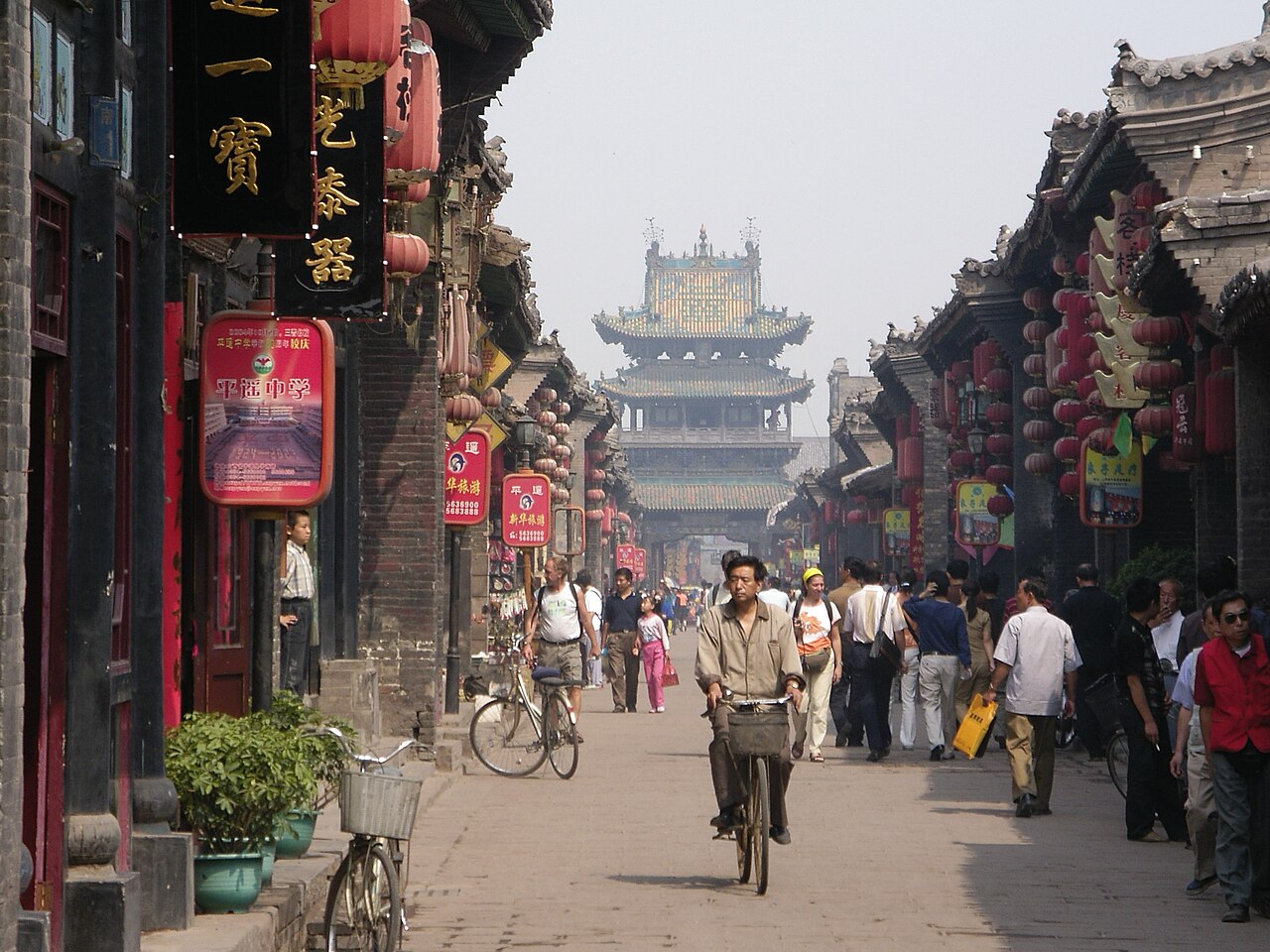
The Ancient City of Pingyao in Shanxi Province was inscribed as a UNESCO World Heritage Site in 1997. The city wall, completed in 1370 CE under the Ming Hongwu Emperor using a labour force conscripted from the surrounding region, is 6.4 kilometres in circumference, between 3 and 6 metres thick at the base, and has survived intact because the People’s Liberation Army entered through the south gate in 1949 rather than breaching the wall; no modern infrastructure was built inside the walls during the subsequent decades of Chinese urbanisation. The Rishengchang exchange house (piaohao), established at 97 Xi Dajie Street in 1823, was the first financial institution in China to issue and honour promissory notes at distant branches, operating a network of 35 branches in 24 cities at its peak; Pingyao-based merchant houses controlled an estimated 30–50 percent of China’s financial activity during the Qing Daoguang and Xianfeng reigns.
North Shanxi and Inner Mongolia: two UNESCO inscriptions 240–280 kilometres from Pingyao 240–280 km, 1.5–2.5 hours by train
The Yungang Grottoes, 280 kilometres north of Pingyao near Datong in northern Shanxi, were inscribed as a UNESCO World Heritage Site in 2001. The site comprises 53 main caves and 252 sub-caves containing approximately 51,000 Buddhist stone figures carved into a 1-kilometre sandstone cliff face between 460 and 525 CE under the patronage of the Northern Wei dynasty. The earliest phase of carving (Caves 16–20, the Tanyao Five Caves, commissioned 460–465 CE) was directed by the Buddhist monk Tanyao under the Emperor Wencheng, whose reign reversed the Taiwu Emperor’s 446 CE proscription of Buddhism; the five large-scale Buddhas in these caves, each between 13.7 and 16.8 metres high, are interpreted as portraits of five successive Northern Wei emperors, rendering the emperors as Buddhas in a programme of political-religious legitimation. The later caves (especially Caves 5 and 6, approximately 490 CE) shift from this single-large-figure format to densely carved narrative programmes covering every surface with scenes from the life of the historical Buddha Shakyamuni and the cosmological hierarchy of the Buddhist universe; Cave 6 is widely regarded as the most elaborate single cave at the site. The stone is a relatively soft Jurassic sandstone that has eroded significantly over 1,500 years; wooden protective structures built over the cave mouths during the Liao and Jin dynasties (tenth to thirteenth centuries) survive at several caves and are themselves of architectural interest. From Pingyao, Datong is reached by train on the Taiyuan–Datong railway; services take approximately 2 to 2.5 hours, with the option of a stopping train via Shuozhou or a more direct service. High-speed rail between Taiyuan North and Datong takes approximately 1 hour 10 minutes, with Taiyuan reachable from Pingyao in 40 minutes by bus or local train. The Yungang Grottoes are 16 kilometres west of Datong station, accessible by bus or taxi in 30 minutes.
The Great Wall of China, inscribed in 1987, has a significant section in northern Shanxi that is directly relevant to Pingyao’s historical context as a merchant city behind the northern frontier. The Yanmenguan Pass (Wild Goose Gate), 240 kilometres north of Pingyao in Xinzhou Prefecture, is one of the eight most important passes of the Great Wall and a component of the broader Great Wall inscription. The pass, at 1,700 metres altitude in the Yanmen Mountains, was the principal military gateway into Shanxi from the northern steppes; it was the site of repeated Tang-dynasty battles between Chinese armies and Turkic forces, and its strategic importance continued through the Song and Ming periods. The current stone gate structure dates to 1506 CE under the Ming Zhengde Emperor. The Northern Qi–era wall sections (550–577 CE) that run east and west from the Yanmenguan Pass are among the earliest surviving Great Wall constructions and differ from the better-known Ming stone walls: they are built of tamped earth (hangtu construction), in some sections reinforced with stone facings, and represent the frontier-consolidation strategy of the Northern Qi against the Rouran nomadic confederation to the north. These Qi-era sections were included in the Great Wall UNESCO inscription as part of the recognition that the Wall is not a single construction but an accumulation of different-period boundary works along the northern frontier. From Pingyao, Yanmenguan is most efficiently reached by train to Xinzhou (approximately 1 hour 30 minutes north), then by local bus or taxi 50 kilometres west to the pass; a private car makes the overall journey approximately 2 hours 30 minutes from Pingyao. The pass is visited by relatively few international tourists and offers an encounter with the Wall in a state close to its pre-restoration condition.
Mount Wutai (Wutaishan), 180 kilometres northeast of Pingyao in northern Shanxi, was inscribed as a UNESCO Cultural Landscape in 2009. The mountain is one of the four sacred Buddhist mountains of China (the others being Emeishan, Putuoshan and Jiuhuashan) and is identified in Buddhist cosmology as the abode of the bodhisattva Manjushri (Wenshu), who represents wisdom. The five flat-topped peaks (wutai means “five terraces”) rise to between 2,482 and 3,058 metres; the central peak (Beitai, North Terrace) at 3,058 metres is the highest point in northern China outside of the Qinghai-Tibetan Plateau. The site contains 53 active temples and monasteries distributed across the mountain complex, dating from the Tang dynasty to the Qing, making Wutaishan one of the densest concentrations of surviving traditional Chinese Buddhist architecture in existence. The Foguang Temple (Foguangsi), 30 kilometres southeast of the main Taihuai temple town and accessible by a side road, contains the East Main Hall dated by ink inscription to 857 CE (Tang Dazhong 11th year); it is the oldest surviving timber-framed building in China and one of only four buildings from the Tang period known to survive. The building was identified by the architectural historian Liang Sicheng and his wife Lin Huiyin in June 1937, weeks before the Japanese invasion; their discovery contradicted Japanese claims that no Tang timber buildings survived in China. From Pingyao, Wutaishan requires approximately 2.5 hours by car via the G55 Erguang expressway and the S312 provincial road to Taihuai; there is no direct train service, and the mountain is typically visited via Xinzhou or Taiyuan by bus.
Southern extensions: Longmen Grottoes and the Luoyang corridor 560 km, 3.5 hours by HSR
The Longmen Grottoes in Luoyang, Henan Province, are 560 kilometres south of Pingyao and reachable in approximately 3.5 hours by a combination of train from Pingyao to Taiyuan (40 minutes) and high-speed rail from Taiyuan South station to Luoyang Longmen station (approximately 2.5–3 hours). Inscribed in 2000, the site comprises 2,345 carved niches containing over 110,000 Buddhist figures in limestone cliffs on either side of the Yi River, with construction spanning from the Northern Wei dynasty (when the capital moved from Datong to Luoyang in 493 CE) through the Tang period. The Northern Wei carved at Yungang and then at Longmen in direct sequence; the stylistic development between the two sites is visible to any visitor who sees both within a single journey. At Yungang, figures retain the broad faces, heavy shoulders and abstracted facial expressions of Central Asian Buddhist art absorbed through the Silk Road; at Longmen, beginning with the Binyang Central Cave (completed 523 CE), the Northern Wei style shifts toward elongated, narrow-shouldered figures with Chinese facial features—a transformation attributed to the sinification policies of the Emperor Xiaowen, who required Northern Wei court officials to abandon Tabgatch language and adopt Chinese dress during the Luoyang period. The Tang-period work at Longmen culminates in the Fengxian Temple complex (completed 676 CE): a large open-air alcove with a central seated Vairocana Buddha 17.14 metres high flanked by ten accompanying figures in a compositional programme of extraordinary refinement. Tang records note that Empress Wu Zetian donated 20,000 guan from her cosmetic allowance to fund the Fengxian Temple completion. The Longmen Grottoes, Yungang Grottoes and the Pingyao merchant city together form a coherent Shanxi-Henan circuit that traces the northward migration of Buddhist imperial art over two centuries and the commercial networks that sustained the Shanxi economy long after the Buddhist period.
Luoyang itself, the city in which Longmen Grottoes are located, was the capital of the Eastern Han dynasty (25–220 CE), the Cao Wei kingdom, the Western Jin dynasty, and the Northern Wei after its southward relocation from Datong; the city’s long history as a political and cultural centre is the reason for the density of UNESCO-related sites within reach. The White Horse Temple (Baima Si), 13 kilometres east of Luoyang city centre, is traditionally dated to 68 CE and identified in Chinese sources as the first Buddhist temple established in China; a delegation of Han Emperor Mingdi brought back Buddhist scriptures from the Kushan Empire carried on white horses, and the temple was built to house them. The founding story is semi-legendary and the current buildings are of much later date, but the temple complex has been in continuous active use since at least the Northern Wei period and several halls retain Ming and Qing-period structures. The Old City of Luoyang has yielded significant archaeological material from Han-period elite burials including multicoloured ceramic tomb figures; the Luoyang Museum in the city centre holds the most important concentrations of this material and is free to enter.
Practical information
Pingyao is 700 kilometres southwest of Beijing; the Taiyuan South high-speed rail station is 85 kilometres north of Pingyao, reachable by bus in approximately 1 hour to 1 hour 15 minutes. From Beijing West station, high-speed rail to Taiyuan South takes approximately 2 hours 45 minutes; total journey time from Beijing to Pingyao is approximately 3.5 to 4 hours with the bus connection. From Pingyao itself, the town is small enough that all major sites within the walls are reachable on foot: the longest diagonal crossing of the walled area is approximately 1.5 kilometres. Bicycle rental is available from several guesthouses near the north gate and is the recommended transport for the outer ring of the city walls.
Accommodation within the walled city consists predominantly of converted traditional courtyard houses (dayuan) that have been adapted as guesthouses; the most historically representative ones are on Xi Dajie (West Main Street) and the lanes to the north. High season is May to October, with the spring and autumn shoulder months (April, October) offering lower prices and comfortable temperatures; Shanxi winters are cold and dry (average January temperature in Pingyao is -5°C) but visitor numbers are low and the walled city takes on a quieter character. The Rishengchang museum at 97 Xi Dajie is the essential starting point for understanding Pingyao’s commercial history; the building preserves the original office layout with counting rooms, codebook vault and the back courtyard in which exchange house employees lived during their contracts. Combined tickets covering the major sites within the wall (Rishengchang, the County Yamen magistrate’s court, the City God Temple and several other buildings) are available at the south gate ticket booth and are considerably cheaper than individual entries.
Frequently Asked Questions
Why did the city walls of Pingyao survive the twentieth century when so many other Chinese walled cities were demolished?
The survival of Pingyao’s Ming-period walls is a result of several converging factors rather than a single decision. The primary reason is economic: Pingyao declined sharply as a financial centre after the 1900 Boxer Rebellion indemnity payments and the subsequent collapse of the piaohao (exchange house) system in the first decade of the twentieth century, accelerated by the arrival of Western-style banks in Shanghai and Beijing. By the time the People’s Republic was founded in 1949, Pingyao was a small agricultural county town with no significant industry. The absence of industrial development meant there was no economic pressure to demolish the walls to build factories or widen roads for heavy vehicle traffic, which was the dominant mechanism by which city walls were removed across China during the 1950s–1970s. The entry of the PLA through the south gate in 1949 is often cited as a specific moment of preservation: had the city been defended, bombardment or deliberate wall-breaching would likely have caused irreparable damage. A subsequent protection order at provincial level in the 1980s formalised the conservation status of the wall and the interior street plan. A third factor is the unusual continuity of the Ming-period urban structure inside the walls: the layout of Xi Dajie and Nan Dajie, the two main commercial streets, the county yamen compound and the temple network largely survived the land redistribution and building confiscations of the 1950s because the buildings were converted to institutional uses (schools, government offices, grain storage) that preserved the structural shells without major alteration. This combination of economic marginalisation, non-destructive military entry and subsequent institutional use inadvertently conserved what a prosperous industrial city would almost certainly have replaced.
What is the Rishengchang exchange house, and what does it mean that it issued China’s first promissory notes?
The Rishengchang (literally “Sunrise Prosperity”) was a merchant firm founded in Pingyao in 1823 by the dye merchant Lei Lutai, who was backed by the Taiyuan cloth merchant Wang Ping’an. The firm’s innovation was a response to a practical logistics problem: merchants trading between Pingyao and distant cities such as Tianjin, Xi’an or Beijing had to transport large quantities of silver coinage physically, which was expensive, risky and slow. The Rishengchang introduced a system of draft transfers (piao) by which a merchant could deposit silver at the Pingyao office, receive a written draft encoded with security features (including a private codebook updated annually and variable character spacing as a forgery deterrent), and present that draft at a Rishengchang branch in another city to collect the equivalent sum in silver, minus a small commission. The system is functionally identical to the bill of exchange that had been used in medieval Italy since at least the thirteenth century and in European commerce continuously since; the Rishengchang achieved it independently in China six centuries later. At its peak, the firm operated 35 branches in 24 cities including Beijing, Tianjin, Shanghai, Hankou, Chengdu, Xi’an and Shenyang, as well as branches in Odessa, St Petersburg, Tokyo and Yokohama. The Shanxi piaohao network as a whole, which by the 1860s comprised over 30 competing firms based in Pingyao and neighbouring Qi County and Taigu, is estimated to have handled remittance transfers equivalent to a significant fraction of the Qing government’s annual fiscal revenues. The collapse began in 1900 when the piaohao were required to advance funds to the Qing government to pay the Boxer Protocol indemnity and subsequently could not recover those advances; the last major piaohao closed in 1921. The Rishengchang building at 97 Xi Dajie has operated as a museum since 1995.
How does the Northern Wei Buddhist sculpture at Yungang compare to what I will see at Longmen Grottoes?
Both Yungang and Longmen are Northern Wei commissions, but they represent different decades and a documented stylistic evolution that is directly readable from the figures themselves. Yungang (460–525 CE) was carved while the Northern Wei capital was at Datong, when the court was culturally close to its Central Asian and nomadic steppe origins. The Tanyao Five Caves (460–465 CE), the earliest major phase, show figures with round faces, large ears, broad shoulders and drapery that falls in parallel ridges suggesting a Central Asian or Gandharan prototype; the scale is monumental and the spiritual effect is one of elemental power rather than refined detail. The later Yungang caves (Caves 7–13, approximately 470–494 CE) develop more complex iconographic programmes with multiple figures per cave and narrative panels, but the figural style retains the broad, frontal, non-naturalistic quality of the earlier work. Longmen’s Northern Wei phase (493–534 CE) follows the capital’s relocation from Datong to Luoyang in 493 CE under the Xiaowen Emperor, who simultaneously required court nobles to abandon Tabgatch customs, language and dress in favour of Han Chinese equivalents. The Longmen Northern Wei figures are visibly different: faces are narrower and more elongated, bodies are thinner and taller, and the drapery develops a distinctive “waterfall” quality with cascading linear folds that become increasingly elegant and stylised. This Northern Wei Longmen style—sometimes called the “Northern Wei linear style”—is one of the most influential formal inventions in Chinese art history, transmitted to Korea and Japan through the sixth and seventh centuries. The Tang Longmen work (Fengxian Temple, 672–676 CE) represents the full maturation of Chinese Buddhist monumental sculpture after another century of development: figures are naturalistic in body proportion, clothing conforms to the body rather than abstracting it, and the compositional relationships between the figures in the Fengxian alcove demonstrate a spatial and narrative sophistication absent from the Northern Wei caves. A visitor who sees Yungang and then Longmen within a single journey observes the full arc of Buddhist sculpture’s sinification across 200 years in concrete, physical form.
Sources
- S1 — UNESCO World Heritage Centre — Ancient City of Ping Yao (Ref. 812) — https://web.archive.org/web/20230601000000/https://whc.unesco.org/en/list/812/
- S2 — Pingyao Heritage Preservation Center — https://whc.unesco.org/en/list/812/
- S3 — Kuhn, Dieter. <em>The Age of Confucian Rule: The Song Transformation of China</em>. Harvard University Press, 2009. ISBN: 978-0-674-03661-1.
Spotted an error? Write to editorial@culturalheritageonline.com and we correct it the same day.