
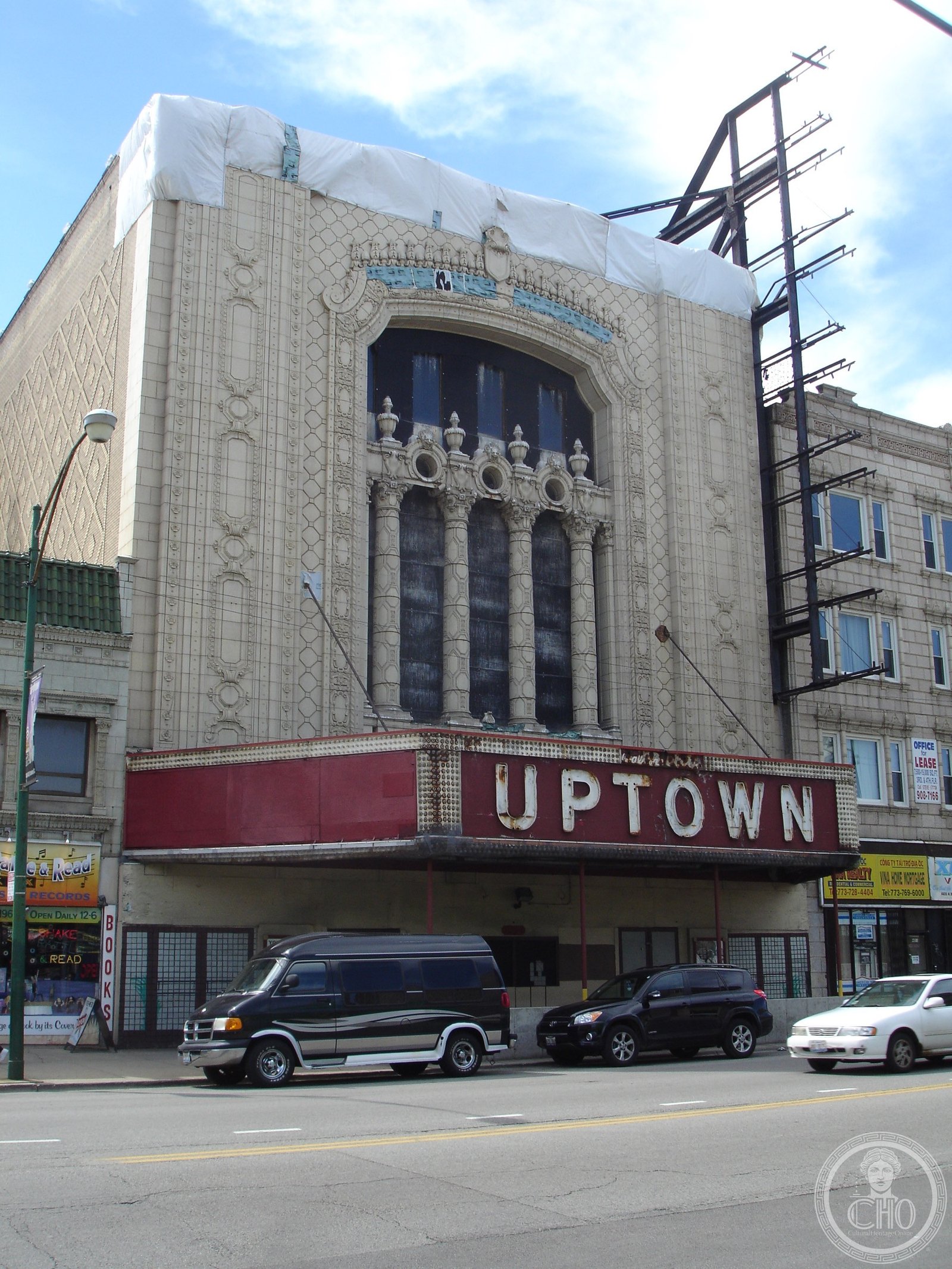
Uptown Theatre (1925), Chicago
The Uptown Theatre on North Broadway was the largest movie theater in the United States when it opened in 1925 with approximately 4,000 seats—a Spanish-Baroque atmospheric palace designed by Walter Ahlschlager that anchored the Uptown entertainment district for five decades before closing in 1981 and entering a decades-long preservation struggle that has not yet delivered the restoration the building’s extraordinary scale demands.
At a glance
The Uptown Theatre at 4816 N Broadway in Chicago’s Uptown neighborhood is one of the most significant unrestored picture palaces in the United States—a 1925 atmospheric theater of approximately 4,000 seats whose Spanish-Baroque interior by Walter Ahlschlager represents the atmospheric theater format at its grandest scale. Built at the peak of the entertainment district’s commercial development and serving as the neighborhood’s cultural anchor for over fifty years, the Uptown closed in 1981 and has remained dark while successive restoration proposals have been developed, revised, and stalled. The Chicago Commission on Chicago Landmarks designated the theater in 1991. The building stands as one of the most compelling challenges in American historic preservation: a structure of unquestioned architectural significance that awaits the financial and organizational commitment to return it to operation.
Key facts
- Address: 4816 N Broadway, Chicago, IL 60640
- GPS: 41.9657° N, 87.6560° W
- Built: 1925
- Architect: Walter Ahlschlager
- Style: Atmospheric theater / Spanish-Baroque Revival
- Capacity: approximately 4,000 seats (one of the largest theaters ever built)
- Status: Closed; restoration pending
- Chicago Landmark: Designated 1991
- NRHP: Listed on National Register of Historic Places
History
Chicago’s Uptown neighborhood developed as an entertainment district through the 1910s and 1920s as the elevated train line on the north side connected the area to downtown and developers responded with theaters, ballrooms, nightclubs, and retail corridors that made Uptown the entertainment capital of the North Side. The Aragon Ballroom (1926), the Green Mill cocktail lounge, and the Riviera Theatre joined the Uptown as anchors of a entertainment economy that drew audiences from across the city and established the neighborhood’s identity as a place of large-scale organized leisure.
The Uptown Theatre opened in 1925 as one of the largest theaters ever built in the United States—approximately 4,000 seats across an orchestra floor, mezzanine, and two balconies—designed by Walter Ahlschlager with an atmospheric interior that deployed the Spanish-Baroque vocabulary in a space whose sheer scale made the Moorish and Spanish ornamental program feel like architecture rather than decoration. The building served the Balaban and Katz theater circuit, which controlled first-run exhibition in Chicago through the 1920s and 1930s. The circuit’s investment in architectural quality—Balaban and Katz commissions also produced the Chicago and Oriental Theatres downtown—meant that the Uptown’s interior was executed with the richness of detail and consistency of design that distinguished the major circuit houses from their less well-funded competitors.
The Uptown ran first-run films and later rock concerts through the postwar decades. Changing neighborhood demographics, competition from suburban multiplexes, and the general decline of the single-screen urban cinema brought the theater to closure in 1981. The building was designated a Chicago Landmark in 1991 and listed on the National Register of Historic Places; successive restoration proposals by Jam Productions and other developers have foundered on the scale of the investment required. The theater remains in private ownership with restoration intent unfulfilled; the building’s condition has continued to deteriorate through the decades of vacancy, making the eventual restoration both more urgent and more expensive.
What you see
The North Broadway facade is one of the most imposing theater exteriors in Chicago: a full-block composition of brick and terra cotta that rises several stories above the street level, with the theater’s identifying vertical sign and marquee at the center of an elevation that carries Spanish Baroque ornamental detail in the upper stories. The terra cotta ornament is elaborate by any standard—twisted columns, cartouches, and sculptural figures in the Churrigueresque manner that Ahlschlager adapted from the Spanish colonial churches of Latin America—and maintains this density of decoration across a facade wider than most theaters in the country.
The interior, closed to public viewing, is documented in historical photographs as one of the great atmospheric theater interiors: a Spanish courtyard on an opera house scale, with side walls presenting tiered balconies and arched colonnades, a ceiling simulating an outdoor sky at dusk, and a proscenium arch of corresponding grandeur. The scale of the space—approximately 4,000 seats under a simulated sky—achieves an atmospheric effect unlike anything in the surviving atmospheric theater corpus, where most examples seat 1,500 to 2,700 people. The Uptown’s scale transforms the atmospheric concept from intimate escapism to civic spectacle.
Practical information
- The Uptown Theatre is currently closed and not accessible for public events or tours.
- The exterior facade on North Broadway is viewable from the street and represents one of the finest atmospheric theater facades surviving in any American city.
- The Chicago Architecture Center and the Theatre Historical Society of America maintain documentation and advocacy for the building’s restoration.
- The surrounding Uptown neighborhood remains an entertainment district: the Aragon Ballroom (1926) at 1106 W Lawrence Avenue is active and programs concerts in its original Moorish ballroom; the Riviera Theatre (1918) at 4746 N Racine also remains in operation.
Getting there
The Uptown Theatre is at 4816 N Broadway in the Uptown neighborhood of Chicago, accessible via the CTA Red Line to Lawrence station (0.5 miles south of the theater) or Wilson station (adjacent). From the Loop, take the Red Line north to Lawrence in approximately 20 minutes. From O’Hare International Airport, take the CTA Blue Line to Clark/Lake, transfer to the Red Line northbound to Lawrence; total time approximately 55 minutes. Street parking on Broadway and adjacent side streets. The Uptown neighborhood is walkable with restaurants, cafes, and the active Aragon Ballroom and Riviera Theatre nearby.
Nearby
- Aragon Ballroom (1926, 2 blocks west): the active Moorish fantasy ballroom at 1106 W Lawrence programs major concerts in a sister-building of the atmospheric theater era; its interior is equally elaborate and fully accessible.
- Green Mill Cocktail Lounge (1 block south): the 1907 jazz bar at 4802 N Broadway has operated continuously since Prohibition and maintains its original back-room character; one of the authentic jazz venues in Chicago.
- Graceland Cemetery (1 mile south): the 1860 cemetery at 4001 N Clark Street contains the graves of Chicago’s architectural community—Daniel Burnham, Louis Sullivan, Ludwig Mies van der Rohe—making it a significant destination for architectural history.
- Chicago History Museum (5 miles south): the museum at 1601 N Clark Street in Lincoln Park holds comprehensive collections on Chicago’s architectural and cultural history, including documentation of the Uptown neighborhood.
Sources
- Chicago Commission on Chicago Landmarks, “Uptown Theatre Designation Report” 1991
- National Register of Historic Places, “Uptown Theatre Chicago” nomination
- Cinema Treasures, “Uptown Theatre, Chicago” database entry
- Theatre Historical Society of America, Uptown Theatre documentation files
Find it on the map
See this place and what’s around it →📷 Diventa un fotografo di Cultural Heritage Online
Condividi le tue foto dei luoghi: restano pubblicate con la tua firma come autore. Più vengono viste, più ti fai conoscere — e presto un concorso premierà le foto più apprezzate.
Accedi o registrati gratis per aggiungere una fotoDo you manage this place?
This page is read by travellers and heritage enthusiasts who find it on Google. Keep it accurate — and make it work for you. Free for non-profit heritage institutions.