
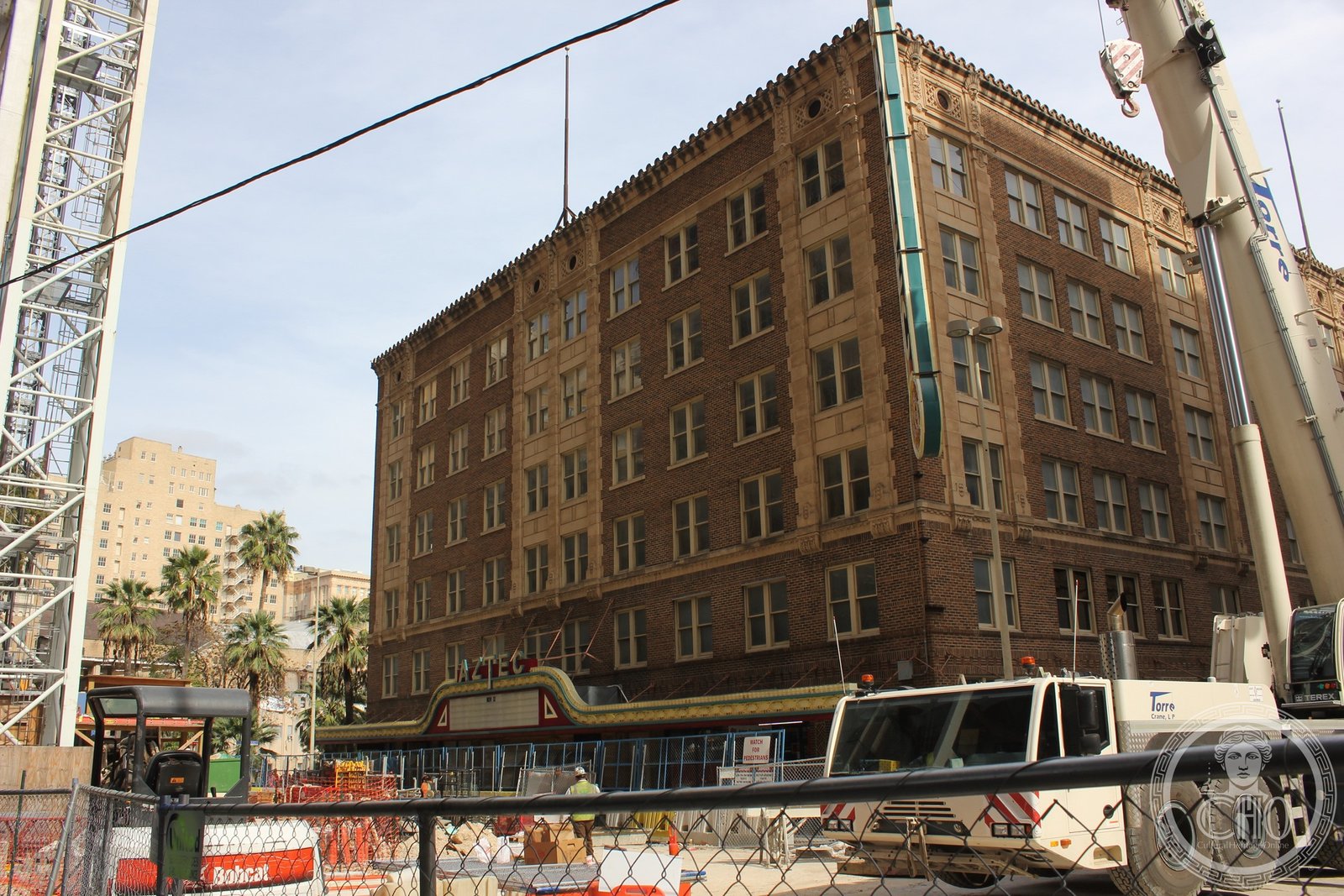
Architect Robert B. Kelly filled the Aztec’s 2,400 seats with carved serpents, Chac masks, and jaguar friezes drawn directly from pre-Columbian codices—making this 1926 theater the most intact and ambitious example of Aztec Revival architecture surviving in any American movie palace.
At a glance
The Aztec Theatre opened in downtown San Antonio in 1926 as one of the most ambitious picture palaces of the decade. Architect Robert B. Kelly translated pre-Columbian iconography into a complete interior environment—carved feathered serpents, Tlaloc rain god masks, calendar stone reliefs, and Aztec warrior friezes covering every pier, cornice, and ceiling coffer. The building operated as a cinema until the 1970s, survived decades of closure, and reopened after restoration as a live music venue and event hall that retains nearly all of Kelly’s original decorative fabric.
Key facts
- Address: 104 N St. Mary’s Street, San Antonio, TX 78205
- GPS: 29.4232° N, 98.4894° W
- Built: 1926
- Architect: Robert B. Kelly
- Style: Aztec/Mayan Revival
- Capacity: approximately 2,400 seats
- Status: Active live music and event venue
- NRHP: Listed on National Register of Historic Places
History
Robert B. Kelly received the Aztec commission at the height of picture palace ambition, when architects competed to produce the most immersive theatrical environments their clients would fund. The choice of Aztec Revival drew on two parallel currents: the post-Revolution Mexican cultural nationalism that had elevated pre-Columbian heritage into a source of civic pride, and San Antonio’s geographic and cultural proximity to Mexico, which gave the Aztec decorative program both local resonance and commercial novelty.
Kelly worked with specialized sculptors to translate Aztec codex imagery into three-dimensional plaster reliefs across every surface of the lobby, foyer, and auditorium. The calendar stone, Tlaloc masks, feathered serpent columns, and Aztec warrior processions formed a continuous archaeological narrative that contemporary press described as “a trip through ancient Mexico” within the city limits. The Aztec opened in 1926 to strong attendance and operated as a first-run cinema house through the mid-twentieth century.
The multiplex era eroded attendance from the 1960s onward, and the Aztec closed as a cinema in the 1970s. Preservation advocates secured National Register listing and pursued successive restoration campaigns through the 1990s and 2000s, stabilizing the structure and converting the auditorium to a live music and events configuration. The original decorative plaster—including the polychrome paint surviving in the upper balcony—remained largely intact through the closure period and was conserved rather than replaced during restoration.
What you see
The St. Mary’s Street exterior presents a stripped Aztec frieze band above the marquee in glazed terracotta: geometric step-frets, feathered borders, and calendar-stone roundels define the cornice line. The entrance pylons carry stacked relief panels derived from temple gateway stele. Inside, the foyer opens into one of the country’s most concentrated collections of Aztec Revival ornament. Every pier carries carved serpent columns; every ceiling coffer holds a modeled Tlaloc or solar disk.
The auditorium rises in three tiers—orchestra, mezzanine, and balcony—each framed by feathered serpent pilasters. The proscenium arch carries a twelve-foot Chac mask as its keystone, its open jaws framing the full width of the stage opening. Side walls display bas-relief processions of Aztec warriors in full feathered regalia. The polychrome paint scheme—documented in Kelly’s original drawings—survived in the upper balcony and provided the color reference for the restoration; the lower zones were repainted to match. The overall effect is more archaeological museum than entertainment venue, the ornament so insistent and specific that the building reads as a scholarly argument as much as a commercial one.
Practical information
- The Aztec operates as a live music venue and event hall; no regular cinema programming.
- Check the Aztec Theatre website for the current concert and events calendar.
- Guided architectural tours offered on select dates; contact the venue for availability.
- Fully accessible main floor; elevator access to upper tiers.
- The lobby is worth visiting even on non-event days—ask the box office about access hours.
Getting there
The Aztec Theatre is at 104 N St. Mary’s Street in downtown San Antonio, two blocks north of the River Walk and within walking distance of the Alamo. VIA Metropolitan Transit serves downtown with multiple routes stopping on Commerce Street and Houston Street, both within one block. Parking is available in downtown garages along Commerce and Market Streets. From San Antonio International Airport, drive south on US-281 to downtown; the trip takes 15–20 minutes.
Nearby
- San Antonio River Walk (1 block south): the linear riverside park and entertainment district is the city’s primary tourist artery, running under the downtown street grid.
- The Alamo (4 blocks northeast): the 1718 mission church and battlefield site at the core of Alamo Plaza.
- Majestic Theatre (2 blocks east): the 1929 Spanish Colonial Revival atmospheric theater at 224 E Houston Street—San Antonio’s other surviving picture palace and a useful companion visit.
- San Fernando Cathedral (3 blocks west): the 1738 cathedral on the original plaza is the oldest continuously active parish in Texas.
Sources
- Aztec Theatre San Antonio, aztectheatre.com — venue history and event schedule
- National Register of Historic Places, “Aztec Theatre San Antonio” nomination
- Preservation Texas, historical documentation
- Cinema Treasures, “Aztec Theatre, San Antonio” database entry
Find it on the map
See this place and what’s around it →Record researched and written by Luigi De Marchi for Cultural Heritage Online, 2026.
📷 Become a Cultural Heritage Online photographer
Share your photos of places: they stay published under your name as the author. The more they're seen, the more you get noticed — and soon a contest will reward the most appreciated photos.
Log in or sign up free to add a photoIs this page about you?
This page is read by travellers and heritage enthusiasts who find it on Google. Tell us how you are connected to this place and we will take it from there.