
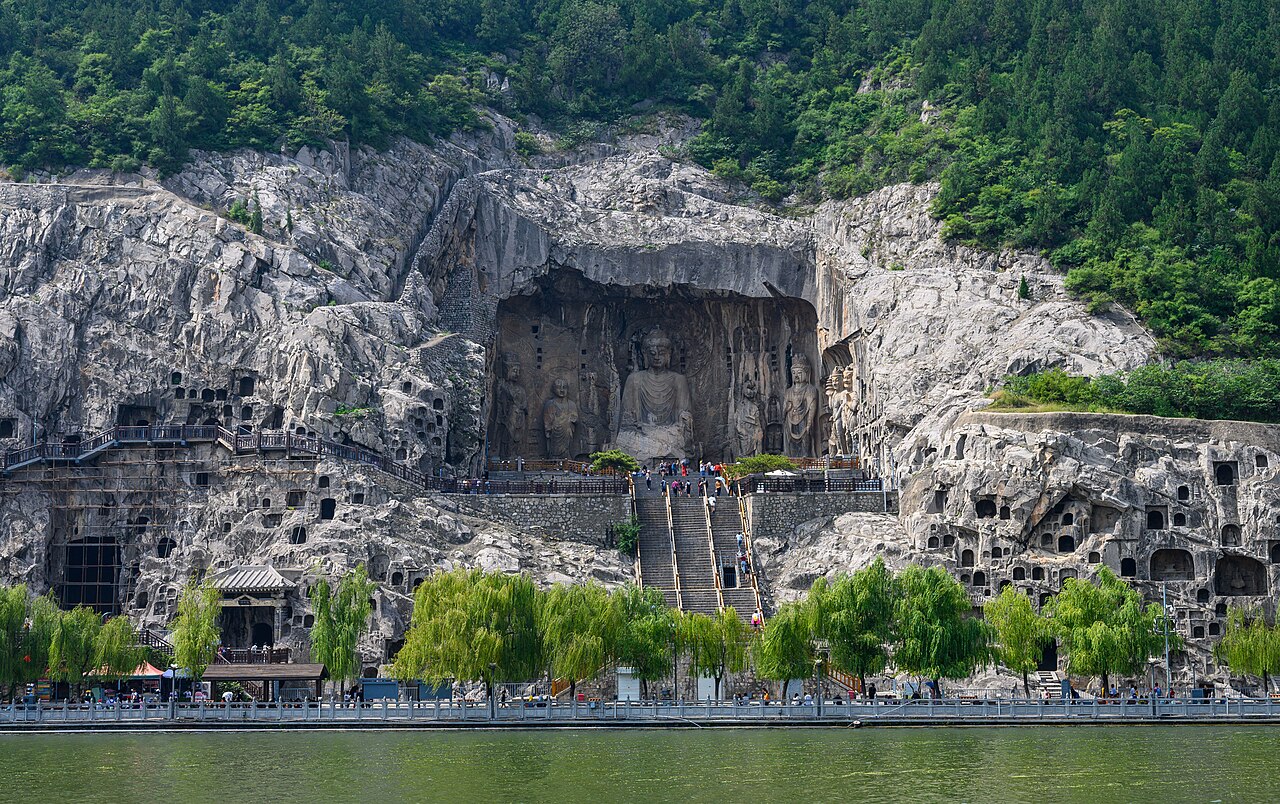
The Longmen Grottoes at Luoyang in Henan Province contain 2,345 caves and niches carved into limestone cliffs along a 1-kilometre stretch of the Yi River gorge, with construction spanning from 493 CE to the end of the Tang dynasty in 907 CE. The site holds 100,000 Buddhist images and 2,800 inscribed stone tablets, representing the most significant surviving collection of Wei and Tang calligraphy in China. Hundreds of carved heads were removed by art dealers in the 1930s through 1960s and are now held in Western museums.
Four centuries of carving: the Northern Wei to Tang stylistic shift 13 km south of Luoyang city centre
The Longmen site was chosen by Emperor Xiaowen of the Northern Wei dynasty when he relocated his capital to Luoyang in 493 CE. The Yi River gorge provided a natural setting — two facing limestone cliffs, Xishan (West Hill) and Dongshan (East Hill) — that Buddhist monks and their patrons found appropriate for rock-cut cave temples of the type already being produced at Yungang in Shanxi Province, where the Wei court had previously been based. The move from Yungang to Longmen brought the carving tradition south into the heartland of Chinese territory, and the style changed accordingly.
Northern Wei carvings at Longmen, concentrated in caves like Guyang (begun around 495 CE), show the aesthetic that originated in contact with Central Asian Buddhist art via the Silk Road: elongated, almost flat figures with deeply carved drapery, sharp linear facial features, and a compressed spatial depth that gives the compositions an austere, frontal gravity. The figures are thin, hieratic, and clearly derived from the same visual chain that connects Indian Buddhist sculpture through Afghanistan and Gandhara to the northwest frontier of China. These are not Chinese faces in any naturalistic sense; they are doctrinal images in a symbolic mode.
The Tang dynasty shift, which becomes visible in caves commissioned from the early 7th century onward, is dramatic. Tang figures at Longmen are fuller-bodied, rounder-faced, and placed in more naturalistic spatial relationships to one another. Attendant bodhisattvas in Tang caves lean slightly toward the central figure; the clothing hangs in softer, more volumetric folds. Scholars read this change as reflecting the consolidation of a distinctly Chinese Buddhist visual tradition that had absorbed and digested its Central Asian sources and was now producing something different — not less sophisticated, but differently grounded. The Longmen Grottoes preserve this transformation in the most concentrated and documented form available anywhere in Chinese Buddhist art.
The 2,800 carved stone inscriptions, or steles, are a separate category of significance. They include calligraphic texts commissioned by donors who funded cave construction, commemorative inscriptions, sutras, and colophons. The “Twenty Pieces of Longmen” — a set of inscriptions selected in the Qing dynasty as exemplary specimens of Wei calligraphy — have been studied and reproduced by calligraphers for centuries. Many professional calligraphers in China still use Longmen rubbings as practice models.
The Fengxian Temple, Empress Wu Zetian and the decapitated Buddhas Xishan cliff, Longmen Grottoes site
The Fengxian Temple (Ancestor Worshipping Cave) is the largest single grotto at Longmen and the one most associated with the political circumstances of its creation. Construction ran from 672 to 676 CE, commissioned by Emperor Gaozong but substantially funded and directed by his consort, Wu Zetian, who contributed 20,000 strings of cash from her personal cosmetic allowance — a detail recorded in the dedicatory inscription and preserved on the site. Wu Zetian would go on to become Emperor of China in her own name in 690 CE, ruling the Zhou dynasty until 705 CE, the only woman in Chinese history to hold the imperial title directly rather than through regency.
The central figure in the Fengxian Temple is the Vairocana Buddha, measuring 17.14 metres in height, seated on a lotus throne and flanked by two disciples, two bodhisattvas, two heavenly kings, and two guardians — nine figures in total, carved from the living cliff. The face of the Vairocana is the subject of a long-standing tradition that it was modelled on Wu Zetian’s own face: the high, broad forehead, the faint downward curve of the lips, the expression of contained authority that Chinese aesthetics associate with female power. Archaeological evidence for this claim is circumstantial — the resemblance is asserted rather than documented — but the tradition has been maintained by Luoyang scholarship for centuries and is built into every formal guide to the site.
The damage to the Longmen Grottoes from the 1930s through the 1960s is a separate and thoroughly documented chapter. Art dealers, working with local collaborators, used saws and chisels to remove carved heads and hands from hundreds of figures and sold them through Shanghai and Hong Kong to intermediaries supplying Western collections. The Metropolitan Museum of Art in New York, the Boston Museum of Fine Arts, the Nelson-Atkins Museum in Kansas City, and institutions in Toronto, Kansas, and Europe acquired Longmen pieces in this period, many without adequate provenance documentation. In 2019, the Chinese government initiated formal legal requests for repatriation under the UNESCO 1970 Convention on the Means of Prohibiting and Preventing the Illicit Import, Export and Transfer of Ownership of Cultural Property. Progress has been limited.
Shaolin Temple, 80 kilometres northwest of Luoyang, holds a distinct UNESCO inscription as part of the “Historic Monuments of Dengfeng” site (2010). Shaolin is identified in Chan (Zen) Buddhist tradition as the location where the Indian monk Bodhidharma spent nine years in meditation in the early 6th century, and where the physical training routines that evolved into what is now called kung fu developed among the monastery’s monks. The connection between Shaolin’s UNESCO listing and the Longmen Grottoes is chronological as well as geographic: both sites are products of the same period of Tang and pre-Tang Buddhist patronage in Henan Province.
Practical information
Luoyang is served by direct high-speed rail connections to Xian (approximately 1 hour 30 minutes), Zhengzhou (45 minutes), and Beijing West (approximately 2 hours). Luoyang Longmen High-Speed Station is 7 kilometres from the Longmen Grottoes site, making it possible to visit directly from the train without entering the city centre first. Local bus route 71 connects the Longmen station to the grottoes; taxis are available.
The grottoes are open year-round. The site involves approximately 1 kilometre of riverside walking on paved paths; the full loop including both the Xishan and Dongshan cliffs takes 2 to 3 hours. Entry tickets include access to both cliff sections. April, May, September, and October offer the most comfortable outdoor conditions; July and August are hot and crowded. The Luoyang Peony Festival in mid-April draws large numbers of domestic tourists and should be factored into accommodation planning. Shaolin Temple and the adjacent Song Mountain scenic area are a feasible half-day excursion at 80 kilometres northwest, accessible by direct tourist buses from Luoyang.
Frequently Asked Questions
What is the difference between the Longmen, Yungang, and Mogao cave complexes?
All three sites are UNESCO-listed Buddhist rock-cut complexes and all three developed during overlapping periods of Northern Wei and Tang patronage, but they differ substantially in medium, location, and cultural context. Yungang (UNESCO 2001), near Datong in Shanxi Province, was the first major Northern Wei cave complex, carved in sandstone beginning around 460 CE; its earliest caves show the most direct Central Asian influence and the least modification by later Chinese aesthetic conventions. Longmen, carved primarily in limestone 13 kilometres south of Luoyang, represents the mature Wei and Tang phases, with the Yi River gorge setting providing a more intimate spatial context than Yungang’s open cliff face. The Mogao Caves at Dunhuang are a different type of site: the rock at Mingsha is too soft for carving, so the Mogao decoration consists entirely of painted plaster applied to brick-lined chambers rather than cut stone. Mogao is also the site of a major manuscript repository (Cave 17), which has no parallel at either Yungang or Longmen. The three sites are complementary in what they represent: Yungang for the introduction of Buddhist cave carving to China, Longmen for its artistic evolution and calligraphic archive, Mogao for the manuscript tradition and international Silk Road character.
How many of the decapitated Longmen statues have been returned to China?
Returns have been limited in number and have proceeded on an institution-by-institution basis rather than through any systematic legal mechanism. A small number of Longmen fragments were returned to Luoyang by US collectors in the 1990s and 2000s through donations rather than formal repatriation orders. The Chinese government’s formal legal actions, initiated from 2019 onward, have focused on pieces acquired after 1970 under the UNESCO Convention — a threshold that excludes most of the major Western museum acquisitions, which predate the Convention. Pieces acquired before 1970 are subject to different legal regimes that generally favour the possessing institution. Repatriation of pre-1970 pieces has depended on individual institutional decisions and bilateral diplomatic arrangements rather than binding international law. The Luoyang Museum maintains a display documenting the removed pieces alongside photographs of their current locations abroad.
Is the face of the Vairocana Buddha at Fengxian Temple really modelled on Wu Zetian?
There is no contemporary documentary evidence — no inscription, no court record, no artist’s note — confirming that the Vairocana’s face was intended as a likeness of Wu Zetian. The tradition is first attested in sources written several centuries after the Tang dynasty and may reflect retrospective attribution designed to associate the monument more firmly with the most famous woman in Chinese imperial history. What is documented is Wu Zetian’s financial contribution to Fengxian Temple’s construction and her political presence at the Luoyang court during the 672–676 CE construction period. Some art historians argue that the degree of stylistic resemblance between the Vairocana and Tang-dynasty portrait conventions for imperial women is too specific to be coincidental; others treat the resemblance as a projection by later commentators who knew both the Buddha’s appearance and Wu Zetian’s reputation. The claim cannot be definitively confirmed or ruled out with available evidence, and reputable art history sources typically describe it as a persistent local tradition rather than an established fact.
Sources
- S1 — UNESCO World Heritage Centre — Longmen Grottoes (listed 2000). https://whc.unesco.org/en/list/1003/
- S2 — Longmen Grottoes Research Academy — official site. http://www.lmsk.cn/
- S3 — Longmen Scenic Area — official site. http://www.longmen.com.cn/
Spotted an error? Write to editorial@culturalheritageonline.com and we correct it the same day.

.jpg)