Kyoto served as Japan’s imperial capital for 1,074 years — from 794 to 1868 — and the UNESCO inscription it earned in 1994 covers 17 monuments spread across Kyoto city, Uji to the south and Otsu to the east. The sites span nearly a millennium of construction, from Heian-period shrines dating to the ninth century through Edo-period castle complexes completed in the seventeenth. Among them are a pavilion sheathed in gold leaf, a Shinto shrine at the base of a mountain threaded with more than 10,000 vermilion gates, and a castle whose floors were engineered to squeak as a security measure.
Kinkaku-ji and the Gold Pavilion: a retirement villa, an arson and a rebuild Northern Kyoto — 40 min by bus from Kyoto Station
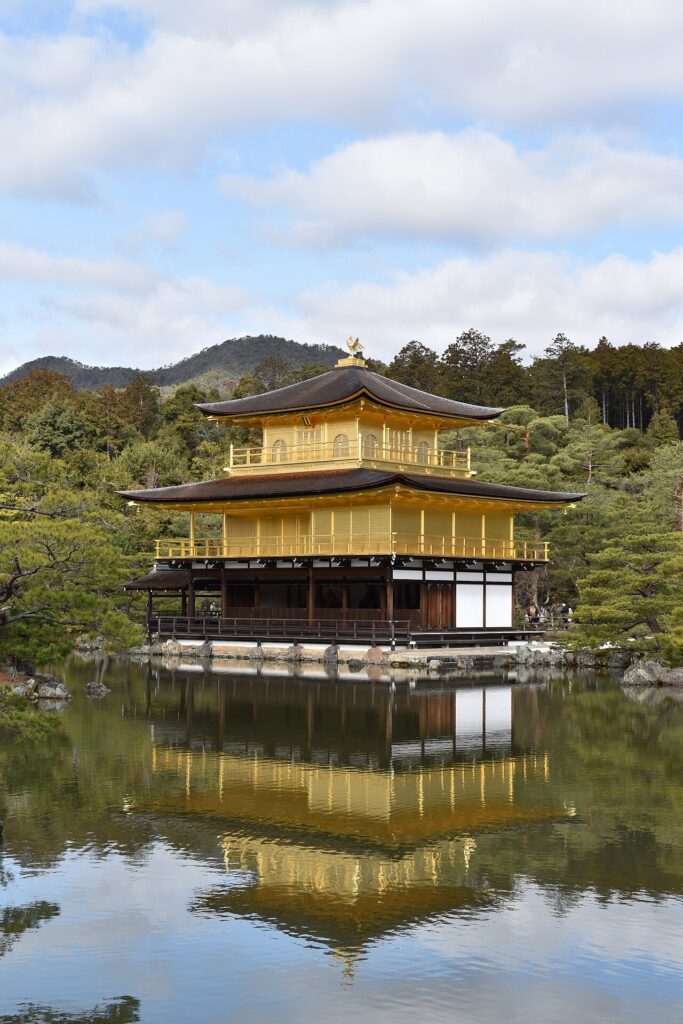
Kinkaku-ji was not built as a temple. Shogun Ashikaga Yoshimitsu had the structure constructed in 1397 as his retirement villa, and it was only converted to a Zen Buddhist temple after his death in 1408. The pavilion stands three storeys above the Kyokochi (Mirror Pond), and the top two floors are entirely clad in gold leaf — pure gold applied directly over the lacquered wood surface. The ground floor, which houses a statue of the Shaka Nyorai Buddha, is left in natural wood in the shinden-zukuri style of Heian aristocratic architecture. The second floor reflects the samurai aesthetic of the Kamakura period, and the third is built in the Chinese Zen style.
The building visitors see today is not the original. On July 2, 1950, a 21-year-old novice monk named Hayashi Yoken set fire to the pavilion and attempted suicide on the hillside behind it. The building burned to the frame. The Kyoto city government rebuilt it in 1955 using archival drawings and photographs. In 1987, the city ordered a fresh application of gold leaf — applied at five times the thickness of the pre-war layer to better resist weathering. The episode inspired Mishima Yukio’s 1956 novel Kinkaku-ji (translated as The Temple of the Golden Pavilion), which explores the monk’s obsessive relationship with an object of impossible beauty.
The surrounding garden was laid out in the Muromachi period and is considered an example of karesansui (dry landscape) combined with pond-and-island composition. The pine tree on the peninsula in the pond — called Riku-shun-no-matsu — is said to have been trained into the shape of a sailing boat by Yoshimitsu himself. The site receives approximately five million visitors per year, which makes early morning arrival — the grounds open at 09:00 — the most practical choice to avoid the thickest crowds at the ticket gate.
Fushimi Inari-taisha: 10,000 torii gates and 233 sub-shrines on a mountain trail Southern Kyoto — 5 min walk from JR Inari Station
Fushimi Inari-taisha was founded in 711 CE on the wooded slopes of Mount Inari, making it among the oldest of the 17 monuments covered by the UNESCO designation. The shrine is the head institution of approximately 32,000 Inari shrines across Japan. Inari is the kami (Shinto spirit) of foxes, rice, agriculture and commercial prosperity, which explains both the white fox statues that appear throughout the complex and the identities of those who donate torii gates: the inscriptions carved into the bases of the gates record the name of the donating company or individual and the date of donation, and many are corporate sponsors seeking blessing for business ventures.
The famous corridor of gates — the Senbon Torii — does not contain exactly 1,000 gates despite its name. The complex has accumulated more than 10,000 torii since the practice of private donation became established in the Edo period (1603–1868). The trail to the summit of Mount Inari is 4.2 kilometres one way and rises approximately 233 metres in elevation through a series of sub-shrine stations. The full round trip takes roughly two to three hours at a walking pace. The 233 registered sub-shrines along the route serve specific requests — certain shrines for eye ailments, others for business success, others for safe childbirth — and each has its own set of stone lanterns and smaller torii donated over centuries.
The main shrine buildings at the base of the mountain were rebuilt in 1499 after fire damage and are representative of Momoyama-period architectural style. The shrine precinct is open 24 hours, which makes it one of the few major sites in Kyoto where night visits are entirely practical. The trail is lit at the lower sections but becomes unlit higher up the mountain, so visitors intending to walk to the summit after dark should carry torches.
Nijo Castle and Nara: shogunal authority made visible Nijo Castle — 15 min by subway from Kyoto Station; Nara — 35 km northeast, 35 min by express train
Nijo Castle was completed in 1603 as the official Kyoto residence of Tokugawa Ieyasu, the first shogun of the Edo period. The structure was designed explicitly to project the power of the Tokugawa military government in the former imperial capital. The Ninomaru Palace — the inner palace — contains 800 painted cedar sliding doors and wall panels executed by the Kano school of painters, depicting pine trees, tigers, wild geese and eagles in the formal nijiri-guchi style that signalled rank through subject matter. The rooms closest to the entrance are decorated with the most aggressive imagery — tigers and eagles — to establish dominance before the shogun was reached.
The “nightingale floors” (uguisubari) in the corridors of Ninomaru Palace are a structural security feature rather than an aesthetic one. The floorboards are suspended on a system of metal clamps (uguisu-bari, literally “bush warbler clamps”) that produce a squeaking sound when weight is applied. The mechanism makes it impossible to walk silently through the corridors, alerting guards to any approach toward the shogun’s quarters. The squeak is produced by clamps rubbing against nails, not by the boards themselves.
Nara, 35 kilometres northeast of central Kyoto, holds its own UNESCO inscription (1998) covering eight monuments from Japan’s Nara period (710–794 CE), when Nara — not Kyoto — served as the imperial capital. The two inscriptions are complementary: the Kyoto sites represent the centuries when the imperial court remained in place; the Nara sites represent the decades before Kyoto existed as a capital. Todai-ji in Nara, with its Great Buddha Hall and 14.98-metre bronze Vairocana Buddha, lies 35 minutes from central Kyoto by express train and is regularly combined with Kyoto visits in multi-day itineraries.
Practical information
Kyoto is served by the JR Tokaido Shinkansen (bullet train) from Tokyo Station (2 hours 15 min, approximately ¥14,000 standard class) and Osaka (15 min, ¥1,420). Within the city, the subway and bus network cover all 17 UNESCO monuments, though some sites (including Kinkaku-ji) require a bus rather than a subway connection from central Kyoto. A one-day bus pass (¥700) is practical for circuits of the northern and western monuments.
Individual site admission charges apply: Kinkaku-ji ¥500, Nijo Castle ¥1,300, Ryoan-ji ¥600, Ginkaku-ji (Silver Pavilion) ¥500. Fushimi Inari-taisha has no admission charge for the shrine grounds or the mountain trail. The 17 UNESCO monuments do not share a combined ticket; each is priced separately.
The city experiences significant visitor volume in late March to early April (cherry blossom season) and November (autumn foliage). July and August are extremely humid, with temperatures regularly exceeding 35°C. January and February are cold but uncrowded. Most monuments have English-language information boards, and Kyoto Station has a well-staffed tourist information centre with multilingual assistance.
Frequently Asked Questions
How many UNESCO World Heritage Sites are in Kyoto, and which ones are most commonly skipped?
The inscription “Historic Monuments of Ancient Kyoto” covers 17 monuments — 13 within Kyoto city, two in Uji (Byodo-in and Ujigami Shrine) and two in Otsu (Enryaku-ji and Nishi-Hongan-ji, though the latter is in Kyoto). The sites that receive the fewest visitors relative to their historical significance include Ujigami Shrine in Uji — the oldest surviving Shinto shrine structure in Japan, dating to the late Heian period (estimated late 10th or early 11th century) and a 10-minute walk from Byodo-in — and Kozanji temple in the Takao mountain area northwest of the city, which holds the oldest surviving tea plantation in Japan (established by the monk Myoe in 1206). Enryaku-ji on Mount Hiei, accessible by cable car and ropeway from the Eizan Railway, is the temple complex where Oda Nobunaga conducted his 1571 massacre of approximately 3,000 monks and villagers to eliminate an obstruction to his military campaigns. It receives a fraction of the visitors who go to Kinkaku-ji, despite its equivalent UNESCO designation and substantially longer historical shadow.
What is the story behind the gold leaf on Kinkaku-ji, and how much gold does the building contain?
The original 1397 pavilion used gold leaf on the upper two floors, but the application was thin by modern standards. The 1950 arson destroyed the original building entirely, and the 1955 reconstruction used archival documentation to reproduce the exterior accurately. However, the 1955 rebuild used a gold leaf application that proved inadequate — the leaf degraded noticeably over the following decades. In 1987, Kyoto city authorised a comprehensive re-gilding at five times the original post-war thickness. The current layer is approximately 0.5 microns thick across the exterior of both gilded floors. The total gold content of the building is not publicly disclosed with precision, but conservation reports from the 1987 project indicate that several hundred sheets of 11-centimetre-square gold leaf were applied per square metre of surface, totalling many thousands of individual sheets. The gold leaf used is Kanazawa gold leaf, produced in Ishikawa Prefecture, where Japan’s gold leaf manufacturing industry has been concentrated since the Edo period.
Can visitors walk the full trail at Fushimi Inari-taisha, and how long does it take?
The full trail from the main shrine at the base of Mount Inari to the summit (Ichinomine, 233 metres above sea level) and back is 4.2 kilometres one way, or approximately 8.4 kilometres return. At a moderate walking pace with stops at the main sub-shrine stations along the route, the round trip takes two to three hours. The trail is well-maintained stone path throughout and is passable in ordinary walking shoes in dry conditions. The path is marked in Japanese at each junction, but the main route to the summit is straightforward: always follow the path marked with the densest torii sequence. The four main stations along the route are Sanno-tani (lowest), Ichi-no-mine (summit), San-no-mine and Nishi-no-mine, each with clusters of smaller shrines and fox statues. The trail is open 24 hours and the lower sections have stone lanterns that are lit after dark. Visitors should be aware that vendors and rest facilities (tea houses selling inari sushi and sake) close by early evening; the upper mountain sections have no facilities after approximately 17:00.
Sources
- S1 — Agency for Cultural Affairs, Government of Japan (文化庁), Cultural Heritage Online — 古都京都の文化財(京都市、宇治市、大津市) — https://online.bunka.go.jp/index.php/special_content/hlink3
- S2 — Kyoto Prefecture (京都府) — 世界遺産(世界文化遺産)古都京都の文化財 — https://www.pref.kyoto.jp/isan/
Spotted an error? Write to the editors and we correct it the same day.