
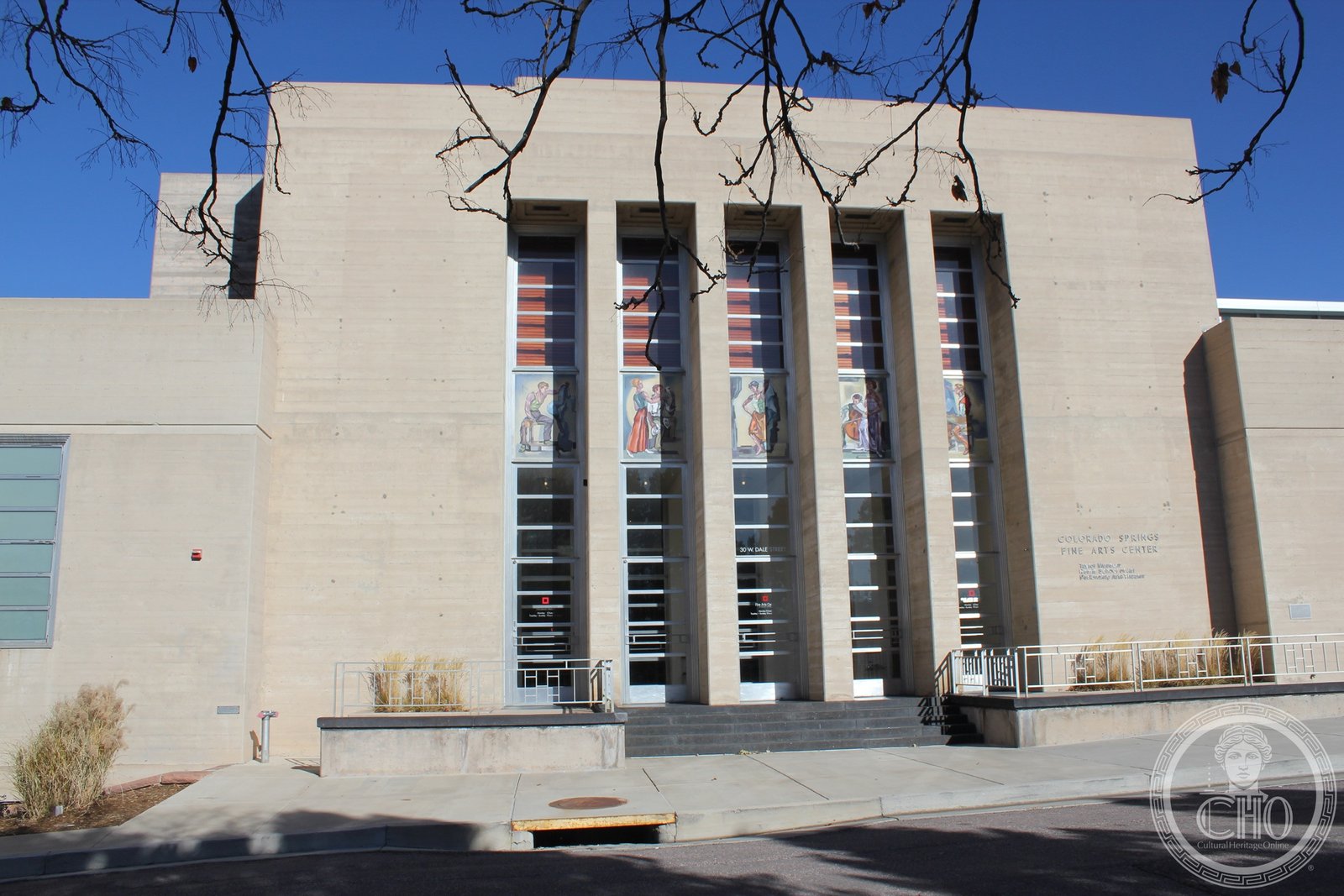
In the shadow of Pikes Peak, architect John Gaw Meem fused the ornamental precision of Art Deco with the organic geometry of Pueblo architecture to produce one of the most distinctive cultural buildings of the New Deal era — a museum, theater, and art school that reads as both modern and rooted in the American Southwest.
At a glance
The Colorado Springs Fine Arts Center at 30 West Dale Street is among the most architecturally original cultural buildings in the American West. Designed by John Gaw Meem and completed in 1936, it synthesizes the formal discipline of Art Deco with the adobe-inspired surfaces, stepped profiles, and organic curves of Pueblo Revival architecture — producing a building that belongs to a specific moment in American cultural history, when the WPA era’s engagement with regional identity found expression in buildings that fused modernist sensibility with indigenous visual traditions. Its collections span Southwestern, Native American, Spanish Colonial, and American modernist art. Since 2016, the center has operated in partnership with Colorado College, whose campus surrounds it. The Fine Arts Center remains one of the defining cultural institutions of Colorado Springs and one of the most visited buildings in the American Southwest.
Key facts
- Address: 30 West Dale Street, Colorado Springs, CO 80903
- Completed: 1936
- Architect: John Gaw Meem
- Style: Art Deco with Pueblo Revival elements
- Facilities: Art museum (permanent collection + exhibitions), 430-seat Lon Chaney Theatre, art school
- Partnership: Colorado College (since 2016)
- Designation: National Register of Historic Places
History
Colorado Springs in the 1930s was a resort city with cultural ambitions beyond its size. Founded as a planned resort community by General William Palmer in 1871, it had attracted wealthy residents and tourists drawn by the mountain air and the proximity of Pikes Peak. By the 1930s the city had an art museum collection, a liberal arts college, and a civic culture that wanted a building worthy of its aspirations. The Fine Arts Center was the result — funded partly through New Deal-era mechanisms and shaped by the conviction that a building in Colorado Springs should engage the visual and material traditions of the American Southwest.
John Gaw Meem, the Santa Fe-based architect who designed the building, was the foremost practitioner of Pueblo Revival architecture in the Southwest. He brought to the Fine Arts Center his characteristic synthesis of traditional Pueblo building forms — thick stucco walls, rounded corners, stepped massing, small window openings — with the ornamental vocabulary and formal discipline of Art Deco. The result was a building unlike anything else being constructed in Colorado at the time: neither purely traditional nor purely modernist, but a deliberate fusion that engaged both.
The building opened with a theater, gallery spaces, and art school facilities that have served Colorado Springs’ cultural life for nearly ninety years. The collection grew to include major works of Southwestern art, Native American objects, Spanish Colonial religious art, and American modernist painting and sculpture. The 2016 affiliation with Colorado College brought new resources and programming to the center while preserving its essential character as an independent cultural institution.
What you see
The exterior presents the distinctive profile of Meem’s synthesis: stucco walls with the warm buff tones of adobe, rounded parapets and stepped massing that recall the geometric profiles of Pueblo buildings, and Art Deco ornamental panels in the entry facade that introduce machine-age precision into an otherwise organic composition. The building sits comfortably within its residential neighborhood, scaled to the block rather than dominating it — though the stepped entrance facade, aligned to West Dale Street, reads clearly as a public cultural institution.
Inside, the galleries and theater interiors continue the fusion: Art Deco detailing in the woodwork, hardware, and lighting fixtures coexists with spatial volumes and surface treatments derived from Pueblo building traditions. The theater — named for Colorado Springs’ most famous native son, the silent-film star Lon Chaney — seats approximately 430 and retains much of its original character. The building reads as a single coherent vision rather than a collection of decorative applied to a neutral structure.
Practical information
- Hours: Check csfineartscenter.org for current museum and theater hours and admission
- Theater: The Lon Chaney Theatre presents a full season of drama, music, and film; check the website for programming
- Collection highlights: Southwestern modernist painting, Native American objects from the Taylor Museum, Spanish Colonial religious art
- Pikes Peak context: The building sits just west of Colorado College’s main campus; Pikes Peak (14,115 feet) is visible from the surrounding streets on clear days
Getting there
Colorado Springs is 65 miles south of Denver on Interstate 25. Denver International Airport, 90 minutes north, is the nearest major hub; Colorado Springs Airport (COS) provides regional connections. The Fine Arts Center is at the north edge of the Colorado College campus, about two miles from downtown Colorado Springs and the Pikes Peak cog railway. The Manitou Incline and Garden of the Gods are both within 20 minutes by car.
Nearby
- Pikes Peak — the 14,115-foot summit is accessible by the Pikes Peak Highway (toll road) or the Broadmoor Manitou and Pikes Peak Cog Railway, the highest railway in North America; the summit view extends hundreds of miles on clear days
- Garden of the Gods — a National Natural Landmark of red sandstone formations rising above the Colorado Springs plain; three miles from the Fine Arts Center
- Colorado College Campus — the liberal arts college surrounds the Fine Arts Center; the Victorian-era Shove Memorial Chapel and the modernist Worner Center mark the campus edges
- Manitou Springs — a Victorian-era resort village three miles west with mineral springs, independent shops, and the Manitou Cliff Dwellings (relocated Ancestral Puebloan structures)
Sources
- National Register of Historic Places, Colorado Springs Fine Arts Center nomination
- Colorado Springs Fine Arts Center, institutional history
- Colorado College, Fine Arts Center affiliation documentation
- Chris Wilson, The Myth of Santa Fe: Creating a Modern Regional Tradition (1997) — John Gaw Meem and Pueblo Revival architecture
- Colorado State Historical Fund records
Find it on the map
See this place and what’s around it →Record researched and written by Luigi De Marchi for Cultural Heritage Online, 2026.
📷 Become a Cultural Heritage Online photographer
Share your photos of places: they stay published under your name as the author. The more they're seen, the more you get noticed — and soon a contest will reward the most appreciated photos.
Log in or sign up free to add a photoIs this page about you?
This page is read by travellers and heritage enthusiasts who find it on Google. Tell us how you are connected to this place and we will take it from there.