Chitwan National Park covers 932 square kilometres of Terai lowland in southern Nepal and holds one of the most documented wildlife recovery stories of the 20th century: the greater one-horned rhinoceros population within its boundaries grew from 95 individuals counted in 1968 to approximately 700 in 2023. UNESCO inscribed Chitwan in 1984 as Nepal’s first World Heritage Site for natural values, eleven years after the Nepalese government declared it the country’s first national park in 1973. The park shares a continuous Terai ecosystem with northern India’s wildlife reserves, and its rivers — the Rapti and Narayani — drain into the Ganges system within a few hundred kilometres.
From Royal Hunting Ground to Conservation Model Sauraha gateway village; 150 km southwest of Kathmandu, 5–6 hours by road
The Chitwan valley was for centuries the exclusive preserve of Nepal’s Shah dynasty and, during the colonial period, of their British guests. In January 1911, King George V participated in a hunt organised by Nepal’s Chandra Shamsher Rana that killed 18 tigers and 10 rhinoceroses over roughly ten days. The scale was not unusual for viceregal-era hunts in the region: the record for a single Chitwan season stands at 38 tigers. These hunts required the labour of hundreds of elephants and thousands of beaters to drive animals toward the shooting lines, an operation that itself demonstrates the density of wildlife that once occupied the Terai.
The same valley was designated the Mahendra Deer Park in 1963 — a wildlife reserve intended to protect rhinoceros specifically — and then upgraded to national park status in 1973, the same year as the Convention on International Trade in Endangered Species (CITES) was drafted. The timing was deliberate: international conservation funding became available in the 1970s, and Nepal’s government used it to establish the anti-poaching infrastructure that transformed the park’s rhinoceros numbers. At the 1968 baseline, 95 individuals of Rhinoceros unicornis were counted in the park; by 1988 the count had risen to approximately 400; by 2023 the official census counted 694 individuals in Chitwan alone, with a total Nepal-wide population of 752.
The rhino recovery is directly attributable to the deployment of armed anti-poaching units inside the park. Nepal’s army has maintained a presence in Chitwan since 1975, with authority to use lethal force against poachers — a policy that has been criticised by human rights organisations on specific grounds but is credited by wildlife managers with producing one of the most dramatic large-mammal recoveries on record. Rhino horn prices on illegal markets in East and Southeast Asia have remained high enough that poaching incentives persist; in years when park security lapses, poaching incidents increase sharply.
The Bengal tiger population in Chitwan stood at approximately 93 individuals as of the 2022 census, a count conducted using camera-trap imagery and individual stripe-pattern identification. Nepal’s total tiger population reached 355 as of 2022, a figure the government announced had exceeded the target set under the 2010 St. Petersburg Declaration (which committed thirteen tiger-range countries to doubling wild tiger numbers by 2022). Chitwan holds the largest single concentration of tigers in Nepal.
Other notable fauna include the gharial (Gavialis gangeticus), a critically endangered fish-eating crocodile with a distinctive long, narrow snout that can reach five metres in length. The Narayani and Rapti rivers support one of the only surviving gharial breeding populations outside India. The Ganges river dolphin (Platanista gangetica), also critically endangered, is recorded in the Narayani River within and adjacent to the park. The marsh mugger crocodile (Crocodylus palustris) is more common and can be observed on river banks throughout the park.
The Terai Ecosystem and the Tall Grass Park interior; jeep and elephant safaris from Sauraha and Kasara ranger station
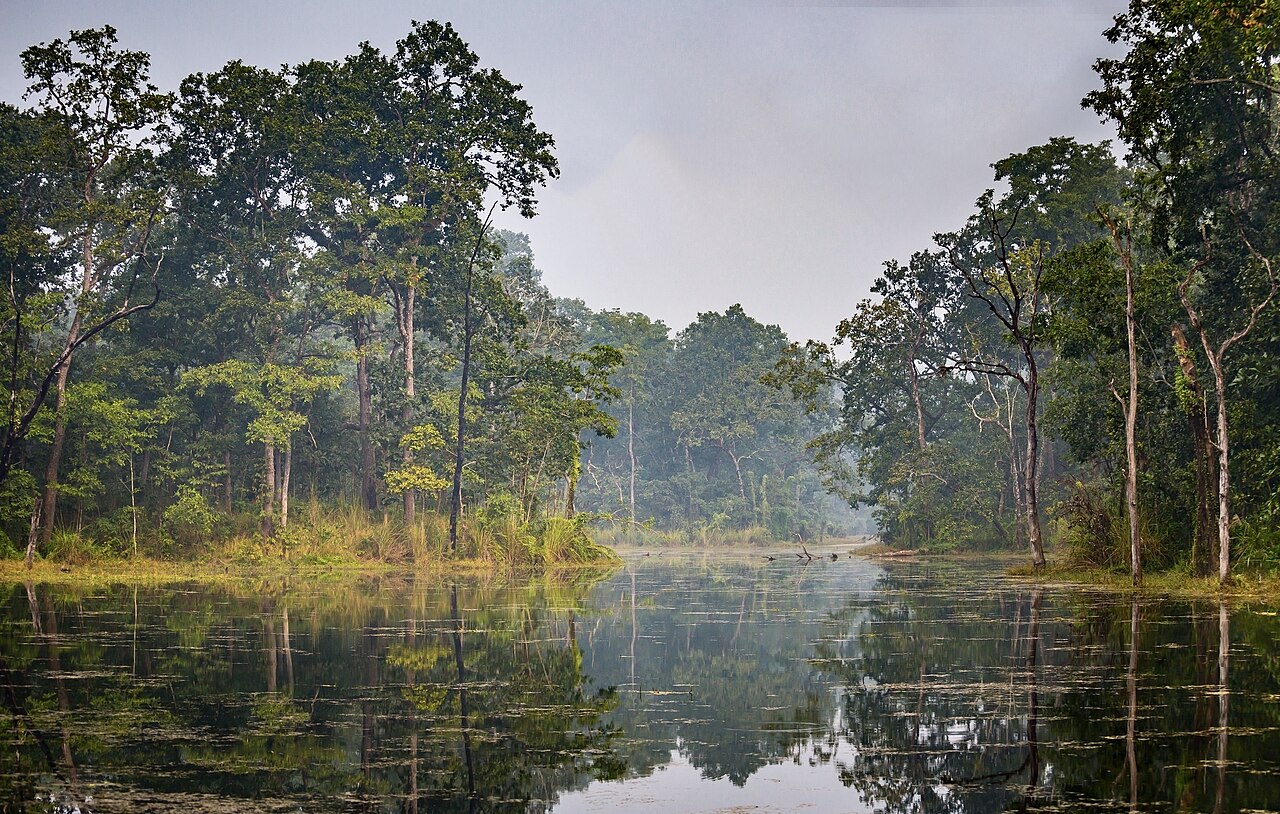
The dominant vegetation of Chitwan’s core zone is tall grassland dominated by Saccharum spontaneum and Saccharum bengalense — species that grow to between four and eight metres in height, creating a habitat where a standing adult is effectively invisible. These grasses, sometimes collectively called “elephant grass” in field guides though they are not a single species, are the primary cover for rhinoceros, tiger and leopard. Visibility within dense stands is near zero; wildlife encounters in this terrain are typically detected by sound or smell before sight. The grasslands are maintained in part by annual burning — a traditional management technique that encourages fresh regrowth used as grazing by deer and rhinoceros.
The park’s sal forest (Shorea robusta) zone covers roughly 70 percent of the total area, with the grasslands concentrated along river corridors and floodplains. Sal is a semi-deciduous hardwood that loses its leaves briefly in the dry season (March–April) before the monsoon brings new growth; during this leafless period, visibility in the forest improves enough to make it the peak season for wildlife observation. The combination of sal forest and riverine grassland supports a mammal fauna that also includes spotted deer (Chital), barking deer, sambar, four-horned antelope, sloth bear, smooth-coated otter and the rare jungle cat.
The Tharu people are the indigenous community most closely associated with the Chitwan valley. Tharu villages surround the park’s buffer zone and extend into its fringes; the community has historically had a degree of resistance to malaria (which kept the Terai largely free of high-caste Nepali and Indian settlement until the malaria-eradication campaigns of the 1950s and 1960s) and developed agricultural and forest-use practices closely adapted to the riverine environment. The establishment of the national park in 1973 displaced approximately 22,000 Tharu and other residents from the core zone; compensation and resettlement were inadequate by the standards applied by international conservation organisations, and the displacement remains a documented grievance. Community-based conservation programmes introduced since the 1990s have restored some resource access and revenue-sharing rights to Tharu communities in the buffer zone.
Lumbini, Kathmandu and the Indian Terai Connections Lumbini 90 km west; Kathmandu 150 km northeast; Valmiki Tiger Reserve 30 km south in India
Lumbini, UNESCO-inscribed since 1997, lies approximately 90 kilometres west of Chitwan’s Sauraha gateway village. The site marks the birthplace of Siddhartha Gautama, confirmed by an Ashokan pillar inscription of approximately 249 BCE; the Maya Devi Temple at the centre of the sacred garden was excavated to its 3rd-century BCE foundations by Japanese archaeologists in 1992. The site is most efficiently visited as a day trip or overnight from Chitwan, as both are in the Terai lowland and the road between them runs on flat ground. Bhairahawa (Siddharthanagar) airport, 23 kilometres from Lumbini, has direct flights to Kathmandu.
Kathmandu Valley lies approximately 150 kilometres northeast of Sauraha by road, a journey of five to six hours through the Mahabharat Range. The Prithvi Highway that connects them was completed in stages between the 1970s and 1990s and remains the principal land route linking the capital to the western Terai. Many visitors to Chitwan combine it with a Kathmandu Valley visit at the start or end of a Nepal trip.
Immediately south of Chitwan, across the Indian border, is the Valmiki Tiger Reserve in Bihar, approximately 30 kilometres from the Sauraha area. Valmiki is contiguous with the Chitwan ecosystem and supports tiger, rhinoceros and elephant populations that move across the international boundary. The cross-border wildlife corridor is the subject of ongoing management discussions between Nepal and India but is not governed by a unified legal framework. Further into India, the Dudhwa National Park in Uttar Pradesh (roughly 200 kilometres from Chitwan’s southern boundary) forms part of the same transboundary Terai Arc Landscape identified by WWF as one of the world’s most important biodiversity corridors.
Sagarmatha National Park, with Mount Everest at 8,848.86 metres, lies approximately 350 kilometres northeast of Chitwan — a contrast in ecology and altitude that is among the most extreme possible within a single country. The distance is effectively measured in travel days rather than kilometres: Chitwan to Kathmandu by road (5–6 hours), Kathmandu to Lukla by air (40 minutes), then two to three weeks of trekking. The juxtaposition of subtropical rhino-and-tiger habitat at 100–200 metres altitude with the world’s highest mountain ecosystem within a day’s travel illustrates why Nepal’s protected area network, despite covering only about 23 percent of national territory, is disproportionately significant in global biodiversity terms.
Practical information
Nepal visas are available on arrival at Tribhuvan International Airport (Kathmandu) and the Birgunj-Raxaul land crossing with India: 15 days USD 30, 30 days USD 50. Chitwan National Park entry costs NPR 1,500 (approximately USD 11) for foreigners. Safari fees vary by activity: jeep safaris and elephant-back safaris are booked through licensed operators in Sauraha or at park lodges inside the core zone. Buffer zone areas have separate, lower entry fees.
February to April is the best period for wildlife observation: the tall grasses are partially burned back, temperatures are moderate (15–30°C), and tiger and rhinoceros sightings are most frequent. October to December is also good but grasses are still high from the monsoon. The monsoon (June–September) brings heavy rain, occasional flooding of river areas, and reduced wildlife visibility; the park may close portions of its trail network. Summer temperatures in the Terai reach 38–42°C in May before the rains arrive.
The gateway village of Sauraha has accommodation ranging from budget guesthouses to park-adjacent lodges. The park interior has several high-end tented camps and lodges accessible by park transport. All vehicles inside the core zone must be park-registered. Medical facilities in the area are limited; serious medical emergencies require evacuation to Bharatpur (15 km) or Kathmandu. Bring prescription medications and basic first-aid supplies. Respect guidance from naturalist guides when on foot — rhinoceros charges are dangerous; the standard advice is to climb the nearest tree or place a large object (vehicle, tree trunk) between yourself and the animal.
Frequently Asked Questions
How did Chitwan National Park achieve such a dramatic recovery in rhinoceros numbers, and is the population considered stable?
The greater one-horned rhinoceros (Rhinoceros unicornis) recovery in Chitwan is the direct result of sustained anti-poaching enforcement combined with a legal framework that made the park a military-guarded exclusion zone. The government deployed Nepalese Army units inside the park from 1975 onward, with a shoot-on-sight policy toward poachers that was enforced through the late 1980s and 1990s. Simultaneously, the international wildlife trade monitoring system under CITES (which came into force in 1975) progressively reduced the legal market for rhino horn in importing countries. The combination of suppressed poaching and protected habitat allowed natural population growth. Rhinoceros have a relatively slow reproductive rate — a female produces one calf every two to four years and calves are dependent for two to four years — which means the recovery from 95 to 700 individuals over 55 years reflects sustained protection over multiple generations. The population is not entirely stable: poaching incidents increase in years of reduced military presence (notably during Nepal’s civil war period 1996–2006, when army resources were diverted). Flooding events damage riverside grassland habitat; inbreeding has not yet been documented as a genetic concern at current population levels, but genetic diversity monitoring is part of the park’s management plan. Nepal’s government has declared a national goal of zero poaching, achieved in some years (2011, 2013 were zero-poaching years) but not consistently maintained.
What is the best way to see tigers in Chitwan National Park, and how reliable are sightings?
Tiger sightings in Chitwan are more reliable than in many other tiger reserves in South Asia, partly because of the relatively high density (approximately 1 tiger per 10 square kilometres in the core zone) and partly because jeep and elephant safaris move through habitat specifically managed to maximise encounter probability. The most productive method is an early-morning jeep safari in the sal forest and grassland transition zone, combined with the services of an experienced naturalist guide who reads animal tracks and alarm calls from deer and peacocks to locate tigers. February to April — when sal trees are briefly leafless and tall grasses partly burned — is the period of highest encounter frequency. Encounters are not guaranteed: even at Chitwan’s density, tigers are cryptic and may go unobserved for days. Elephant-back safaris allow movement through tall grass where a jeep cannot follow; the elevation of an elephant also allows sight lines over the grass canopy. Canoe trips on the Rapti River are effective for spotting gharial, mugger crocodile, river dolphins and water birds, and occasionally a tiger drinking or crossing. Walking safaris with armed guards are available in the buffer zone and some portions of the core zone; these offer a different quality of observation — slower, quieter, with more attention to smaller fauna and tracks — but are not specifically more effective for tiger encounters than vehicle safaris.
Can Chitwan National Park and Lumbini be visited in a single trip from Kathmandu, and how long does a reasonable combined visit take?
Chitwan and Lumbini can be combined efficiently in a single circuit from Kathmandu, and many Nepal itineraries do exactly this. The standard routing is: Kathmandu to Chitwan by road or by flight to Bharatpur airport (25 minutes), two to three nights in the park for wildlife safaris, then onward to Lumbini by road (approximately two hours from Sauraha via the East-West Highway). Lumbini warrants at minimum one full day — the sacred garden with the Ashokan pillar and Maya Devi Temple, the monastic zone with national monasteries built by Buddhist communities from 30+ countries, and the Lumbini Museum. A second day allows more thorough exploration of the wider archaeological zone and the central canal area. From Lumbini, the return to Kathmandu can be made by road (six to seven hours via the Prithvi Highway) or by flying from Bhairahawa airport. A combined Kathmandu–Chitwan–Lumbini–Kathmandu circuit requires a minimum of six to seven days to do both sites justice without feeling rushed; eight to ten days is a more comfortable allocation. Both Chitwan and Lumbini are at Terai lowland altitude (100–200 metres) and pose no acclimatisation requirements. The combination can be appended to or prepended to a Kathmandu Valley monument visit (three to four days) for a comprehensive twelve- to fourteen-day Nepal itinerary covering three of the country’s four UNESCO sites without entering the high mountains.