Jongmyo Shrine in central Seoul is the royal ancestral shrine of the Joseon dynasty (1392–1897) and one of the oldest and best-preserved Confucian ancestral shrines in East Asia, inscribed by UNESCO in 1995. Its main hall, the Jeongjeon, is 101 metres long and is considered the longest single wooden structure in Asia — extended chamber by chamber over five centuries as each new king died and required a tablet compartment. The shrine continues to function: once a year, on the first Sunday of May, the full royal ancestral ritual (Jongmyo Jerye) is performed here with music, dance, and ritual food offerings to the spirit tablets of 19 Joseon kings.
The Jeongjeon: A Hall That Grew With Every Royal Death Jongno-gu, Central Seoul, South Korea
Jongmyo Shrine was established in 1394, two years after the founding of the Joseon dynasty, when the dynastic capital was moved to Hanyang (present-day Seoul). Confucian statecraft required the ruling family to maintain a dedicated space for ancestral veneration: the ritual relationship between the living king and his deceased predecessors was not incidental to governance but central to it. The king who performed the ancestral rites affirmed his legitimacy as part of an unbroken chain of royal succession. The shrine was therefore one of the first buildings constructed in the new capital, alongside the royal palace (Gyeongbokgung) and the Sajik altar for earth and grain.
The Jeongjeon, the main hall, currently contains 19 chambers, each housing the spirit tablets (sinju) of one king and his principal queens. Each sinju is a small wooden tablet inscribed in Chinese characters with the posthumous title of the deceased. The tablets are stored in individual compartments within the chambers, and each chamber is sealed during ordinary times — the tablets are only brought into ritual use during the Jongmyo Jerye ceremony. When the dynasty began in 1394, the hall was smaller; as kings died over the following centuries, the hall was extended by adding new chambers at the ends of the existing structure. The building was burned during the Japanese invasions of Korea (Imjin War, 1592–1598) and reconstructed in 1608. The final extension to its current length of 101 metres brought it to its maximum capacity.
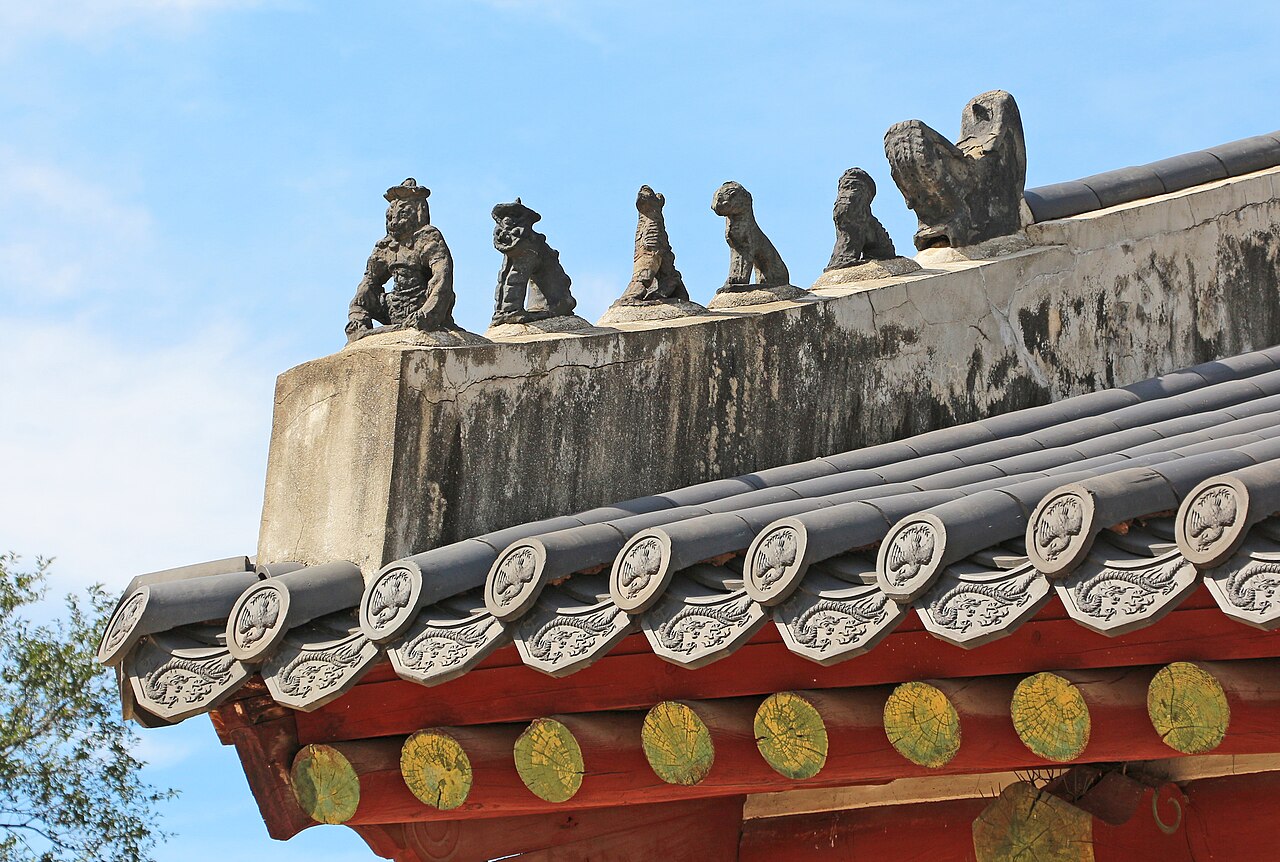
The deliberate austerity of the Jeongjeon’s appearance is worth noting because it contrasts sharply with the ornate painted facades of Korean palace buildings. The hall has plain whitewashed walls, grey ceramic roof tiles, and no coloured paintwork on the exterior. This is not an economy measure but a design choice rooted in Confucian aesthetics: a space for solemn ancestral veneration was required to project gravity rather than beauty. The approach to the hall along the straight stone path (sinro, spirit path) is similarly unadorned. The spirit path is elevated slightly above the walking paths on either side and is reserved for the spirits of the deceased; the living approach along the lower side paths. This spatial hierarchy — invisible to casual visitors but immediately apparent in the stonework — encodes the Confucian understanding of the relationship between the dead and the living at every step of the ritual approach.
The Yeongnyeongjeon (Hall of Eternal Peace) is a secondary hall to the rear of the main complex, containing the spirit tablets of 34 additional royal figures who received posthumous elevation but whose tablets were not placed in the Jeongjeon. These include posthumously elevated ancestors of Joseon’s founder, King Taejo, and kings whose short reigns or unusual circumstances placed them in a different ceremonial category. The two halls together house the tablets of all 27 Joseon kings and approximately 30 queens, along with a number of queens who outlived their husbands and were added after the kings’ deaths.
Jongmyo Jerye: The Royal Ritual Still Performed After 630 Years 600 metres east of Changdeokgung Palace, Seoul
The Jongmyo Jerye is a Confucian ancestral rite that has been performed at Jongmyo since 1394, with interruptions only during periods of foreign occupation or political disruption. The ritual was suspended during the Japanese colonial period (1910–1945) and resumed after Korean independence. Today it takes place once a year, on the first Sunday of May, and is open to public observation. The ceremony involves several hundred participants in historical costume representing the roles of the ancestral rite: officiants who carry the food offerings, musicians who perform the Jongmyo Jeryeak (Royal Ancestral Ritual Music and Dance), and dancers who perform the civil and military dance sequences (munmu and mumu).
The music performed during Jongmyo Jerye — Jongmyo Jeryeak — was itself inscribed by UNESCO on the Representative List of Intangible Cultural Heritage of Humanity in 2001, making Jongmyo one of a small number of sites recognised by UNESCO for both its tangible architectural heritage and the intangible cultural practice it houses. Jongmyo Jeryeak is considered the most complete surviving example of Korean court music from the Joseon period. It uses instruments that include large hanging bells (pyeonjong), stone chimes (pyeongyeong), hourglass drums (janggu), and long double-reed oboes (taepyeongso). The music is slow, modal, and repetitive in a way that matches the ritual’s temporal scale: the full ceremony takes several hours.
The ritual food offerings (jeonsik) presented to each spirit tablet follow a precise protocol: rice, soup, wine (offered three times in sequence), and ten secondary dishes including seasoned vegetables, dried meat, rice cakes, and pickled vegetables. The offerings are laid out on low tables in front of each chamber and presented in a fixed ceremonial order. After the ritual concludes, the food is symbolically consumed or redistributed according to tradition. The entire sequence reflects the Confucian understanding that the dead, properly venerated, continue to exist in a relationship of mutual obligation with the living: the descendants provide nourishment and respect; the ancestors provide legitimacy and protection.
Changdeokgung Palace, another UNESCO World Heritage site, stands approximately 600 metres west of Jongmyo. The two sites were originally connected by a private royal road that allowed the Joseon kings to travel between the palace and the shrine without passing through the public streets of the capital. The road no longer exists in its original form, but the walking distance between the two UNESCO sites is under 15 minutes along율곡로 (Yulgok-ro) and the surrounding neighbourhood, making a combined visit straightforward.
Practical information
Jongmyo Shrine is located in the Jongno district of central Seoul, a short walk from Jongno 3-ga subway station (Lines 1, 3, and 5). Opening hours are 09:00 to 18:00 from March to October, and 09:00 to 17:30 from November to February; the shrine is closed on Tuesdays. Admission is 1,000 KRW for adults. The shrine can only be visited as part of a guided tour on most days (tours depart at regular intervals in Korean, English, Chinese, and Japanese); on Saturdays, visitors may enter independently without a guide. The Jongmyo Jerye ceremony on the first Sunday of May is free to attend; it typically begins at 11:00, and arrival by 09:30 is advisable to secure an observation position. Changdeokgung Palace (including the Secret Garden) is 600 metres west and tickets must be purchased separately. The National Folk Museum of Korea and Gyeongbokgung Palace are within a 20-minute walk to the northwest.
Frequently Asked Questions
What exactly is a spirit tablet (sinju), and how does it function in the Confucian ancestral ritual at Jongmyo?
A sinju (spirit tablet) is a small rectangular wooden board, typically 20 to 30 centimetres tall, inscribed in Chinese characters with the posthumous title and honorific name of a deceased royal figure. In Confucian belief, the spirit of the deceased does not simply cease to exist at death but continues to require care, respect, and periodic nourishment from descendants. The tablet is the material object through which this ongoing relationship is maintained: it serves as the dwelling place of the ancestral spirit during the ritual, concentrating the spirit’s presence in a specific location where offerings can be made. Outside of ritual periods, the tablets are stored in their individual sealed compartments within the Jeongjeon’s 19 chambers. During Jongmyo Jerye, the compartments are opened, the tablets are addressed, and the sequence of food and wine offerings is presented to each one in prescribed order. The posthumous titles inscribed on the tablets are long honorific compositions that enumerate the qualities and achievements of the deceased king — these titles were composed by court officials after the king’s death and formally conferred as part of the mourning protocol. The title inscribed on a given tablet may consist of 20 to 30 Chinese characters and forms part of the formal ancestral address during the ritual. The tablets at Jongmyo have accumulated from the dynasty’s founding through to the end of the royal line in the 20th century; they represent an unbroken material record of Joseon dynastic succession in a single building.
Why is the Jeongjeon deliberately plain, and how does this reflect Confucian ideas about ritual space?
The contrast between the Jeongjeon’s austerity and the elaborately painted and decorated buildings of the nearby royal palaces is immediately apparent to anyone who visits both. Gyeongbokgung and Changdeokgung are covered in polychrome decorative painting (dancheong) in green, red, blue, and gold — a visual language of royal power and cosmological symbolism. The Jeongjeon has none of this. Its walls are plain, its roof is grey tile, and its wooden structure is unpainted or painted only in dark ochre. This plainness is not a marker of lower status but of a different kind of architectural intention. In Confucian thought, the space reserved for ancestral veneration demanded solemnity and gravity above all other qualities. Ornament, colour, and visual complexity belonged to the world of the living and its concerns with status, beauty, and the assertion of power. The ancestral shrine was a space for the dead, and the appropriate register for addressing the dead was restrained, formal, and stripped of the living world’s decorative impulse. The Korean term jeongjeong (正正, correct correctness) captures something of this idea: the ritual space was supposed to embody a kind of correctness that excluded superfluous elements. The same logic applied to the spirit path (sinro): it was elevated and undecorated because its purpose was functional within the ritual logic — the path of the spirits — not ornamental. Visitors who come from the palace and then walk the short distance to Jongmyo often find the shift in visual register as striking as any of the specific architectural features.
What is Jongmyo Jeryeak, and why did UNESCO inscribe the music separately from the shrine itself?
Jongmyo Jeryeak is the musical tradition performed during the Jongmyo Jerye ancestral rite — a body of ceremonial music and dance that was codified during the reign of King Sejong in the 15th century and has been transmitted continuously since then, with a significant interruption during the Japanese colonial period (1910–1945). The music uses a combination of Chinese-derived court instruments (the aak tradition) and native Korean instruments: the pyeonjong (sets of 16 bronze bells arranged by pitch), pyeongyeong (stone chimes tuned to the same pitches), buk (barrel drums), and taepyeongso (a loud double-reed instrument used to lead the outdoor processional sequences). Two dance forms accompany the music: munmu (civil dance, performed with feathered headdresses and long flutes) and mumu (military dance, with axes and shields). The dance movements are prescribed in detail in historical texts, including illustrated manuals (akhak gwebeom) from the 15th century that allow modern practitioners to reconstruct earlier performance forms. UNESCO inscribed Jongmyo Jeryeak on the Intangible Cultural Heritage list in 2001 — six years after the shrine’s own inscription in 1995 — for two reasons: first, the music is considered the most complete surviving example of Joseon court music from its founding period; and second, the ceremony as a whole represents a living tradition rather than a historical reconstruction. It has been performed continuously within living memory, adapted and maintained by trained musicians and officiants, and is not a revival of a lost practice but the continuation of one that survived, imperfectly, through the 20th century’s disruptions.