Hōryū-ji is a Buddhist temple complex in Ikaruga, Nara prefecture, Japan, founded in 607 CE by Prince Shōtoku and inscribed as a UNESCO World Heritage Site in 1993 — Japan’s first UNESCO inscription, alongside Himeji Castle. The temple’s western precinct contains the world’s oldest surviving wooden buildings: a five-story pagoda and a golden hall (Kondō) rebuilt after a fire in 670 CE and standing for approximately 1,300 years. The site documents the arrival of Buddhism in Japan and the systematic cultural transfer from the Asian continent that Prince Shōtoku directed during his regency.
The World’s Oldest Wooden Buildings: The Five-Story Pagoda and the Kondō Ikaruga, Nara prefecture, 12 km from Nara city
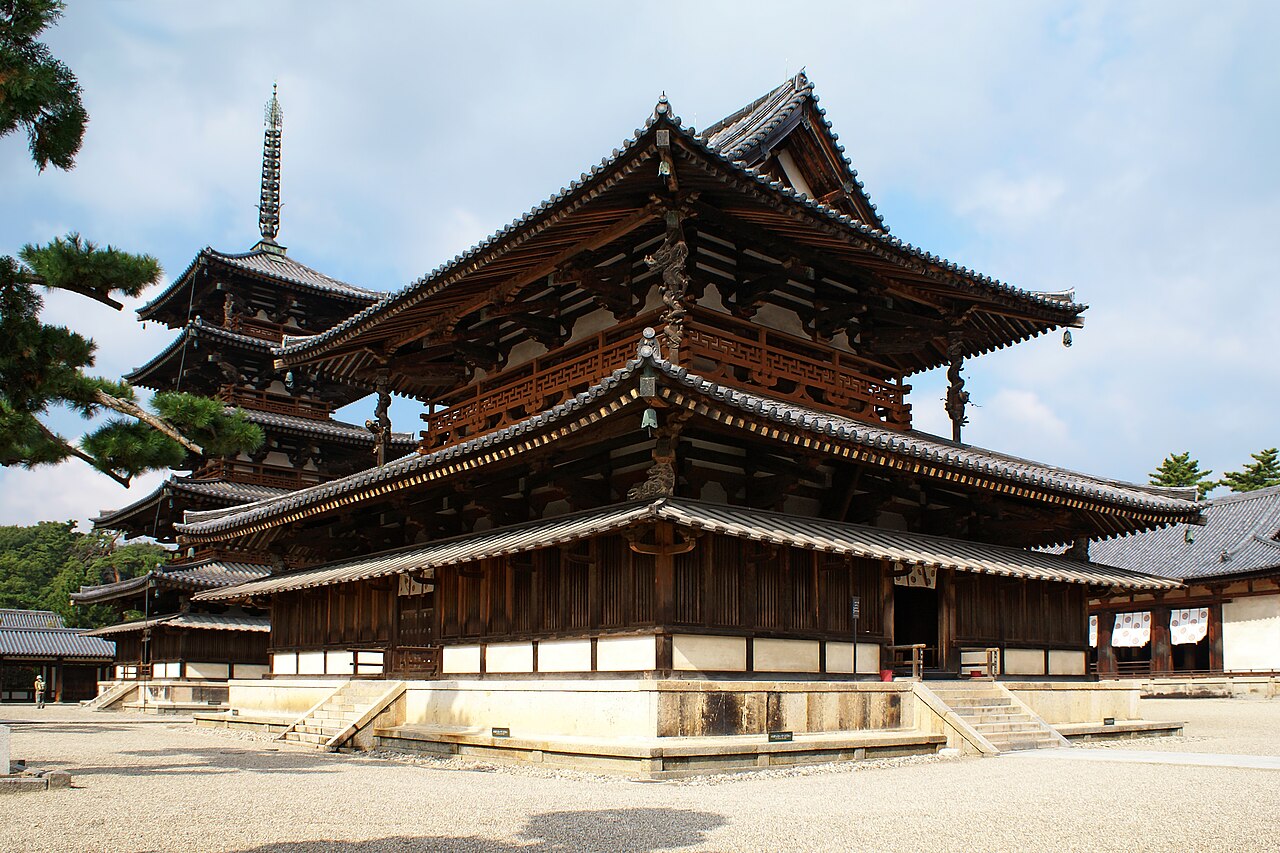
The western precinct of Hōryū-ji — the Sai-in — contains two structures that structural engineers, architects, and historians treat as primary evidence of early Japanese timber construction: the Gojū-no-tō (five-story pagoda) and the Kondō (golden hall). Both date from the reconstruction of the temple undertaken between approximately 680 and 710 CE, following a fire recorded in 670 CE that destroyed the original structures. The original complex, founded in 607 CE, does not survive above ground.
The pagoda stands approximately 32 metres tall. It has remained standing for approximately 1,300 years without the benefit of modern engineering materials. The structural principle that accounts for its seismic resilience was not fully understood until the 20th century, when it was rediscovered in the design of large modern towers. At the centre of the pagoda is a shinbashira — a central pillar that does not rest on the ground. It hangs from the top of the structure, suspended from above. When an earthquake shakes the building, the outer frame moves; the shinbashira, suspended independently, swings like a pendulum, out of phase with the frame. The two motions partially cancel each other, reducing the net structural stress. This “hanging from above” principle was applied explicitly in the design of the Tokyo Skytree (634 metres, completed 2012), where engineers cited the shinbashira principle as a precedent for the tower’s central concrete shaft, which is isolated from the outer frame to absorb differential seismic motion.
The Kondō stands immediately adjacent to the pagoda. Inside, on the main altar, is the Shaka Triad: three gilt-bronze figures cast in 623 CE by the sculptor Tori Busshi. The central figure is the historical Buddha (Shakyamuni); flanking figures are Bodhisattvas. The triad was commissioned as a memorial to Prince Shōtoku, who died in 622 CE; the casting inscription, preserved on the back of the throne, states the purpose explicitly and gives the date. It is one of the earliest dated inscriptions in Japanese sculptural history. The figures show direct stylistic influence from the sculpture of the Northern Wei dynasty of China, brought to Japan through the cultural exchanges Prince Shōtoku organised during his regency.
The treasure house (Daihōzō-in) built in the 1990s to conserve the temple’s most vulnerable objects contains the Kudara Kannon: a wooden Bodhisattva sculpture approximately 2.09 metres tall, carved in the early 7th century. The name “Kudara” refers to the ancient Korean kingdom of Baekje, and reflects the sculpture’s stylistic connections to the Korean Buddhist tradition that was one of the conduits through which Buddhism reached Japan. The figure is carved from a single piece of camphor wood and is considered one of the supreme achievements of Asuka period sculpture.
Prince Shōtoku and the Buddhist State: Why Hōryū-ji Was Built Nara Basin, Kinki region, western Honshū
Hōryū-ji was not built as an ordinary religious foundation. Prince Shōtoku — Shōtoku Taishi, 574–622 CE — founded it in 607 CE as a fulfilment of a personal vow: when his father, Emperor Yōmei, fell gravely ill, Shōtoku prayed to the Buddha and vowed to build a temple if the emperor recovered. The emperor did not recover; he died in 587 CE. Shōtoku built the temple anyway, as a merit-making act for his father’s spirit, and as a physical embodiment of his vision for Japan.
Shōtoku served as regent under Empress Suiko from 593 CE. In that role he initiated the most significant administrative and cultural transformation in Japanese history to that point. In 604 CE he promulgated Japan’s first constitutional document: the Seventeen-Article Constitution, a set of moral and governmental principles drawn from Chinese Confucian and Buddhist thought. It was not a legal code in the modern sense — it did not establish courts or define crimes — but it articulated for the first time the principles that should govern Japanese public life: that harmony (wa) is paramount, that the ruler’s commands must be respected, and that Buddhist teachings are the highest truth.
To implement this vision practically, Shōtoku dispatched multiple official embassies to the Sui dynasty of China. These missions — the most important sent in 607 CE and 608 CE — returned with Buddhist scriptures, architectural plans, musical instruments, medical knowledge, and craftsmen who could build in the Chinese and Korean Buddhist tradition. Hōryū-ji was constructed using this imported knowledge: its layout follows a Chinese Buddhist monastery plan, its timber joinery techniques were brought from the continent, and the sculptors who made the Shaka Triad worked in a style directly derived from Chinese imperial Buddhist workshops.
The Nara Historic Monuments — a separate UNESCO inscription covering the ancient capital of Nara itself, including Tōdai-ji (housing the great bronze Buddha) and Kōfuku-ji — lie approximately 12 kilometres east of Hōryū-ji. Nara city was established as Japan’s first permanent capital in 710 CE, three years after the reconstruction of Hōryū-ji was completed. The two sites represent consecutive chapters in the same history: Hōryū-ji documents the introduction of Buddhism under Prince Shōtoku; the Nara monuments document what that introduction produced within a century.
Practical information
Hōryū-ji is located in Ikaruga, approximately 12 kilometres southwest of Nara city and 25 kilometres south of Osaka. By rail: from Nara Station, take the JR Yamatoji Line to Hōryūji Station (approximately 10 minutes), then a 20-minute walk or 5-minute bus ride to the temple. From Osaka Tennoji, the JR Yamatoji Line runs direct to Hōryūji Station (approximately 30 minutes). The temple complex is open daily; standard hours are 08:00–17:00 (last entry 16:30) from late February through mid-November, and 08:00–16:30 (last entry 16:00) from mid-November to late February. A single entry ticket covers the western and eastern precincts; an additional ticket is required for the Daihōzō-in treasure house, which is strongly recommended for access to the Kudara Kannon and other objects from the main complex. The Nara Historic Monuments, including Tōdai-ji and Kasuga Grand Shrine, are reachable in approximately 40 minutes by road or rail combination. Visitors spending a full day in the area can cover Hōryū-ji in the morning and the Nara park complex in the afternoon.
Frequently Asked Questions
What makes the Hōryū-ji pagoda earthquake-resistant?
The five-story pagoda at Hōryū-ji has stood for approximately 1,300 years in a seismically active region without experiencing structural collapse. The key structural feature is the shinbashira: a central wooden pillar that runs the full height of the pagoda but does not bear load in the conventional sense. Instead of resting on the ground and supporting the floors above, the shinbashira is suspended from the top of the structure. It hangs freely within the building. When an earthquake causes the outer timber frame to sway, the shinbashira — free to move independently — swings out of phase with the outer structure. The two motions partially cancel each other, reducing the peak stresses in the timber frame. This is now recognised as a passive vibration control system operating on a principle similar to the tuned mass dampers used in modern high-rise buildings. The principle was explicitly cited by the engineers who designed the Tokyo Skytree (634 metres, completed 2012): the tower’s central concrete shaft is structurally isolated from its outer lattice frame so that the two can move independently during an earthquake, absorbing energy through differential motion. The Skytree designers described this as a contemporary application of the shinbashira principle. The age and condition of the Hōryū-ji pagoda remain the longest-running empirical test of whether the system works.
Who was Prince Shōtoku and why did he build Hōryū-ji?
Prince Shōtoku (Shōtoku Taishi, 574–622 CE) was the regent of Japan under Empress Suiko from 593 CE. He is regarded as one of the most consequential figures in early Japanese history: the architect of Japan’s first constitutional document (the Seventeen-Article Constitution of 604 CE), the organiser of Japan’s first formal diplomatic and cultural exchanges with China, and the patron who directed the systematic introduction of Buddhism, Confucian governance principles, and continental craft traditions into Japan. He founded Hōryū-ji in 607 CE as a religious vow — specifically as a merit-making act on behalf of his deceased father, Emperor Yōmei, who had converted to Buddhism shortly before his death. The temple was built using knowledge and craftsmen brought back from the Sui dynasty of China through the embassies Shōtoku dispatched from 607 CE onward. Shōtoku died in 622 CE, before what became the current structure was completed: the original temple was destroyed by fire in 670 CE, and the rebuilt complex — the world’s oldest surviving wooden buildings — was completed between approximately 680 and 710 CE. The Shaka Triad in the Kondō was cast in 623 CE as an explicit memorial to Shōtoku, commissioned by his widow and court the year after his death, and bears an inscription stating this purpose.
How is Hōryū-ji related to the other UNESCO sites in the Nara area?
Hōryū-ji and the Historic Monuments of Ancient Nara are two separate UNESCO World Heritage inscriptions covering sites approximately 12 kilometres apart. Hōryū-ji was inscribed in 1993; the Nara Historic Monuments were inscribed in 1998. They are historically connected: Hōryū-ji documents the introduction of Buddhism into Japan and the cultural infrastructure Prince Shōtoku built in the early 7th century; the Nara monuments — Tōdai-ji, Kōfuku-ji, Kasuga Grand Shrine, Ganko-ji, Yakushi-ji, Tōshōdai-ji, the Nara Palace site, and Kasugayama Primeval Forest — document the mature expression of that tradition in Japan’s first permanent capital, established in 710 CE. The great bronze Buddha of Tōdai-ji (completed 752 CE), at 14.9 metres tall, represents a scale of Buddhist patronage made possible by the century of institutional foundation that Shōtoku began. Visitors covering both sites in sequence are tracing the same historical thread: the conversion of Japan to Buddhism and the political and artistic consequences of that conversion. The journey between Hōryū-ji and central Nara by bus or rail combination takes approximately 40–50 minutes.