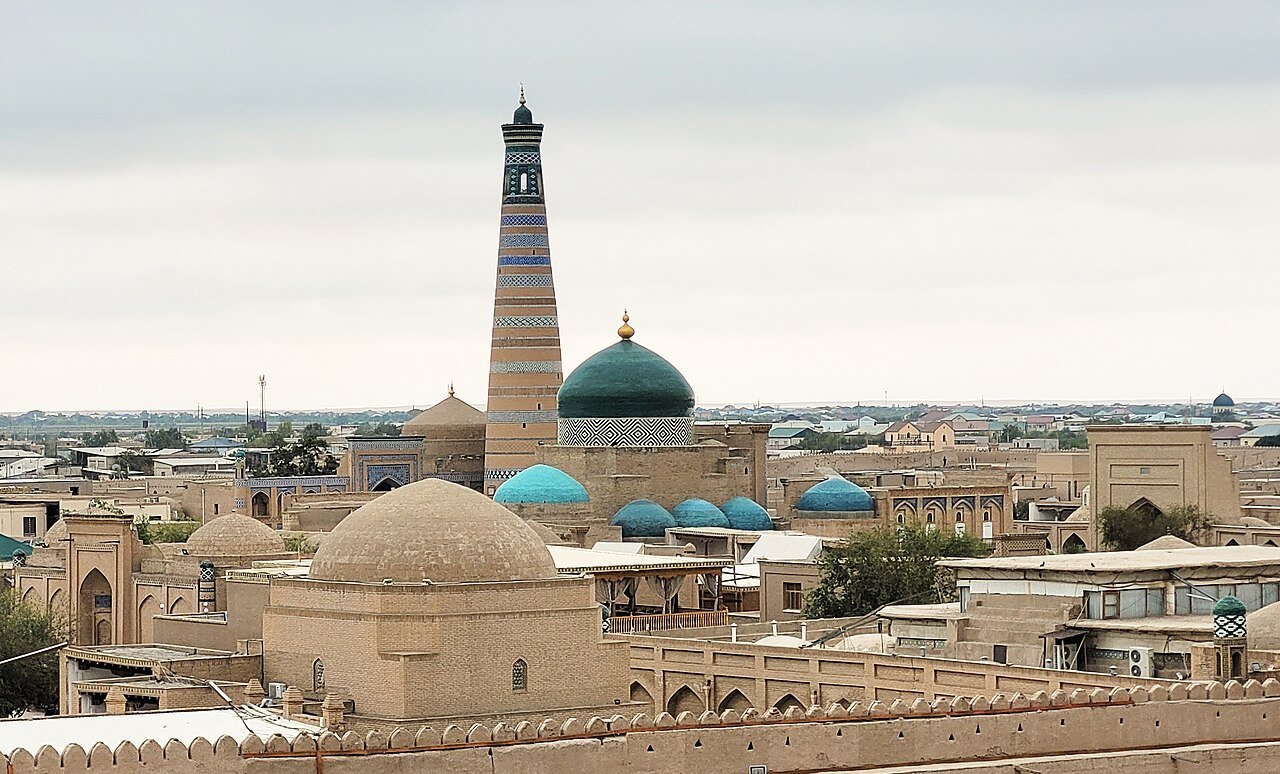
Itchan Kala, the walled inner city of Khiva in western Uzbekistan, was the first site in Soviet Central Asia to be inscribed as a UNESCO World Heritage Site, receiving the designation in 1990. The mud-brick and fired-brick walls enclose approximately 26 hectares and contain palaces, mosques, mausoleums, and madrasahs built across several centuries within a medieval urban plan that was never destroyed by Mongol forces — making Khiva structurally unlike any other major Silk Road city in the region. Approximately 3,000 people still live within the walls.
The Kalta Minor minaret and the Juma Mosque: an unfinished tower and a forest of columns Itchan Kala interior, city centre
The Kalta Minor minaret is the most recognisable structure in Khiva. Muhammad Amin Khan, who ruled the Khanate of Khiva from 1845 to 1855, ordered its construction in 1851 with the ambition of making it the tallest minaret in Central Asia — plans described by contemporaries as projecting a height of 70 metres or more. When Muhammad Amin Khan died in battle against Turkmen forces in 1855, construction stopped. The minaret stands at approximately 26 metres, less than half the intended height, and with a base diameter of 14 metres — unusually wide for its actual height — it has the proportions of a truncated cylinder rather than the tapered tower typical of Central Asian minarets.
The exterior is covered in glazed turquoise and white tilework, arranged in geometric and calligraphic bands. The contrast between the massive girth and the abrupt flat top gives the Kalta Minor a profile that appears in virtually every image of Khiva and has become its visual signature. The unfinished quality is not masked or disguised: the broken crown of the minaret is visible in its raw state, a monument to interrupted ambition.
The Juma Mosque, a few hundred metres from the Kalta Minor, presents one of the most unusual interior spaces in Central Asian Islamic architecture. Rather than the typical arrangement of a courtyard with a prayer hall opening onto it, the Juma Mosque is entirely enclosed: a hypostyle structure with no exterior courtyard, its roof supported by 212 carved wooden columns arranged in a grid. The current building dates to the 18th century, but the mosque is documented from the 10th century, and the oldest surviving columns — approximately a dozen — are dated by their carving style to the 10th or 11th century. In a region where wood was scarce and expensive, the accumulation of 212 carved columns in a single structure represents an enormous investment of resources. The interior, lit only by small skylights above the column grid, creates an atmosphere different from any mosque built around an open courtyard.
Islam Khodja Minaret and the political history of the last minaret in Khiva Eastern quarter of Itchan Kala
The Islam Khodja Minaret (1910) is the tallest minaret in Khiva at 56 metres, built under circumstances that illustrate the tension between traditional power structures and modernisation at the end of the Khanate of Khiva’s existence. By 1910, Khiva was a Russian protectorate; the Khan retained nominal authority but Russian advisers and military forces controlled external affairs. Islam Khodja, who served as Grand Vizier under Khan Isfandiyar Khan, was an unusual figure in the late Khanate: he introduced the first secular school in Khiva, established a hospital with Russian medical personnel, and began a postal service and telegraph connection. These reforms made him popular with younger educated Khivans and with Russian administrators; they made him enemies among the religious establishment and traditional court factions who saw the changes as a threat to their authority.
The minaret Islam Khodja built adjacent to his madrasah is the final major monument of the Khanate period. Its banded exterior — horizontal stripes alternating white and terracotta brick — breaks with the standard Khivan and Central Asian minaret aesthetic. The striped pattern has no precedent in the local tradition and may reflect exposure to Ottoman or Indian architectural imagery. The minaret and the small mosque complex around it are among the better-preserved structures in the Itchan Kala. Islam Khodja was assassinated in 1913, reportedly by conservatives resentful of his reforms — a common fate for Central Asian modernisers in the early 20th century.
The Khanate of Khiva itself fell to Soviet forces in 1920. The khan fled; the Khorezm People’s Soviet Republic was declared and merged into the Soviet Union in 1924. The physical preservation of the Itchan Kala through the Soviet period was partly the result of the city’s relative isolation — Khiva lies near the Amu Darya River and the Karakum Desert, far from the main Soviet industrial and administrative centres — and partly of deliberate heritage protection efforts that began in the 1960s and 1970s. Unlike Samarkand, which lost significant urban fabric to Soviet-era clearance, Khiva’s historic core was not redeveloped.
Practical information
Khiva is the most remote of the three Uzbek UNESCO World Heritage cities. Urgench Airport, 35 km from Khiva, has flights to Tashkent (approximately 1.5 hours) and seasonal international connections. By train, the journey from Bukhara to Urgench takes approximately 7–9 hours; from there, a shared taxi or bus covers the final 35 km to Khiva. The UNESCO boundary corresponds to the Itchan Kala walls; entrance to the walled city is through several historic gates, with a combined ticket covering the main monuments.
A single day is sufficient to visit the principal monuments within the Itchan Kala. The walled perimeter can be walked in under an hour. The city is extremely compact: no monument within the walls is more than 15 minutes’ walk from the main western gate. Khiva is significantly quieter than Samarkand and Bukhara outside the summer peak months. The nearest UNESCO site is the Historic Centre of Bukhara, 450 km to the east. There is no convenient rail link to Ancient Merv (Turkmenistan); the Uzbek–Turkmen border crossing at Farap–Alat is the most practical land route, requiring a Turkmenistan transit or tourist visa obtained in advance.
Frequently Asked Questions
Why was Itchan Kala the first Soviet Central Asian site inscribed by UNESCO, and what made it eligible?
The 1990 UNESCO inscription of Itchan Kala came at a moment of significant political change — the Soviet Union was in its final years, and Uzbekistan was still a Soviet republic. The inscription was unusual in that it represented a Cold War-era geopolitical thaw in UNESCO procedures as much as a purely technical heritage assessment. The heritage case was strong in its own right: Itchan Kala met the criteria as an outstanding example of a medieval Islamic city where the urban structure — the street grid, the relationship between mosque, madrasah, palace, and bazaar — was preserved in physical form rather than only documented. Unlike Samarkand and Bukhara, where significant medieval fabric was lost to Mongol destruction, Soviet urban redevelopment, or post-earthquake reconstruction, Khiva escaped sustained large-scale destruction. The 1221 Mongol campaign under Jochi that devastated much of the Khorezm region bypassed the town; subsequent Timurid and Shaybanid rulers built new structures within the existing urban frame rather than clearing it. The result is an ensemble where buildings from the 17th through early 20th centuries sit within a street network that is documented from the medieval period. UNESCO’s Outstanding Universal Value assessment emphasised both the architectural quality of individual monuments and the integrity of the urban layout as a rare surviving record of a Central Asian khanate city.
What was the Khanate of Khiva, and how did its position between Russia and the Central Asian steppe shape the city?
The Khanate of Khiva emerged as a distinct political entity in 1511, when the Shaybanid Uzbek confederation displaced the Timurid rulers from the Khorezm region. The khanate controlled the lower Amu Darya River and the oasis around it — one of the few areas in western Central Asia with sufficient water and agricultural capacity to support a substantial urban population. Its strategic position between the Russian Empire expanding south from the Caspian steppe and the Bukharan Emirate to the east meant that Khiva was subject to pressure from multiple directions. The Russian Empire twice sent military expeditions against Khiva — in 1717 (which ended in the massacre of the entire Russian force) and in 1873 (which resulted in a protectorate that stripped the khanate of external sovereignty but preserved the khan’s domestic authority). The protectorate period (1873–1920) was when several of Itchan Kala’s later monuments were built, including the Islam Khodja complex (1910), using building materials and techniques that reflected both local tradition and exposure to Russian and broader Islamic world influences through the now-open political connection. The khanate’s final character — conservative Islamic governance under increasing Russian influence, with competing court factions including religious conservatives and cautious modernisers — was physically expressed in the Itchan Kala’s last monuments.
How does the Juma Mosque’s hypostyle structure differ from standard Central Asian mosque design, and why is it unusual?
Standard Central Asian mosque design, as established across the Timurid and later Shaybanid periods, follows an iwan-courtyard plan: a large open courtyard is framed by arched porticoes on three sides, with a monumental barrel-vaulted iwan hall on the fourth side (the qibla side, facing Mecca). This arrangement allows natural ventilation in the hot summers of Central Asia and creates a clear visual hierarchy directing attention toward the prayer hall. The Juma Mosque’s hypostyle plan — a closed interior supported entirely by columns, without a courtyard — is typical of early Islamic architecture in the 7th–9th century Arab tradition (the Great Mosque of Córdoba is the most famous example), but it is rare in Central Asia after the Timurid period established the iwan-courtyard as the regional standard. The Juma Mosque in Khiva preserves this older typology. The practical result is an interior that is darker and more atmospheric than a courtyard mosque, and one where the space is experienced as a dense field of columns rather than an open void framed by architecture. The oldest columns, datable by their carved geometric and floral patterns to the 10th or 11th century, are recycled from earlier structures — a common practice in Central Asian religious architecture — and represent the only surviving pre-Mongol carved woodwork of this scale in Uzbekistan.