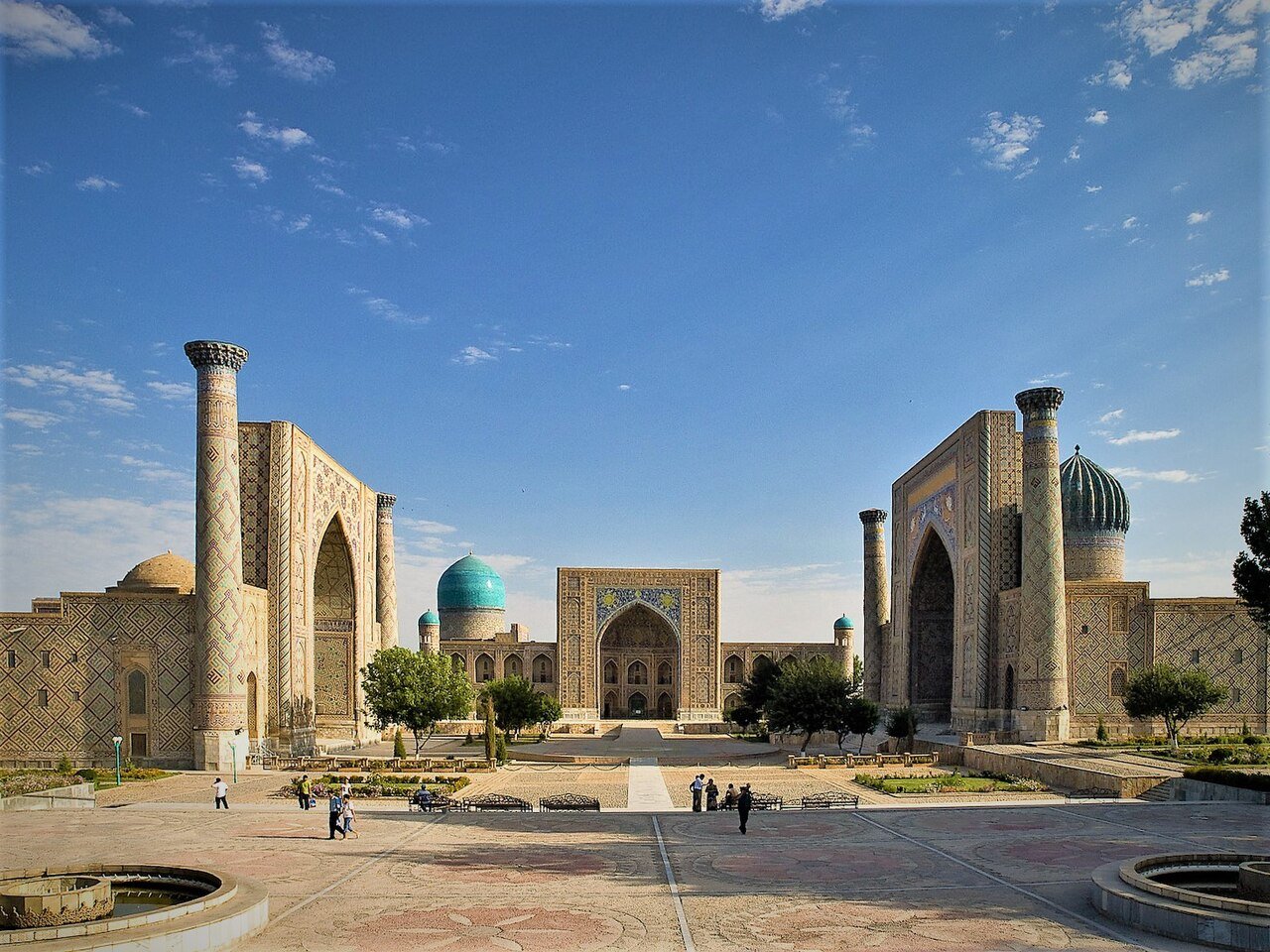
Samarkand, one of the oldest continuously inhabited cities in Central Asia, has stood for more than 2,750 years in the Zerafshan valley of modern Uzbekistan. Alexander the Great conquered it in 329 BCE, calling it Maracanda. UNESCO inscribed it as a World Heritage Site in 2001 under the designation “Samarkand — Crossroads of Cultures,” recognising the exceptional concentration of Timurid architecture that makes the city unique among Silk Road metropolises.
The Registan: three madrasahs and one public square City centre
The Registan — the word means “sandy place” in Persian — was the civic heart of Timurid Samarkand, a public square where caravans unloaded, decrees were announced, and executions were carried out. Three Islamic colleges (madrasahs) face each other across the open plaza, each built in a different century, and together they form the most complete ensemble of Timurid public architecture anywhere in the world.
The Ulugh Beg Madrasah (1420) is the oldest of the three. Ulugh Beg was the grandson of Timur (Tamerlane, 1336–1405) and one of the most accomplished astronomers of the pre-telescope era; his observatory on the hills north of Samarkand produced star tables accurate to within seconds of arc, tables that European astronomers used for two centuries. The madrasah he founded taught mathematics and astronomy alongside theology, an unusual curriculum for the time. The entrance portal reaches 35 metres and is clad in the blue-and-turquoise geometric mosaic tilework that became the architectural signature of the Timurid court.
Across the square, the Sher-Dor Madrasah (1636) takes its name from the tigers — or lions, the Arabic word sher covers both — depicted on its entrance spandrels. Figurative animals are rare in Islamic architecture; the Sher-Dor breaks with convention in showing each beast chasing a white deer, with a sun-face rising behind it. The Tilya-Kori Madrasah (1660), the third building, closes the northern side of the square. Its name means “gilded”: the main prayer hall interior is covered in gold-leaf decoration applied over a deep blue ground, one of the most extravagant interiors in Central Asian Islamic art.
Timur himself built the first version of Samarkand’s grandeur after conquering territory from Turkey to northern India between 1370 and 1405. He brought craftsmen, architects, and scholars from every conquered city — from Tabriz, Isfahan, Baghdad, Delhi, and Shemakha — to transform Samarkand into a showcase capital. The result was a city that contemporaries compared to paradise. The Registan as it stands today postdates Timur by two centuries, but it is the direct expression of the court culture he established.
Gur-e-Amir and Shah-i-Zinda: the tomb of Tamerlane and the avenue of mausoleums 15 minutes on foot from the Registan
The Gur-e-Amir mausoleum (1403) stands ten minutes’ walk southwest of the Registan. Timur built it initially for his favourite grandson Muhammad Sultan, who died on campaign; Timur himself died in 1405 while leading an army toward China and was buried there in the same structure. The dome — a ribbed, melon-shaped form on a high cylindrical drum — reaches approximately 34 metres and is covered in turquoise and ultramarine hexagonal tiles. The colour combination became a model for mausoleums across the Islamic world, from Persia to India.
Inside the Gur-e-Amir, a large slab of dark green nephrite (jade) marks Timur’s grave. It is the largest single piece of jade in the world outside China. The actual burials lie in a crypt below the decorative cenotaphs in the upper chamber. In June 1941, Soviet archaeologist Mikhail Gerasimov opened the tomb to study Timur’s skeletal remains. His team confirmed historical accounts of Timur’s limp (a wound gave him the Persian epithet Timur-e Lang, Timur the Lame, which became Tamerlane in European languages). Two days after the tomb was opened, Germany invaded the Soviet Union; in popular memory the timing created a curse legend that still circulates in Uzbekistan today.
Shah-i-Zinda, roughly translated as “the living king,” is a necropolis on the northeastern edge of the old city. A narrow street approximately 900 metres long is lined with 11 mausoleums, most built between the 1360s and the 1430s. The site takes its name from a shrine to Kusam ibn Abbas, a cousin of the Prophet Muhammad who, according to tradition, was martyred on the site in the 7th century and lives on beneath it. The tilework in Shah-i-Zinda represents the full range of Timurid ceramic technique: carved terracotta, mosaic faience, painted tile, and underglaze polychrome — more variety in one street than in any comparable site in the Islamic world. The necropolis remains an active pilgrimage destination.
Practical information
Samarkand is connected to Tashkent by the Afrosiyob high-speed rail service (approximately 2 hours 10 minutes, several daily departures). The Registan, Gur-e-Amir, and Shah-i-Zinda are all within 15 minutes’ walk of each other in the centre of the city. A combined ticket covers the main monuments; the Registan ticket includes access to the roof terraces of two of the three madrasahs.
The best light on the Registan tilework falls in the early morning and late afternoon. Midday sun washes out the blue-and-turquoise mosaic panels. Shah-i-Zinda is significantly less crowded than the Registan and is best visited early in the morning when pilgrims are present but tour groups have not yet arrived.
The nearby UNESCO World Heritage sites of Bukhara (270 km west, approximately 3 hours by rail or road) and Shakhrisabz (85 km south, approximately 1.5 hours by road over the Takhta-Karacha Pass) can be combined with a Samarkand visit. Shakhrisabz was Timur’s birthplace and contains the ruins of his Ak-Saray palace.
Uzbekistan introduced an electronic visa system; nationals of most countries can obtain a 30-day e-visa online. The local currency is the Uzbek som; ATMs are available in the city centre. Summer temperatures in Samarkand regularly exceed 40°C; spring (April–May) and autumn (September–October) are more comfortable for extended outdoor visits.
Frequently Asked Questions
Why did Timur choose Samarkand as his imperial capital rather than a city in his homeland?
Timur was born in Shakhrisabz (then called Kesh), 85 km south of Samarkand, in 1336. When he consolidated power over the Chagatai Khanate in the early 1370s, he selected Samarkand as his capital for practical and symbolic reasons. The city sat at the convergence of the main Silk Road routes linking China to the Mediterranean: north-south routes from the steppe to India passed through it, as did the east-west corridor from China to Persia and beyond. Controlling Samarkand meant taxing the most lucrative trade in the medieval world. The Zerafshan River provided the agricultural surplus needed to feed a large urban population and court. Samarkand also had the advantage of being a city with existing infrastructure and a trained artisan class, unlike the smaller towns of Timur’s homeland. He then systematically augmented it: craftsmen deported from Tabriz after 1386, from Delhi after 1398, and from Damascus and Anatolia after 1401 gave Samarkand a depth of technical expertise that no single city could otherwise have accumulated. The result — the tilework, the vaulting, the garden design, the astronomical instruments — reflected the convergence of Persian, Indian, Chinese, and Byzantine craft traditions in a single court.
What is the significance of the jade block in Timur’s tomb, and how did it end up there?
The dark green nephrite slab that marks Timur’s cenotaph in the Gur-e-Amir is approximately 1.8 metres long and cut from a single piece of stone. Nephrite of that quality and size came from the Yarkand region of what is now the Xinjiang province of China — a significant journey even by Silk Road standards. The stone was brought to Samarkand as part of the tributary gifts and war booty that flowed into Timur’s court from across his empire. It was placed in the mausoleum after Timur’s interment in 1405. In the early 17th century, the Mughal Emperor Shah Jahan — who built the Taj Mahal — reportedly had the stone transported to Delhi, cracking it in the process; a viceroy later returned the broken pieces and had them rejoined. The hairline crack is still visible. The stone’s size made it the largest piece of jade outside the major Chinese imperial collections, a distinction it retains. The cenotaphs visible in the upper chamber of the Gur-e-Amir are nominal monuments for the purpose of public veneration; the actual burials are in a crypt directly below, accessible via a separate staircase that is not open to general visitors.
How did Samarkand end up as a UNESCO World Heritage Site given that much of the architecture dates from several different centuries?
UNESCO inscribed “Samarkand — Crossroads of Cultures” in 2001 under criterion (i) for outstanding universal value as a masterpiece of human creative genius, and criterion (ii) for the exceptional interchange of cultural influences. The inscription recognised that the Outstanding Universal Value of Samarkand lies not in any single building but in the accumulated density of Timurid urban planning and architectural achievement, and in the city’s documented role as a physical junction point for cultures across Eurasia. The World Heritage designation covers a buffer zone that includes the Registan, Gur-e-Amir, Bibi-Khanym Mosque, Shah-i-Zinda, and the Afrasiab archaeological site (the pre-Timurid city, including the 7th-century Sogdian palace murals now in the Afrasiab Museum). The spread of dates — from the 7th-century Sogdian murals to the 17th-century Sher-Dor and Tilya-Kori madrasahs — reflects the site’s value as a continuous record of Central Asian urban culture rather than a preserved moment in time.