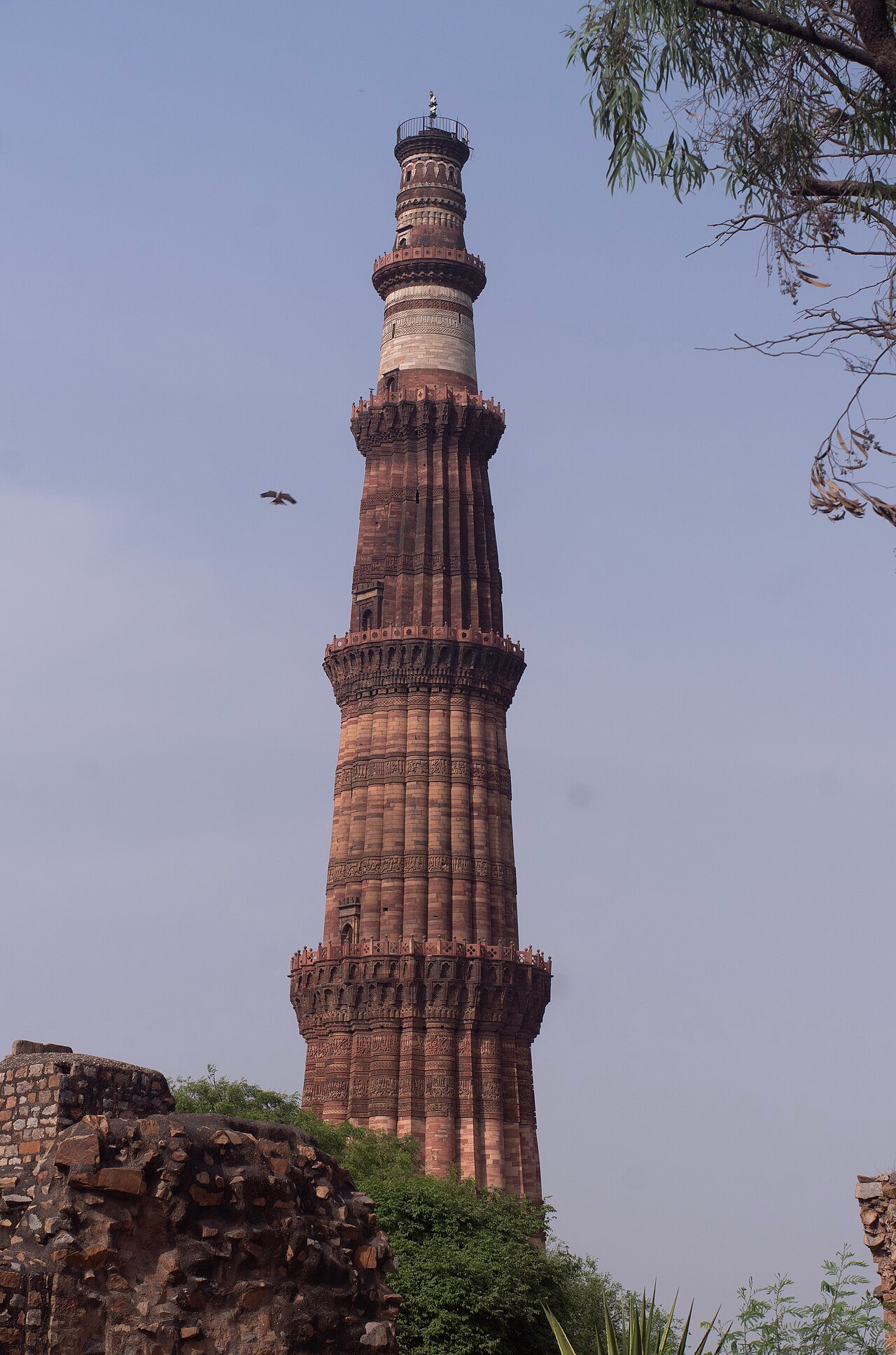
The Qutb Minar is a 72.5-metre minaret of red sandstone and marble in the Mehrauli area of south Delhi, begun in 1193 CE by Qutb-ud-din Aibak — founder of the Delhi Sultanate, the first Muslim sultanate to rule the Indian subcontinent. The complex surrounding it includes the Quwwat-ul-Islam Mosque (the first mosque built in Delhi after the Islamic conquest), the Iron Pillar of Delhi (cast around 402 CE with extraordinary corrosion resistance), and the Alai Darwaza (1311 CE, the first building in India to deploy true arches and a true dome in the Indo-Islamic style). UNESCO inscribed the site in 1993.
The Minaret, the Mosque and the Iron Column That Does Not Rust Mehrauli, south Delhi
The Qutb Minar rises in five storeys, each separated by a projecting balcony supported on muqarnas — the stalactite corbelling characteristic of Islamic architecture from Central Asia and Persia. The surface of each storey alternates between circular and angular fluting and is densely covered with calligraphic inscriptions from the Quran in two scripts: the early angular Kufic and the later cursive Naskh. Construction began under Qutb-ud-din Aibak and was completed by his successor Iltutmish. At 72.5 metres, the Qutb Minar is the tallest brick minaret in the world — a record it has held for over 800 years.
The Quwwat-ul-Islam Mosque, whose name translates as “the might of Islam,” was the first congregational mosque built in Delhi after the Ghurid forces under Muhammad of Ghor defeated the Rajput ruler Prithviraj Chauhan at the Second Battle of Tarain in 1192. The mosque was constructed on and around the site of a Hindu or Jain temple complex; the builders reused columns and architectural members from 27 temples on the site, which are still visible in the mosque’s colonnaded halls. The columns — bearing Hindu iconography, brackets in animal forms, and bells — stand alongside the later Islamic screen of arches added to the mosque’s west facade, producing an architectural palimpsest that makes the Qutb complex one of the most historically dense monuments in India.
The Iron Pillar of Delhi stands within the courtyard of the Quwwat-ul-Islam Mosque. Cast around 402 CE during the reign of the Gupta king Chandragupta II, the pillar is approximately seven metres tall and weighs an estimated six tonnes. A Sanskrit inscription on its surface records military victories, thought to refer to campaigns by Chandragupta II. The pillar was originally erected at Udayagiri in Madhya Pradesh, where a rock-cut cave complex from the same Gupta period still stands; it was moved to Delhi at some point in the medieval period, probably between the 10th and 12th centuries. The pillar has stood in the open air for over 1,600 years with minimal surface corrosion — a phenomenon that puzzled metallurgists for centuries. Modern analysis has established that the answer lies in the iron’s high phosphorus content (around one percent, far above modern steel), which promotes the formation of a stable amorphous iron hydrogen phosphate hydrate (misawite) layer on the surface that inhibits further oxidation. The tradition that anyone who could stand with their back to the pillar and encircle it with arms clasped behind them would have a wish granted was a fixture of visits for centuries; the pillar is now enclosed by a protective fence.
Alai Darwaza and the Architectural Innovations of the Complex UNESCO site; Humayun’s Tomb 12 km northeast; Red Fort 20 km northeast
The Alai Darwaza, built in 1311 CE under the Delhi Sultanate ruler Alauddin Khalji, stands at the southern entrance to the Quwwat-ul-Islam Mosque complex. It is architecturally significant as the first building constructed in India to use true arches and a true dome — structural forms in which the arch or dome is constructed of wedge-shaped voussoirs that transfer load through compression, without relying on a corbelled or trabeated structure. Earlier “arches” in Indian architecture were corbelled approximations; the Alai Darwaza introduced the genuine Islamic arch to the subcontinent. The building is faced in red sandstone with white marble inlays in geometric and calligraphic patterns, the colour combination that became the standard palette of Sultanate and early Mughal architecture.
The complex also contains the tomb of Iltutmish (died 1236 CE), Qutb-ud-din Aibak’s son-in-law and successor as sultan. The tomb is significant as one of the earliest surviving Islamic tombs in India; its interior is decorated with calligraphic bands and geometric carving of exceptional quality. The unfinished Alai Minar — begun by Alauddin Khalji with the intention of building a minaret twice the height of the Qutb Minar — stands at the northern edge of the complex. Construction ceased at the first storey upon Alauddin Khalji’s death in 1316; the stump, approximately 24 metres tall, remains. It represents one of the most ambitious unfulfilled building projects in medieval Indian history.
The Qutb Minar complex is located in Mehrauli, which was the first of Delhi’s successive capitals. The city of Delhi has been built and rebuilt across different locations over approximately a thousand years: Mehrauli, Siri, Tughlaqabad, Jahanpanah, Firozabad, Dinpanah/Shergarh, Shahjahanabad (Old Delhi), and finally the New Delhi of the British Raj. The Qutb Minar therefore stands at the historical origin point of the layered metropolitan capital that Delhi is today. Humayun’s Tomb, 12 kilometres to the northeast in the Nizamuddin area, and the Red Fort Complex, 20 kilometres further northeast in Old Delhi, form the other two UNESCO World Heritage sites within the metropolitan area — together mapping the arc from the Delhi Sultanate through the mature Mughal period.
Practical information
The Qutb Minar complex is open daily from sunrise to sunset. The Archaeological Survey of India manages the site; entry fees apply, with different rates for Indian and foreign visitors. The interior of the minaret itself is not accessible to visitors (it was closed after a 1981 stampede). Photography is permitted throughout the complex grounds. The Qutb Minar Metro station on the Delhi Metro Yellow Line is approximately one kilometre from the entrance; auto-rickshaws cover the final distance. Mehrauli is approximately 15 kilometres south of central Delhi (Connaught Place) and approximately 18 kilometres from Indira Gandhi International Airport. The Mehrauli Archaeological Park, immediately adjacent to the Qutb complex, contains numerous additional medieval structures — tombs, mosques, and a step-well — that extend a site visit significantly for visitors interested in Delhi’s Sultanate-period architecture. The best visiting times are early morning or late afternoon, when the red sandstone is illuminated laterally and the heat is manageable; Delhi summers (April–June) reach 40°C or above, making morning visits essential. The Qutb Festival of classical music and dance, held annually in November or December in the complex’s open air, is one of the major cultural events in the Delhi calendar.
Frequently Asked Questions
Why does the Iron Pillar of Delhi not rust after 1,600 years?
The Iron Pillar of Delhi’s resistance to corrosion was observed for centuries without a satisfactory explanation, and a variety of explanations circulated — among them the idea that the iron had been mixed with materials that rendered it permanently inert, or that the dry Delhi climate was responsible. Modern metallurgical analysis, particularly work published from the 1990s onward, established the actual mechanism. The pillar’s iron has an unusually high phosphorus content — approximately one percent by weight, compared to essentially zero in modern steel production. This high phosphorus level promotes the formation of a specific passivating layer on the iron surface: an amorphous iron hydrogen phosphate hydrate compound sometimes called misawite (after its characteriser, Balasubramaniam, who named it for his collaborator). This layer forms within a few years of the pillar’s initial exposure to the atmosphere and then acts as a barrier against further oxidation, effectively sealing the underlying iron from moisture and oxygen. The layer is stable under Delhi’s alternating wet and dry conditions — the monsoon and dry seasons — which may actually help regenerate the protective layer if it is locally disturbed. High-phosphorus wrought iron was produced in ancient India through specific smelting techniques that, as a side-effect, introduced elevated phosphorus levels; modern iron and steel production deliberately removes phosphorus because it embrittles steel under other conditions. The Iron Pillar is now considered a significant example of early Indian metallurgical sophistication, and its mechanism has informed research into developing phosphoric iron alloys for modern corrosion-resistant applications.
What temples were demolished to build the Quwwat-ul-Islam Mosque?
The Quwwat-ul-Islam Mosque was built using materials from temples that previously occupied the site, a practice documented in an inscription within the complex itself. The number of temples cited in the inscription is 27, though the exact count and the identity of the temples — whether Hindu, Jain, or a mix of both — has been debated by historians. What is visually apparent to any visitor today is the column forest within the mosque’s colonnaded halls: the columns are of varying heights and styles, clearly collected from different original structures, and many retain their original Hindu or Jain decorative elements — lotus flower capitals, bracket figures, bells, and chain motifs. The builders used the columns as structural elements while inserting an Islamic screen of pointed arches at the mosque’s western (qibla) facade. The result is an architectural assemblage that makes the transition between the two building traditions directly visible: the earlier temple columns and the new Islamic screen coexist in a single structure. The practice of building mosques on or from the materials of religious sites was common across the Ghurid and early Sultanate period in India. The Qutb complex is the most prominent and best-preserved example, but similar assemblages exist at Ajmer (the Adhai Din Ka Jhonpra mosque) and other early Sultanate sites. Interpretation of these conversions has ranged from iconoclasm to pragmatic reuse of available materials; the historical evidence suggests both motivations were present in different instances.
How does the Qutb Minar complex relate to the other UNESCO World Heritage Sites in Delhi?
Delhi has three properties on the UNESCO World Heritage List: the Qutb Minar and its Monuments (1993), Humayun’s Tomb (1993), and the Red Fort Complex (2007). Each corresponds to a distinct period in the city’s history. The Qutb Minar complex represents the founding of Islamic rule in Delhi — the Delhi Sultanate established by Qutb-ud-din Aibak in 1206 CE, itself an extension of the Ghurid conquest of northern India from the 1190s onward. The complex’s architectural vocabulary is early Indo-Islamic: Central Asian and Persian forms adapted to local materials and labour. Humayun’s Tomb (1572) represents the early Mughal period — the second great phase of Muslim rule in India, now with Persian architects working directly on the commission and introducing the formal charbagh (four-part garden) layout and the double dome. The Red Fort, built by Shah Jahan in 1638–48 as the centrepiece of his new capital Shahjahanabad, represents Mughal imperial architecture at its grandest scale. Together the three sites span approximately 450 years of the same broad dynastic continuum, from the first conquest to the peak of Mughal power. Visiting all three in a single trip — easily achievable in two days using the Delhi Metro — gives a coherent chronological sequence through Indo-Islamic architecture from its founding moment to its high imperial expression.