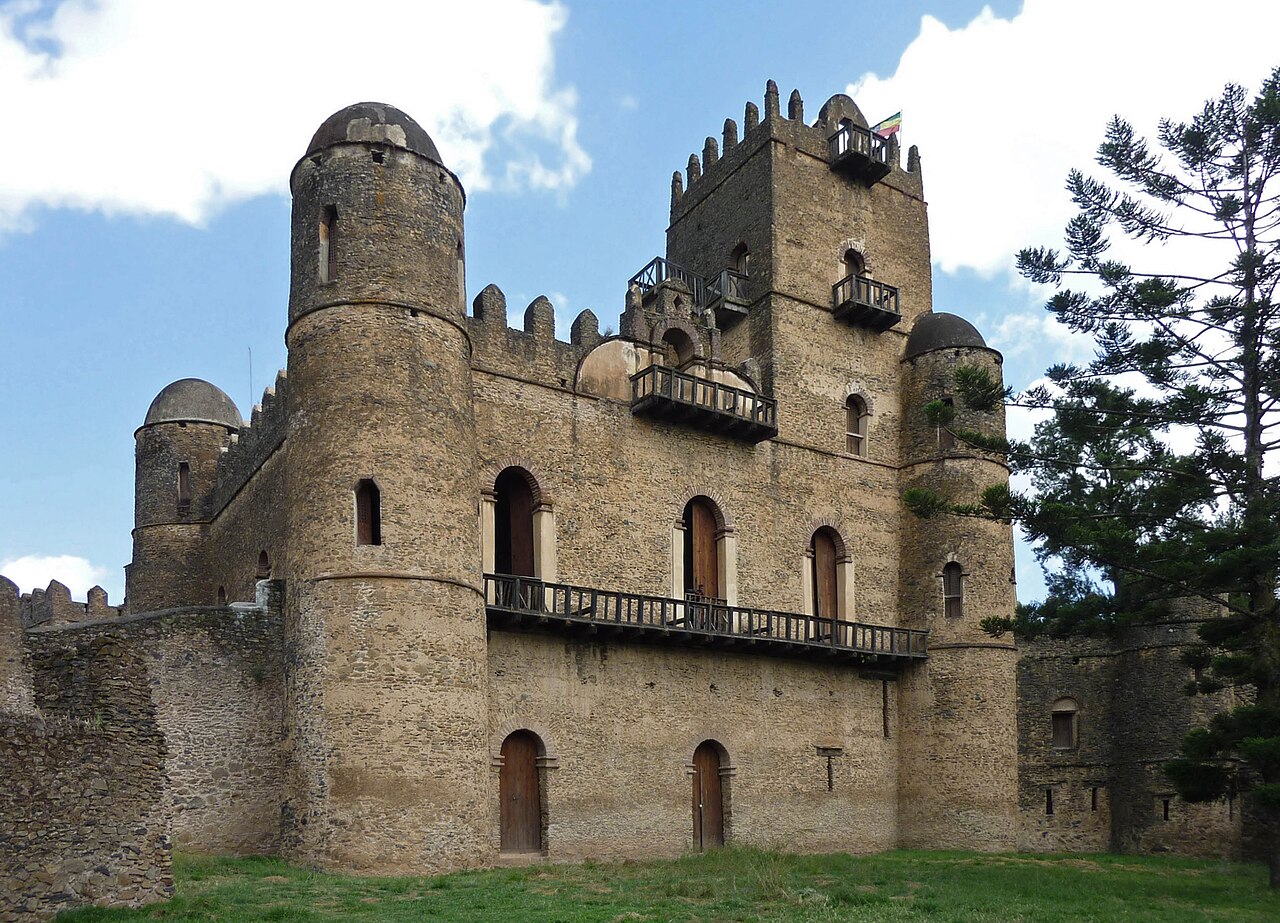
Fasil Ghebbi — the Royal Enclosure of Gondar — is a 70,000-square-metre walled compound in the Amhara region of northern Ethiopia containing the palaces, libraries, and ceremonial halls of six Ethiopian emperors built between 1636 and the late 17th century. It is the architectural record of a period when Ethiopian rulers traded and corresponded with Portugal, India, and the Ottoman Empire, and its stonework absorbs influences from all of them into a style that is recognisably and distinctly Aksumite-Ethiopian at its core. UNESCO listed it as a World Heritage Site in 1979.
From Itinerant Court to Fixed Capital: Gondar and the Foundation of Fasil Ghebbi Gondar, Amhara Region
Before Emperor Fasilides founded Gondar in 1636, the Ethiopian imperial court had no fixed capital. It moved — an itinerant royal camp that struck and re-erected its tents and wooden structures as the emperor shifted across the highlands, campaigning, administering provinces, and consuming the agricultural surplus of each region in sequence before moving to the next. This pattern, rooted in the practicalities of pre-modern Ethiopian logistics, also served a political function: constant movement prevented any single provincial elite from building influence by proximity to power. The decision to build a permanent capital was therefore not merely a shift in logistics but a fundamental change in the political model of Ethiopian kingship.
Fasilides chose the Gondar site for its spring water, its defensible hilltop position, and possibly for prophetic reasons — accounts mention a hermit’s prediction that a great city would rise at the confluence of the Angareb and Qeha rivers. He built his palace first: Fasil Gemb (Fasilides’ Palace), a three-storey structure with crenellated battlements, corner towers, and a flat roof, connected to the compound walls by a raised walkway. The building’s immediate visual references are complex. The crenellations and corner towers recall European medieval castle forms absorbed via Portuguese contacts; the flat roof and the proportions of the towers draw on Aksumite precedent; the arched loggias on the upper floors show Indian and Moorish influence arriving through Ethiopian trade contacts with Goa and the Gulf.
Portuguese Jesuit missionaries had been active at the Ethiopian imperial court since the early 17th century, and while Fasilides ultimately expelled them (re-establishing Ethiopian Orthodoxy after a brief period of Catholic influence under his predecessor), their presence and that of Indian craftsmen and merchants created a court culture absorbing multiple external architectural vocabularies. The result at Fasil Ghebbi is a hybrid that does not reduce cleanly to any single source tradition — it is the product of an Ethiopian empire at the peak of its international connectivity, building in stone with the full reach of its trade networks available to its craftsmen.
Each subsequent emperor added to the compound. Iyasu I (r. 1682–1706) built the largest palace in the enclosure, now known as Iyasu’s Palace, with an elaborately carved upper floor. Dawit III added a library. Mentewab, empress regent in the 18th century, built her own castle with a connecting bridge to the main compound. A banquet hall, stables, a bathhouse, three churches, and a walled lion cage — emperors maintained lions as living symbols of the Solomonic dynasty’s descent from the Lion of Judah — complete the ensemble. The total compound as it stands represents more than sixty years of continuous royal building on a single site.
Fasilides’ Bath, Timkat, and the Damage of 1868 and 1941 Gondar and surrounding area
Two kilometres from the main compound, and technically a separate component of the World Heritage property, stands Fasilides’ Bath (sometimes called Kuskuam, though that name properly refers to another complex associated with Empress Mentewab on a hill north of the city). The bath is a walled pool enclosure with a two-storey stone pavilion rising from an island at its centre, connected to the surrounding walkway by a stone bridge. In normal months the pool holds a shallow residue of water. Once each year, in January, the pool is deliberately flooded for the celebration of Timkat — Ethiopian Epiphany, the commemoration of Christ’s baptism in the Jordan.
The Timkat ceremony at Fasilides’ Bath is among the most photographed religious events in sub-Saharan Africa. On the eve of Timkat, priests from Gondar’s churches carry their tabots — consecrated altar tablets — in procession to the pool, where they are placed in tents for an overnight vigil attended by thousands of white-robed faithful. At dawn on Timkat day, the blessing of the water is performed and the crowd enters the pool: a mass ritual bathing that re-enacts the baptism of Christ and renews the participants’ own baptism. The ceremony combines genuine liturgical solemnity with the physical intensity of tens of thousands of people in a single walled space.
The palaces of Fasil Ghebbi did not survive intact. British forces under General Robert Napier bombarded Gondar in 1868 during the expedition to free European hostages held by Emperor Tewodros II — a complex episode that ended with Tewodros’s suicide at Maqdala rather than capture, but left Gondar significantly damaged. Italian aircraft bombed the city again in 1941 during World War II operations in the East African campaign, causing further structural damage to roofs and upper floors. The compound that visitors see today is the product of both that damage and decades of UNESCO-assisted restoration: original stonework, collapsed sections rebuilt with documentation, and ongoing conservation work that has been running since the 1980s. The distinction between original fabric and restoration is not always visible to the casual eye, which is one reason licensed guides familiar with the site’s restoration history are valuable.
The compound’s three churches — Bete Abba Kstos, the circular Tekla Haymanot Church, and Maryam Gimb — are active Ethiopian Orthodox places of worship, not museums. Priests and deacons are present throughout the compound; services are held on major feast days and on the weekly Ethiopian Sabbath (Saturday) and Sunday. The compound as a whole functions simultaneously as a royal monument, a heritage site, and a living religious precinct — a combination that shapes the experience of visiting it in ways that a purely archaeological site would not.
Practical information
Gondar is served by Gondar Airport (GDQ) with daily flights from Addis Ababa on Ethiopian Airlines (approximately 1 hour 30 minutes). The Royal Enclosure (Fasil Ghebbi) is a short walk or tuk-tuk ride from the city centre. A separate ticket is required for Fasilides’ Bath, which is 2 km from the main compound and most easily reached by tuk-tuk. The compound is open daily from approximately 8:00 to 17:30; arrive early to avoid the hottest part of the day and the busiest visitor periods. Licensed guides are available at the entrance. The Simien Mountains National Park, a second UNESCO World Heritage Site, is approximately 100 km to the north on a paved road; the journey takes two to three hours. Lalibela is approximately 180 km to the south-east, accessible by road or by air. Gondar has a range of accommodation from budget guesthouses to mid-range hotels near the compound.
Frequently Asked Questions
What is the architectural style of the Gondar palaces, and why does it look like a European castle?
The resemblance of Fasilides’ Palace to a European medieval castle is real but partial, and its origin is specific. Portuguese Jesuit missionaries arrived at the Ethiopian imperial court in the early 17th century, seeking to bring the Ethiopian Orthodox Church into communion with Rome. Emperor Susenyos (r. 1606–1632) converted to Catholicism and briefly imposed it on his kingdom, provoking civil war. His son Fasilides reversed the decision on his accession in 1632, expelled the Jesuits, and re-established Ethiopian Orthodoxy as the state religion — but the Portuguese influence on court culture and material practice did not disappear with the missionaries. European castle forms had entered the visual vocabulary of Ethiopian royal architecture during the Jesuit period. The crenellations and corner towers of Fasilides’ Palace draw on these; the arched loggias on the upper floors reflect Moorish architecture as filtered through Portuguese colonial buildings in Goa and along the East African coast, which Ethiopian merchants and envoys encountered through Red Sea trade. Indian craftsmen and traders were also present in Gondar, contributing pointed arch forms visible in several of the compound’s structures. The underlying structural logic and building material — dry-stone masonry in a warm brown basalt — are continuous with the Aksumite tradition that precedes any European contact. The result is a layered hybrid: not an imitation of European architecture, but an Ethiopian royal tradition absorbing external influences at a moment of maximum international connectivity and processing them into something new.
What happened to Emperor Tewodros II, and why did Britain attack Gondar?
The British expedition of 1867–68 — known as the Expedition to Abyssinia or the Napier Expedition — was launched in response to Emperor Tewodros II’s detention of the British consul and several other European nationals after Queen Victoria failed to respond to a diplomatic letter he sent in 1862. Tewodros, who had unified Ethiopia by force after decades of civil war and harboured ambitions of modernising the country with European assistance, interpreted the unanswered letter as a personal insult and imprisoned the Europeans at his mountain stronghold of Maqdala. Britain dispatched General Robert Napier with approximately 13,000 soldiers, who landed at Zula on the Red Sea and marched inland. In April 1868 the British force defeated Tewodros’s army at the Battle of Arogi and advanced on Maqdala. Tewodros freed the hostages but refused to surrender, and when British troops stormed the fort he shot himself rather than be taken prisoner. The expedition looted Maqdala extensively — manuscripts, crowns, ceremonial crosses, and other objects were removed and distributed among soldiers and the British Museum; repatriation of these objects has been a recurring point of diplomatic tension between Ethiopia and Britain into the 21st century. Gondar was bombed during the expedition as a punitive measure against remaining resistance, causing structural damage to the Fasil Ghebbi compound that was compounded by the Italian air raids of 1941.
Can visitors attend the Timkat ceremony at Fasilides’ Bath, and how should they prepare?
Yes, Timkat at Fasilides’ Bath is open to all visitors. It is one of the most accessible major religious ceremonies in Ethiopia for non-Orthodox observers, partly because it takes place in an open outdoor setting rather than inside a church, and partly because Gondar has a long tradition of receiving visitors for the event. The ceremony runs across two days: the eve (usually January 18) brings the procession of tabots from the churches to the pool, with priests in elaborate embroidered vestments under ceremonial umbrellas, accompanied by chanting, drums, and sistra — the ancient rattles used in Ethiopian Orthodox liturgy. This procession through the city streets in the late afternoon is the most visually intense part of the ceremony. The overnight vigil at the pool requires stamina; it is cold at Gondar’s altitude in January and the vigil runs until dawn. On Timkat day (January 19 in most years; Timkat falls on January 20 in leap years by the Ethiopian calendar), the blessing of the water and the entry into the pool occur in the morning. Visitors should: arrive in Gondar at least one day before the eve of Timkat to secure accommodation and orient themselves; dress modestly and bring a warm layer for the overnight vigil if attending; stay at the edges of the crowd to avoid pressure near the pool; and treat the ceremony as a religious event, not a spectacle. Photography is accepted but should be unobtrusive during liturgical moments. Accommodation in Gondar books out completely for Timkat, sometimes months in advance.