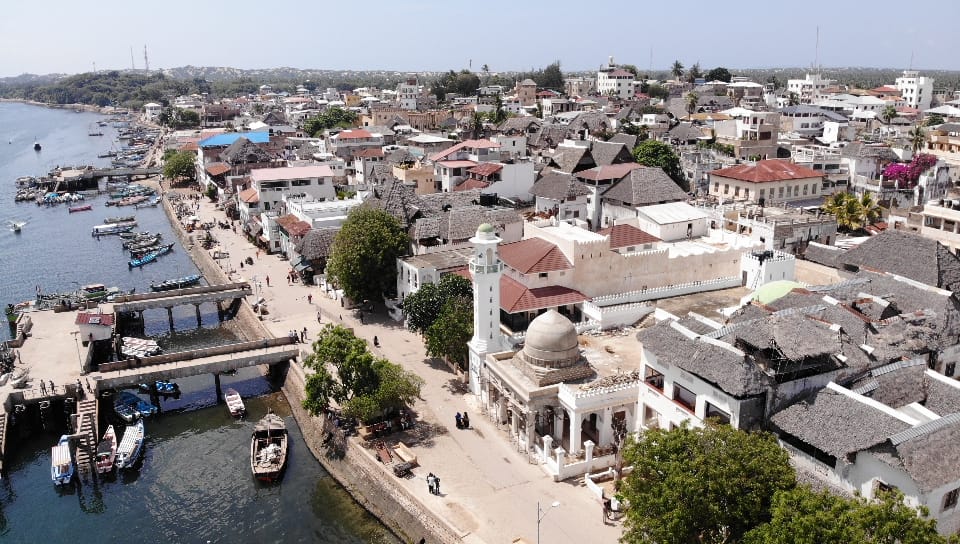
Lamu Old Town, on Lamu Island 340 kilometres north of Mombasa on the Kenyan coast, is the oldest continuously occupied Swahili settlement in East Africa, inhabited since at least the 14th century and today home to approximately 20,000 people. The town has no motor vehicles — its streets are navigated by donkey or boat — and contains over 23 documented styles of carved wooden doors that function as architectural markers of a household’s wealth, religion, and cultural origin. UNESCO inscribed Lamu Old Town in 2001.
Coral Stone and Carved Wood: The Architecture of a Nine-Century Trading Town Lamu Island, Lamu County, Kenya — accessible by air (Wilson Airport Nairobi) or ferry from Mokowe
Lamu sits on a coral island in the Lamu Archipelago, a group of islands separated from the Kenyan mainland by channels navigable by dhow and motor launch. The town’s foundations in the current location date to at least the 14th century, with archaeological evidence suggesting earlier occupation on the island from the 9th century onward as part of the wider Swahili coast settlement pattern. Unlike many Swahili towns of comparable antiquity — Manda, Shanga, Ungwana — Lamu was never abandoned and retains its urban fabric as living infrastructure rather than archaeological ruin.
The buildings of Lamu Old Town are constructed almost entirely from two locally abundant materials: coral stone and mangrove wood. The coral, quarried from fossil reef beds on and around the island, is cut into blocks for walls and carved into decorative elements for doorways, window frames, and interior niches. The mangrove poles, harvested from the coastal forests of the mainland, serve as roof beams, floor joists, and the structural frame of the buildings’ interior wooden elements. This combination produces buildings that are thick-walled, with high ceilings that allow heat convection, and deeply shaded interior courtyards that reduce solar gain. The architecture is passive climate control operating without mechanical systems, and it remains effective in conditions where concrete-block modern construction typically requires air conditioning.
The characteristic feature of Lamu’s architecture — the element most frequently photographed and most discussed in the UNESCO inscription — is the carved wooden entrance door. Over 23 distinct door styles are documented in Lamu, each encoding information about the household behind it. The oldest and most prestigious style consists of two main panels covered with geometric and floral carving, flanked by a carved frame with a recessed arched reveal — a form derived from the woodcarving traditions of Oman and the Persian Gulf, brought by the Arab and Omani settlers who established themselves in the town from at least the 18th century. Indian-origin households commissioned doors with a distinctive brass-studded panel below the carved section, a convention associated with merchants from Gujarat. Swahili-origin families used simpler carved patterns that drew on local rather than imported aesthetic conventions. The doors are not decorative: they are structural, built to last generations, and represent significant economic investment. They are also property markers — in Lamu’s historical legal tradition, ownership of the door was considered separate from ownership of the house.
The street network of Lamu Old Town is a product of its pedestrian scale. The widest streets are approximately 2 metres across; most are narrower, with upper floors of adjacent buildings sometimes projecting across to create covered passages. Navigation within the old town requires orientation by landmark rather than grid — the Lamu Fort on the waterfront, the Friday Mosque tower, and the seafront promenade are the primary reference points. The absence of motor vehicles is not a policy decision imposed for heritage preservation: the streets were simply never wide enough to accommodate them, and the island’s geography — a coral island in a tidal channel — meant that a road connection to the mainland was never built. The only wheeled vehicle on the island belongs to the government hospital for patient transport.
Approximately 3,000 donkeys currently live on Lamu Island, serving as the primary freight and transport animals for goods moving through the town’s streets. The Lamu Donkey Sanctuary, operated since 1985, provides veterinary care and has significantly improved the welfare of the working donkey population. The animals are a functional necessity of the island’s economy rather than a heritage attraction.
The Indian Ocean Node: Trade, the Maulidi Festival, and the Battle That Built the Fort Lamu waterfront and Riyadha Mosque quarter
Lamu’s position in the Indian Ocean trading network shaped its material culture, its religious life, and the ethnic composition of its population. From at least the 9th century, the Lamu Archipelago was integrated into the monsoon trade system that connected East Africa to Arabia, Persia, India, and — through intermediate networks — to China and Southeast Asia. The town’s exports included mangrove poles (essential building material in the treeless Gulf and Red Sea coasts), ivory from the East African interior, ambergris from sperm whales in the Indian Ocean, and enslaved persons taken from inland communities. In return, Lamu received cotton cloth from India, porcelain from China, glass beads from Venice and Bohemia (traded through Arab intermediaries), and the religious and cultural influence of the Islamic world.
The Omani Arab presence in Lamu became particularly significant in the 18th century, when Omani settlers established themselves as a merchant class and later as a political force. Their cultural impact is visible in the door styles and the architectural layout of the wealthier merchant houses in the stone town. It is also visible in the political history: the Battle of Shela in 1812, fought between Lamu and a coalition from the rival island of Pate, was decided with Omani military support for Lamu. Following the battle, the Sultan of Oman ordered the construction of the Lamu Fort (1813-1821) on the waterfront as a garrison and symbol of Omani authority. The fort served as a prison from independence until 1984; it is now a museum and library, with a roof terrace that provides the best elevated view of the town and the harbour.
Lamu’s religious character is the most immediately evident aspect of its social life for visitors. The town is described as one of the most observantly Islamic communities in sub-Saharan Africa. Five daily prayer calls from multiple mosques structure the audible environment of the town; during Ramadan, the night schedule of the old town shifts significantly toward communal activity after iftar. The most important annual religious event is the Maulidi Festival, the celebration of the Prophet Muhammad’s birthday, which draws pilgrims from across East Africa, from Arabia, and from the Indian subcontinent. The festival, typically held in the third month of the Islamic calendar, involves days of public prayer, Sufi chanting, dhow races in the harbour, and cultural events in the streets of the old town. It attracts significantly more visitors than the town’s normal tourist season.
The Riyadha Mosque, built in 1901 by the Yemeni scholar Habib Swaleh, is the centre of Lamu’s Sufi tradition. The Alawi tariqah (Sufi order) associated with the mosque remains active, and the mosque is the primary organizing institution of the Maulidi Festival. Non-Muslim visitors do not enter the mosque during prayer times but can observe the courtyard gatherings and the public events of Maulidi from the adjacent streets. The Lamu Museum on the waterfront, established in the former district commissioner’s residence, houses collections of Swahili furniture, navigational instruments, and musical instruments from the town’s trading history.
Fort Jesus in Mombasa, a Portuguese fortification built in 1593-1596 and a separate UNESCO World Heritage site since 2011, lies approximately 340 kilometres south of Lamu by sea. The two sites — both inscribed for their Indian Ocean cultural heritage — are sometimes combined in itineraries that follow the Swahili coast, though the journey between them requires either a domestic flight or a significant overland trip via Malindi and Mombasa.
Practical information
Lamu is accessible by daily flights from Wilson Airport in Nairobi (approximately 1 hour) and from Mombasa (approximately 40 minutes) to Manda Airport, which is on the adjacent island of Manda. From Manda, a water taxi crosses to Lamu waterfront in approximately 10 minutes. There is no road connection to the island; all visitors arrive by air or by boat from Mokowe on the mainland (accessible by road from Malindi or Mombasa, with a ferry crossing from Mokowe jetty).
Within Lamu Old Town, all movement is on foot or by donkey. The old town is compact enough to walk completely in under an hour; navigating the interior streets requires willingness to ask for directions. The Lamu Fort is open daily with a small entry fee. The Lamu Museum on the seafront has regular opening hours and an entry fee. The old town’s streets are safe to walk independently but visitors carrying obvious camera equipment should be alert to the normal precautions appropriate in a densely populated town.
Accommodation ranges from simple guesthouses to restored merchant houses rented as boutique hotels. The waterfront has several cafes and restaurants serving Swahili food. The best time to visit for quiet exploration is July through September (dry, cool season); the Maulidi Festival is the busiest period of the year but the most culturally distinctive. Check the Islamic calendar for the specific date, which shifts approximately 11 days earlier each year.
Frequently Asked Questions
What do the 23 carved door styles of Lamu actually mean, and how do you read them?
The carved wooden doors of Lamu Old Town are a form of material communication that encoded, for the building’s contemporaries, a set of information about the owner’s cultural origin, religious affiliation, wealth, and social aspiration. The documentation of 23 distinct styles is based on systematic architectural surveys that categorised doors by their structural form (single-panel, double-panel, divided-panel), their carving conventions (geometric, floral, calligraphic, figural), their hardware (brass studs, iron bars, rope hinges), and their frame treatments (plain reveal, arched reveal, projecting lintel). The most prestigious form — double-panel doors with extensive floral and geometric carving, an arched reveal, and a carved threshold plank — derives from Omani and Gulf Arab aesthetic conventions and was associated with the wealthiest merchant and noble families, many of Omani origin. Doors with a lower panel of brass studs below the carved section indicate a household with Gujarati Indian merchant connections, a tradition imported from the woodcarving practices of coastal Gujarat. Swahili-origin households typically commissioned doors with carving that drew on local rather than imported patterns, distinguishable to specialists by the specific floral and chain motifs that appear in local textile traditions as well as on building elements. Calligraphic inscriptions from the Quran appear on doors across all cultural traditions, since the Islamic religious identity of Lamu is broadly shared. The door as a separate legally significant object — in historical Swahili law, ownership of the door could be distinct from ownership of the house behind it — made the investment in a prestigious door a transferable asset as well as a visible status marker.
Why does Lamu have no cars, and how does the island function without them?
Lamu’s street widths were established over nine centuries of incremental construction in coral stone, adapted to the scale of human and donkey movement rather than to wheeled vehicles. The widest streets in the old town are approximately 2 metres across — enough for two people to pass with luggage, or for a laden donkey, but not for a vehicle of any practical size. The street network also lacks the linear logic of a road designed for traffic: it is a system of short connections between courtyards, mosques, wells, and landing points on the waterfront, shaped by nine centuries of use rather than by planning. When wheeled vehicles became available elsewhere in Kenya during the 20th century, there was no practical way to retrofit them into Lamu’s street structure without demolishing significant portions of the old town. The island government has maintained a near-complete vehicle ban since the colonial period, and this has incidentally become one of the most effective mechanisms of heritage preservation in East Africa: the old town was never subjected to the road-widening and building demolition that destroyed the historic cores of Mombasa, Malindi, and most other Kenyan coastal towns during the 20th century. The single hospital vehicle is the only wheeled exception. Goods arrive at the Lamu waterfront by dhow or motor launch, and porters and donkeys distribute them through the town. The system functions because the island’s economy is built around it: the port, the market, the mosques, and the residential quarters are all within 10 to 15 minutes’ walking distance of each other, which is the practical radius of a pedestrian and donkey economy.
What is the Maulidi Festival and when is the best time to attend?
The Maulidi Festival (Maulid al-Nabi) is the celebration of the Prophet Muhammad’s birthday, observed by Muslims worldwide on the 12th day of Rabi al-Awwal, the third month of the Islamic lunar calendar. In Lamu, the festival has developed over more than a century into one of the most significant Maulidi observances in East Africa, drawing pilgrims from Kenya, Tanzania, Uganda, Somalia, Comoros, and from Arabia and the Indian subcontinent. The Riyadha Mosque, established in 1901 by the Yemeni Hadhrami scholar Habib Swaleh, is the organising centre of the festival. The events span approximately a week and include nightly recitations of the Maulidi (a poem in praise of the Prophet), communal dhikr (Sufi chanting), public processions through the streets of the old town, dhow races in the harbour, donkey races on the beach, and sporting competitions. The most significant religious event is the public reading of the Barzanji, a classical Arabic poem about the Prophet’s life, which takes place over successive nights in the Riyadha Mosque courtyard and in the streets. Non-Muslim visitors are welcome at the public outdoor events; the mosque interior during prayer is not accessible to non-Muslims. Because the Islamic calendar is lunar, the date of Maulidi shifts approximately 11 days earlier each year relative to the Gregorian calendar. A visitor planning to attend should calculate the date for the specific year of travel using an Islamic calendar converter. The festival period significantly increases demand for accommodation on the island; booking several months in advance is necessary.