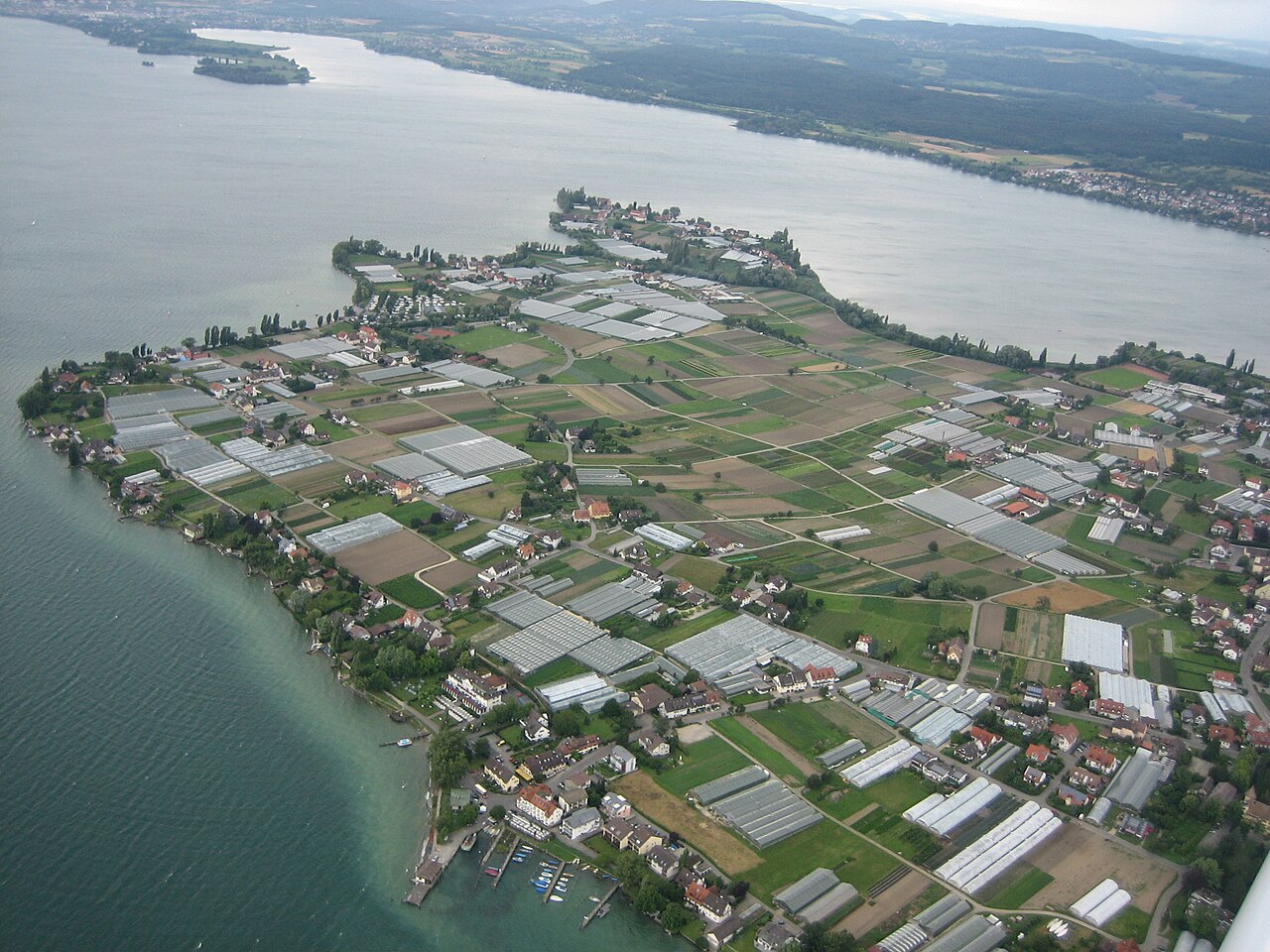
The island of Reichenau in Lake Constance (Bodensee), Baden-Württemberg, Germany, was inscribed as a UNESCO World Heritage Site in 2000. Measuring 4.3 kilometres long and 1.5 kilometres wide, and connected to the mainland by a causeway since 1838, it carries three Carolingian and Romanesque churches, the remnants of a Benedictine abbey once central to learning across the Carolingian and Ottonian empires, and 10th-century mural paintings considered among the finest surviving examples of Ottonian wall art in existence.
The Benedictine Abbey and Its Role in Medieval Learning Island of Reichenau, 20 min by car from Constance; 5 km causeway road
The Benedictine Abbey of Reichenau was founded in 724 CE by Saint Pirmin, a Frankish monk operating under the patronage of the Alemannian nobility and with the approval of Charles Martel. Pirmin established the community on what was then a relatively isolated island and it grew, over the following two centuries, into one of the most significant centres of intellectual and artistic production in the Carolingian world.
By the 9th century Reichenau had become a leading scriptorium — a workshop for the copying and illumination of manuscripts — under the Carolingian imperial patronage of Louis the Pious and his successors. The abbey’s library and scriptorium produced texts in theology, natural science, medicine, and poetry, and attracted scholars from across the Frankish realm. Among the figures connected to Reichenau was Walahfrid Strabo (808–849), abbot of Reichenau from 838 and author of the Hortulus, an early medieval Latin poem about garden plants that is one of the few surviving treatises on practical horticulture from the period.
At its peak in the 10th century, under abbots such as Haito and later Witigowo, the community numbered around 700 monks and commanded substantial landholdings across the Lake Constance region. The scriptorium produced some of the most celebrated illuminated manuscripts of the Ottonian period; a group of Reichenau manuscripts — including the Gospels of Otto III, now in the Bavarian State Library in Munich — is listed separately on UNESCO’s Memory of the World Register as documents of exceptional world cultural significance. The manuscripts are distinguished by their use of gold and lapis lazuli pigments, their characteristic frontal figures in gold framing, and their extraordinary technical quality.
The abbey’s influence declined from the 11th century onward as Cluny-type reformed monasticism spread, and by the late medieval period Reichenau had lost its earlier prominence. It was secularised in 1803, and the monastic buildings were later used for other purposes. What survived — three complete Carolingian and Romanesque churches with their original fabric largely intact — constitutes the physical archive of the abbey’s former importance.
Three Churches and the Ottonian Frescoes Rediscovered in 1880 Three separate sites across the island, 15 min cycling between them
Three Carolingian-Romanesque churches survive on Reichenau, distributed across the island at Mittelzell, Niederzell, and Oberzell.
The Münster of St Mary and St Mark at Mittelzell is the largest and oldest, its nucleus dating from the early 9th century with later Romanesque and Gothic additions. The Münster preserves relics of Saint Mark the Evangelist, brought to Reichenau from Alexandria — the possession of such relics placed the abbey in the first rank of pilgrimage destinations in the medieval German-speaking world. The interior retains carved capitals and architectural elements from successive building campaigns and gives a clear picture of the abbey’s architectural ambition across several centuries.
The church of St Peter and St Paul at Niederzell, at the western tip of the island, is a smaller Romanesque structure with apse paintings restored in the 19th century. It is the quietest of the three churches and often overlooked, but its proportions and the character of its interior are worth the short detour.
The church of St George at Oberzell is the most important for art historians. Its nave walls carry eight large mural paintings depicting the miracles of Christ — the healing of the leper, the stilling of the storm, the raising of Lazarus, the healing of the blind man at Jericho, and others — executed in the late 10th century and now regarded as among the finest surviving examples of Ottonian mural painting in existence. The frescoes were plastered over at some point in the post-medieval period and completely forgotten; they were rediscovered in 1880 during restoration work and have been carefully preserved since. The frontal figures, the strong outlines, the flat gold-tinged backgrounds, and the narrative clarity of the compositions are characteristic of the Ottonian aesthetic that also shaped the illuminated manuscripts produced in the same period on the same island. The Oberzell frescoes thus represent a rare case where surviving wall painting and surviving manuscript illumination from the same workshop tradition can be studied in parallel.
Today Reichenau is also a working agricultural island: approximately 75 percent of Germany’s consumption of lettuce, radishes, and fresh herbs is grown here, in a pattern of intensive market gardening that dates from the medieval monastic tradition of cultivating the island’s fertile, lake-moderated soil. The combination of Carolingian churches, 10th-century frescoes, and working vegetable fields is specific to this place and nowhere else in Europe.
Practical information
Reichenau is connected to the mainland by a causeway at the town of Allensbach. By car from Constance, the drive takes approximately 20 minutes. A regular bus service connects Constance railway station with the island. Bicycles can be rented in Constance and the island’s flat terrain makes it well suited for cycling; all three churches are within a 5-kilometre circuit.
All three Carolingian churches — Münster Mittelzell, St George at Oberzell, and St Peter and Paul at Niederzell — are open to visitors, with modest admission fees at each. The Oberzell frescoes are the main draw for art-history visitors; the church has limited capacity and timed access may apply in peak months. A small island museum covers the abbey’s history and the manuscript tradition.
Constance (Konstanz) on the Swiss border is the main base for visits, with good rail connections from Stuttgart (around 2 hours) and Zurich (around 1 hour). The island itself has limited accommodation; most visitors stay in Constance or the surrounding towns. There is no UNESCO World Heritage Site immediately adjacent on the Swiss side of Lake Constance, though the lake shore on both sides preserves individual prehistoric pile-dwelling sites from the Alpine Pile Dwellings World Heritage property.
Frequently Asked Questions
Why is the Monastic Island of Reichenau a UNESCO World Heritage Site?
Reichenau was inscribed as a UNESCO World Heritage Site in 2000. The designation recognised the island as an exceptionally well-preserved example of a Carolingian monastic landscape, where the physical fabric of a major medieval religious and intellectual centre has survived largely intact over more than twelve centuries. The three Carolingian and Romanesque churches — at Mittelzell, Niederzell, and Oberzell — retain their original architectural character and together form a coherent ensemble that testifies to the abbey’s role as a centre of learning, manuscript production, and artistic creation during the Carolingian and Ottonian periods. The late 10th-century Ottonian frescoes in the church of St George at Oberzell — eight mural paintings of the miracles of Christ — are considered among the finest surviving examples of Ottonian wall painting in Europe and are a central element of the UNESCO assessment. The Reichenau illuminated manuscripts produced in the same period, several of which are preserved in major European libraries, are separately listed on UNESCO’s Memory of the World Register. The inscription also notes the island’s continuous cultural landscape, combining the medieval monastic heritage with an agricultural tradition of market gardening that has characterised Reichenau for over a millennium.
What are the Ottonian frescoes in the church of St George at Oberzell?
The church of St George at Oberzell contains eight large mural paintings on the nave walls, depicting the miracles of Christ as recorded in the Gospels. The paintings date from the late 10th century — approximately 970–1000 CE — and were produced during the height of the Reichenau scriptorium’s artistic output under the Ottonian emperors. They depict the healing of the leper, the stilling of the storm at sea, the healing of the paralytic at Capernaum, the raising of Lazarus, the healing of the blind man at Jericho, and several other miracles. The style is characteristic of Ottonian art: figures are frontal and schematically rendered, backgrounds are flat or simply indicated, colours are bold, and gold is used for emphasis. The same aesthetic — and in some cases the same workshop — produced the illuminated Gospels manuscripts of the Ottonian period, several of which survive in Munich, Bamberg, and Aachen. The frescoes were plastered over at an unknown date after the medieval period and were discovered in 1880 during restoration work on the church. They have been carefully conserved since and are accessible to visitors; the church has limited capacity, and small-group visits are preferable to allow time to examine each panel. The combination of surviving mural paintings and manuscripts from the same tradition makes Reichenau uniquely important for understanding Ottonian art.
What is the best way to visit all three churches on Reichenau in a single day?
The island’s compact size — 4.3 kilometres long — makes visiting all three churches on a single day straightforward, and cycling is the most pleasant way to do it. Bicycles can be rented in Constance or at the causeway entry to the island. The recommended order is to begin at the church of St George at Oberzell (east end of the island) to see the frescoes when the morning light is best in the nave, then cycle west to the Münster at Mittelzell (centre of the island) to see the main church and the island museum, and finish at St Peter and Paul at Niederzell (west end). The full circuit including time inside each church takes three to four hours. A visit to all three churches plus the island museum can comfortably be completed before early afternoon, leaving time to return to Constance and cross into Switzerland for a walk around the Swiss bank of the lake, or to visit the Constance cathedral and the Konzilgebäude where the Council of Constance was held in 1414–1418 — the council that burned Jan Hus and ended the Western Schism. Constance has good restaurants, and the island itself has a handful of simple cafes and inns where the locally grown produce features prominently on the menu.