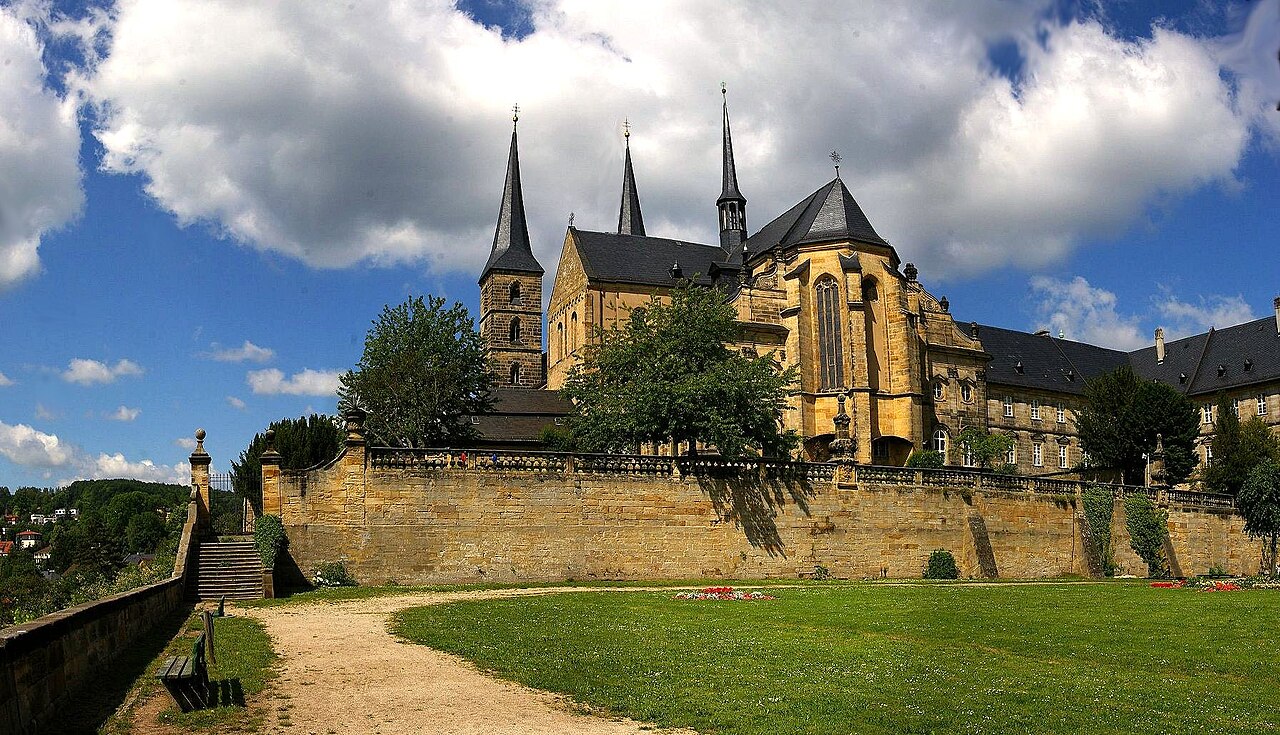
The Town of Bamberg, inscribed in 1993, is the best-preserved medieval urban ensemble in the German-speaking world — a Carolingian-era planned city of seven hills, each crowned with a church, whose historic centre survived the Second World War undamaged. The Bamberg Cathedral’s equestrian statue (the Bamberger Reiter) and the smoked beer tradition (Rauchbier) make it one of the most distinctive heritage destinations in Bavaria. Würzburg’s Baroque residences and the Romantic Road extend the Franconian heritage itinerary.
Town of Bamberg: The Carolingian City on Seven Hills City centre
The Town of Bamberg, inscribed in 1993 under criteria (ii) and (iv), is the most completely preserved medieval city in the German-speaking world — a city founded on seven hills each crowned with a church, modelled consciously by its founder, Bishop Otto of Bamberg (1102–1139), on Rome’s Seven Hills. The city was established as a centre of Holy Roman Imperial power by Emperor Henry II in 1007, who founded the Diocese of Bamberg and built the imperial cathedral; Henry and his wife Cunigunde are the only German emperor and empress to be canonised, and their tombs are in the Cathedral of Bamberg. The Bamberg Cathedral (Dom St. Peter und Georg, begun 1007, substantially rebuilt after fire 1081, consecrated 1237) contains the Bamberger Reiter (Bamberg Rider) — a painted equestrian statue of c. 1235–1240, the oldest secular equestrian statue in German medieval art, whose rider’s identity remains unknown (candidates include King Conrad III, Saint George, and King Stephen I of Hungary). The Cathedral also holds the tomb of Pope Clement II (d. 1047), the only papal tomb north of the Alps. The Old Town Hall (Altes Rathaus, 1461) is built on an artificial island in the Regnitz River — according to legend because the bishop refused to give land for a town hall (the town belonged to the diocese) and the citizens built their hall on the only neutral ground: the river itself. The Baroque New Residence (Neue Residenz, 1695–1703) holds the state gallery and the Rose Garden with its view over the seven church towers.
Rauchbier and the Bamberg Beer Culture Historic breweries throughout the city
Bamberg has nine working breweries for a city of 70,000 — one of the highest brewery densities in the world — and is the centre of one of the rarest beer traditions in Germany: Rauchbier (smoked beer), made with malt dried over beechwood fires that impart a distinctive smoky flavour unique to Bamberg. The Schlenkerla brewery (Heller-Bräu Trum, in continuous operation since the fourteenth century, malting its own beechwood-smoked malt) is the oldest surviving Rauchbier producer; its tap house on the Dominikanerstraße has served Rauchbier in the same vaulted rooms since 1405. The Spezial brewery (Spezial-Keller) is the only other traditional Rauchbier producer in the world. Bamberg was the model for the Bavarian Purity Law (Reinheitsgebot) of 1516 — the oldest binding food safety law in the world still in effect, requiring that beer contain only water, barley, and hops (later amended to permit yeast). The annual Sandkerwa folk festival (August) is the largest riverside festival in Bavaria.
Würzburg Residence: Tiepolo and the Prince-Bishops 🚗 ~1 hr south
The Würzburg Residence with the Court Gardens and Residence Square, inscribed in 1981 under criteria (i), (ii), (iii), and (iv), is the most important Baroque palace in Germany — built 1720–1744 by the Prince-Bishop of Würzburg to designs by Balthasar Neumann (who designed the staircase, the most technically ambitious curved-vault staircase in eighteenth-century Europe) and decorated with the world’s largest ceiling fresco: Giovanni Battista Tiepolo’s Apollo and the Continents (1752–1753), covering 677 square metres of the staircase ceiling with an allegorical programme representing the four known continents receiving tribute from the arts. The fresco survived the bombing of Würzburg on 16 March 1945 (which destroyed 90% of the old city) because the ceiling’s plaster was exceptionally thick; the marble floor below was destroyed and replaced. Neumann’s staircase — which carries a load-bearing vault of unprecedented span without supporting columns — was dismissed as structurally impossible by contemporary engineers; Neumann famously offered to have a battery of cannon fire inside the staircase to prove it would not collapse. It was not tested.
Vierzehnheiligen and the Franconian Baroque Circuit 🚗 ~30 mins north
The Basilica of Vierzehnheiligen (Fourteen Holy Helpers), 20 km north of Bamberg, is not UNESCO-inscribed but is the finest example of South German Baroque church architecture — designed by Balthasar Neumann in 1743 and completed in 1771. The church’s interior plan is organised around a central oval that encompasses the Gnadenaltar (Altar of Grace), a Rococo shrine of the Fourteen Holy Helpers positioned at the exact spot where a shepherd boy reportedly saw visions in 1445 — creating a spatial sequence in which the architecture curves around the devotional object rather than the object being subordinated to the architecture, a reversal of standard Baroque spatial logic. The basilica and the nearby Banz Abbey (across the Main River, c. 1710, designed by Johann Dientzenhofer) are the best examples of the distinctively Franconian variant of Baroque architecture that shaped the regional building tradition from 1680 to 1780.
Practical information
Bamberg is served by direct trains from Nuremberg (35 mins), Munich (2 hrs), and Frankfurt (2 hrs) on the Nuremberg-Würzburg main line. The historic centre is compact and walkable; the Cathedral, Old Town Hall, Altes Rathaus, and Klein Venedig (Little Venice — the fishing quarter on the Regnitz) form a circuit of 2–3 hours. The Schlenkerla tap house on Dominikanerstraße requires no booking and is open 9:30 a.m. daily. Würzburg is 1 hour south by train; the Residence opens at 9 a.m. and is closed Monday. Vierzehnheiligen is 20 km north, best reached by car; it is on the route to the Coburg Fortress (50 km north), the largest castle in Germany. The best season for Bamberg is May–October; the Sandkerwa festival (August) fills the city but accommodation books up months in advance.
Frequently Asked Questions
Is Bamberg a UNESCO World Heritage Site?
Yes. The Town of Bamberg was inscribed in 1993 under criteria (ii) and (iv). The inscription covers the medieval city centre including the Cathedral, the seven hilltop churches, the Old Town Hall on its river island, the New Residence, the Franciscan monastery, and the historic brewery district — one of the most completely preserved medieval German cities to survive the Second World War intact.
What is Rauchbier and where can you drink it?
Rauchbier (smoked beer) is made with malt kiln-dried over beechwood fires, which impart a pronounced smoky flavour — similar to the smokiness of Islay whisky. It is specific to Bamberg; only two breweries still produce it traditionally: Schlenkerla (Heller-Bräu Trum, since the 14th century) and Spezial. The Schlenkerla tap house on Dominikanerstraße 6, open from 9:30 a.m. daily, serves Rauchbier Märzen on draught directly from wooden barrels; the Spezial-Keller, a biergarten on a hill, serves its version in summer. The taste takes adjustment — many first-time drinkers compare it to liquid bacon — but most find it highly drinkable by the second glass.
What is the Bamberger Reiter and why is it famous?
The Bamberger Reiter (Bamberg Rider) is an equestrian statue of polychromed sandstone, c. 1235–1240, mounted on a column in the north transept of Bamberg Cathedral. It is the oldest secular equestrian statue in German medieval art and is famous for the quality of its carving — both horse and rider are individualised with a naturalism unusual for the period — and for the complete mystery of the rider’s identity. No inscription names him; candidates proposed by art historians include King Conrad III (Hohenstaufen), Saint George, King Stephen I of Hungary (the husband of Henry II’s sister Gisela, who was instrumental in introducing Christianity to Hungary), or a symbolic figure of an ideal Christian king. No consensus has been reached after 200 years of study.
Sources
- S1 — Baumgärtner, Ingrid. Bamberg: Geschichte einer europäischen Stadt. Schnell & Steiner, 2007. ISBN 978-3-7954-1912-7.
- S2 — Binding, Günther. Deutsche Königspfalzen: Von Karl dem Großen bis Friedrich II. Primus Verlag, 1996. ISBN 978-3-89678-016-4.
Spotted an error? Write to editorial@culturalheritageonline.com and we correct it the same day.