The Rammelsberg mine outside Goslar, Germany, operated for more than 1,000 years — from approximately 968 CE to 1988 — making it one of the longest continuously worked metal ore mines in recorded history. Together with the historic centre of Goslar and the Upper Harz Water Management System, it has been a UNESCO World Heritage Site since 1992 (extended 2010). The ore body yielded silver, lead, zinc, copper, and gold, and the wealth it generated underwrote the power of the medieval Holy Roman Emperors for two centuries.
A Mountain of Silver: The Rammelsberg Mine and the Rise of Goslar Goslar, Lower Saxony
The Rammelsberg sits at the southern edge of the Harz mountains, less than a kilometre from the centre of Goslar. According to medieval chronicle tradition, a horseman named Ramm tethered his horse to a tree on the slope in 968 CE; the horse’s hooves scraped away soil to reveal gleaming ore. The story is almost certainly legendary, but excavations have confirmed mining activity beginning in the late tenth century, and written records from the reign of Emperor Otto I document royal interest in the site from the start. What followed was an unbroken working life of just over 1,000 years, ending only when the mine closed as an economically unviable operation in 1988.
The ore body at Rammelsberg is geologically unusual: a massive sulphide deposit formed roughly 380 million years ago that contained silver, lead, zinc, copper, and traces of gold all within the same mass. Medieval miners did not separate these metals with modern precision — they processed what they could with smelting technology available to them — but even partial extraction of the silver and lead was enough to produce revenues that contemporaries described as extraordinary. The mine fell under imperial control early, and control of Goslar effectively meant control of the mine. Successive Holy Roman Emperors made the town a preferred residence precisely because proximity to Rammelsberg meant proximity to wealth.
The underground workings visible today represent the accumulated labour of a hundred generations. Visitors descend into tunnels carved by hand with iron picks and wooden wedges, passing through galleries that date from the medieval period alongside machinery installed in the nineteenth and twentieth centuries. The sheer stratigraphic depth of the site — different centuries of technology layered one above the other — is what makes Rammelsberg unusual as an industrial heritage monument. Most working mines obliterate their own past; here, the compressed timeline of the deposit meant that older workings were frequently accessible alongside newer ones rather than being destroyed. The mine museum, opened in the old processing buildings after closure, holds ore carts, pumping machinery, and the tools of ten centuries of underground labour. Guided tours run into the actual galleries, where temperature stays around eight degrees Celsius regardless of season.
The broader landscape around the mine still bears the scars and infrastructure of millennium-scale extraction. Slag heaps from medieval smelting operations remain visible. The streams draining the Harz foothills carry trace metal concentrations that researchers have used to date and quantify past mining activity. And climbing the Rammelsberg itself — a modest hill by mountain standards — gives a clear view of how the town of Goslar grew in the shadow of the ore body: the church towers of the historic centre visible from the mine head, the Kaiserpfalz rising on its slight plateau a short walk to the north.
The Kaiserpfalz and the Medieval Town: Where Emperors Chose to Die Historic Town Centre, Goslar
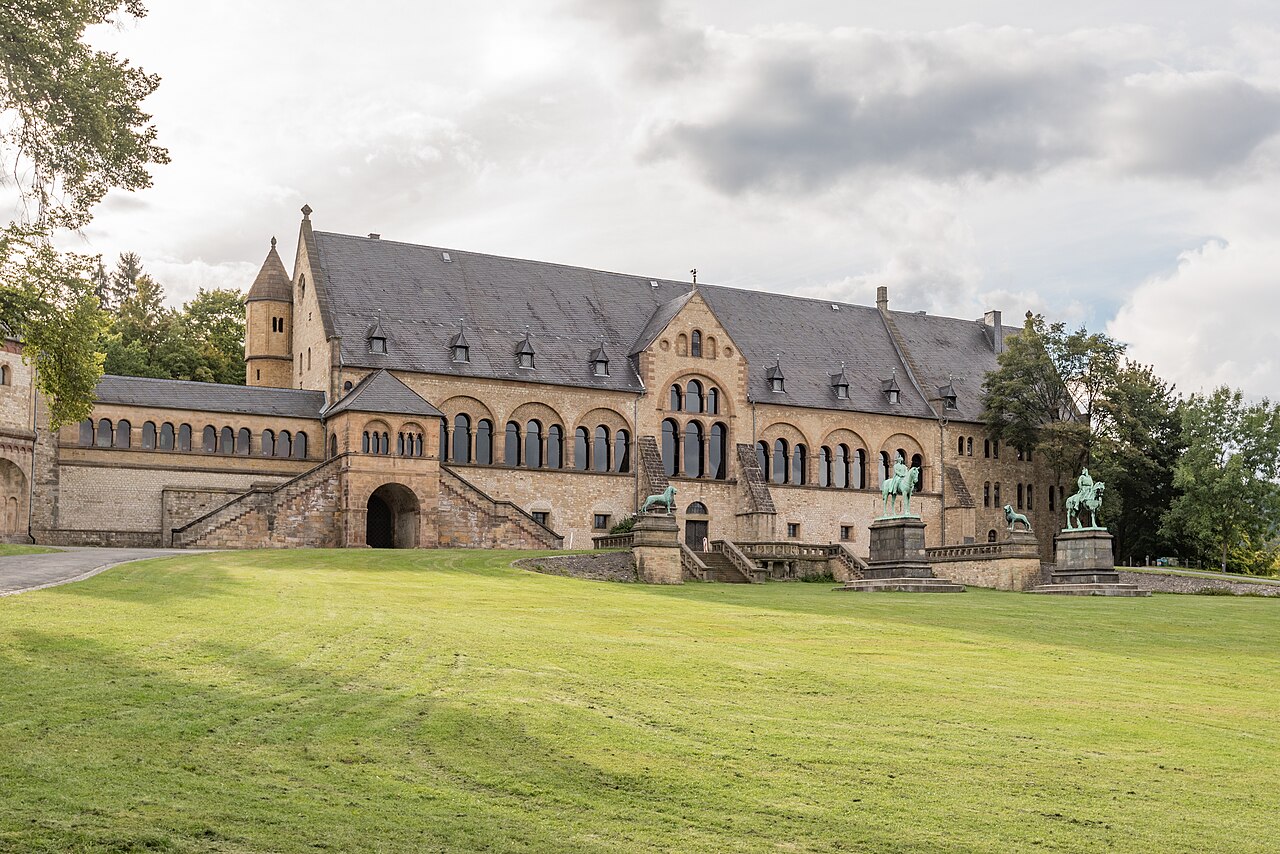
The Kaiserpfalz — the Imperial Palace of Goslar — stands on a low rise above the Gose stream, about ten minutes’ walk from the Rammelsberg entrance. Emperor Henry III ordered its construction between 1040 and 1050, and the result is the largest surviving Romanesque secular building in Germany: a two-storey hall 53 metres long with rounded apse ends and a fenestrated upper gallery. For roughly two hundred years after its completion, Holy Roman Emperors held imperial assemblies here, received ambassadors, issued decrees, and returned repeatedly when they could have stayed in any of dozens of other imperial residences scattered across the German lands.
Henry III’s attachment to Goslar was recorded by contemporaries as exceptional even for an emperor with a strong connection to the place. He allegedly declared he would rather die at Goslar than live anywhere else — and he kept the promise, dying in the Kaiserpfalz in 1056. His heart is buried in the collegiate church of St Simon and St Jude adjacent to the palace; the rest of his body was interred at Speyer Cathedral. The palace remained in regular imperial use through Henry IV and Henry V, hosting the Diet of Goslar multiple times, before political shifts in the twelfth century moved the centre of imperial gravity eastward and Goslar’s importance declined.
The building visitors see today is not entirely medieval. In 1879–1897 Kaiser Wilhelm I ordered a comprehensive restoration — more accurately, a reconstruction — that introduced large-scale historicist paintings in the main hall by Hermann Wislicenus. The paintings depict scenes from German imperial history with the nationalist fervour of the Wilhelmine era, and art historians have debated their appropriateness ever since. They are now themselves historical documents of nineteenth-century political culture, which creates an interpretive layer that the museum inside the palace addresses directly.
The historic town centre surrounding the palace rewards extended walking. The Marktplatz is one of the best-preserved medieval market squares in northern Germany, anchored by the Marktbrunnen — the market fountain decorated with the Imperial Eagle, a symbol of Goslar’s status as an imperial free city. The surrounding streets contain half-timbered buildings from the fifteenth to seventeenth centuries in densely packed rows; the Goslarer Museum on Königstraße holds finds from the mine alongside medieval metalwork. The collegiate church of St Cyriacus, the twelfth-century Neuwerk church, and several historic guildhalls complete a historic centre that is walkable in a full morning but rewards a longer stay.
The Upper Harz Water Management System: 500 km of Channels That Powered a Mine Upper Harz highlands, around Clausthal-Zellerfeld
The third component of the World Heritage designation — added in 2010 — is the Upper Harz Water Management System, a technical infrastructure of extraordinary scale built to solve a problem every deep mine eventually faces: water accumulation and the need for mechanical power. From the sixteenth century onward, miners and hydraulic engineers constructed an interconnected network of 65 artificial ponds (Teiche), approximately 500 kilometres of channels and ditches (Gräben), and underground drainage tunnels (Stollen) across the Harz highlands. The system was designed to collect rainwater and snowmelt, route it where needed, and release it to power waterwheels driving pumps, hoists, and stamping mills in the mines below.
The engineering achievement lies in the integration of elements across a landscape of hundreds of square kilometres. Individual ponds were connected by channels that followed elevation contours precisely, routing water around ridges and across valleys, storing it in wet seasons and releasing it during dry periods. The underground drainage tunnels — some of them kilometres long, driven through rock by hand — carried water out of the mine workings and simultaneously acted as delivery channels for fresh power water routed to different levels. Parts of the system remain functional today, used for drinking water supply and flood management rather than mining.
Hiking through the Upper Harz on any of the marked trails will bring walkers across channels, ponds, and sluice works from this system. The landscapes around Clausthal-Zellerfeld and Sankt Andreasberg are particularly dense with visible infrastructure. The Oberharzer Wasserregal — the formal historical right to manage these waters, established in the sixteenth century — was one of the earliest systematic frameworks for water resource management in European history, predating modern water law by centuries.
Practical information
Goslar is served by direct trains from Hanover (approximately 1 hour 15 minutes) and Braunschweig (approximately 45 minutes). By car, the A7 motorway connects to Goslar from the north via the B6. The historic centre and the Kaiserpfalz are easily walkable from the main railway station in under 15 minutes. The Rammelsberg mine museum is a further 15–20 minutes on foot from the market square, or reachable by a short bus journey.
The Rammelsberg mine museum (Bergbaumuseum Rammelsberg) is open daily; guided underground tours last approximately 90 minutes and require sturdy footwear — the temperature underground stays around 8°C year-round. The Kaiserpfalz is open to visitors daily from April to October and Tuesday through Sunday from November to March. Combined tickets covering the mine museum and the Kaiserpfalz are available. The Goslarer Museum on Königstraße holds the town’s historical collections and is worth a separate visit. The Upper Harz Water Management System can be explored on foot or by bicycle along the network of marked trails connecting the ponds and channels — maps are available at the Goslar tourist office and online. Quedlinburg Abbey, another UNESCO World Heritage Site, lies 45 km northeast of Goslar and is reachable by regional train via Halberstadt.
Frequently Asked Questions
How long did the Rammelsberg mine operate, and what made it so significant?
The Rammelsberg mine operated for just over 1,000 years, from approximately 968 CE to its closure in 1988 — one of the longest continuous working periods of any metal mine in recorded history. Its significance derives from several intersecting factors. First, the ore body was exceptionally rich: a single massive sulphide deposit containing silver, lead, zinc, copper, and gold in concentrations high enough to sustain extraction for a millennium. Second, the mine fell under imperial control from the earliest documented period, and its revenues directly funded the military campaigns, court expenditure, and administrative apparatus of the Holy Roman Empire during the high medieval period. The wealth from Rammelsberg was a material foundation for imperial power in the tenth through twelfth centuries in a way that is sometimes underappreciated in general historical accounts. Third, because the mine closed without having been fully exhausted or physically destroyed by later industrial processes, its underground workings preserve an unbroken record of mining technology from medieval pick-and-wedge methods through early modern water-powered machinery to twentieth-century mechanised extraction. Archaeologists and historians can read that technological sequence as a single continuous document. The UNESCO designation in 1992 recognised this combination of exceptional historical duration, imperial political significance, and physical integrity of the surviving evidence.
What is the Kaiserpfalz in Goslar, and how much of it is original medieval fabric?
The Kaiserpfalz is an imperial palace complex built between 1040 and 1050 on the orders of Emperor Henry III, making it one of the earliest and best-preserved Romanesque palace buildings in Germany. As originally constructed, it consisted of a two-storey great hall approximately 53 metres in length, a connected chapel dedicated to St Ulrich, and various ancillary structures. Holy Roman Emperors used the complex as a primary residence and assembly point for approximately two centuries. The answer to the question of original fabric requires care. The basic structural shell of the great hall — its walls, rounded apses, and general form — is substantially medieval in origin, though it had been in a ruined state for several centuries before restoration. The comprehensive restoration programme carried out between 1879 and 1897 under Kaiser Wilhelm I repaired the fabric but also introduced significant interventions: the large-scale cycle of historicist paintings by Hermann Wislicenus in the upper hall depicts scenes from German imperial history in the style of nineteenth-century nationalism and has no medieval precedent. Visitors therefore experience a building that is simultaneously an authentic medieval structure and a Wilhelmine-era political monument. The palace museum interprets both layers honestly, which makes it a more intellectually interesting visit than a purely “original” monument would be.
What is the Upper Harz Water Management System and can visitors see it?
The Upper Harz Water Management System is a network of hydraulic infrastructure built between the sixteenth and nineteenth centuries to supply power and drainage to the mines of the Harz mountains, including Rammelsberg. It consists of 65 artificial storage ponds (Teiche), approximately 500 kilometres of open channels and ditches (Gräben) following the landscape contours, and a series of underground drainage and conveyance tunnels (Stollen). The system worked by collecting rainwater and snowmelt in the highland ponds during wet seasons, then releasing it in controlled flows to power waterwheels that drove mine pumps, hoists, and processing machinery. It was one of the most sophisticated hydraulic engineering systems in early modern Europe, and parts of it remain in operational use today for water supply and flood control. Visitors can absolutely see it: the Upper Harz highlands around Clausthal-Zellerfeld and Sankt Andreasberg are crossed by marked hiking and cycling trails that pass directly alongside the channels, ponds, and sluice structures. The terrain is relatively gentle by mountain standards, and many sections of the Grabenweg trail system are accessible to walkers of moderate fitness. The landscapes are pleasant in all seasons, though spring and autumn offer the best combination of water flow and visibility. The UNESCO designation for this component was added in 2010, extending the original 1992 listing.