
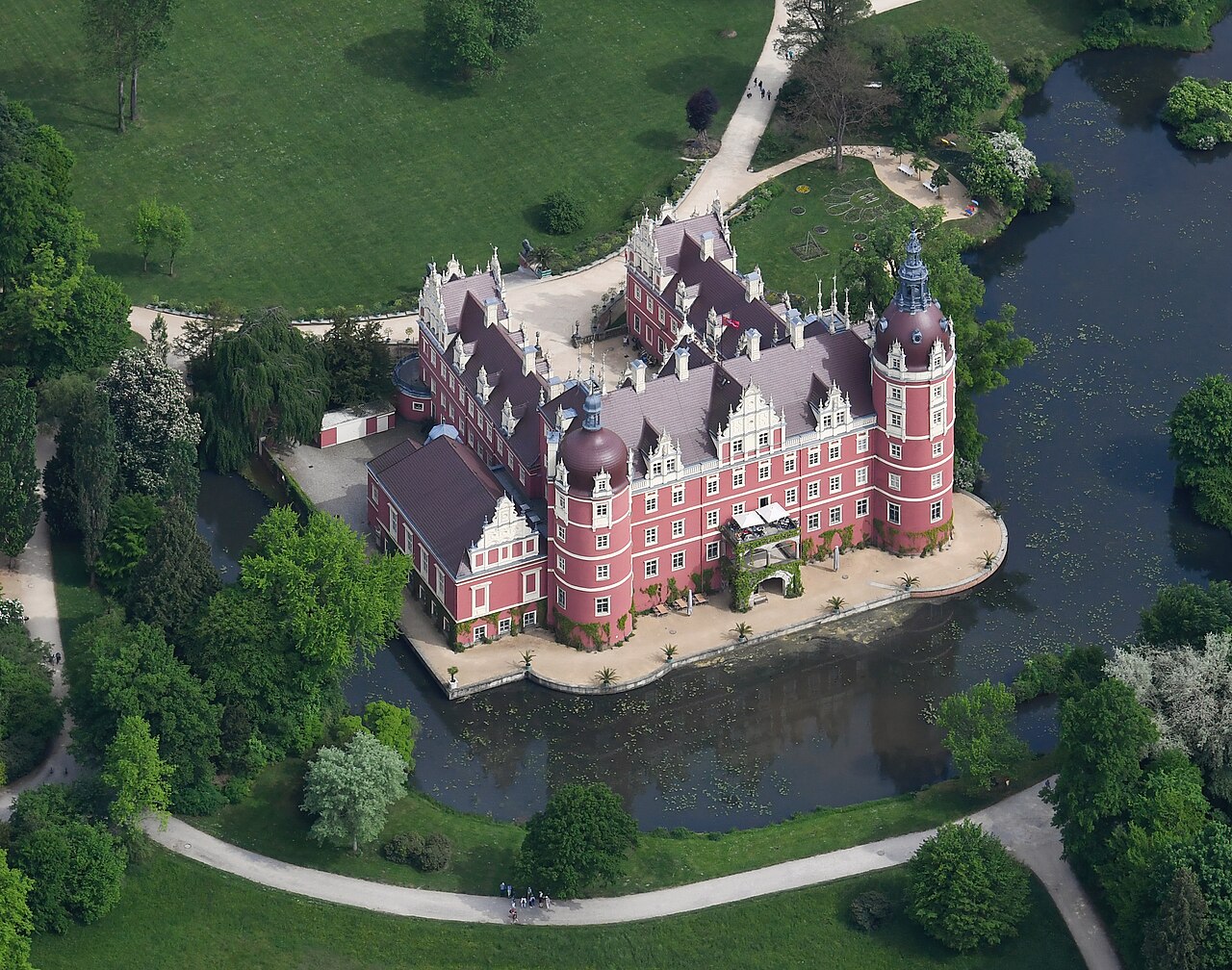
Muskauer Park — Park Mużakowski in Polish — covers 830 hectares across the German-Polish border, with the Lusatian Neisse River running through its centre as the axis around which Prince Hermann von Pückler-Muskau designed one of the most ambitious landscape gardens of the 19th century. Pückler built it from 1815 to 1844, spent two fortunes doing it, and sold the estate in 1845 to fund his travels in North Africa. The park was divided by the post-war Oder-Neisse line in 1945, reunited administratively after 1989, and inscribed as a trans-border UNESCO World Heritage Site in 2004. The New Castle on the German side, destroyed in the war’s final weeks, was fully rebuilt between 2003 and 2015.
A landscape park designed to look like nature Bad Muskau (Germany) and Łęknica (Poland) — 120 km northwest of Wrocław, 180 km east of Dresden
Hermann von Pückler-Muskau inherited the Muskau estate in 1811 and began transforming it four years later. His ambition was total: he wanted to redesign the entire landscape — not a formal garden within a park, but a park that would read as a naturalised, perfected version of the existing terrain. Working in the English landscape tradition established by Capability Brown and Humphry Repton, Pückler followed the topography of the Neisse valley, using the river bends, the meadow edges, and the woodland masses as the raw material for a composition that was to appear entirely natural while being entirely designed.
The difference between the English landscape style and the French formal garden that had dominated European aristocratic horticulture is fundamental. A French formal garden — Versailles is the extreme case — imposes a geometric order on nature: clipped hedges, parterres, straight allées, symmetrical pools. The English landscape park reverses this: it curves everything, hides the estate walls, lets the grass run to the water’s edge, places trees in informal groups rather than avenues, and designs walks that reveal vistas gradually rather than all at once. Pückler was the leading German practitioner of this approach, and his 1834 book “Andeutungen über Landschaftsgärtnerei” (published in English as “Hints on Landscape Gardening”) was read across Europe and in North America, where it influenced the design of Central Park in New York through its effect on Frederick Law Olmsted’s thinking.
The park at Muskau runs for several kilometres along both banks of the Neisse. On the German side (Bad Muskau), the New Castle stands on a raised position above the river with views over the formal terraced gardens that descend to the water — the one part of the park where Pückler allowed himself an ordered, axial design, as a transition zone between the built structure and the naturalistic landscape beyond. The Polish side (Łęknica) was historically the pleasure ground and the agricultural support area of the estate; after 1945 it became separated from the castle and gardens and fell into a different kind of use. The post-1989 restoration programme has progressively reunited the park’s management and restored the connecting bridges across the Neisse to pedestrian use.
Pückler’s personality is inseparable from the park. He was an aristocratic eccentric: a travel writer (his account of his time in England and Ireland, written as anonymous letters and published in 1830, was a European literary sensation), an abolitionist at a time when that was unusual in German-speaking Europe, and a man who twice spent himself to the edge of ruin pursuing his horticultural vision. He sold his first wife’s jewellery to fund plantings. He eventually sold the entire Muskau estate in 1845 to Duke Wilhelm of the Netherlands — keeping the title and moving to another property — and used the proceeds to travel in North Africa, producing another travel book that was equally successful. The park outlasted its creator’s ownership by 180 years.
The Cold War border and the park reunited Cross-border on foot via restored Neisse bridges — German side by car from Cottbus or Görlitz; Polish side from Zielona Góra or Żagań
The Oder-Neisse Line was established at the Potsdam Conference in August 1945 as the provisional western border of Poland pending a final peace treaty with Germany. It followed the Oder and Lusatian Neisse rivers south from the Baltic, and it cut directly through the Muskau estate. Bad Muskau and the New Castle remained in East Germany (the German Democratic Republic); the Polish portion of the park fell under the administration of the People’s Republic of Poland, administered as the town of Łęknica. For forty-four years, the Neisse bridges were closed to ordinary movement; the park existed in two different national systems with no coordinated management.
The final German-Polish border treaty of 1990 confirmed the Oder-Neisse Line as permanent, removing the legal ambiguity that had characterised the postwar period. With the border question settled, cross-border cooperation became possible. A joint German-Polish restoration and management programme began in the 1990s, and by the time UNESCO inscribed the park in 2004, it was operating as a functionally unified site for the first time since 1945. The Neisse bridges — several of them designed by Pückler as integral elements of the park’s landscape composition — were reopened for pedestrian and cycle crossing, allowing visitors to walk from the German to the Polish side without formality.
The New Castle (Neues Schloss) tells the story of destruction and recovery in compressed form. The building was a Neo-Gothic and Neo-Renaissance palace that Pückler began remodelling in the 1820s; it was largely destroyed in the last days of World War II as Soviet and German forces fought through the area in February 1945. The ruin stood for decades, used variously as storage and a local cultural facility, until a systematic rebuilding campaign began in 2003. The castle was fully restored by 2015 and now operates as a museum with exhibitions on the park’s history and on Pückler’s life and work. The interiors are reconstructed rather than original, but the exterior is faithful to the 19th-century design and the building’s position above the terraced gardens is as Pückler intended.
The Centennial Hall in Wrocław, inscribed separately on the UNESCO World Heritage List in 2006, is approximately 120 kilometres to the east — close enough to combine in a multi-day itinerary. The Collegial Church and the broader Quedlinburg ensemble in Saxony-Anhalt, another UNESCO site, lies about 220 kilometres to the west across Germany, a different direction of travel but reachable for visitors spending longer in the region.
Practical information
The park is freely accessible on both sides of the border. The German side (Bad Muskau) is reached by car from Cottbus (about 50 km north) or Görlitz (about 50 km south). The Polish side (Łęknica) is most easily reached from Zielona Góra (about 80 km northeast) or from Żagań. A direct train from Berlin to Bad Muskau does not exist; the nearest rail stations are Weißwasser (Germany) and Żagań (Poland), both requiring a taxi or bus connection for the last stretch.
Admission to the park is free. Entry to the New Castle museum carries an admission charge (check current prices at the castle website). The park is at its most rewarding in late spring (May–June) when the flowering plantings are in season, and in autumn (September–October) when the deciduous woodland shows its full range of colour — exactly as Pückler designed it, choosing species for seasonal effect. Winter is open and often quiet, giving a clear view of the park’s spatial structure without leaf cover.
Bad Muskau has a small range of accommodation; Görlitz (a beautifully preserved Baroque and medieval city in its own right) is a better base with more options. On the Polish side, Łęknica and Żagań have basic facilities. Cyclists will find the park particularly rewarding — the entire circuit of the park on both sides can be completed in a half-day at an easy pace.
Frequently Asked Questions
Who was Prince Pückler-Muskau and why does he matter to landscape design?
Hermann Ludwig Heinrich von Pückler-Muskau (1785–1871) was a Prussian nobleman, travel writer, and landscape designer who is considered the most important figure in the development of the English landscape style in German-speaking Europe. He inherited the Muskau estate in 1811 and spent the next three decades remaking it according to principles he had studied during extended visits to England, where he met and corresponded with John Nash, the architect responsible for London’s Regent’s Park. His 1834 book “Andeutungen über Landschaftsgärtnerei” — translated into English as “Hints on Landscape Gardening” — was the first systematic German-language treatment of the English landscape tradition and remained in print and in use for decades. The American landscape architect Frederick Law Olmsted, who designed Central Park in New York and Prospect Park in Brooklyn, is known to have read Pückler’s work, and the influence of his ideas on naturalistic urban park design in the United States has been documented by landscape historians. Beyond his professional legacy, Pückler was a vivid literary personality: his pseudonymous letters from England and Ireland (“Briefe eines Verstorbenen,” 1830) were a bestseller across Europe, written with the wit and sociological observation of a man who was simultaneously insider and outsider in English aristocratic society. His later travels in North Africa and the Middle East produced equally readable accounts. He lived until 1871 at his second estate at Branitz, where he created another significant landscape park (now in Cottbus, Germany) and where he was buried in a pyramid he had constructed in the lake.
What does it mean for a UNESCO site to be trans-border?
A trans-border UNESCO World Heritage Site is a single inscription that covers territory in two or more countries, recognised as a single outstanding universal value that happens to cross a national boundary. Muskauer Park / Park Mużakowski is one of several dozen such sites on the World Heritage List — others include the Primeval Beech Forests shared between Germany, Slovakia, Ukraine, and several other European countries, and the Prehistoric Rock Art of the Côa Valley and Siega Verde, shared between Portugal and Spain. The nomination process for trans-border sites requires both (or all) countries to submit coordinated documentation and to agree on joint management arrangements. For Muskauer Park, the inscription in 2004 formalised an already-existing bilateral management programme that Germany and Poland had established after German reunification and the settlement of the border question in 1990. Trans-border inscriptions are significant not only as heritage recognition but as diplomatic instruments: they commit neighbouring countries to sustained cooperation on a shared resource, which requires joint governance structures, shared funding, and agreed conservation standards. In the case of Muskau, the practical result is that a visitor can walk from Germany into Poland across a bridge that was closed for four decades, in a park that was designed as a unified whole and is now managed as one again.
Is the rebuilt New Castle authentic, or is it a reconstruction?
The New Castle (Neues Schloss) at Bad Muskau is explicitly a reconstruction rather than a restoration of original fabric. The building was largely destroyed in February 1945 during fighting in the final weeks of World War II, and the ruin stood for sixty years before the rebuilding programme began in 2003. The project was completed in 2015. What visitors see today is a faithful replica of the 19th-century palace based on historical documentation — photographs, architectural drawings, and written descriptions — rather than original stonework or plasterwork. This is a significant distinction in heritage conservation terms: a restoration preserves and consolidates original material; a reconstruction rebuilds a lost structure using new materials. UNESCO’s inscription of the park in 2004, during the rebuilding process, recognised the castle and the park together as a cultural landscape in which the designed relationship between built structure and garden is the outstanding value — not the building fabric alone. The reconstruction is therefore consistent with the inscription’s logic: the castle is important as an element of the designed landscape, and its rebuilt presence restores the park’s intended spatial composition. The museum inside uses the rebuilt interiors to tell the history of the estate and of Pückler’s life, which is appropriate given that the interiors were never preserved in any case.
Sources
- S1 — Bowman, Cordelia. Fürst Pücklers Park in Bad Muskau. Nicolai Verlag, 2004. ISBN 978-3-89479-168-1.
- S2 — Rohde, Michael. Pücklers Parkwelten: Parklandschaften an Neisse und Spree. DKV, 2008. ISBN 978-3-422-02112-9.
Spotted an error? Write to editorial@culturalheritageonline.com and we correct it the same day.

.jpg)