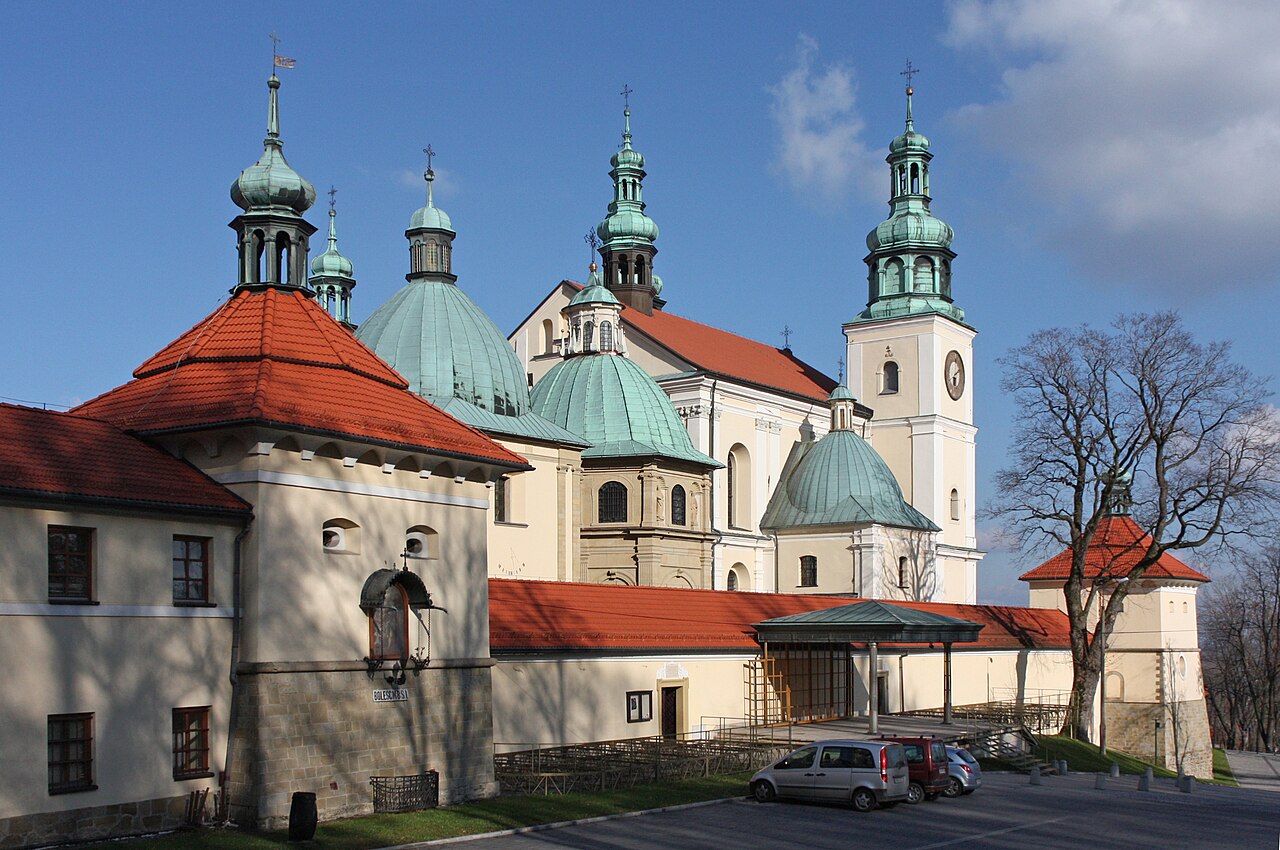
Kalwaria Zebrzydowska is a pilgrimage complex spread across the wooded hills of the Beskid Makowski range, 35 kilometres south of Kraków. Its founder commissioned 40 chapels and churches to recreate the topography of Jerusalem across the Polish landscape — a sacred geography that has drawn pilgrims continuously since 1600. UNESCO inscribed it in 1999 as an outstanding example of the intentional integration of a religious landscape with its natural setting, and as a living cultural tradition that has never been interrupted.
Jerusalem Mapped onto the Polish Hills: 40 Chapels Across a Mannerist Landscape 35 km south of Kraków · bus from Kraków Główny bus station, 50 min
The founding of Kalwaria Zebrzydowska in 1600 was an act of topographical imagination on a considerable scale. Mikołaj Zebrzydowski, Voivode of Kraków and one of the most powerful magnates in the Polish-Lithuanian Commonwealth, studied accounts of Jerusalem’s sacred geography and identified in the hills of his Zebrzydów estate a landscape whose contours he believed corresponded to the actual topography of the Holy Land. The comparison was not merely poetic: Zebrzydowski had surveys made of the hills and measured distances to ensure that the intervals between stations on the Via Crucis — the Way of the Cross — matched the distances between corresponding sites in Jerusalem as closely as the terrain allowed.
Working with two architects — the Flemish Giovanni Maria Bernardoni and later Paweł Baudarth — Zebrzydowski commissioned a programme of construction that continued through the first decades of the 17th century. The result was 40 chapels and churches distributed across the hillsides, connected by a network of paths and roads that constitute the pilgrimage route. Each station on the route corresponded to an episode in the Passion narrative; the distances between them were calibrated to the accounts of those who had measured the actual Via Dolorosa in Jerusalem. The pilgrim who walks the full route traverses a sacred landscape that is simultaneously Polish countryside and symbolic Holy Land.
The architectural programme is Mannerist in character: the individual chapels and churches reflect the late Renaissance style that prevailed in the Polish-Lithuanian Commonwealth in the early 17th century, with decorative programmes drawn from Flemish and Italian sources. The Bernardine monastery at the complex’s centre, founded in 1602 and expanded repeatedly over the following century, is the largest building in the ensemble and the organisational hub of the pilgrimage. Its church, the Basilica of Our Lady of the Angels, was built between 1603 and 1641 and contains the centrepiece of the complex’s Marian devotion: a painting of the Virgin Mary, venerated as miraculous and granted the title “Queen of Poland” following a formal coronation ceremony in 1641. The painting drew pilgrims to the site in such numbers that the town that grew around the monastery — Kalwaria Zebrzydowska — became one of the most important Marian shrines in Central Europe.
The concept of a Calvary pilgrimage complex — a landscaped recreation of Jerusalem’s sacred topography — was not unique to Poland in the early 17th century. Similar sacred landscapes were established across Catholic Europe in the late 16th and early 17th centuries, from the Sacro Monte complexes in northern Italy (several of which are themselves UNESCO World Heritage Sites) to similar foundations in Spain and Portugal. What distinguishes Kalwaria Zebrzydowska is the scale of its ambition, the degree to which the natural landscape was incorporated rather than merely used as a backdrop, and the unbroken continuity of the living pilgrimage tradition that has used it since its foundation.
The Shrine John Paul II Called His Own — and 400 Years of Living Pilgrimage Basilica open daily · pilgrimage paths open year-round
Kalwaria Zebrzydowska holds a specific significance in contemporary Polish religious life that stems from its connection to Karol Wojtyła, who became Pope John Paul II in 1978. Wojtyła grew up in Wadowice, a town approximately 15 kilometres west of Kalwaria Zebrzydowska; the pilgrimage complex was a central presence in his childhood and youth. He visited the sanctuary many times over the course of his life, both before and after becoming pope, and described it in characteristically direct terms: “the sanctuary which is very dear to me.” Following his election as pope, he returned to the complex on several occasions during his pastoral visits to Poland, celebrating mass for crowds in the hundreds of thousands on the hillsides of the pilgrimage route.
The papal connection is an intensification of a tradition of pilgrimage that was already ancient by the mid-20th century. The Passion Mystery plays — dramatic re-enactments of the events of Holy Week performed across the entire landscape of the complex — have been staged annually since the 17th century. The Good Friday procession, in which the stations of the Via Crucis are performed sequentially across the hillside chapels with the participation of thousands of pilgrims taking on the roles of the Gospel narrative, draws up to 50,000 participants and spectators each year. This is not a theatrical performance for tourists: it is a living religious practice that has functioned continuously for more than three centuries, with the same liturgical form, across the same landscape, using the same physical path network that Zebrzydowski established in 1600.
The UNESCO inscription of 1999 recognised several interlocking values. The architectural ensemble of 40 chapels and churches is significant in itself as an exceptionally complete example of a Mannerist sacred landscape. But the committee’s assessment placed particular weight on what UNESCO calls the “integrity” of the site: the fact that the pilgrimage tradition, the physical landscape, and the built architecture have all survived together without fundamental interruption. Most comparable sacred landscapes in Europe were disrupted by the Reformation, the French Revolution, or the political upheavals of the 20th century; at Kalwaria Zebrzydowska, the continuity is genuine and verifiable.
The surrounding UNESCO landscape is dense. The Wieliczka Salt Mine lies 35 kilometres northeast, and the Historic Centre of Kraków is the same distance north — both inscribed in 1978 as part of the inaugural World Heritage List. The Wooden Churches of Southern Małopolska, a serial UNESCO inscription covering several timber-built churches from the 15th and 16th centuries, lies 40 to 80 kilometres to the east. No other region in Poland concentrates a comparable density of World Heritage Sites within a single day’s travel.
Practical information
Kalwaria Zebrzydowska is 35 kilometres south of Kraków. Buses depart from Kraków’s main bus station (Dworzec Autobusowy MDA, adjacent to Kraków Główny railway station) several times per hour throughout the day; the journey takes approximately 50 minutes. By car, the drive from Kraków’s city centre via the DK52 road takes around 45 minutes, with parking available near the monastery. The nearest train station is in Kalwaria Zebrzydowska town, served by regional trains from Kraków — a slightly longer journey with less frequent departures than the bus.
The monastery complex and basilica are open to visitors daily; entry to the church and monastery courtyard is free. The pilgrimage paths connecting the 40 chapels are open year-round and can be walked independently with a map available from the monastery’s information office. The full route across all stations takes between three and five hours to walk; shorter circuits covering the central chapels and the monastery can be completed in one to two hours. Some of the more remote chapels on the outer circuit are reached by footpaths through woodland and may be muddy in wet weather.
The most significant time to visit is Holy Week, particularly Good Friday, when the Passion Mystery plays draw tens of thousands of pilgrims. The August holiday period (around the Feast of the Assumption on 15 August) is the second peak pilgrimage season, with large celebrations at the basilica. Outside these periods, the complex is relatively quiet and can be explored at leisure. Accommodation is available in the town of Kalwaria Zebrzydowska itself, with additional options in Wadowice (15 km west) and the full range of Kraków’s hotels accessible as a day-trip base.
Frequently Asked Questions
How does Kalwaria Zebrzydowska compare to the Sacro Monte complexes in Italy?
The Sacro Monte complexes of Piedmont and Lombardy — nine of which were inscribed as a group on the UNESCO World Heritage List in 2003 — represent the same tradition of sacred landscape architecture that produced Kalwaria Zebrzydowska. Both arose in the Catholic world’s response to the Reformation in the late 16th and early 17th centuries: the creation of accessible holy landscapes that allowed pilgrims who could not travel to Jerusalem or Rome to engage with the Passion narrative in a physical, embodied way. The Sacro Monte at Varallo, the earliest and most elaborate, was begun in the 1480s and expanded through the 17th century; its chapels are filled with life-size painted terracotta figures depicting Gospel scenes with the realism of the Counter-Reformation. Kalwaria Zebrzydowska is larger in geographical scale — its 40 chapels are spread across a landscape of several square kilometres — and its tradition of living dramatic performance during Holy Week is arguably more sustained than at any of the Italian comparators. The key difference in UNESCO terms is that the Italian Sacro Monte complexes were inscribed partly as works of art — the painted chapels are themselves the heritage — while Kalwaria’s inscription weighed more heavily on the integration of landscape and living tradition. Both represent the same impulse: the human desire to make the sacred geography of the Holy Land physically present in a local landscape.
What is the significance of the miraculous painting at the Basilica of Our Lady of the Angels?
The painting of the Virgin Mary venerated at Kalwaria Zebrzydowska’s Basilica of Our Lady of the Angels is classified as a miraculous image in Catholic devotional tradition — meaning it has been associated by the Church with documented or reported miraculous healings and interventions. The painting dates from the early 17th century and was formally crowned as the “Queen of Poland” in 1641, a title that in Polish Catholic tradition carries both religious and national significance: the Virgin Mary’s protective role over Poland is a central motif of Polish Catholicism that intensified during the 17th century, when the Commonwealth faced existential military threats from multiple directions. The painting’s coronation at Kalwaria Zebrzydowska preceded by a decade the vows of King Jan II Kazimierz at Lwów in 1656, when he consecrated Poland to the Virgin Mary following the Swedish invasion. The two acts belong to the same cultural-religious movement. The painting draws pilgrims to the basilica throughout the year; ex-votos — votive offerings left by pilgrims who attribute favours received to the image’s intercession — line the walls of the basilica in large numbers, providing a direct material record of continuous devotion from the 17th century to the present. The image was restored and re-crowned in 1887 and again in 2002 during Pope John Paul II’s last pastoral visit to Poland.
Can the Passion Mystery plays at Kalwaria be attended by non-Catholic visitors?
The Passion Mystery plays at Kalwaria Zebrzydowska during Holy Week are public events held on public paths and hillsides, not enclosed liturgical ceremonies requiring religious affiliation. Non-Catholic visitors attend regularly, both as observers of a remarkable cultural and theatrical tradition and as tourists interested in the heritage of the site. The Good Friday procession is the centrepiece: it begins in the morning and continues through the afternoon, with participants — some in costume as Roman soldiers, disciples, and other figures from the Passion narrative — moving between the 40 chapels across the hillside in a sequence that follows the traditional Stations of the Cross. The crowd of pilgrims and visitors that joins the procession can reach 40,000 to 50,000 people, making it one of the largest outdoor religious gatherings in Poland. The atmosphere is genuinely devotional rather than theatrical — this is not a performance staged for visitors but a practice maintained by a living religious community for its own purposes — but non-Catholics are welcome to walk alongside and observe. Practical considerations: arrive early, wear comfortable shoes suitable for uneven hillside paths, and be prepared for slow movement through large crowds at the most popular stations. The events are held regardless of weather; April weather in the Beskid Makowski hills can be cold and wet, and appropriate clothing is essential.