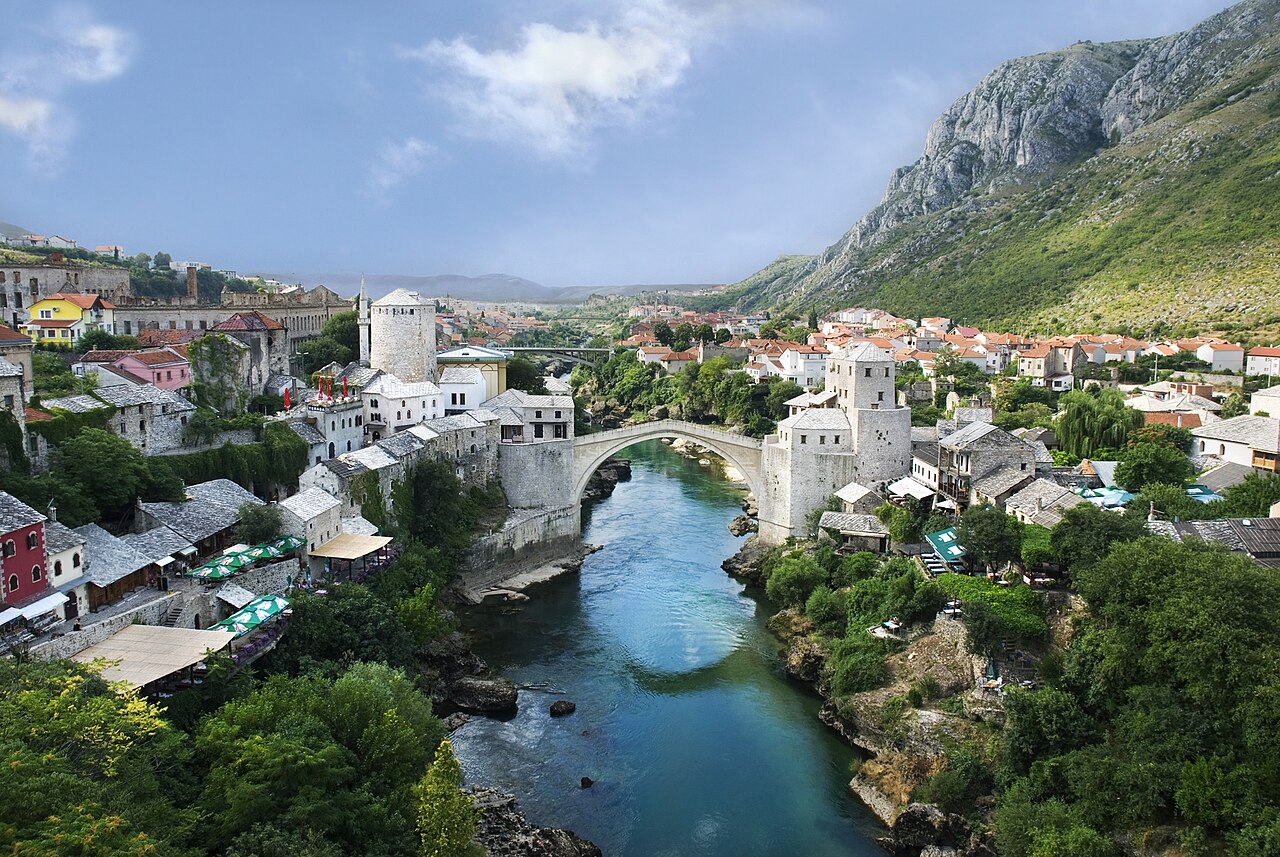
The Stari Most (Old Bridge) in Mostar, Bosnia and Herzegovina, was built in 1566 by Ottoman architect Mimar Hayruddin: a single elegant arch of 29 metres spanning the Neretva River that was, at the time of its construction, the widest arch bridge in the world. Croatian military forces shelled it to destruction on 9 November 1993. It was rebuilt using the same Turkish limestone from the same quarry and reopened in 2004; UNESCO inscribed the Old Bridge Area as a World Heritage Site in 2005. The reconstruction is itself now part of the site’s meaning.
The 1566 Ottoman Bridge and the City It Defined Mostar, Herzegovina · Bosnia and Herzegovina · 130 km from Dubrovnik
Mostar takes its name from the mostari — the bridge-keepers — who guarded the first wooden crossing over the Neretva River at this location during the early Ottoman period. When the Ottoman governor Suleiman Pasha commissioned a permanent stone bridge in the 1550s, the task went to Mimar Hayruddin, a student of the great imperial architect Mimar Sinan, who had built the Süleymaniye Mosque in Istanbul and the Selimiye Mosque in Edirne. Hayruddin’s design for the Mostar bridge is far smaller in scale than his master’s celebrated works, but it represents a structural achievement of comparable ambition: a single semicircular arch of tenelija limestone — a compact, slightly soft stone quarried from the hills above the Neretva — spanning 29 metres with a rise of 21 metres above the river’s surface. When it was completed in 1566, after nine years of construction, it was the widest single-arch bridge in the world.
The technical challenge was considerable. Tenelija hardens on exposure to air, which made it ideal for a bridge that needed to resist the force of mountain river floods but required careful management during construction: the stone had to be quarried, shaped, and set before it hardened fully. Contemporary Ottoman accounts describe the construction as a risky undertaking; Hayruddin reportedly feared failure to the point of making preparations to flee if the scaffolding was removed and the arch collapsed. It held. The bridge became the defining landmark of Mostar, the connection between the Muslim-majority eastern bank (Kujundžiluk bazaar, the old town, the mosques) and the mixed western bank, and the symbol of the city’s Ottoman urban identity.
The wider old town (Stari Grad) that UNESCO designated in 2005 is a 16th-century Ottoman urban ensemble that grew up around the bridge as its commercial and religious nucleus. The Kujundžiluk bazaar — a street of small workshops and shops selling copper goods, textiles, and leather — runs from the bridge head eastward and is one of the best-preserved Ottoman bazaars in the Balkans, active and inhabited rather than museumified. The hammam (bathhouse) at the bridge head dates to the 16th century; several hans (caravanserais) survive in modified form. The Koski Mehmed Pasha Mosque, built in 1617, stands a short distance from the bridge on the eastern bank; its minaret offers the most comprehensive aerial view of the bridge, river, and surrounding old town available to visitors.
Two towers flanked the original bridge as defensive structures. The Tara tower on the eastern bank and the Helebija tower on the western bank were built contemporaneously with the bridge and housed the bridge-keepers and a small garrison. Both towers survive; the Helebija tower now functions as a diving association clubhouse, connected to the long tradition of competitive bridge-diving that has been practised at Mostar since 1664.
The bridge and old town are understood by UNESCO not merely as a well-preserved Ottoman urban landscape but as an example of a multicultural meeting point — the physical evidence of several centuries of coexistence between Muslim, Orthodox Christian, Catholic, and Sephardic Jewish communities in a single city. That characterisation makes the events of 1993 part of the site’s meaning rather than merely its prehistory.
Destruction and Reconstruction: 1993, 2004, and the Meaning of the Rebuilt Bridge Old Bridge · historic district · walkable from central Mostar
The Bosnian War began in April 1992. Mostar, located in Herzegovina near the Croatian border, became a site of particularly complex fighting: initially, Bosniak (Bosnian Muslim) and Croat forces allied against the Bosnian Serb Army, but from mid-1993 the Croatian Defence Council (HVO) and the Army of the Republic of Bosnia and Herzegovina turned against each other in a brutal conflict within the city. The front line ran along the Neretva River, dividing the Muslim eastern bank from the Croatian-controlled western bank.
The Stari Most bridge was a target of deliberate military action. On 9 November 1993, Croatian forces positioned a tank and artillery on the heights above the western bank and opened fire on the bridge over the course of the day. The arch — which had stood for 427 years through multiple wars, floods, and earthquakes — collapsed into the Neretva that afternoon. Eyewitness accounts describe the city falling silent when the bridge fell; for many Bosniak residents, the destruction was understood as an attempt to erase the Ottoman identity of the city along with its physical landmark. The date — coincidentally the fourth anniversary of the fall of the Berlin Wall — added a bitter irony to the timing.
The reconstruction began in 2001 after a post-war period of documentation and archaeological recovery. Blocks of the original tenelija limestone were recovered from the riverbed by divers; the quarry at Mukoša, above Mostar, which had supplied Hayruddin’s original stone, was reopened. Ottoman construction techniques were studied from historical sources, and Turkish engineers from the government of Turkey (which contributed major funding to the project) worked alongside Bosnian craftsmen. The arch was built using traditional methods including hand-cut stone and the same geometric proportions as the original. The rebuilt bridge was inaugurated on 23 July 2004 in a ceremony attended by international dignitaries; UNESCO inscribed the Old Bridge Area on the World Heritage List in 2005, explicitly noting that the reconstruction demonstrated the possibility of renewal after destruction and recognising the site as a symbol of reconciliation.
The bridge diving tradition adds another layer. Since 1664, Mostar’s young men have been diving from the top of the Stari Most into the Neretva — a jump of approximately 21 metres into river water that maintains a temperature of around 10°C year-round due to its source in mountain snowmelt. The annual Stari Most Bridge Diving Competition, held each July, draws professional and amateur divers and large crowds. The dive itself requires a running jump from the parapet to clear the bridge’s curved sides; an imperfectly executed entry at that height and water temperature can cause serious injury. The tradition continued during and after the war, resuming on the rebuilt bridge as a statement of continuity.
The surrounding UNESCO landscape reinforces Mostar’s position at a historical crossroads. The Old City of Dubrovnik, 130 km to the southwest along the Adriatic coast in Croatia, is a late medieval and Renaissance walled city that represents the heritage of the independent Republic of Ragusa; its relationship with Mostar reflects centuries of Adriatic–Balkan trade networks. Kotor in Montenegro, 120 km to the south, is a walled Venetian city on the Bay of Kotor; like Dubrovnik, it represents the Venetian sphere of influence on the eastern Adriatic. The Natural and Cultural Heritage of the Ohrid Region, 450 km to the east in North Macedonia, is a mixed site centred on Lake Ohrid and the medieval city of Ohrid, which contains early Byzantine churches and the see of an ancient Orthodox archbishopric.
Practical information
Mostar is well connected by road and rail. From Sarajevo, the journey by bus takes approximately 2.5 hours; by train (a scenic route through the Neretva Canyon) approximately 2 hours 15 minutes. From Dubrovnik, Croatia, buses run year-round to Mostar in approximately 3–3.5 hours; many visitors combine the two cities in a single itinerary. From Split, Croatia, the journey by bus or car takes approximately 3–4 hours via the coastal route and the Makarska hinterland. The Stari Most bridge and the Stari Grad (old town) are walkable from the central bus station in under ten minutes. There is no entrance fee to the bridge or the old town streets; the Koski Mehmed Pasha Mosque charges a small admission. The minaret climb at the mosque (approximately €3) is the recommended viewpoint for the bridge. The Tara tower (eastern bank) houses a small museum about the bridge’s history. Summer (June–August) is the busiest season; the Bridge Diving Competition in late July draws large crowds. Spring and autumn are quieter and more comfortable for walking. Accommodation in Mostar ranges from family-run guesthouses in the old town (typically modest and very affordable) to small boutique hotels; the most atmospheric options are on the eastern bank within a few minutes of the bridge. Day-trippers from Dubrovnik and Split are numerous in summer; an overnight stay allows the old town to be seen in the early morning and evening when the crowds have thinned.
Frequently Asked Questions
Why was the Stari Most bridge destroyed in 1993, and was it intentional?
The destruction of the Stari Most on 9 November 1993 was deliberate. International criminal proceedings and the subsequent investigation by the International Criminal Tribunal for the former Yugoslavia (ICTY) established that Croatian Defence Council (HVO) forces positioned artillery on the heights above the western bank of the Neretva and fired on the bridge over the course of several hours, causing the arch to collapse. The bridge had no military function: it did not serve as a supply route for military forces and its destruction provided no tactical advantage. Mostar’s commander at the time, General Slobodan Praljak, was tried and convicted by the ICTY for war crimes including the destruction of the bridge; he died in 2017 after swallowing poison in the courtroom following the upholding of his conviction on appeal. The deliberate targeting of a civilian cultural monument is prohibited under the 1954 Hague Convention for the Protection of Cultural Property in the Event of Armed Conflict, and the ICTY treated the destruction of the bridge as evidence of the broader campaign against Bosniak cultural identity in Mostar. Historians and legal scholars have noted that the choice of target — a bridge built by Ottoman architects in 1566 and long identified with the Muslim heritage of the city — was evidently symbolic as well as destructive. The date, coinciding with the anniversary of the fall of the Berlin Wall and the German Kristallnacht pogrom of 1938, was noted by commentators at the time, though whether the timing was deliberate has not been established.
How authentic is the rebuilt Stari Most bridge — is it the same bridge?
The rebuilt Stari Most, inaugurated in 2004, is as close to the original as the available evidence and traditional techniques permitted. The reconstruction was a serious engineering and historical research project, not a rapid replacement. Blocks of the original tenelija limestone were recovered from the Neretva riverbed by divers after the 1993 collapse; many of these original stones were incorporated into the rebuilt structure where their condition permitted. The quarry at Mukoša above Mostar, which had supplied the stone for Hayruddin’s 1566 bridge, was reopened specifically for the reconstruction. The geometric proportions of the arch — its span, rise, and curvature — were taken directly from pre-war surveys and historical documentation rather than estimated. Ottoman stone-cutting and construction techniques were researched from historical sources, and Turkish engineers from the Turkish government (a major financial contributor to the project) collaborated with Bosnian craftsmen trained in traditional methods. The scaffolding and centering techniques used to support the arch during construction replicated, as far as possible, what historical accounts described for the original. The result is a bridge built from the same material using the same geometry and the same techniques as the 1566 original. Whether it is “the same bridge” is a philosophical question about the ship of Theseus rather than a technical one; UNESCO’s decision to inscribe it as a World Heritage Site in 2005 — one year after its reopening — reflects an assessment that the reconstruction was carried out to a standard that warrants heritage recognition, and that the rebuilt bridge carries the same cultural meaning and historical significance as its predecessor.
What UNESCO World Heritage Sites are within reach of Mostar for a multi-day itinerary?
Mostar sits at the junction of several UNESCO-rich travel corridors. The most popular combination is with the Old City of Dubrovnik, 130 km to the southwest on the Croatian Adriatic coast. Dubrovnik’s 13th–17th century walled city — the seat of the independent Republic of Ragusa — contains one of the best-preserved medieval urban fabrics in Europe, including the Rector’s Palace, the Onofrio Fountain, the Franciscan and Dominican monasteries, and the complete circuit of city walls that visitors can walk. The bus journey from Mostar to Dubrovnik passes through extraordinary landscape in the Neretva delta and coastal Herzegovina; the crossing into Croatia at Neum takes approximately 20 minutes at the border. A two-city itinerary of two nights in Mostar and two nights in Dubrovnik covers both sites thoroughly. To the south, Kotor in Montenegro (approximately 120 km from Mostar) is another Venetian-era walled coastal city, smaller and less visited than Dubrovnik but arguably more intimate; it sits at the inner end of the Bay of Kotor, a fjord-like inlet in the Dinaric Alps. The drive from Dubrovnik to Kotor (approximately 1.5–2 hours) is among the most scenic coastal routes in the Adriatic. For visitors travelling northeast from Mostar, Sarajevo (2.5 hours by bus) offers the 16th-century Ottoman bazaar district of Baščaršija and proximity to the Drina Valley sites. The Ohrid region in North Macedonia, while more distant (approximately 450 km east), extends the Balkan UNESCO circuit to the early Byzantine ecclesiastical heritage of Lake Ohrid.