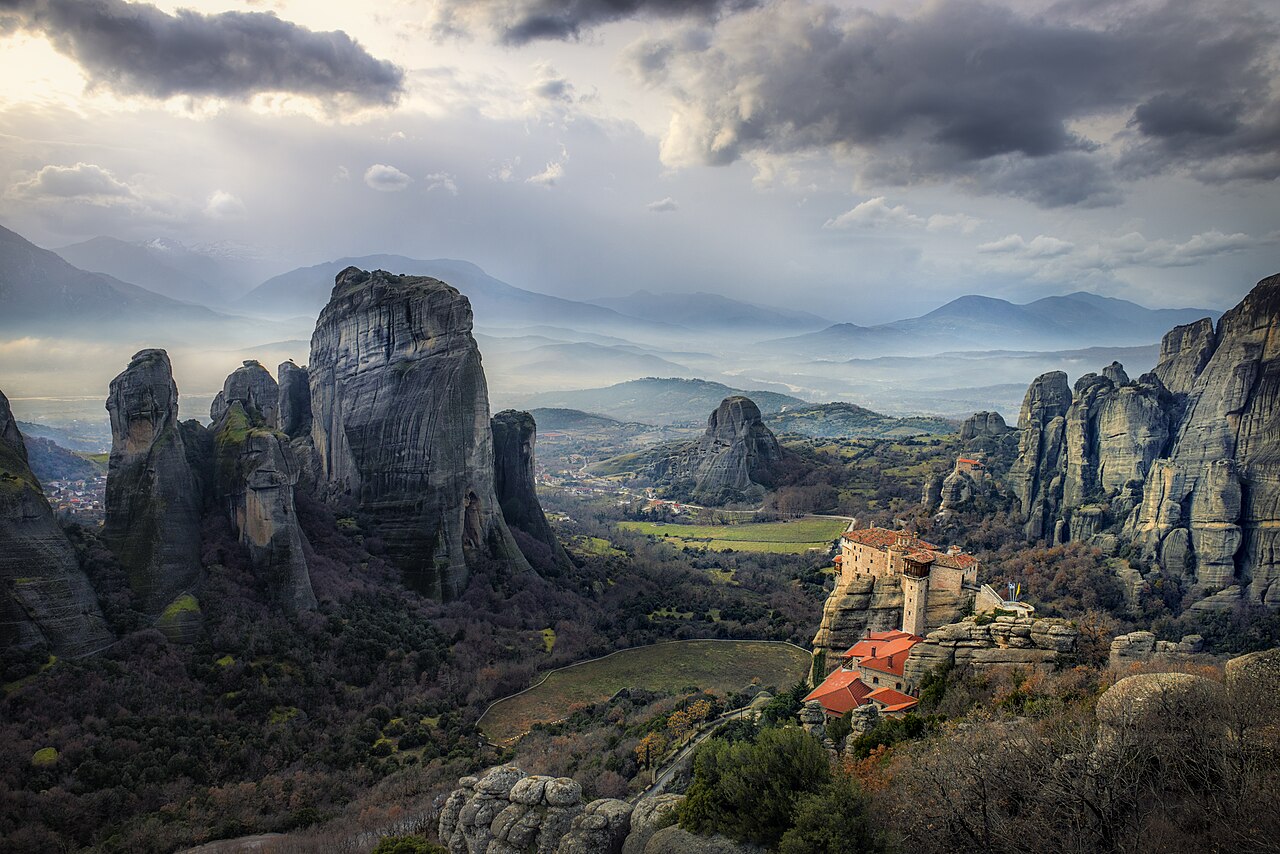
In Thessaly, central Greece, Orthodox monasteries stand on the summits of sheer sandstone pillars that rise up to 400 metres from the valley floor. Meteora — from the Greek for “suspended in air” — has been a place of monastic habitation since the 9th century; the first full monasteries were established in the 14th and 15th centuries, when monks and building materials were hauled up the cliff faces in nets. Six of the original 24 monasteries survive and remain active communities today. UNESCO listed Meteora as a mixed natural and cultural World Heritage Site in 1988.
Sixty Million Years of Geology, One Thousand Years of Monastic Life Thessaly, central Greece · near Kalambaka · 3 hrs from Athens by train
The sandstone pillars of Meteora are the product of geological processes that began approximately 60 million years ago, in the Eocene epoch, when the rivers draining the ancient Pindus mountain range deposited their sediments into a large inland lake in what is now the Thessalian plain. Over millions of years, compaction and lithification transformed those sediments into the hard conglomerate rock that now stands exposed. Subsequent tectonic uplift, combined with erosion by water and wind acting over tens of millions of years, carved the sedimentary mass into the forest of vertical columns and towers that characterizes the site today. The tallest pillar reaches approximately 400 metres; dozens of others rise between 100 and 300 metres, their vertical faces largely devoid of ledges or easy climbing routes.
The first human inhabitants of this landscape arrived long before the monasteries. Archaeological evidence in the region suggests prehistoric occupation, and Byzantine sources record the presence of hermit monks living in the caves and rock shelters of the pillars from at least the 9th to 10th century. These early ascetics sought the extreme isolation that the inaccessible geology provided — Meteora’s cliffs were not a challenge to overcome but a feature to exploit. The harder the access, the fewer the distractions.
Organized monastic life began in the 14th century. The key figure is Saint Athanasios Koinovitis (not to be confused with Saint Athanasius the Athonite of Mount Athos, though the parallel is suggestive), who arrived at Meteora around 1344 and founded Megalo Meteoro — the Great Meteoron — on the highest accessible summit. Athanasios gathered a community around him and established the first cenobitic (communal) monastery on the site, as opposed to the purely eremitic (solitary) practice of the earlier cave-dwellers. Subsequent decades saw an expansion of monastic foundations: Serbian rulers, notably Stefan Uroš IV Dušan and later the Palaiologos dynasty, patronized the construction of new monasteries, and by the 16th century — the peak of Meteoran monastic life — 24 monasteries were active across the pillars.
The founding of these communities raised an obvious logistical problem: how do you build on a vertical rock face? The answer, before the cutting of steps into the stone, was rope ladders and nets. Monks, stone, timber, food, and water were hauled up the cliff faces in large rope-and-wicker baskets operated by windlasses anchored to the summit rock. Contemporary accounts and later travellers’ records note that the ropes were replaced not on a fixed schedule but when they broke — a practice that, whether or not it reflected theological fatalism, must have concentrated the mind. Wooden drawbridges could be raised between the cliff top and the monastery entrance to prevent unwanted access. Steps were cut into the rock at various monasteries beginning in the 17th century, and more systematic stairways were constructed in the 1920s, making the monasteries accessible to visitors for the first time without specialist equipment.
UNESCO’s 1988 designation as a mixed natural and cultural site reflects the inseparability of the geology and the human achievement: the monasteries exist only because the pillars exist, and the pillars are most fully understood in the context of the extraordinary decision to build on them.
Six Surviving Monasteries: What to See and How to Visit Kalambaka base town · road circuit of all 6 monasteries approx. 20 km
Of the 24 monasteries that operated at Meteora’s 16th-century peak, six remain active. Each is an independent community with its own visiting hours, dress code requirements, and collection of art and artefacts. A full circuit of all six by car or on foot takes most of a day; many visitors spread the visit across two days to allow more time inside each monastery.
Megalo Meteoro (the Great Meteoron) is the oldest and largest, founded by Saint Athanasios in the mid-14th century and occupying the highest pinnacle at approximately 613 metres above sea level. Its catholicon (main church) was built in 1388 and expanded in the 16th century; it contains well-preserved frescoes from both periods, including a series of martyr cycles with the detailed narrative quality characteristic of post-Byzantine Cretan school painting. The refectory museum holds illuminated manuscripts, carved wooden crosses, and gold-threaded vestments spanning several centuries.
Varlaam Monastery, founded in 1541, is visually one of the most dramatic: its katholikon sits at the very edge of its summit platform, with sheer drops on three sides. The frescoes in the narthex (1566) are attributed to the Theban painters Georgios and Frangos Katelanos and are among the finest examples of the Cretan school active at Meteora. The All Saints church contains a 16th-century painting of the Last Judgment with an elaborately hierarchical composition that rewards close examination. Varlaam’s net-hoist mechanism — the windlass, net, and rope apparatus used before the steps were cut — survives and is displayed in the structure built over the cliff edge to operate it.
Rousanou Monastery, perched on a narrower pillar than the others, appears from certain angles to be floating entirely detached from the rock. It is currently inhabited by a community of Orthodox nuns. Agios Nikolaos Anapafsas is the smallest of the six and contains frescoes by the painter Theophanes the Greek (also active at Mount Athos), dating to 1527. Agia Triada (the Holy Trinity), made internationally recognizable by its appearance in the 1981 James Bond film For Your Eyes Only as the location where a villain’s compound is staged, sits on a particularly isolated pillar reached by a long stairway cut into the rock face. Agios Stefanos is the most accessible of the six monasteries, connected to the plateau by a short bridge, and is also inhabited by nuns.
Dress codes at all six monasteries are strictly enforced: men must cover their legs (long trousers or a provided wrap), women must cover shoulders and legs. Photography is typically permitted in the grounds but not always inside the churches. Each monastery charges a small entry fee, currently around €3. Visiting hours vary between monasteries and are staggered to allow staff rest days — typically each monastery closes one or two days per week on different days, so a visitor can usually access four or five of the six on any given day.
The nearby UNESCO landscape extends in several directions. The Archaeological Site of Delphi, 160 km to the south across the Pindus range, is the sanctuary of Apollo where the most famous oracle of the ancient world operated from the 8th century BC to the late 4th century CE. Mount Athos, 280 km to the northeast, offers the most natural comparison — another landscape where Orthodox monasticism met extreme geography, though on a peninsula rather than pillars. The Byzantine Monuments of Thessaloniki are 250 km northeast and can be combined with Meteora on a circuit of northern and central Greece.
Practical information
Meteora is reached via Kalambaka, a town at the base of the pillars that serves as the primary accommodation hub. Kalambaka is connected to Athens by direct train (approximately 4–4.5 hours) and by intercity bus (approximately 4.5 hours). Thessaloniki is approximately 3.5 hours by road. From Kalambaka, the monasteries are accessible by taxi, hired car, or on foot via marked hiking paths — the walking circuit between all six takes 3–5 hours depending on pace and is well signed. Several tour operators offer half-day or full-day guided circuits by bus. Opening hours vary by monastery and season; most open from around 09:00 and close between 15:00 and 17:00, with a midday break typical. Entry to each monastery costs approximately €3. Dress codes are mandatory at all sites: long trousers for men, skirts or wraps covering the knees for women, covered shoulders. The busiest period is Easter and summer (June–August); spring (April–May) and autumn (September–October) offer more comfortable temperatures and smaller crowds. Sunrise and late afternoon light are particularly striking on the pillars; photography tours at dawn are popular. Accommodation ranges from budget rooms in Kalambaka to boutique hotels with direct views of the pillars from the terrace.
Frequently Asked Questions
How were the Meteora monasteries built on top of sheer rock pillars before steps were cut?
The construction of the Meteora monasteries in the 14th to 16th centuries posed a logistical challenge that the monks solved through a combination of ingenuity and considerable risk. Before steps were cut into the rock faces — a development that began in the 17th century and was completed more systematically in the 1920s — the only way up was by rope ladder or net. Long knotted rope ladders dangled from the cliff tops to allow individual monks to ascend; for heavier loads — stone, timber, food, water, construction materials, and visiting pilgrims — large wicker or net baskets were used, operated by a windlass mechanism anchored to the summit rock. The ropes that held these nets were replaced not on any fixed maintenance schedule but, according to accounts preserved in monastic records and later travellers’ writings, when they broke or when a monk decided they looked dangerously worn. Whether this approach reflected theological confidence in divine protection or simply the pragmatics of rope supply in a remote medieval community is a matter of interpretation. The windlass mechanism at Varlaam Monastery survives and is displayed in the purpose-built net house that projected over the cliff edge. Once the construction materials were hauled to the summit, the actual building process was carried out by monastic communities assisted by specialist craftsmen — the 16th-century frescoes at several monasteries were painted by professional painters from the Cretan school, who must have ascended by the same net-and-rope system. The physical difficulty of access is precisely what the early monks sought; the same inaccessibility that made construction demanding made intrusion by hostile forces or secular disruption almost impossible.
Which of the six active Meteora monasteries is best for first-time visitors?
The most commonly recommended starting point for first-time visitors is Megalo Meteoro (the Great Meteoron), for several practical and historical reasons. It is the oldest of the six (founded mid-14th century), the largest in scale, and sits on the highest accessible pinnacle — the views from its terrace across the Thessalian plain and the surrounding pillars are unobstructed and comprehensive. Its museum, housed in the former refectory, has the most extensive collection of any of the six monasteries: illuminated manuscripts, embroidered vestments, icons, carved wooden objects, and monastic implements spanning several centuries. The main church contains frescoes from both the 14th and 16th centuries, making it possible to compare early and mature post-Byzantine painting in a single space. Varlaam is the second strongest choice: its 16th-century frescoes attributed to the Katelanos brothers are of exceptional quality and the surviving net-hoist mechanism gives a concrete sense of the construction logistics. Visitors with more time should aim to visit at least four of the six across two mornings — the monasteries keep different closing days, so the combination that works on any particular day requires checking schedules in advance. The smallest and most intimate monastery is Agios Nikolaos Anapafsas, with frescoes by Theophanes the Greek (1527), who also worked at Mount Athos; its scale makes the paintings unusually immediate and easy to read. Agia Triada, while famous from the Bond film, is most rewarding for the dramatic approach up the long rock-cut stairway rather than for its interior.
What other UNESCO World Heritage Sites can be visited during a trip to Meteora?
Meteora’s location in Thessaly places it within reasonable reach of several UNESCO sites that together cover ancient Greek and Byzantine heritage comprehensively. Delphi, 160 km to the south, is the most accessible major addition: the sanctuary of Apollo on the slopes of Mount Parnassos was the site of the most influential oracle of the ancient Greek world and remained an active cult centre from the 8th century BC to the closure of pagan sanctuaries in the late 4th century CE. The site includes the Temple of Apollo, the Treasury of the Athenians, the theatre, the stadium used for the Pythian Games, and the Delphi Archaeological Museum, which holds the original bronze Charioteer of Delphi (478 BC) and the Naxian Sphinx (570–560 BC). Athens is approximately 4–4.5 hours from Kalambaka and offers the Acropolis, ancient Agora, and other Athenian monuments under separate UNESCO designations. Northward from Meteora, Thessaloniki (approximately 3.5 hours by road) contains fifteen UNESCO-listed Byzantine monuments and is also the departure point for Mount Athos permits and the Ouranoupoli ferry. Vergina, near Thessaloniki, adds the Macedonian royal tombs (4th century BC) to the circuit. A well-planned ten-day itinerary through central and northern Greece can combine Meteora, Delphi, the Thessaloniki monuments, Vergina, and the Ouranoupoli ferry to Athos (for male visitors with advance permits), covering nearly every chapter of Greek heritage from prehistoric times through the Byzantine period.