
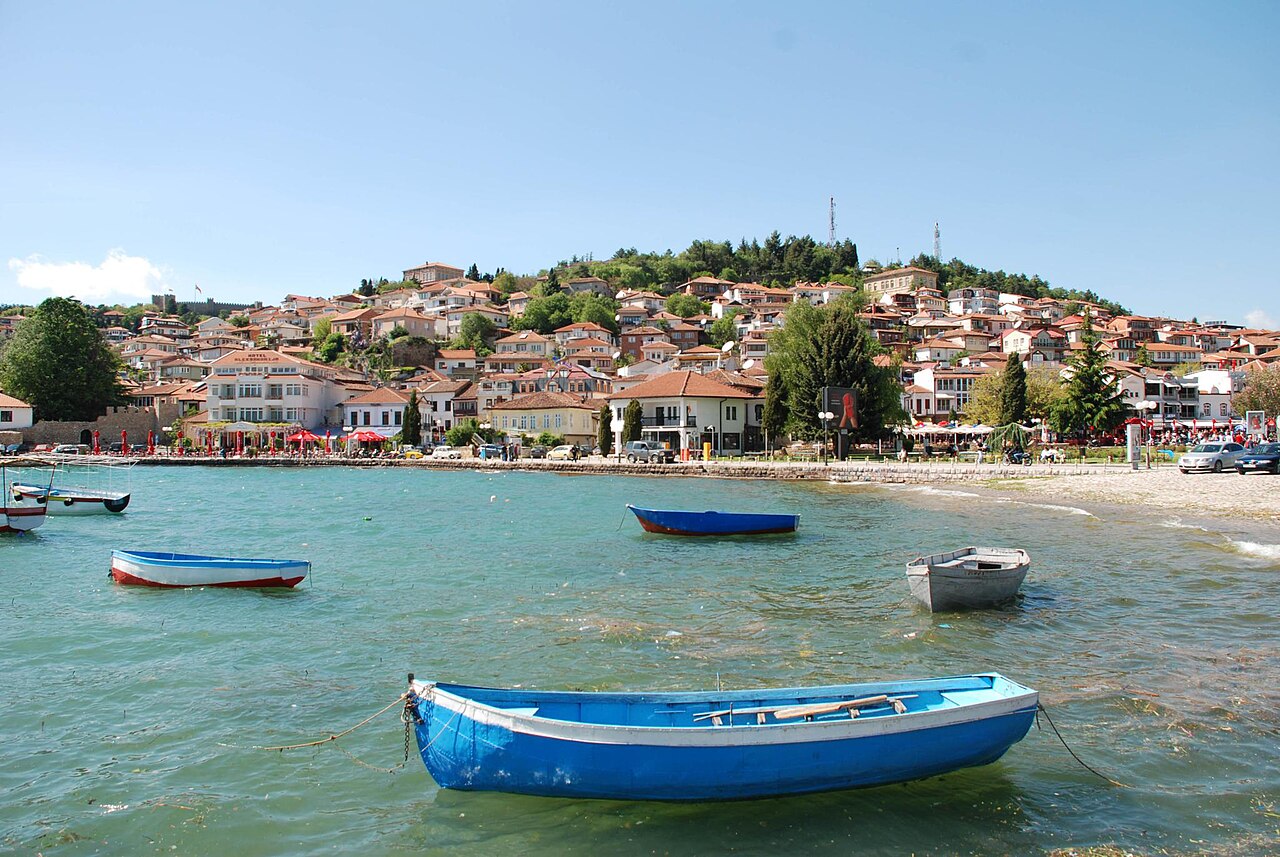
Lake Ohrid is one of the oldest lakes on Earth — two to three million years old, up to 288 metres deep — and supports more than 200 endemic species found nowhere else. The town above its shores gave the world the Cyrillic alphabet in the 9th century, and the fortress on its ridge was the seat of Tsar Samuel’s Bulgarian Empire. UNESCO inscribed the site under both cultural and natural criteria in 1979 and 1980, making it one of the very few places on the planet to hold that dual distinction.
A Lake That Predates the Ice Age North Macedonia, western edge — 2.5 hours from Skopje
Lake Ohrid formed between two and three million years ago, making it one of the oldest lakes in Europe alongside Lake Prespa and Lake Scutari. At its deepest point, the lake reaches 288 metres, and its basin remained unfrozen throughout the Pleistocene glaciations. That unbroken continuity of habitat accounts for an extraordinary density of endemic life: more than 200 species unique to the lake, including the Ohrid trout (Salmo letnica) and endemic freshwater sponges, snails, and crustaceans found in no other body of water on Earth. Visibility in the lake extends to 22 metres in places, making it one of the clearest lakes in Europe.
The lake covers approximately 358 square kilometres and is shared between North Macedonia and Albania. The Albanian shore — including the city of Pogradec and the monastery of Sveti Naum at the southern tip — became part of the UNESCO property when a cross-border extension was ratified in 2019. The designation, now called the Natural and Cultural Heritage of the Ohrid Region, unites two national heritage frameworks under a single UNESCO inscription and extends protection across the entire lake watershed. This kind of transboundary inscription remains rare in Europe and places particular obligations on both governments regarding development along the shoreline.
The lake’s exceptional clarity results from its hydrology. Unlike most lakes fed by turbid rivers, Ohrid is supplied primarily by underground springs that filter water through the karst limestone of the surrounding mountains. The Crni Drim river flows out northward into the Adriatic watershed. The national park covering the Macedonian shore encompasses beaches of fine pebble, ancient plane tree groves, and the monastery of Sveti Naum at the southern boundary — a 9th-century church complex set above springs that surge up from the lake bed with enough force to be felt by swimmers.
Bird life along the shores is substantial. The reed beds on the Albanian side shelter Dalmatian pelicans, herons, cormorants, and pygmy cormorants. Additional Ramsar Wetland of International Importance protections, applied in 1995, layer over the UNESCO designation. For visitors arriving from Kotor or Mostar, the lake presents a qualitatively different heritage experience: not medieval architecture or Venetian walls, but a three-million-year geological record and a living laboratory of evolutionary biology.
The Cradle of the Cyrillic Alphabet and Samuel’s Imperial Capital Ohrid Old Town — walkable from the lake shore
In 886 CE, the Byzantine scholar Clement arrived at Ohrid carrying the Glagolitic alphabet devised by Saints Cyril and Methodius for Slavic liturgical translation. Working from Ohrid, Clement established the first Slavic-language literary school and trained hundreds of clergy in the new script. Over the following years he also developed a simplified alphabet based on Greek letterforms but with additional characters for Slavic sounds not found in Greek. This script was named Cyrillic in honour of his teacher Cyril. Spread outward from Ohrid, Cyrillic became the writing system for Bulgarian, Serbian, Russian, Ukrainian, and dozens of other languages — today used by roughly 250 million people. The Ohrid Literary School stands as one of the most consequential educational institutions of the medieval world.
The town built across the hillside above the lake contains more than 365 churches — one for each day of the year, according to local tradition, though many are now in ruins or converted. The most significant surviving church is St. Sophia, an 11th-century cathedral and the largest medieval church in North Macedonia. Its interior preserves Byzantine frescoes from the 11th century, among the oldest in the region. The building was converted into a mosque during Ottoman rule and returned to use as a museum and concert hall in the 20th century. The acoustics inside its stone interior are exceptional, and it regularly hosts summer festival performances.
On a cliff above the western shore, the Church of St. John at Kaneo was built in the 13th century in a Byzantine cross-in-square plan. Its position — perched at the edge of a rocky promontory above turquoise water, with Albanian mountains visible to the south — has made it one of the most reproduced images in the Balkans. The interior retains traces of medieval fresco work; the building is modest in scale but its setting is among the most dramatic of any church in southern Europe.
Above both churches, Samuel’s Fortress crowns the highest ridge of the old town. Tsar Samuel of the First Bulgarian Empire made Ohrid his capital in the late 10th century and extended fortifications across the hilltop. The walls visible today are largely Venetian and Ottoman rebuilds over earlier foundations, but the view from the ramparts — over the red-roofed old town, across the lake, and into Albania — makes the site’s strategic importance legible without any interpretive signage. Samuel’s empire collapsed at the Battle of Kleidion in 1014 CE, when Byzantine Emperor Basil II blinded an estimated 15,000 Bulgarian soldiers and earned the epithet Bulgaroktonos, “Bulgar-Slayer.”
Practical information
Ohrid is 170 km southwest of Skopje by road, a journey of approximately 2.5 hours by car or intercity bus. Ohrid Airport (OHD) operates seasonal flights from several European cities between May and October. The Albanian border crossing at Sveti Naum, 29 km south of town, is open year-round and permits crossing by car or on foot, connecting south to Pogradec and onward to Tirana (roughly 150 km).
The best time to visit is May through June or September through October. July and August bring the Ohrid Summer Festival — classical music and theatre on open-air stages including the Antique Theatre — but also peak crowds and highest accommodation prices. Spring and early autumn offer warm water temperatures (the lake retains summer heat well into October), smaller crowds, and lower prices.
Samuel’s Fortress charges approximately 100 MKD (around €1.50) for entrance. The St. Sophia Cathedral-museum has a separate ticket. The Church of St. John at Kaneo is freely accessible from outside; a small donation is customary for interior access. The Monastery of Sveti Naum, 29 km south, charges a separate entrance fee for the church complex. Accommodation ranges from guesthouses in the old town — within walking distance of all major sites — to hotels along the modern lake shore. Book well in advance for July and August.
Frequently Asked Questions
Why is Lake Ohrid considered one of the world’s most scientifically significant ancient lakes?
Most lakes are geologically young — formed during or after the last ice age within the past 20,000 years — and disappear within a few thousand years as they fill with sediment. Lake Ohrid formed two to three million years ago in a tectonic graben, a block of crust that dropped between two parallel fault systems, and has remained as a continuous body of water ever since. That unbroken duration through ice ages, mass extinction events, and global climate shifts created conditions for biological evolution that most lakes never provide: stable temperatures, consistent chemistry, and isolation from competing gene pools. The result is an endemism rate extraordinary for a lake of Ohrid’s size. More than 200 species found nowhere else on Earth inhabit the lake, including multiple trout lineages, freshwater sponges, snails, planktonic crustaceans, and bottom-dwelling invertebrates. Scientists studying ancient lakes — Ohrid, Baikal, Tanganyika, Malawi — use the endemic species as biological timekeepers, calibrating evolutionary rates and reconstructing past climate conditions from sediment cores. UNESCO’s natural criteria inscription in 1980 recognised this research significance explicitly. Conservation pressure is increasing from tourism infrastructure development along the Macedonian shore, agricultural runoff, and the introduction of invasive species; the 2019 cross-border extension with Albania was partly designed to bring stricter integrated management to the entire watershed.
What is the connection between Ohrid and the Cyrillic alphabet used today in Russian, Bulgarian, and Serbian?
The story begins not in Ohrid but in Moravia (present-day Czech Republic), where in 863 CE the Byzantine missionaries Cyril and Methodius devised the Glagolitic alphabet to represent Slavic sounds for liturgical translations — Greek had no letters for several Slavic phonemes. After Methodius died in 885 CE, their disciples were expelled from Moravia by Frankish clergy hostile to the Slavic liturgical tradition. Clement, the most capable of these disciples, made his way to Bulgaria, where Tsar Boris I welcomed the scholars. Clement was assigned to the Ohrid region and established a school there in 886 CE. Over the following years, he trained around 3,500 clergy in literacy while also developing a simpler, more teachable alphabet. This new script, named Cyrillic in honour of Cyril, used Greek letterforms as its base with added characters for sounds Greek could not represent — making it faster to learn than the purely original Glagolitic. Spread from Ohrid across the First Bulgarian Empire, Cyrillic became the standard writing system in Orthodox Slavic cultures: Bulgaria, Serbia, Russia, Ukraine, and eventually dozens of modern states. The Glagolitic script survived in Croatian Catholic liturgical use into the 20th century but never achieved Cyrillic’s geographic reach. Clement was later named the first Bishop of the Ohrid Diocese. The Ohrid Literary School thus stands as one of the most consequential educational institutions of the medieval world — the point from which two writing systems and a continent-wide literary tradition radiated outward.
How does Ohrid connect to other UNESCO World Heritage Sites in the Balkans, and is a multi-site itinerary practical?
Ohrid sits at a crossing point between the Adriatic and Aegean cultural zones, making it an ideal anchor for a Balkan UNESCO circuit. Kotor in Montenegro is approximately 300 km to the northwest, reachable in a long day via Albania’s Riviera and the Montenegrin coast — or more comfortably over two days. Mostar in Bosnia and Herzegovina is roughly 450 km northwest, a full driving day. Thessaloniki in Greece lies about 170 km east via the A1 motorway, with its own Early Christian and Byzantine UNESCO cluster. The Albanian city of Berat — another UNESCO-inscribed “city of a thousand windows” — is approximately 140 km southwest of Ohrid, a practical half-day drive. For visitors with one week in the western Balkans, a circuit from Ohrid south to Berat, then north along the Albanian Riviera to Kotor, and onward to Dubrovnik covers four UNESCO sites in a logical geographic arc. Those with more time can continue northward to Mostar and Sarajevo. Ohrid provides the oldest historical layer in this circuit — three million years of geological history and the 9th-century birth of Cyrillic — while the Adriatic sites add Venetian maritime heritage and Ottoman architecture, giving the itinerary real chronological and cultural depth.


.jpg)