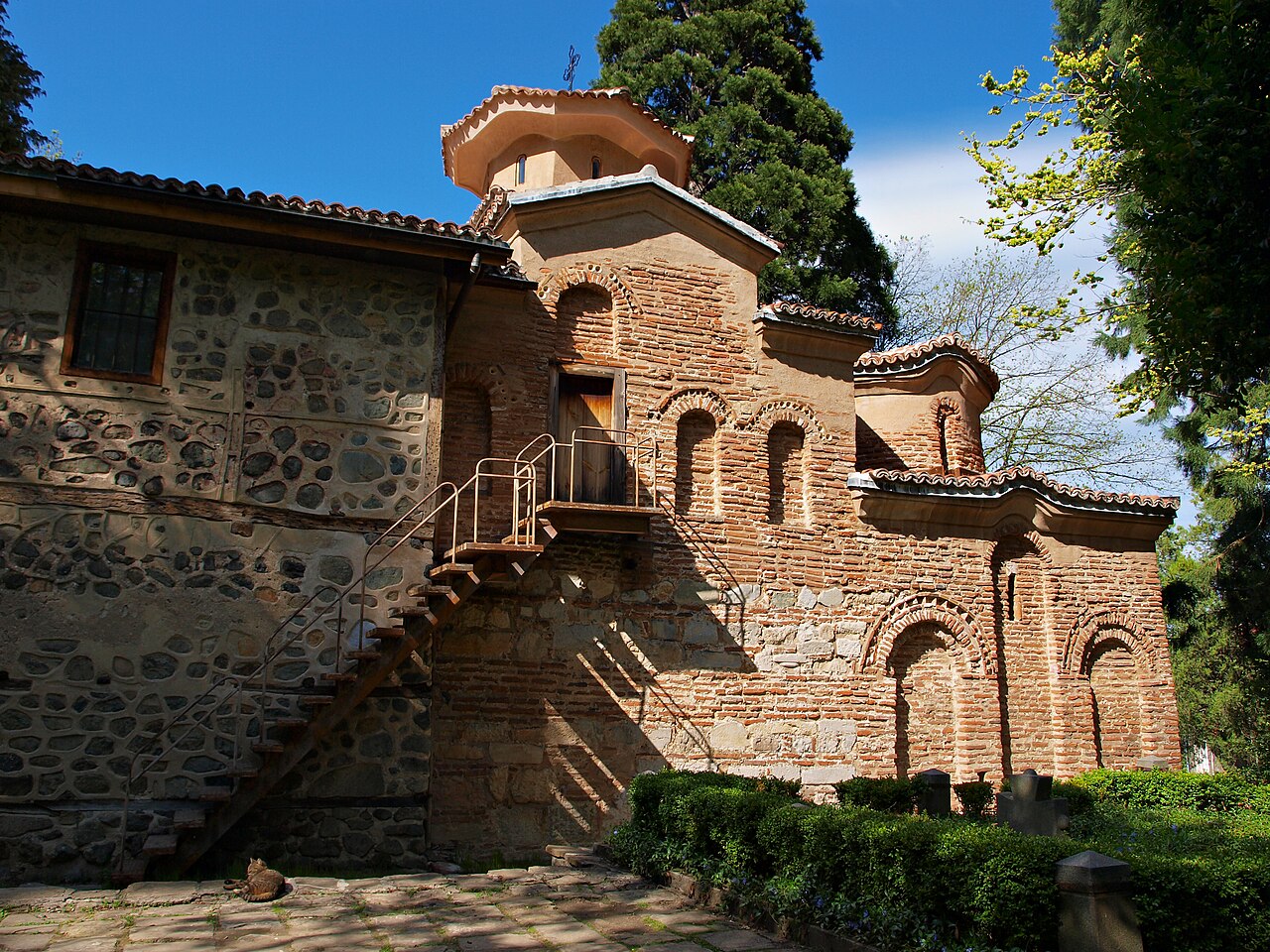
At the foot of Vitosha Mountain, 8 km south of central Sofia, stands one of medieval Europe’s most significant small buildings. Boyana Church — a UNESCO World Heritage Site since 1979 — contains frescoes painted in 1259 that show individual human faces with a psychological realism that would not reappear in European painting until the Italian Renaissance, a generation later. The narthex where these paintings survive measures roughly 30 square metres.
Three Centuries of Building, One Extraordinary Year Sofia, Bulgaria · 8 km south of city centre
Boyana Church is not a single building but a layered accumulation of three construction phases across three centuries, each grafted onto the last. The oldest part, the eastern church, dates to the late 10th or early 11th century and follows a simple cruciform plan typical of the First Bulgarian Empire’s ecclesiastical architecture. It was built in an era when Bulgaria was reasserting its Orthodox Christian identity after periods of Byzantiner pressure, and its compact stone forms reflect both the theological conservatism and the regional building traditions of that moment.
The middle church was added in the early 13th century, enlarging the space westward, and it is to this period that the exterior’s characteristic articulation of blind arcades and decorative brickwork belongs. But the transformation that makes Boyana genuinely exceptional came in 1259, when Sebastokrator Kaloyan — a Bulgarian nobleman and brother-in-law of Tsar Konstantin Asen — financed a narthex addition to the west. Kaloyan’s patronage was not simply architectural. He commissioned the painting programme that covers the narthex walls, and in doing so sponsored one of the most advanced artistic achievements of medieval Eastern Europe.
The 1259 fresco cycle depicts 240 figures across the interior surfaces. What distinguishes these paintings from their Byzantine contemporaries is their insistence on individual faces. Byzantine painting of the 13th century operated within a well-defined system of types: saints, emperors, and donors were recognisable by attribute and position, not by physiognomy. The Boyana painters broke with this convention. The portrait of Sebastokrator Kaloyan and his wife Desislava, shown as donor figures presenting a model of the church, depicts two specific people with distinguishable features — rounded, weighted faces that suggest actual observation rather than idealized formula. The fresco of St Nicholas from the same campaign is considered one of the earliest known realistic individual portraits in medieval European painting.
This matters in the context of European art history. The Italian proto-Renaissance — Cimabue, Duccio, the young Giotto — was still a decade away when the Boyana painters were at work. Whether any connection existed between the Bulgarian workshop and Italian developments remains debated among art historians, but the chronology is clear: Boyana’s individualism precedes Florence’s. The church sits within the broader UNESCO World Heritage landscape of medieval Bulgaria, which encompasses several sites across the country representing different facets of the First and Second Bulgarian Empires’ cultural achievement.
Visiting Boyana: Small Space, Timed Access, and What the Frescoes Actually Show Boyana quarter · Metro + bus or taxi from central Sofia
Boyana Church is administered by the National Historical Museum of Bulgaria, and access is strictly managed. The interior is tiny — the three interconnected spaces total only a few dozen square metres — and the microclimate inside must be carefully controlled to preserve the frescoes. Visitors enter in timed groups of no more than ten people, each group allowed approximately ten minutes inside. This is not a site where you linger; it is a site where you look carefully and quickly.
The fresco programme rewards prior study. The narthex walls are organized according to Byzantine iconographic conventions — scenes from the life of Christ, martyrdom cycles, donor portraits — but the execution departs from convention repeatedly. Look specifically at the faces of the apostles in the Dormition of the Virgin scene: each is differentiated by age, expression, and posture in a way that suggests the painter was working from observation as much as from model books. The Desislava portrait is particularly striking: her face is neither idealized nor generic, and the slight asymmetry of her features gives the impression of a likeness taken from life.
The middle church contains frescoes from the early 13th century that predate the narthex paintings and operate in a more conventionally Byzantine mode — useful context for understanding how dramatically the 1259 campaign departed from established practice. The eastern church retains traces of even earlier painting, though these are fragmentary.
Because the interior experience is so brief, the National Historical Museum maintains a replica exhibition in the adjacent building where full-scale reproductions of the key frescoes can be examined at leisure. This is not a substitute but a complement: the replicas allow close study of compositional details that the time limit inside makes difficult. Many visitors spend more time with the replicas than with the originals, which is a reasonable use of the site.
Boyana’s location in the forested foothills of Vitosha Mountain gives it a quieter atmosphere than sites closer to central Sofia. The Boyana quarter is a pleasant residential neighbourhood, and the approach through tree-lined streets makes the arrival at the small walled compound feel appropriately unhurried. The church grounds are compact; allow 45 minutes to an hour for the full visit including the replica museum.
The broader UNESCO context of Bulgaria places Boyana within a network of medieval heritage sites. Rila Monastery, 117 km to the south, is the country’s largest and most visited Orthodox monastery, founded in the 10th century and rebuilt in its current form in the 19th century, with its own exceptional fresco programme. The Madara Rider, 420 km to the northeast, is a large-scale rock relief carved in the 8th century and one of the few examples of early medieval monumental sculpture in Europe. The Thracian Tomb of Kazanlak, 200 km to the east, preserves 4th-century BC Hellenistic funerary painting that offers a different chapter in the long history of Bulgarian artistic production. Each of these sites can be reached on day trips or short overnight journeys from Sofia, making the Bulgarian capital a practical base for a UNESCO-focused itinerary.
Practical information
Boyana Church is located at 1–3 Boyansko Shose Street in the Boyana district of Sofia. From the city centre, take the Sofia Metro to Business Park Sofia station, then bus 64 to the Boyana Church stop; alternatively, a taxi from central Sofia takes approximately 20 minutes and costs around 10–12 BGN (roughly €5–6). The church is open Tuesday through Sunday, typically 09:30–17:30 in winter and 09:00–18:00 in summer; it closes on Mondays. Admission for adults is approximately 10 BGN (around €5); combined tickets with the National Historical Museum in Sofia are available. Pre-booking is strongly recommended during peak season (May–September) as daily visitor numbers are capped. The site is not wheelchair accessible due to uneven historic paving. Photography is not permitted inside the church. The nearest accommodation is in central Sofia, which offers a full range of options from budget hostels to international hotels; the Boyana area itself has a small number of guesthouses. Spring and early autumn are the most comfortable visiting seasons; summer can be warm but Vitosha’s elevation keeps the area slightly cooler than the city centre.
Frequently Asked Questions
Why are the Boyana Church frescoes considered so important in the history of European art?
The Boyana frescoes painted in 1259 represent an early and significant departure from the dominant conventions of Byzantine painting. In the Byzantine tradition, figures in religious art were rendered according to established types: saints, emperors, and donors were identifiable through symbolic attributes, gestures, and compositional position, but their faces followed formulaic ideals rather than individual observation. The Boyana painters, working under the patronage of Sebastokrator Kaloyan, broke from this convention in a systematic way. The donor portraits of Kaloyan and his wife Desislava show recognizably individual faces with differentiated features, and the cycle’s treatment of biblical figures — particularly in the Dormition of the Virgin — gives each apostle a distinct physiognomy, age, and emotional response. The fresco of St Nicholas from the same 1259 campaign is considered one of the earliest surviving attempts at realistic individual portraiture in medieval European painting. What makes this historically significant is the date: these innovations at Boyana predate the Italian proto-Renaissance by roughly a decade to a generation, placing them ahead of Cimabue’s reforms in Florence and contemporary with the earliest experiments of Duccio in Siena. Art historians continue to debate whether any direct connection existed between Bulgarian and Italian workshop traditions, but the chronological priority of Boyana’s naturalism is well established.
How do I book a visit to Boyana Church, and what should I expect on arrival?
Visits to Boyana Church require pre-booking, particularly between May and September when daily visitor quotas fill quickly. Tickets can be purchased through the National Historical Museum of Bulgaria’s website or by telephone; walk-in visits are sometimes possible in the off-season but cannot be relied upon. On arrival, visitors are assigned to a timed group of up to ten people and must wait for their allocated entry slot. Each group spends approximately ten minutes inside the three interconnected spaces, accompanied by a museum guide. Photography inside the church is prohibited — this is strictly enforced to protect the frescoes from light exposure. The interior is very small and can feel crowded even with ten people, so take a moment before entering to recall what you most want to observe. After the interior visit, the adjacent replica museum is strongly recommended: it displays full-scale reproductions of the key frescoes, including the donor portraits and the St Nicholas fresco, which can be examined in detail without time pressure. Allow 45 minutes to an hour for the complete visit. The grounds are modest but pleasant, set among trees in the residential Boyana quarter. The site is open Tuesday through Sunday; Monday is the standard closing day.
What other UNESCO World Heritage Sites can be visited from Sofia in a short trip?
Sofia is a practical base for visiting several of Bulgaria’s UNESCO World Heritage Sites. The closest and most popular is Rila Monastery, located 117 km south of the capital in the Rila Mountains. The monastery was founded in the 10th century by Saint John of Rila and is Bulgaria’s largest Orthodox monastery; its current buildings date mainly from a 19th-century reconstruction after a fire and contain an extraordinary fresco programme, a medieval tower (Hrelyo’s Tower, 1335), and a museum with religious artefacts. Day trips by bus or car from Sofia are straightforward, though an overnight stay in the Rila area allows a more relaxed visit and the possibility of combining it with a walk in the surrounding Rila National Park. Further afield, the Thracian Tomb of Kazanlak (approximately 200 km east of Sofia, near Kazanlak in the Rose Valley) preserves a painted burial chamber from the 4th century BC with exceptional Hellenistic fresco decoration. The Madara Rider, 420 km northeast near Shumen, is a 23-metre-high rock relief carved during the First Bulgarian Empire in the early 8th century, accompanied by Greek inscriptions recording diplomatic agreements with Byzantium. A route combining Boyana, Rila, and Kazanlak over three to four days covers a broad sweep of Bulgarian history from antiquity through the medieval period.