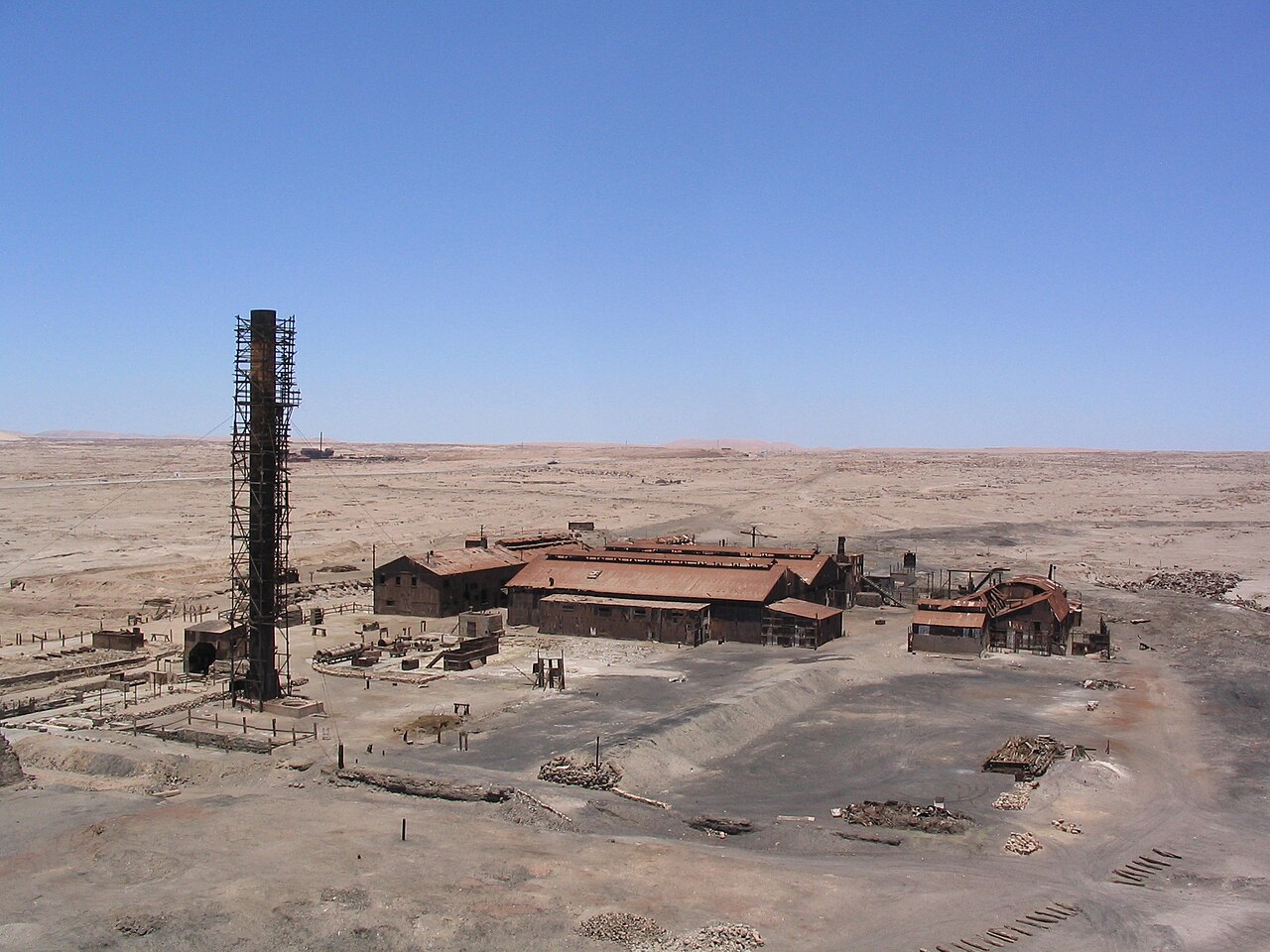
The Humberstone and Santa Laura Saltpeter Works, inscribed by UNESCO in 2005, are the ruins of two oficinas salitreras — saltpeter processing plants — in the Atacama Desert of northern Chile that represent the industry that once supplied the world’s agriculture and armed its wars. At the height of the nitrate boom around 1910, Chile controlled roughly 65 percent of global sodium nitrate production, and more than 200 such facilities operated simultaneously across the Atacama. Humberstone alone housed 3,700 residents in a self-contained industrial town complete with a theatre, a swimming pool, and a hotel, before the invention of synthetic ammonia rendered the entire industry obsolete within a generation.
The age of nitrate and Chilean dominance 45 km east of Iquique, Tarapacá Region, northern Chile
To understand Humberstone, it is necessary to understand why sodium nitrate — a white crystalline salt found in the caliche ore of the Atacama Desert — was one of the most economically and strategically critical commodities of the second half of the nineteenth century. European agriculture had exhausted its traditional nitrogen sources — bird guano from Pacific islands, which had been mined out within decades — and Chilean natural nitrate (salitre) offered a replacement fertilizer that could be applied at scale to the grain fields of Britain, Germany and France. At the same time, sodium nitrate was the essential ingredient in black powder and early high explosives: every major war of the era, including the American Civil War and the Franco-Prussian War, was fought partly with Chilean nitrogen. This dual use meant that Tarapacá Region’s nitrate fields were simultaneously the fertilizer belt for European food production and the ammunition reserve for European warfare.
The region itself changed hands violently to secure this resource. The War of the Pacific (1879–1884), fought between Chile on one side and Peru and Bolivia on the other, was driven primarily by control of the nitrate territories. Chile’s victory left it the dominant global supplier. Foreign capital — British, German and American — poured into the region to build and operate the oficinas. The British financier John Thomas North became known as the “Nitrate King” of Chile; at his peak in the 1880s he controlled railways, banks, water companies and nitrate estates across Tarapacá.
Humberstone was founded in 1872 under the name La Palma. It was renamed in 1925 after James Thomas Humberstone, a British chemical engineer who arrived in the Atacama in 1875 and spent four decades systematizing and improving the “Shanks process” for extracting sodium nitrate from caliche ore — a method involving leaching crushed ore in a series of open iron tanks with hot water, then crystallizing the dissolved nitrate as the solution cooled. His improvements to this process were fundamental to the expansion of Chilean nitrate production, and he remained in the region until 1925. The adjacent Santa Laura plant, built in 1872 and operational until 1960, retains its original machinery almost entirely intact, including a rare iodine extraction plant — since Chilean nitrate ore also contains iodine, and for a period Chile was the world’s dominant iodine supplier as well.
The pampinos and the labor movement Atacama Desert, elevation ~1,000 m, extreme aridity
The social world of the Atacama nitrate camps was shaped by extreme isolation, company control, and a labor force drawn from the most desperate sectors of Chilean and Peruvian society. The workers who made their lives in the oficinas were known as pampinos — people of the pampa — and they lived in company-owned housing, shopped in company-owned stores called pulperías, and were paid not in Chilean pesos but in fichas: metal or cardboard tokens issued by the company that were redeemable only in the company store at prices the company set. This sistema de fichas was a mechanism of economic control that tied workers to the oficina regardless of wages, since accumulated tokens had no value outside the company’s commercial network.
The concentration of thousands of workers in isolated industrial camps under these conditions produced one of the earliest and most militant labor movements in South American history. The nitrate unions organized strikes with increasing frequency from the 1890s onwards, demanding payment in legal currency, an eight-hour working day, and improved safety conditions in the plants. The response of the Chilean state was frequently violent, but no event of the nitrate era left a deeper mark on Chilean national memory than the Iquique Massacre of 21 December 1907. Some 10,000 striking workers and their families — men, women and children — had traveled from the nitrate camps to the coastal city of Iquique and were sheltering in the Santa María de Iquique school when Chilean Army troops and sailors opened fire on the crowd. Estimates of the dead range from around 2,000 to 3,600; the exact number has never been established because the bodies were removed before any official count could be made. The massacre became a founding trauma of the Chilean labor movement and is commemorated annually.
The fate of Humberstone was sealed not by any local event but by a German laboratory breakthrough. The Haber-Bosch process, developed between 1909 and 1913 by Fritz Haber and Carl Bosch at BASF, provided a method for fixing atmospheric nitrogen as ammonia using high pressure and temperature over an iron catalyst. Synthetic ammonia fertilizer and explosives no longer required Chilean caliche. The nitrate industry entered a long decline after 1913; the global collapse of demand during the Great Depression finished most oficinas. Humberstone operated intermittently until 1960 and was definitively abandoned. UNESCO added it to the World Heritage List in 2005; it was simultaneously inscribed on the List of World Heritage in Danger due to structural deterioration, and remained there until 2022 when it was removed following significant conservation work.
Practical information
Humberstone and Santa Laura are located 45 km east of Iquique along the Pan-American Highway (Ruta 16 — take the clearly marked exit). The site is open daily, typically from 09:00 to 18:00; a single entry fee covers both plants. Iquique is served by Diego Aracena International Airport with direct flights from Santiago (approximately 2 hours) on several Chilean carriers. Rental car is the most practical way to reach the site independently; organized day tours from Iquique are also available and typically include both Humberstone and Santa Laura as well as the nearby ghost town of Pisagua. The Atacama is one of the driest places on earth: sun protection, a hat and water are essential at all times of year. Temperatures can range from intense heat in summer (December–February) to cold nights year-round. The ruins include uneven terrain and open shafts; follow marked visitor paths. On-site interpretation is in Spanish; the museum inside the Teatro Humberstone provides the best English-language context available at the site itself.
Frequently Asked Questions
Why was Chilean sodium nitrate so important, and what ended the industry?
Sodium nitrate, the natural salt found in Chile’s Atacama Desert caliche ore, served two critical and simultaneous functions in the global economy of the mid-nineteenth to early twentieth century. As a fertilizer it was the primary source of fixed nitrogen for European agriculture at a time when the world’s population was growing rapidly and traditional nitrogen sources — chiefly Peruvian guano from Pacific bird rookeries — had been exhausted. Applied to wheat fields in Britain, Germany, France and Argentina, Chilean nitrate sustained the food production that fed industrializing cities. As an explosive precursor it was equally indispensable: sodium nitrate is a key ingredient in black powder and early nitrate explosives, which meant that Chilean mines supplied the ammunition for virtually every major nineteenth-century war, from the American Civil War to the conflicts that unified Germany and Italy. This dual function made control of the nitrate fields geopolitically decisive — the War of the Pacific (1879–1884) was fought primarily to determine which nation would collect the export taxes on Tarapacá’s production. The industry ended not through market forces but through chemistry: the Haber-Bosch process, patented in Germany in 1909–1913, enabled industrial-scale synthesis of ammonia from atmospheric nitrogen. Synthetic fertilizers and explosives made Chilean caliche economically irrelevant within fifteen years. The nitrate towns of the Atacama, which had been among the wealthiest communities in South America, became ghost towns within a generation.
Who were the pampinos and what was the sistema de fichas?
The pampinos were the workers of the Atacama nitrate camps, recruited primarily from the poorest agricultural regions of southern Chile and from Peru and Bolivia — populations displaced by the aftermath of the War of the Pacific and the collapse of traditional agriculture. Life in an oficina like Humberstone was entirely structured by the company. Workers and their families lived in company-provided housing — typically rows of adobe or corrugated iron rooms with shared sanitary facilities — and bought food, clothing and all household goods at the pulpería, the company store. The payment system known as fichas compounded this dependency: rather than Chilean legal currency, workers received metal or cardboard tokens issued by the company, redeemable only in the company’s own commercial network and at prices the company set. Accumulated fichas had no purchasing power outside the oficina, which made it practically impossible for workers to save money in a form they could use elsewhere, or to leave without losing what they had earned. This system was declared illegal by the Chilean government in 1925, but it remained in use in some form well beyond that date. The pampinos organized into some of the earliest trade unions in Chilean history, producing a labor movement of considerable political sophistication that eventually gave rise to the Workers’ Federation of Chile (FOCh) and contributed to the formation of Chile’s Socialist and Communist parties in the early twentieth century.
What happened at the Iquique Massacre of 1907, and why does it still matter?
The Iquique Massacre of 21 December 1907 — known in Chile as the Masacre de la Escuela Santa María de Iquique — was the single most lethal suppression of labor protest in Chilean history. In late November 1907, nitrate workers at dozens of oficinas in Tarapacá launched a coordinated strike demanding payment in legal currency rather than fichas, an improvement in exchange rates, better safety conditions, and an end to arbitrary dismissal. Tens of thousands of workers and their families — estimates range between 10,000 and 20,000 people — converged on Iquique and occupied the Plaza Manuel Montt and the nearby Santa María school, believing that the presence of women and children would prevent a violent response. After days of negotiations failed, the Chilean government declared a state of siege. On the morning of 21 December, Army infantry and a naval landing party surrounded the school and opened fire on the crowd with rifles and machine guns. Bodies were removed by the military before any independent count could be made; death toll estimates range from approximately 2,000 to 3,600. The massacre destroyed the immediate strike movement but became a founding event in Chilean working-class memory. It was commemorated in song, poetry, and political rhetoric throughout the twentieth century, most famously in Víctor Jara’s 1970 cantata La Población. The centenary in 2007 prompted an official parliamentary declaration of regret.