
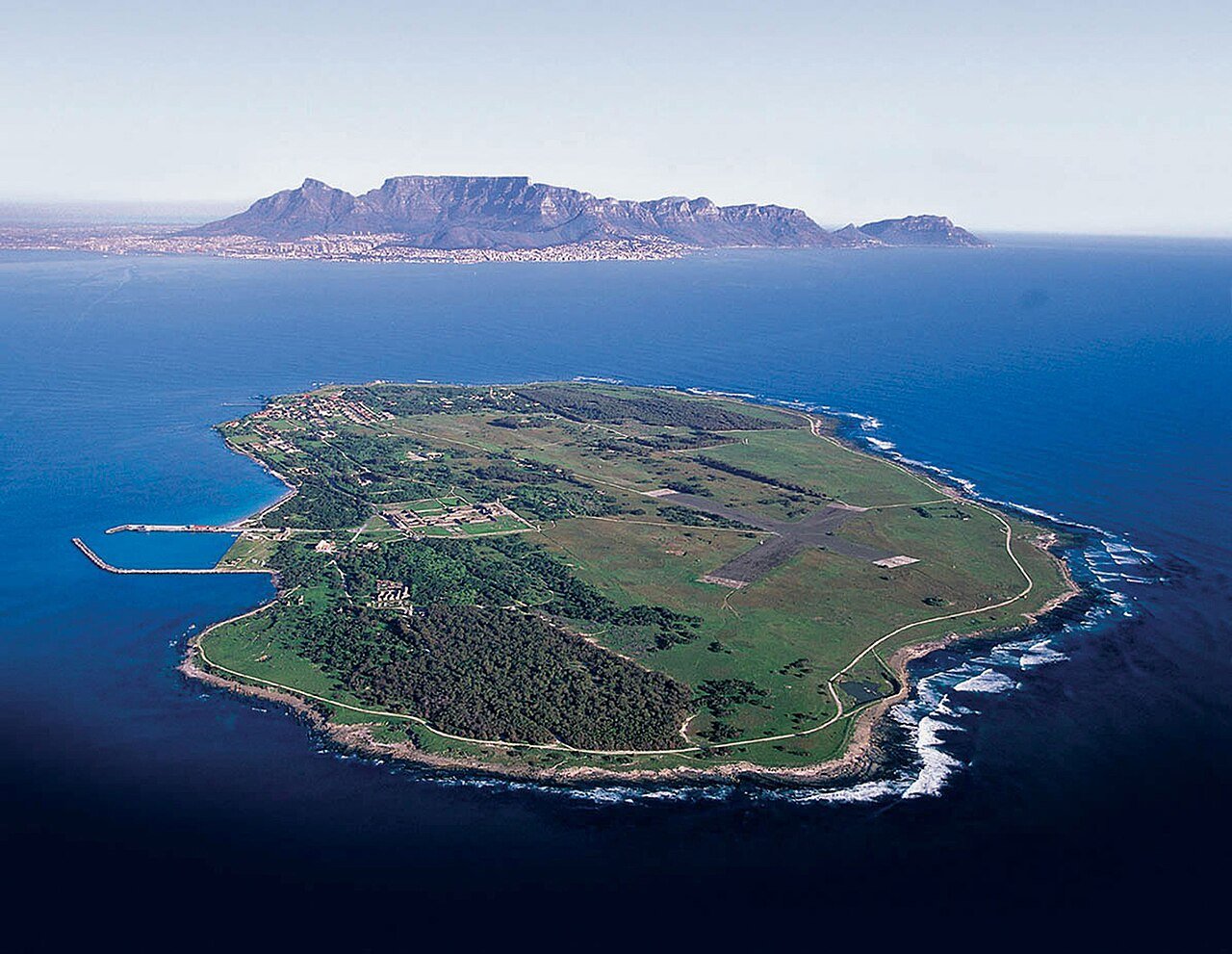
Robben Island sits seven kilometres from Cape Town in Table Bay — close enough to see the lights of the city from the prison yard — and for three decades it was the place where the South African apartheid government imprisoned the people most dangerous to its continued existence. Nelson Mandela spent 18 of his 27 total prison years here, in a cell 2.1 metres by 2.4 metres, sleeping on a mat on the floor. The island’s history as a site of confinement stretches back to the 17th century, encompassing colonial political prisoners, a leper colony and a mental institution, but it was the maximum-security political prison of 1961-1991 that transformed it into a global symbol. UNESCO inscribed Robben Island in 1999 as “a symbol of the triumph of the human spirit, freedom and democracy over oppression.”
A prison island in the colonial era: from Dutch exiles to lepers 7 km from V&A Waterfront, Cape Town, Table Bay
The name “Robben” comes from the Dutch word for seals (robben), and Dutch sailors identified the island as a useful waystation during the early 17th century when the Dutch East India Company (VOC) began using the Cape of Good Hope as a resupply point on the route to the spice islands. The island first functioned as a place of banishment under the VOC: one of the earliest recorded political prisoners was Autshumato, a Khoikhoi leader who had worked as an interpreter for Dutch settlers and was exiled to Robben Island in 1658 after leading a cattle raid against the colony. He remains the only prisoner known to have successfully escaped from the island, reportedly by paddling to the mainland on a makeshift raft. Under Dutch and then British colonial rule through the 18th and early 19th centuries, the island received a succession of political exiles, primarily African leaders from the eastern Cape frontier wars — chiefs whose military resistance to colonial expansion made them too dangerous to execute and too threatening to hold on the mainland.
From 1845 to 1931, Robben Island operated as a leper colony. At its peak in the 1890s, it housed approximately 900 lepers under conditions that were harsh by any standard: patients were compulsorily removed from their families under the Cape Colony’s Leprosy Repression Act, shipped to the island and confined indefinitely. The physical segregation reflected both genuine medical anxiety about contagion and the deeply racialised logic of colonial public health — the majority of those confined were Black and Coloured South Africans, while wealthier white patients with leprosy often received exemptions or better conditions. The leper colony church, the small Anglican church that still stands on the island, was built for the leper patients and later used by prison staff. The leper colony ran concurrently for a period with a facility for the mentally ill, making the island in the late 19th century one of the most concentrated sites of colonial incarceration in southern Africa.
The island also served as a British military garrison during the two World Wars, with gun emplacements, barracks and a lighthouse constructed that are still visible today. A small colony of African penguins — which arrived and established itself on the island without human assistance — now occupies a section of the island’s shoreline and has become an unexpected draw for wildlife visitors alongside the historical sites. The combination of prison history, colonial architecture, wildlife and the extraordinary backdrop of Table Mountain across the bay makes Robben Island one of the most layered heritage sites on the African continent.
The apartheid political prison (1961-1991): Mandela, the lime quarry and Section B Maximum-security prison, eastern side of the island
The South African apartheid government converted Robben Island into a maximum-security political prison for convicted anti-apartheid activists in 1961. The decision was deliberate and strategic: the island’s geography made escape almost impossible (the waters of Table Bay are cold, with strong currents, and the crossing is seven kilometres), its isolation made communication with the outside world extremely difficult, and its remoteness made it easier to administer a regime of control that included hard physical labour, racial classification within the prisoner population, and systematic humiliation designed to break the will of men who had chosen to resist the apartheid state.
Nelson Mandela arrived at Robben Island in 1964, having been convicted under the Sabotage Act at the Rivonia Trial along with seven colleagues including Walter Sisulu and Govan Mbeki. He was assigned to Section B, Cell Number 5 — a space measuring 2.1 metres by 2.4 metres, with a single small window near the ceiling. Prisoners in Section B were classified by the apartheid state as “D-category” — the lowest category, meaning the fewest privileges, the most restricted communication and the harshest conditions. Mandela was permitted one visitor (30 minutes, through a glass partition) and one letter every six months for the first several years. Study was initially prohibited; later, after sustained pressure and hunger strikes, prisoners were permitted to study by correspondence through the University of South Africa, and Robben Island developed a remarkable informal university environment in which prisoners taught each other history, politics, economics and languages. Mandela himself studied Afrikaans to understand the thinking of the apartheid architects.
The lime quarry on the island’s western side is one of the most significant physical sites of prisoner experience. Section B prisoners, including Mandela, were required to do manual labour in the quarry — breaking limestone and shovelling lime dust — for years. The reflected sunlight from the white lime surface, combined with the prohibition on wearing sunglasses, permanently damaged Mandela’s eyesight; he suffered from lacrimal duct problems for the rest of his life and was sensitive to bright light in all photography. The quarry has become a place of pilgrimage for visitors: former prisoners have left stones at the entrance as a gesture of remembrance, and the pile grows with each visiting group. In 1995, the year after Mandela became president, he returned to Robben Island and added his own stone to the pile.
Other significant prisoners at Robben Island included Walter Sisulu (who served 25 years, the same Rivonia sentence as Mandela), Govan Mbeki (father of the future president Thabo Mbeki), Ahmed Kathrada, Andrew Mlangeni, Elias Motsoaledi, and Robert Sobukwe — the leader of the Pan Africanist Congress (PAC), who was held in isolation in a separate house on the island under a unique “Sobukwe Clause” appended to South African law specifically to allow his indefinite detention without charge after his original sentence expired. Sobukwe died in 1978 having spent years of arbitrary isolation on the island and was never convicted of any violent crime. Hundreds of other prisoners convicted under the Terrorism Act, the Sabotage Act, the Suppression of Communism Act and other apartheid legislation served sentences at Robben Island during its 30 years as a political prison. Mandela was transferred to Pollsmoor Prison on the mainland in 1982, then to Victor Verster Prison in 1988, and was finally released in February 1990.
Practical information
Robben Island is operated as a museum by the Robben Island Museum (RIM), a public entity established in 1997. The museum is accessible exclusively by official ferry from the Nelson Mandela Gateway at the V&A Waterfront in Cape Town. Ferries run multiple times daily, with the crossing taking approximately 30 minutes each way; the full island visit — including the ferry, a bus tour of the island and a guided tour of the prison — takes approximately three and a half hours. Tickets must be purchased in advance from the Robben Island Museum website or the V&A Waterfront box office; the site is one of the most visited heritage attractions in southern Africa and ferries frequently sell out weeks in advance, especially during the South African summer (December to February) and school holiday periods.
The guided prison tours are led by former political prisoners — survivors of the apartheid incarceration system — who walk visitors through the cell blocks and explain their personal experiences. This direct transmission from eyewitness to visitor is a central element of the site’s UNESCO significance and one that cannot be replicated by signage or audio guides. The tour includes Mandela’s Cell Number 5 in Section B, the prison courtyard, the quarry viewpoint and the broader island infrastructure. Photography is permitted throughout. Table Bay can be rough in winter (May to August), and ferries are occasionally cancelled in poor weather; check conditions in advance if visiting outside the summer months. The nearby Cape Town waterfront offers abundant accommodation at all price levels, and Cape Town’s other major heritage sites — the District Six Museum, the Castle of Good Hope and the Slave Lodge museum — form a coherent programme for understanding the full arc of South African colonial and apartheid history.
Frequently Asked Questions
How long did Nelson Mandela spend on Robben Island, and what were conditions like in Section B?
Nelson Mandela was held on Robben Island for 18 of his 27 total years in prison, from his arrival in June 1964 following the Rivonia Trial until his transfer to Pollsmoor Prison on the South African mainland in April 1982. He was classified as “D-category” prisoner — the lowest possible category in the apartheid prison system — which meant he received the minimum allowed privileges: initially, one 30-minute contact visit and one letter every six months. His cell, Number 5 in Section B of the Maximum Security Prison, measured 2.1 metres by 2.4 metres. He slept on a sisal mat on the concrete floor (a bed was provided only later in his imprisonment), had no running water in the cell, and used a bucket as a toilet. Racial classification extended inside the prison: Black African prisoners received smaller food rations than Coloured or Indian prisoners under official prison regulations, a disparity that Mandela and his colleagues protested repeatedly. Work in the lime quarry was compulsory for the first decade, and the sunlight reflected from the white lime permanently damaged Mandela’s tear ducts — a condition that affected him for the rest of his life and made him sensitive to photographic flash lighting. Despite these conditions, Mandela and his colleagues organised what became known informally as “Robben Island University” — a structured programme of mutual education in which prisoners with expertise taught others, covering history, economics, political theory and languages, using whatever materials could be obtained through the prison’s censored book and correspondence system.
Who were the other significant political prisoners on Robben Island?
Robben Island held hundreds of political prisoners during its 30 years as a maximum-security facility, but several individuals stand out for their political significance or the particular nature of their imprisonment. Walter Sisulu, one of the founding members of the African National Congress Youth League and Mandela’s mentor, served 25 years on the island and was released alongside Mandela’s Rivonia Trial co-defendants in 1989. Govan Mbeki — economist, journalist, and father of future South African president Thabo Mbeki — served 24 years. Ahmed Kathrada, the only Indian prisoner in the Rivonia group, also served 26 years, the longest of any of the group. Robert Sobukwe, the leader of the rival Pan Africanist Congress (PAC), experienced the most extreme form of isolation: after his three-year sentence expired in 1963, the South African parliament passed an amendment — colloquially known as the “Sobukwe Clause” — that allowed his indefinite detention without charge, conviction or trial. He was held in a separate house on the island, prohibited from communicating with other prisoners, for a further six years, before being released to a banning order in Kimberley. Sobukwe never regained his freedom in any meaningful sense and died in 1978. His treatment is widely cited by legal scholars as one of the most egregious abuses of rule of law in the apartheid system’s history, and his relative obscurity compared to Mandela in international memory reflects the PAC’s smaller global profile rather than any difference in the injustice he suffered.
What is the significance of UNESCO inscribing Robben Island in 1999, and how is it managed today?
The UNESCO inscription of Robben Island in 1999 — five years after South Africa’s first democratic election and Nelson Mandela’s inauguration as president — carried an explicit statement about the meaning of the site that went beyond its physical fabric. The World Heritage Committee described Robben Island as a symbol of “the triumph of the human spirit, freedom and democracy over oppression,” a framing that situates the site not as a memorial to suffering but as evidence that suffering can be resisted and overcome. This distinction shapes how the Robben Island Museum operates today. The decision to use former political prisoners as tour guides — a policy that has been in place since the site opened to the public in 1997 — embeds living memory directly into the visitor experience in a way that no interpretive panel can replicate. As the generation of imprisoned activists ages, the museum faces a succession challenge: the pool of former prisoners who can serve as guides is shrinking, and a training and oral history programme has been developed to preserve their testimonies for future interpretation. The Robben Island Museum is a public entity funded partly by entrance fees and partly by South African government allocation; it faces ongoing challenges of structural conservation (the Maximum Security Prison buildings date from the 1960s and require maintenance), ferry infrastructure upkeep, and the management of very high visitor volumes (approximately 300,000-400,000 visitors per year in pre-pandemic years). The site is formally managed in partnership with the South African Heritage Resources Agency (SAHRA) and is subject to UNESCO’s periodic reporting cycle on conservation state.


.jpg)