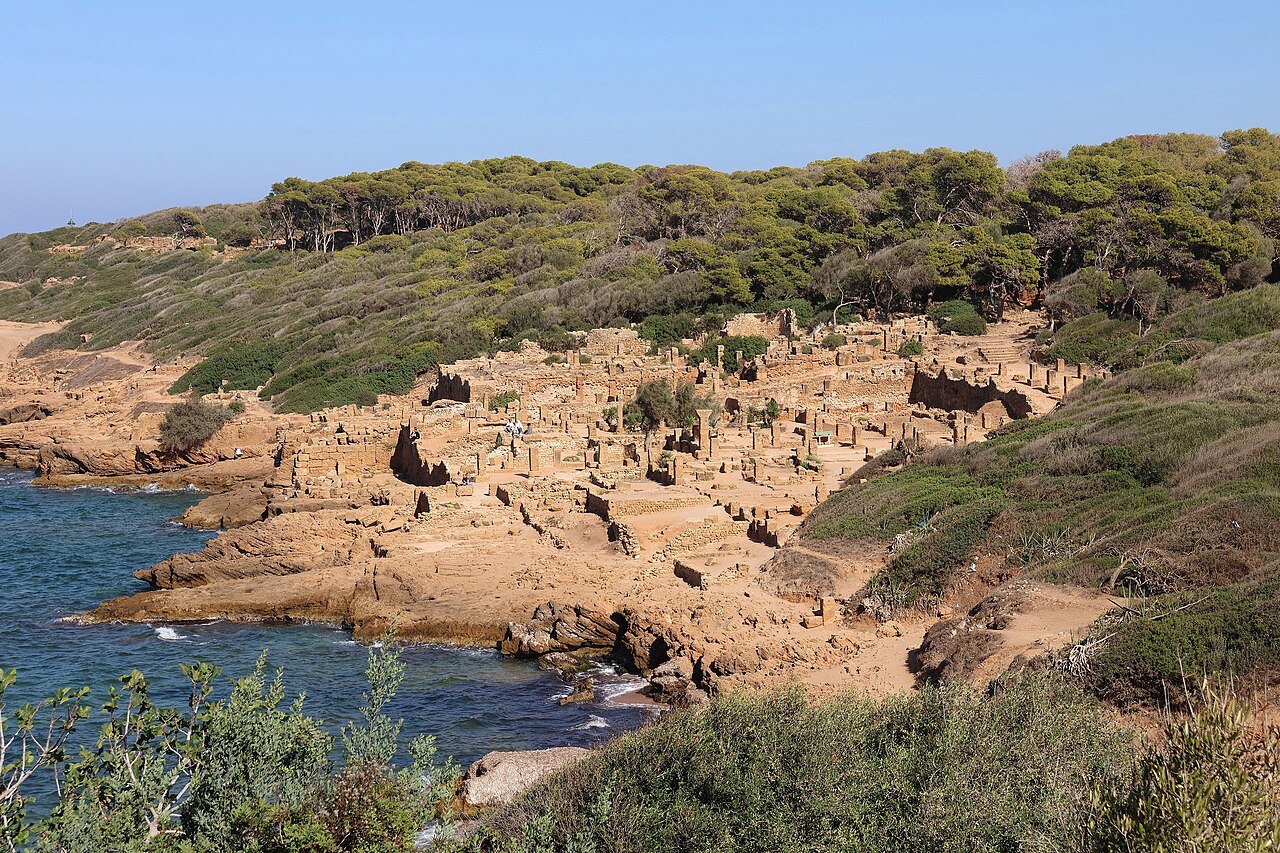
Tipasa sits on a rocky promontory west of Algiers where the Sahel coastal hills meet the sea, and its ruins — Phoenician trading post, Roman colony, early Christian necropolis — lie scattered among Mediterranean pines and scrub oak, with the smell of sea salt and wild thyme doing more to evoke the ancient world than most purpose-built archaeological parks ever manage. It is a site where the physical beauty of the landscape and the historical density of the ruins reinforce each other unusually well, which is perhaps why Albert Camus, born 70 kilometres east in Dréan, returned here repeatedly and wrote some of the most precise sentences about ruins and the living world that the French language contains.
Phoenicians, Romans and the Royal Mausoleum of Mauretania History & Archaeology
Tipasa was already old when Rome arrived. The Phoenicians established a trading post here in the 3rd century BCE, attracted by a sheltered anchorage, access to the fertile coastal plain behind the hills, and proximity to the indigenous Berber kingdoms of Mauretania that controlled the trade routes into the Saharan interior. The settlement accumulated slowly through the Numidian and early Mauretanian period, accumulating the cosmopolitan character that Phoenician-connected trading towns tend to develop: multiple languages, multiple religious cults, a population that negotiated identity pragmatically rather than ethnocentrically.
Roman colonisation changed the scale but not the fundamental character of the place. Emperor Claudius established Tipasa as a Roman colony in 45 CE, which meant a land survey, a grid of streets, a forum, temples, baths, an amphitheatre and the full infrastructure of civic Romanitas — all imposed on or built alongside the existing Punic and Numidian layers. The result, visible today in the archaeological park, is a stratigraphy of cultures rather than a single-period site: Phoenician sherds beneath Roman mosaic floors beneath early Christian basilica foundations beneath Byzantine defensive walls. UNESCO inscribed Tipasa in 1982, recognising both the density of this layering and the exceptional preservation achieved partly by accident — the site lay largely abandoned after the Arab conquest of the Maghreb in the 7th century CE, sparing it the systematic robbing of building materials that destroyed many comparable sites.
The most structurally impressive monuments are the Roman ones: the theatre, built against the hillside in the classical manner so that the tiers of seats use natural topography rather than artificial vaulting; the western basilica, whose standing columns and apse wall give a sense of a complete building even in ruin; and the network of necropolises surrounding the town on all sides, with Christian epitaphs in Latin mixed among pagan grave goods in a record of the community’s 4th-century religious transition. The mosaic floors preserved in the museum built on site show the quality of patronage available to provincial craftsmen — geometric patterns and hunting scenes of a technical standard that would not embarrass a floor in Rome itself.
Two kilometres east of the main archaeological park, the Kbour Roumia — the Royal Mausoleum of Mauretania — rises from the coastal plain as a circular stone drum 60 metres in diameter and 32 metres high, visible from a considerable distance and unmistakable in the landscape. Built in the 1st century BCE for the Mauretanian royal family, it is almost certainly the tomb of Cleopatra Selene II — daughter of Cleopatra VII of Egypt and Mark Antony, given in marriage to the Mauretanian king Juba II, and the last surviving member of the Ptolemaic dynasty. The mausoleum was investigated in the 19th century by a French archaeological mission who found the main burial chamber plundered but the architectural fabric intact. The conical top and the engaged columns of the drum give it a silhouette unlike any other funerary monument in North Africa — part Libyan pyramidal tumulus tradition, part Hellenistic royal mausoleum, a monument that physically embodies the cultural hybrid world its occupant inhabited.
Albert Camus and the inhabited ruins Literature & Landscape
In the spring of 1936, a 22-year-old Albert Camus walked through the ruins of Tipasa for the first time and wrote the essay that would open his first published book, Noces (1939). “In spring, Tipasa is inhabited by the gods and the gods speak in the sun and the smell of absinth leaves, in the silver armour of the sea, in the raw blue sky, in the flower-covered ruins and in the great bubbles of light among the heaps of stone.” The sentence is famous enough to have been carved onto a stele in the archaeological park, and tourists photograph it, but the observation it records is still empirically accurate in March and April: the combination of warm light, salt air, wild fennel and the physical scale of the ruins does produce a sensory experience that the word “inhabited” captures better than “picturesque” or “impressive.”
Camus returned to Tipasa in 1952, during the darkest period of his public dispute with Jean-Paul Sartre, and wrote a second essay, “Return to Tipasa,” which appeared in his collection L’Été (1954). Where the first essay was an almost ecstatic celebration of physical presence in the ancient landscape, the second is about the difficulty of recovering that state of attention after years of political argument and moral compromise. Both essays are worth reading before visiting the site — they do not substitute for direct engagement with the ruins, but they provide a calibration of attention that makes the experience more precise.
The site is 70 kilometres west of Algiers on the coastal road through Cherchell (Roman Caesarea, the capital of Mauretania Caesariensis and another significant archaeological site). The drive takes approximately 90 minutes in normal traffic, though the coastal road between Zeralda and Tipasa can be congested on summer weekends when Algiers residents use it as a beach corridor. Independent access from Algiers requires either a private vehicle or a shared taxi to Cherchell followed by onward transport; there is no direct public bus. The best time to visit is weekday mornings in spring or autumn, before the heat builds and before tour groups from Algiers arrive.
The nearest UNESCO site is the Roman ruins of Tipasa’s near-neighbour Djémila (UNESCO 1982), approximately 230 kilometres east through the Algerian highlands — reachable in under three hours by car, making a two-day circuit of Algerian Roman heritage entirely feasible. The Casbah of Algiers (UNESCO 1992) is 70 kilometres east, a logical half-day addition on the same journey.
Practical information
Getting there: Tipasa is 70 km west of Algiers on the RN11 coastal road. Shared taxis (service taxis) run from Algiers’ Tafourah bus station toward Cherchell and stop at Tipasa; journey approximately 1.5 hours. Private taxis from Algiers cost around DZD 3,000–4,000. No direct bus from Algiers city centre. Algiers Houari Boumediene International Airport (ALG) is 75 km east.
Entry: The main archaeological park is open daily except Monday, roughly 08:00–17:00. Entry fee is nominal (confirm current pricing at the park gate). The Royal Mausoleum of Mauretania (Kbour Roumia) is on the main road 2 km east of the park entrance and has separate opening hours; confirm locally as staffing varies.
When to go: March–May is optimal — wildflowers among the ruins, bearable temperatures, fewer visitors. October–November is the second-best window. July–August brings intense coastal heat and weekend crowds from Algiers.
Practicalities: Bring water and sun protection; shade is limited within the archaeological park. The on-site museum is small but holds the best mosaics. A separate visit to the Cherchell Museum (Roman Caesarea collections) 25 km east is strongly recommended for context on the regional Roman period.
Frequently Asked Questions
Who was Cleopatra Selene II and why is she buried in Algeria?
Cleopatra Selene II was born around 40 BCE as the daughter of Cleopatra VII of Egypt (the Cleopatra of popular history) and Mark Antony, the Roman general and triumvir. After the defeat of her parents at the Battle of Actium in 31 BCE and their subsequent suicides, the ten-year-old Cleopatra Selene and her twin brother Alexander Helios were taken to Rome as captives and displayed in the triumph of Octavian (later Augustus). Her brother disappeared from historical record — most likely dying young — but Cleopatra Selene was given in marriage around 25 BCE to Juba II, the Numidian-born client king whom Augustus had made ruler of Mauretania, the kingdom covering what is now northern Morocco and northwestern Algeria. Juba and Cleopatra Selene ruled Mauretania from their capital at Caesarea (modern Cherchell, 25 km east of Tipasa), maintaining a court remarkable for its Hellenistic learning and its collection of Greek sculpture. Cleopatra Selene died sometime around 6 BCE and was buried in the Royal Mausoleum of Mauretania — the Kbour Roumia — which she and Juba had probably already commissioned. She was the last surviving member of the Ptolemaic dynasty that had ruled Egypt since 305 BCE, and her tomb on the Algerian coast is, for this reason, one of the stranger endpoints of the Hellenistic world.
What did Albert Camus actually write about Tipasa?
Camus wrote two essays about Tipasa, published roughly fifteen years apart, which together form one of the most sustained literary meditations on ruins and presence in 20th-century French literature. The first, “Noces à Tipasa” (1936, published in Noces 1939), was written when Camus was 22 and studying philosophy in Algiers. It is an essay of intense physical attention — to light, smell, texture, the heat of stone — and an explicit rejection of any attempt to impose historical or metaphysical meaning on the experience of being in the ruins. The ruins are valuable precisely because they are not signs of anything beyond themselves. The second essay, “Retour à Tipasa” (1952, published in L’Été 1954), was written after a decade of political controversy surrounding Camus’s position on the Cold War and his break with Sartre. It returns to the site to test whether the experience of the first essay can be recovered, and it is both more guarded and more deliberate in its conclusions. A stone stele in the archaeological park carries the most quoted sentence from the first essay: “In spring, Tipasa is inhabited by the gods and the gods speak in the sun and the smell of absinth leaves…” The siting of the stele — visible as you enter the park — makes it impossible to miss, which is either moving or irritating depending on your relationship with literary tourism. Both essays are short (under 3,000 words each) and available in English translation in the Penguin collection Personal Writings.
How does Tipasa fit into a wider Algerian heritage itinerary?
Tipasa works well as the western anchor of a three-site Algerian Roman circuit. From Algiers, the logical sequence is: Tipasa (70 km west) — a half-day to full day; Cherchell / Caesarea (25 km east of Tipasa, not UNESCO-listed but with an exceptional Roman sculpture museum) — 2 hours; then either return to Algiers or continue east toward the UNESCO sites of the north-central highlands. Djémila (Roman Cuicul, UNESCO 1982) is 230 km east of Algiers in the mountains of Sétif Province — roughly 3 hours by road — and is considered by many visitors the most dramatically sited of Algeria’s Roman sites, its ruins preserved at 900 metres altitude by the very isolation that eventually emptied the town. Timgad (Roman Thamugadi, UNESCO 1982) is a further 100 km south of Djémila, a complete Roman colonial grid preserved in the semi-arid landscape of the Aurès mountains. A four-day circuit — Algiers, Tipasa (night), Djémila (night), Timgad (half-day), return via Constantine — covers three UNESCO sites and the best of Algeria’s Roman heritage without rushing. The Casbah of Algiers (UNESCO 1992) can be added as a day-trip from the capital before or after the circuit.