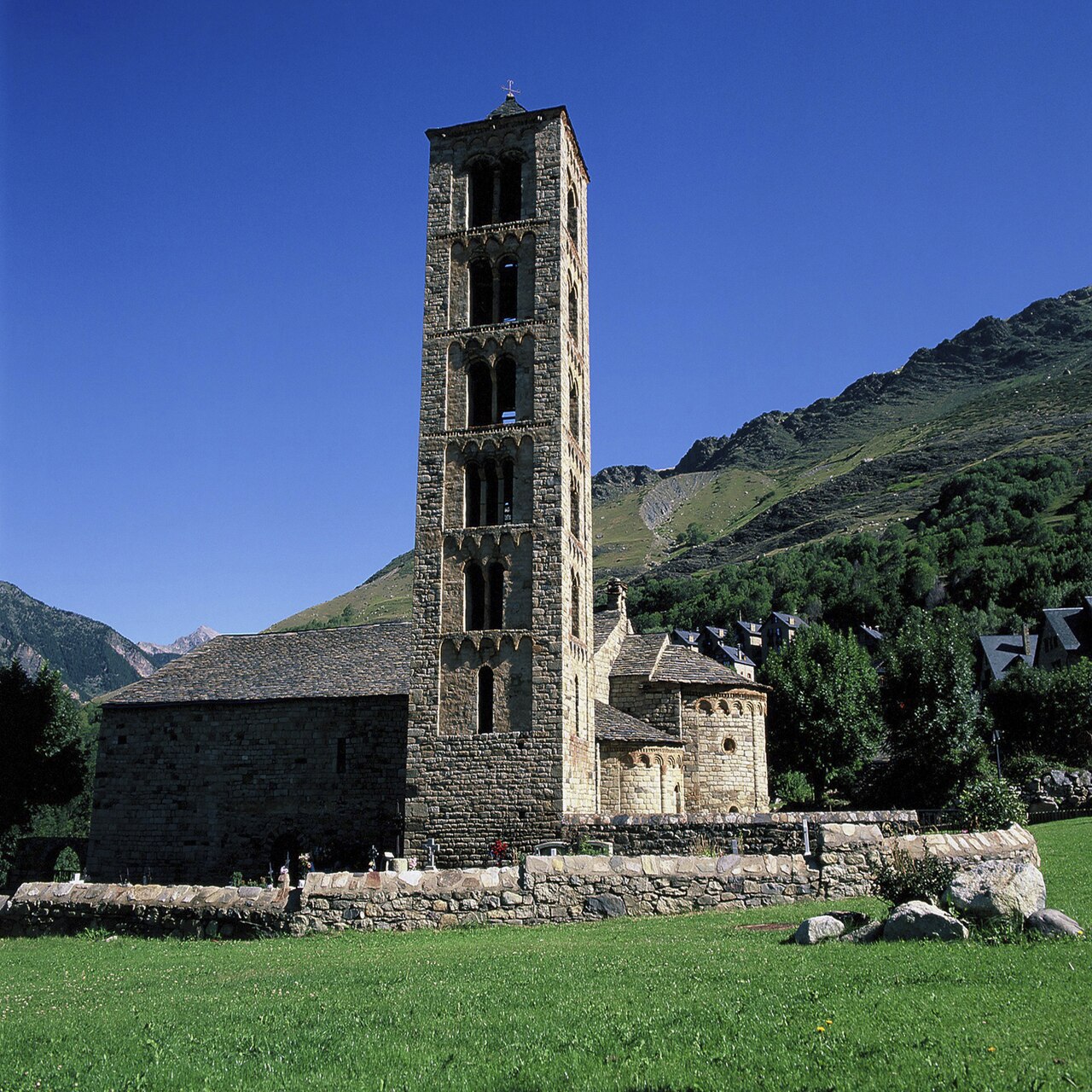
Andorra has no inscribed UNESCO World Heritage Sites, but the Pyrenees surrounding the capital Andorra la Vella hold two of the most significant UNESCO sites in the Iberian Peninsula: the Catalan Romanesque churches of the Vall de Boí, 100 km southwest, and the Pyrenees – Mont Perdu landscape, 200 km east on the French border. From Cultural Heritage Online.
Catalan Romanesque Churches of the Vall de Boí 100 km southwest — 2 hr by road via La Seu d’Urgell
The Vall de Boí is a remote valley in the Lleida Pyrenees with a concentration of Romanesque churches that is unmatched anywhere in the Iberian Peninsula. Nine churches and a hermitage were built between the eleventh and thirteenth centuries by Lombard master builders brought across the Alps by Catalan bishops with means and ambition: Sant Climent de Taüll (1123), Santa Maria de Taüll (1123), Sant Joan de Boí, Santa Maria de Cardet, Sant Feliu de Barruera, Sant Eulàlia d’Erill la Vall, La Nativitat de Durro, Sant Quirc de Durro, and Santa Maria de Cóll. The church of Sant Climent de Taüll contains what is arguably the finest surviving Romanesque apse fresco in the world — the Pantocrator by the Master of Taüll, created in 1123 and now held in the National Art Museum of Catalonia in Barcelona (replaced in the church by a facsimile).
The churches share stylistic characteristics: tall, slender bell towers with multiple levels of Lombard blind arcading, semicircular apses decorated with carved corbels, and interiors that once contained cycle fresco painting of extraordinary quality. Most of the original frescoes were removed in the early twentieth century by art dealers and Catalan museum collectors; they are now conserved in the MNAC in Barcelona and the Episcopal Museum of Vic. The apse walls of several churches have been fitted with high-quality facsimile reproductions that allow visitors to experience the original chromatic effect. The Vall de Boí was inscribed as a UNESCO World Heritage Site in 2000.
Getting there: From Andorra la Vella, drive west via La Seu d’Urgell on the N-260 to El Pont de Suert, then north into the Vall de Boí — approximately 100 km, 2 hours. The valley has a small tourist office at Barruera. Allow: Full day to visit multiple churches; half day for Sant Climent de Taüll alone. Best for: Medieval architecture and religious art visitors; Pyrenees hikers combining culture and mountain.
Pyrenees — Mont Perdu 200 km east — 3.5 hr by road to Gavarnie (French side)
The Pyrenees-Mont Perdu World Heritage Site, shared between France and Spain and inscribed in 1997 (extended 1999), covers the highest massif in the Pyrenees and the glacial canyon landscapes of the Ordesa valley (Spanish side) and the cirques of Gavarnie, Troumouse, and Estaubé (French side). The area is inscribed for both its outstanding natural landscape — glacial valleys, canyon walls, and one of the last significant herds of izard (Pyrenean chamois) — and its cultural landscape: the transhumant pastoral tradition of moving livestock between winter lowlands and summer mountain pastures, documented here for over two millennia and still practiced today. The Ordesa y Monte Perdido National Park on the Spanish side is the entry point from Andorra direction.
Getting there: From Andorra la Vella, drive east via France through Tarascon-sur-Ariège to Gavarnie (French side, approx. 200 km, 3.5 hr); or south via Lleida and Ainsa to Ordesa National Park entrance at Torla-Ordesa (Spanish side, approx. 280 km, 4 hr). Allow: Full day minimum for either approach. Best for: Mountain landscape visitors; hikers with experience in high-altitude terrain.
Frequently Asked Questions
Does Andorra have any UNESCO World Heritage Sites?
No. As of 2026, Andorra has no inscribed UNESCO World Heritage Sites. The nearest are in Spain and France: the Catalan Romanesque Churches of the Vall de Boí (100 km southwest in Catalonia) and the Pyrenees – Mont Perdu landscape (approximately 200 km east, shared between France and Spain).
Where are the Catalan Romanesque Churches of the Vall de Boí?
The Vall de Boí is a valley in the Alta Ribagorça comarca of Lleida province in Catalonia, Spain. The nine inscribed churches are distributed across the valley villages: the most visited are Sant Climent de Taüll and Santa Maria de Taüll in the village of Taüll, at the head of the valley. The best base for visiting is El Pont de Suert, the largest town in the area.
What happened to the original frescoes from the Vall de Boí churches?
Most of the original Romanesque frescoes were detached from the church walls in the early twentieth century by art dealers and sold to museums. The most important collection is now in the National Art Museum of Catalonia (MNAC) in Barcelona, including the celebrated Pantocrator from Sant Climent de Taüll. The churches now contain high-quality facsimile reproductions that restore the original visual experience, while the MNAC galleries in Barcelona display the detached originals in reconstructed apse settings.
Can you hike between Andorra and the UNESCO sites in the Pyrenees?
Yes, though not as a day walk. The long-distance GR 11 trail (Senda Pirenaica) crosses through Andorra and connects to the Ordesa y Monte Perdido area and the Vall de Boí. Serious multi-day trekkers use Andorra as a staging point for Pyrenean traverses that pass through or near both UNESCO landscapes. Day hikers from Andorra will need vehicles to reach the trailheads for either site.
Sources
- S1 — Junyent, Eduard. L'arquitectura romànica a Catalunya. Publicacions de l'Abadia de Montserrat, 1983. ISBN 978-84-7202-581-3.
- S2 — Conant, Kenneth John. Carolingian and Romanesque Architecture: 800 to 1200. Penguin Books, 1978. ISBN 978-0-14-056113-5.
Spotted an error? Write to editorial@culturalheritageonline.com and we correct it the same day.