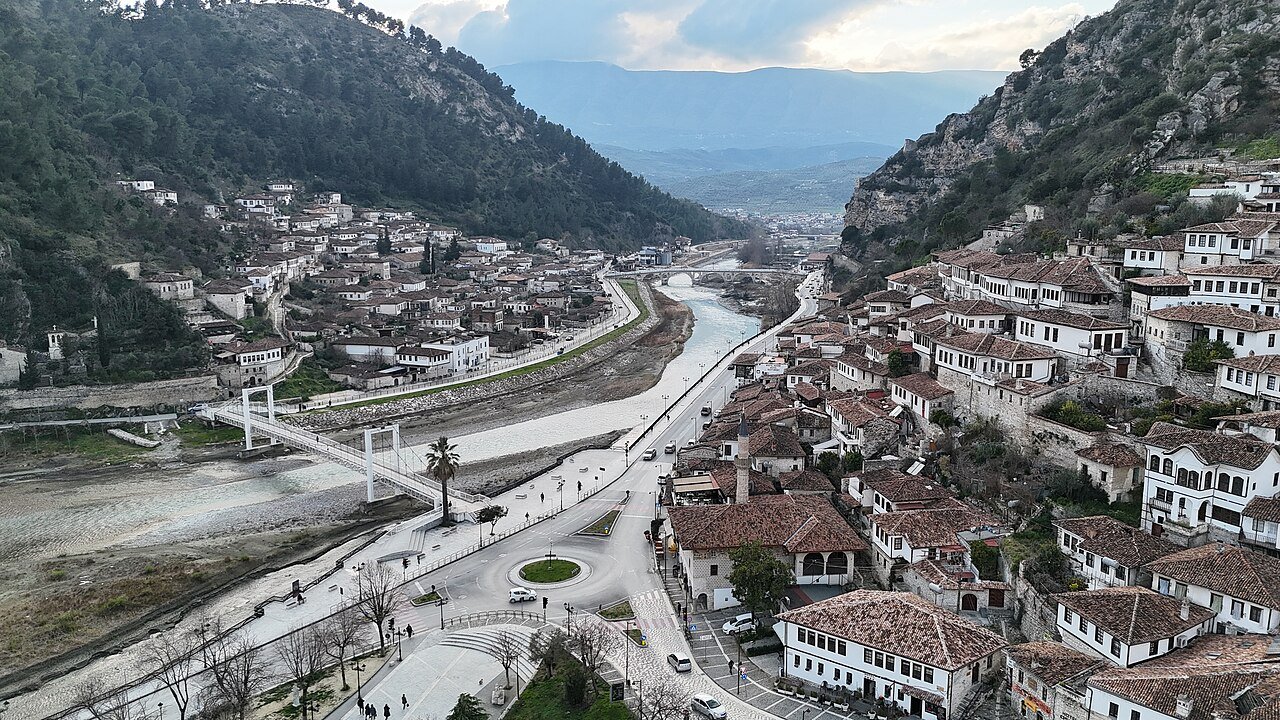
Berat rises in tiers from the gorge of the Osum River in central Albania: whitewashed Ottoman houses stacked on a steep hillside, each facade dominated by rows of large windows that gave the city its legendary nickname, “Qyteti i Njëmijë Dritareve” — City of a Thousand Windows. A Byzantine castle crowns the hilltop above; the Mangalem quarter of Muslims and the Gorica quarter of Orthodox Christians face each other across the river below; and the medieval Kalasa neighbourhood survives within the castle walls, continuously inhabited for at least eight centuries. The UNESCO inscription of 2005 — extended in 2008 to include the nearby city of Gjirokastër — recognised Berat as an exceptional example of an Ottoman-period Balkan town, almost perfectly preserved.
The City of a Thousand Windows: Ottoman Urbanism on the Osum Historic Centres of Berat and Gjirokastër, UNESCO 2005 · central Albania
Berat’s history extends far beyond the Ottoman period that defines its current appearance. The site was settled in the fourth century BCE as an Illyrian fortification, became the Roman city of Antipatrea, and was subsequently a Byzantine episcopal centre of considerable importance. The castle that crowns the hilltop — Kalaja e Beratit — was built in its present form in the thirteenth century under the Byzantine Despotate of Epirus, though its foundations rest on much earlier defensive works. Within the castle walls, the neighbourhood of Kalasa persists: a continuous community of families living in medieval and post-medieval houses, surrounded by the ruins of Byzantine churches and the remnants of earlier structures, in what amounts to a living archaeological stratigraphy.
The Mangalem quarter, on the steep southern slope below the castle, is the primary residential district of Berat’s Ottoman urban form. Houses here are characteristically Ottoman Balkan in their construction: ground floors of stone, upper storeys of timber-framed plaster projection (çıkma) that extend over the narrow lanes, and facade walls dominated by large multi-pane windows that flood the interiors with light while allowing the inhabitants to observe the street below without being seen. The cumulative effect of hundreds of such houses rising in near-uniform white tiers above the Osum gorge is arresting — a human landscape of extraordinary visual coherence.
The Onufri Museum, housed in the Cathedral of the Dormition of the Virgin within the castle complex, is one of the most important collections of Byzantine and post-Byzantine icons in the Balkans. Onufri, an Albanian icon painter active in the mid-sixteenth century, is the museum’s namesake and its primary treasure: his icons, characterised by vivid cinnabar reds and a distinctive handling of facial features, represent the finest expression of a regional painting tradition that adapted Byzantine conventions to local materials and devotional needs. The museum’s collection also includes works by Onufri’s son Nikolla and by other painters of the sixteenth to nineteenth centuries.
The Gorica quarter, across the Osum from Mangalem and connected by the old stone bridge, was the predominantly Orthodox Christian quarter of Berat. Its houses are somewhat different in character — more enclosed, with courtyard plans recalling earlier Balkan domestic traditions — and the neighbourhood preserves several small Orthodox churches from the post-Byzantine period. The bridge itself, a single-arch stone structure rebuilt in the late Ottoman period on earlier foundations, is one of the most photographed points in the city.
Walking Berat requires accepting that the city is built on an extremely steep hillside: the lanes between the houses rise sharply, paved with worn stone sets that become slippery when wet. The physical challenge is part of the experience. The reward at the top — the castle platform with its panoramic view of the Osum gorge, the river plain below and the mountains that surround the valley — justifies the effort entirely.
Within the Castle Walls: The Kalasa Quarter and Byzantine Churches Berat castle · 30 min walk uphill from town centre
The Kalasa neighbourhood within the castle walls is genuinely unlike almost any other inhabited historic urban space in Europe. A small permanent community — several dozen families — lives among the medieval and Ottoman-period houses inside the fortified perimeter, tending vegetable gardens, keeping chickens and navigating the same worn stone paths that their ancestors used for centuries. The Byzantine churches of Berat are concentrated here: the Cathedral of the Dormition (fifteenth century, rebuilt and expanded in the nineteenth), the Church of the Holy Trinity (thirteenth century), the Church of St Michael (thirteenth century) and several others, many in various states of preservation.
The archaeological layer within the castle is deep. Excavations have revealed Illyrian, Roman, Byzantine and medieval strata; the walls themselves incorporate blocks from multiple periods, identifiable by their different cutting and coursing styles. The north tower of the castle, now a lookout point accessible to visitors, gives the clearest sense of the fortification’s scale and of the strategic logic that made this hilltop the key to controlling the Osum valley.
Beyond the castle and the two main residential quarters, Berat has a modest but pleasant town centre on the flat ground along the river, developed in the nineteenth and early twentieth centuries with administrative buildings and a bazaar district. The National Ethnographic Museum, housed in a restored Ottoman mansion near the bazaar, documents traditional Albanian rural and urban life with collections of costumes, tools, textiles and household objects. The bazaar itself — partly restored, partly still in its original state — preserves the covered arcade character of the Ottoman commercial district.
Access from Tirana, Albania’s capital, takes approximately 2 hours 30 minutes by furgon (shared minibus, the primary mode of intercity transport in Albania) or approximately 2 hours by car. There is no rail connection to Berat from Tirana. The nearest airport is Tirana International Airport Nënë Tereza (TIA), which has connections to most European capitals and to several Middle Eastern cities. Road conditions on the approach to Berat have improved significantly in recent years with EU-funded infrastructure investment.
Practical information
Getting there: Berat is 122 km south of Tirana. Furgons (shared minibuses) depart from the Tirana Kombinat bus terminal and take approximately 2 hours 30 minutes; buses also serve the route. No direct train connection exists. By car, the journey from Tirana takes approximately 2 hours via the SH4 national road. Tirana Airport (TIA) is the primary international gateway, with connections across Europe.
When to visit: April to June and September to October are ideal — warm, relatively uncrowded, and with comfortable temperatures for walking the steep hillside streets. July and August are hot and can be busy with Albanian diaspora visitors. Winter is mild but rainy; the city is significantly quieter.
What else is nearby: The Apollonia archaeological site (50 km southwest), one of the most important ancient Greek and Roman cities in Albania, is an excellent half-day extension. The Osumi Canyon, formed by the Osum River 30 km south of Berat, is a dramatic natural gorge accessible by organised kayaking or walking tours. Gjirokastër (UNESCO co-inscribed) is approximately 2 hours 30 minutes south by road.
Frequently Asked Questions
Why is Berat called the City of a Thousand Windows?
The nickname refers to the visual effect created by the Ottoman-period houses of Berat’s Mangalem quarter, whose facades are dominated by unusually large windows arranged in symmetrical rows across two or three storeys. The window design is functional: the deep valley setting and steep hillside orientation mean that maximising natural light required large openings, and the Ottoman Balkan domestic tradition of extended upper storeys (çıkma) projecting over the street created facade surfaces that could be almost entirely glazed. The cumulative effect of hundreds of such houses rising in tiers above the Osum gorge, each reflecting light from its rows of windows at different times of day, gives the city a distinctive visual rhythm. The nickname “City of a Thousand Windows” appears in Ottoman-period travel literature and has remained in use ever since. It is worth noting that Gjirokastër, the other city jointly inscribed with Berat in the UNESCO listing, has a contrasting character — its houses are closed, stone-faced towers whose defensive form minimises window openings — making the two cities a complementary study in the range of Ottoman Balkan domestic architecture.
Who was Onufri and why is he important to Albanian cultural heritage?
Onufri (active c. 1540–1578) is the most celebrated Albanian painter of the post-Byzantine tradition and one of the most distinctive icon painters of the sixteenth-century Balkans. Very little is known of his life: he is documented in inscriptions on his own works, which note that he was a priest (prift) and later an archpriest, and that he worked in the regions of Berat, Korçë and the surrounding areas. His most immediately recognisable characteristic is his use of an extraordinarily vivid cinnabar red — a pigment derived from mercury sulphide — that gives his icons a warmth and intensity unusual in the sombre palette of most Byzantine-tradition painting. His figural style also departs from strict Byzantine convention: his faces have a psychological directness and his drapery a rhythmic expressiveness that suggest awareness of contemporary Cretan and possibly Italian painting, filtered through a thoroughly Albanian sensibility. The museum bearing his name in the Cathedral of the Dormition in Berat’s castle contains the largest collection of his authenticated works and those of his son Nikolla, making it the essential destination for understanding this tradition.
What is the difference between the Mangalem and Gorica quarters of Berat?
Mangalem and Gorica are the two principal historic residential quarters of Berat, separated by the Osum River and the old stone bridge. Mangalem, on the southern slope below the castle, was the Muslim quarter of the Ottoman-period city: its mosques, most of which are no longer standing or functioning, anchored a community of Albanian Muslim families who built the characteristically open, window-rich houses that define Berat’s visual identity. Gorica, across the river on the northern bank, was the Orthodox Christian quarter, inhabited primarily by Albanian Christians who maintained their own churches and a somewhat more enclosed domestic architectural tradition with courtyard plans recalling pre-Ottoman Balkan building practice. The division was not absolute — the communities interacted through the bazaar and across the bridge — but it was socially and spatially real, reflecting the Ottoman millet system that organised urban populations by religious community. Today, Berat’s inhabitants are predominantly Muslim (following the patterns of post-communist Albanian society), and both quarters are inhabited by Albanian families without the religious segregation of the Ottoman period. The architectural distinction between the two sides of the river, however, remains clearly legible.