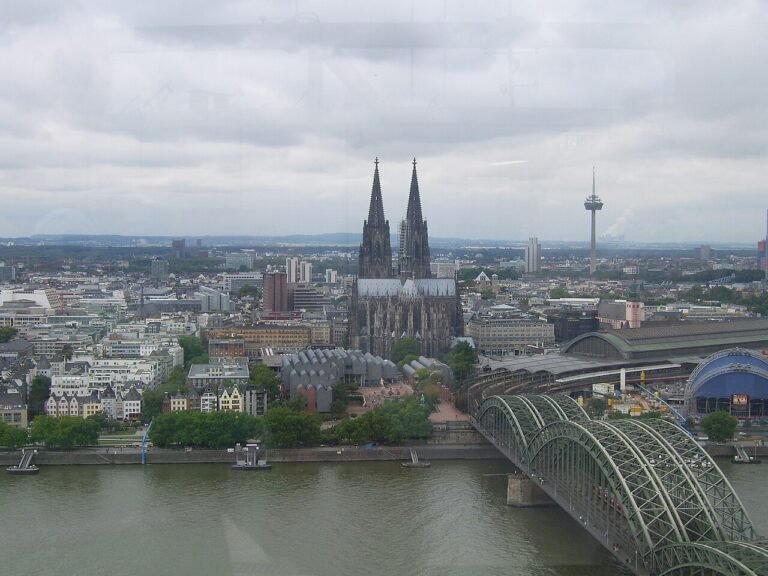
Wikimedia Commons,
CC BY 3.0.
Toruń stands on the Vistula in north-central Poland, its red-brick skyline unchanged in outline since the Teutonic Knights built their first fortifications here in 1231. The city gave the world Nicolaus Copernicus, signed the Peace of Toruń that ended a thirteen-year war, and has been turning out spiced gingerbread for nearly seven hundred years. Its medieval core was inscribed on the UNESCO World Heritage List in 1997, and it sits within easy reach of several other listed sites across Poland and the southern Baltic.
Why Toruń is one of Europe’s great Gothic cities Central Poland · Vistula Valley · 2.5 hrs from Warsaw by train
When the Teutonic Order founded their fortified post at Toruń in 1231, they chose one of the most strategically valuable crossing points on the Vistula. The river was broad and navigable, the surrounding plain was fertile, and a castle here could dominate trade between the Baltic coast and the Polish interior. Over the following two centuries the town that grew around and beyond the castle became one of the wealthiest in the Hanseatic network, its merchants exporting grain, amber, and wax westward and importing Flemish cloth in return.
The architecture left behind by those centuries of prosperity is concentrated in two medieval cores — the Old Town (Stare Miasto) and the New Town (Nowe Miasto) — that together form the inscribed UNESCO area. The Old Town Hall, a massive four-winged Gothic structure completed in the early 15th century, is the visual anchor of the Rynek Staromiejski. Its octagonal corner tower, added around 1385, is among the most recognisable silhouettes in Polish Gothic architecture. Inside, the Regional Museum occupies rooms whose vaulted ceilings still bear painted decorations from the 14th and 15th centuries.
Around the market square, the burgher houses present an uninterrupted sequence of Gothic brick facades, many of them retaining their original proportions even where later centuries added Renaissance or Baroque ornament. The Parish Church of St John the Baptist and St John the Evangelist — the largest Gothic hall church in the region — was begun in the 13th century and contains a great bronze bell, the Tuba Dei, cast in 1500 and weighing nearly 7 tonnes. The ruins of the Teutonic Castle, systematically demolished by the citizens of Toruń themselves in 1454 after Poland annexed the town, survive as a deliberate reminder of the Order’s former grip on the city.
The Peace of Toruń, signed here in October 1466, ended the Thirteen Years’ War between the Kingdom of Poland and the Teutonic Order. Poland recovered Pomerelia and Western Prussia, the Order was reduced to a vassal state, and Toruń briefly became the most important diplomatic address in northern Europe. A second Peace of Toruń in 1411, also signed here, had ended the Battle of Grunwald conflict: the city has an unusual distinction as the location of two major medieval treaties.
Nicolaus Copernicus was born in Toruń on 19 February 1473, in a merchant’s house on ul. Kopernika that now serves as his birthplace museum. The heliocentric model he developed — published as De revolutionibus orbium coelestium in 1543 — overturned more than a millennium of Ptolemaic cosmology. Toruń claims him with a civic pride that permeates the city: his statue dominates the Old Town square, his portrait appears on the 1,000-złoty banknote, and the University of Toruń, founded 1945, bears his name.
The gingerbread tradition is equally ancient. Pierniki Toruńskie — spiced honey biscuits pressed into carved wooden moulds depicting saints, knights, and heraldic animals — appear in guild records from the 14th century. Toruń bakers developed their own blend of spices, including cardamom, cloves, cinnamon, pepper, ginger, anise, and nutmeg, that still distinguishes local production from other Central European gingerbreads. The Living Museum of Gingerbread (Muzeum Piernika) on ul. Rabiańska allows visitors to mix and mould their own batches in a workshop setting that recreates a 15th-century bakery.
Heritage sites within reach: Malbork, Gdańsk and Chełmno Within 120 km · direct train or bus connections
The Teutonic Order’s castle at Malbork (Marienburg), 93 km north-west of Toruń, is the largest castle in the world by land area and a UNESCO World Heritage Site since 1997 — the same year as Toruń. Built from 1274 onward in banded brick of a reddish colour almost identical to the walls of Toruń, Malbork served as the Grand Master’s residence and administrative centre of the Order’s Prussian state. Its three-court structure — High, Middle, and Lower Castle — enclosed an area of roughly 21 hectares. The Amber Museum within the castle displays pieces from the local Baltic deposits that the Teutonic Knights controlled and taxed for two centuries.
Gdańsk (formerly Danzig), 143 km to the north, was also a Hanseatic city and shares the architectural DNA of Toruń: brick Gothic churches, stepped gabled merchant houses, crane-equipped waterfront. The Neptune Fountain on Długi Targ (Long Market), the monumental Golden Gate, and the Great Crane (Żuraw) on the Motława River are the most-photographed elements of a cityscape rebuilt after wartime destruction with painstaking accuracy. Gdańsk is also the city where World War II began, on 1 September 1939, and where the Solidarity movement was born in August 1980.
Chełmno, 45 km south-east of Toruń, is a smaller medieval town founded by the Teutonic Order in 1233, two years after Toruń itself. Its original Gothic city walls survive to nearly their full circuit — 2.2 km of brick fortifications with 23 towers and 2 gates, among the most complete in Poland. The Chełmno Measure (Chełmińska łokieć), a medieval standard of length, was established here and used throughout Teutonic Prussia; a replica is displayed in the market square. Chełmno is reachable from Toruń in about 45 minutes by regional bus.
For visitors approaching from Warsaw, Toruń’s main railway station (Toruń Główny) is served by direct InterCity trains taking approximately two and a half hours. The Old Town is a 20-minute walk or a short tram ride from the station. Budget travellers should note that Toruń’s hotel prices are substantially lower than Kraków or Warsaw, and the city is seldom crowded outside summer weekends.
Practical information
Getting there: Toruń is served by direct trains from Warsaw Centralna (2 h 30 min, PKP InterCity), Bydgoszcz (30 min), and Gdańsk (1 h 45 min). There is no commercial airport at Toruń; the nearest airports are Bydgoszcz (BGD, 50 km) and Poznań (POZ, 155 km). Buses from Warsaw’s central bus station take approximately 3 hours and are often cheaper than the train.
Getting around: The inscribed UNESCO area — Old Town and New Town — is compact and walkable in two to three hours. The Copernicus Birthplace Museum, the Old Town Hall, the ruined Teutonic Castle, and the Church of St John are all within a ten-minute walk of each other. Bikes are available for hire near the Vistula embankment.
Best time to visit: May and June offer the best balance of warm weather and modest crowds. The Medieval Festival (Festiwal Wisły) in late June brings jousting and craft markets to the Old Town. July and August are peak season; the city fills on weekends but rarely feels overwhelmed. December is atmospheric, with Christmas markets and gingerbread everywhere in the shops.
Practical tips: The Toruń Card (available at the tourist office on Rynek Staromiejski) covers entry to the Regional Museum, the Copernicus Museum, and the Living Museum of Gingerbread, and includes public transport. The Vistula embankment walk between the ruined castle and the Old Bridge (Most Staromiejski) is free and takes about 20 minutes. The town centre restaurants on and around the Rynek offer reasonable prices by Western European standards; look for żurek (sour rye soup) served in bread bowls, a local favourite.
Frequently Asked Questions
Is Toruń worth visiting if you have already seen Kraków?
Yes — and precisely because it is different from Kraków. Where Kraków’s heritage is largely Gothic stone and Renaissance marble, Toruń’s is brick Gothic of a northern European character closer to Lübeck, Gdańsk, or Tallinn than to anything in southern Poland. The Rynek Staromiejski feels more intimate than Kraków’s Rynek Główny and, outside of peak summer weekends, significantly less crowded. The Copernicus dimension adds an intellectual itinerary — from his birthplace museum to the university named after him — that has no parallel in Kraków. Visitors doing a first trip to Poland often prioritise Kraków, Warsaw, and Gdańsk; Toruń fits naturally into a longer itinerary that adds Malbork and the Vistula cities. Allow at least a full day in the city; an overnight stay lets you see the brick facades lit at dusk and explore the embankment at a leisurely pace.
What is the significance of the Peace of Toruń?
There are in fact two Peaces of Toruń. The first, signed 1 February 1411 after the Battle of Grunwald, ended the Polish-Lithuanian-Teutonic War: the Order was forced to pay reparations but retained most of its territory. The second and far more consequential Peace of Toruń was signed 19 October 1466 at the end of the Thirteen Years’ War. Under its terms, the Teutonic Order ceded West Prussia (including Gdańsk, Malbork, and Elbląg) to the Kingdom of Poland and was forced to acknowledge Polish suzerainty over the remainder of its territory. Poland thereby gained direct access to the Baltic coast for the first time, transforming the Polish-Lithuanian Commonwealth into the dominant power of northern Europe for the following two centuries. The treaty was negotiated inside Toruń’s Franciscan monastery, a building that still survives on ul. Żeglarska.
How did Toruń’s gingerbread become famous across Europe?
The trade routes that made Toruń a wealthy Hanseatic city also brought it an exceptional supply of spices. Ships returning from the eastern Baltic carried pepper, cardamom, and other aromatics from Arab and Asian trade networks that reached the Baltic via Novgorod and Riga. Toruń bakers combined these spices with local rye flour and honey — a product of Poland’s abundant apiaries — to create a durable, fragrant biscuit that survived long journeys and sold well at trade fairs. The Toruń Guild of Gingerbread Bakers was formally constituted in the 14th century and maintained strict quality controls: only licensed masters could press the carved wooden moulds, and the standard spice blend was a guild secret. By the 16th century, Toruń gingerbread was exported to markets in Hamburg, Antwerp, and London. Today, the brand Kopernik — named after the city’s most famous son — continues to produce katarzynki (small round gingerbreads named after the feast of St Catherine) in the traditional manner and exports them to more than 60 countries.