
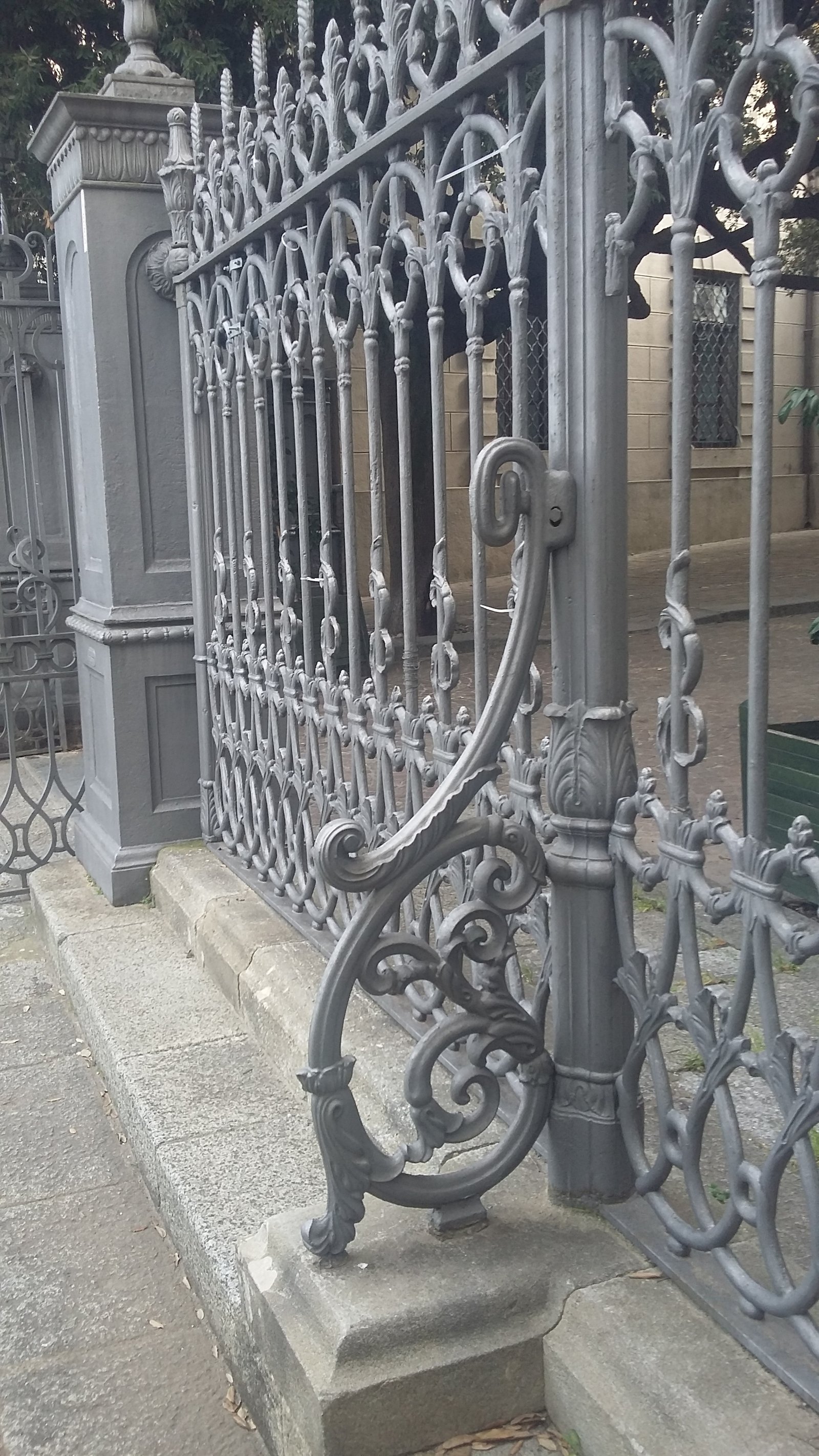
Grilles, gates, balconies, lamps, andirons: wrought iron is one of the most common decorative crafts on Italian facades, and one of the least documented. Art historian Ortensio Mendicino, author of a 2006 monograph on the ironwork of Pisa and co-author of a 2025 study of Catanzaro’s historic centre, surveys six centuries of the craft — how it was made, who made it, and why so much of it still goes uncatalogued.
A decorative craft, and an endangered one
Wrought iron belongs to the history of the decorative and industrial arts as a craft that is, above all, ornamental — even though the line between decoration and structural use has never been entirely clear. Guild statutes regulated the profession for centuries, changing as they passed from one regional state to another in the patchwork of Italy before unification. Over time, ironworkers developed a repertoire tied to the architecture they served: mullioned windows, arches and columns for door and stair surrounds, and smaller fittings — handles, door-panel mounts, flag-holders, bells, candle-stands, andirons, tables — for facades and interiors. Each piece belongs to the artistic and stylistic currents of its century, designed and made by the blacksmith, sometimes to a client’s own drawing.
The craft’s industrial turn began in the last quarter of the eighteenth century in England, and in the early nineteenth century in the rest of Europe. The first and second industrial revolutions, the growth of the railways and the automobile, rising populations, new building and new artistic currents all pushed up demand for ironwork across Europe, reaching Italy a few years behind. Cast-iron ornament and industrial finishes were increasingly combined with forged work. The craft’s fortunes have risen and fallen unevenly by region ever since, carried by workshops old and new.
Between the nineteenth and twentieth centuries, the blacksmith worked iron that industry had already squared and prepared for cutting — a real change from earlier centuries, when smiths at least finished the raw metal bought as bars, blocks, plates and fixings themselves (no documents survive of a clear separation between ore-smelters and smiths in earlier periods). The craft’s decline since has been slow but steady, for reasons that compound each other: the physical toll of the work, high production costs, the limited capital needed to open or renovate a workshop, a shortage of people willing to take the risk, market competition, and the simple fact that many of the fittings a blacksmith once forged — a gate, a railing — can now be bought ready-made from a factory. Industry’s partial takeover cut the labour needed for a finished piece and lowered its price for the buyer, in a division of labour that began with the first industrial revolution and continues today, as prefabricated components are assembled rather than forged to order.
How the metal was worked
Forging, hammering and drawing iron are the basic operations behind both the raw material and the finished piece, and have been since iron itself was first produced, around the middle of the fourth millennium BC, among the Egyptians and the Chaldeans. In Italy, ore — hematite, pyrite, iron oxides — was smelted with wood fuel in furnaces from around the ninth century BC; those who produced the iron also made the finished piece. The bloom was laid on a firm support and beaten and drawn — with a stone in antiquity, later with a hammer — to drive out slag and carbon monoxide; heating and hammering were repeated until the carbon content fell low enough to produce malleable wrought iron, which was then slowly worked into bars and sheets of varying thickness and section.
The production method itself changed little for centuries beyond new tools, until it gathered new momentum from the eleventh century on: larger furnaces, bellows driven by water power, water-powered trip-hammers, and tools suited to the work. Demand drove constant improvements in smelting and in the search for new designs and decorative techniques — damascening, niello work, godron fluting, beading, chasing, piercing, engraving, moulding, cutting, stamping — applied by smiths capable of a high degree of specialisation to both simple and complex commissions worked to order in the shop. Working the metal in a general sense defines a blacksmith (fabbro); what was produced defined the specialisation — smiths proper, dealing in furniture and fittings; farriers, shoeing and harnessing horses; and armourers, making armour, swords, knives and firearms.
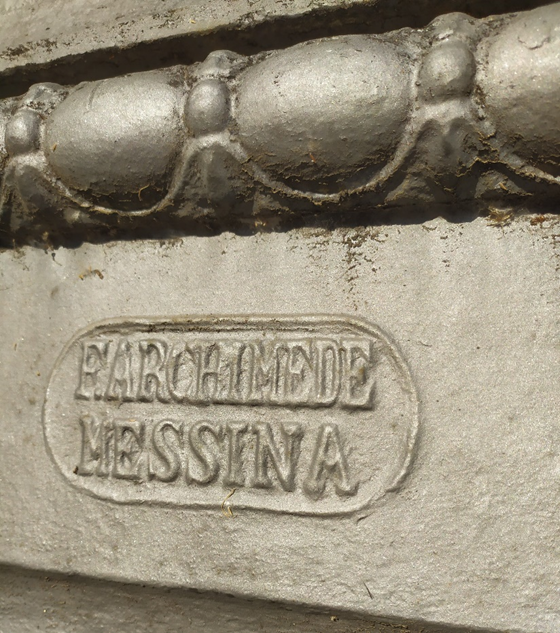
The craft’s slow decline begins in the eighteenth century, with the first blast furnaces and coke smelting (in England, in the last quarter of the 1700s) and, at the same time, a first industrial revolution that shifted smiths from making their own raw material to buying it from suppliers. The difference shows in the metal itself: hand-worked iron is less regularly squared than the more uniform sections that came from early industrial production — a visible line between the two methods, and between the two eras of production. The blacksmith still managed the shop’s finances, bought the raw material and did the work; the apprentice and the boy who once learned every stage of the craft were now largely reduced to carrying metal and coal and tending the forge — though, over the years, this is still how they learned the trade and its designs, to pass on in turn. The workshop of the period is illustrated in several plates of Diderot and d’Alembert’s Encyclopédie (1758–1776, Lucca edition), showing its full range of tools: the forge and bellows, tongs and pokers, double-horned and flat-topped anvils, hammers with hemispherical, square and pyramidal faces, chisels and gouges of every profile, shears, files, templates and heavy worktables.
The smith drew on plane and solid geometric figures to shape a piece, and returned constantly to the letters C, S, V, X, U and Z, and to a repertoire of leaves and flowers, in laying out the design. Once a bar or sheet matched its paper design, filing and grinding removed the burrs and hammer marks — though hammer marks were sometimes left deliberately, as a decorative finish in themselves. Finished components were laid out on a heavy horizontal workbench, drilled where needed, and assembled with hot-riveted nails, bands and eyelets. Quenching in water, followed by oil or an anti-rust coating, protected the finished piece from corrosion. The vocabulary that came out of this repertoire — moulded and engraved feet, rounded and cast-and-cleaned bronze knots, round and trilobed arches, S-scrolls, engraved claw feet and wolf’s-teeth, pierced plates, fluted columns, lily-shaped leaves in sheet metal, grape clusters, pomegranates, tulip flowers, quatrefoils and acanthus leaves — repeats without much variation, drawn from a shared stock of knowledge each smith inherited.
The workshops
The activity of individual smiths is reasonably well documented where technique, the finished piece, records and drawings survive together. The broader historiography of Italian ironwork, spanning the eleventh to the twentieth century, still looks mainly to historical, cultural and stylistic questions. Its photographic record is almost never accompanied by the documentation a proper attribution needs; a photograph is often useful only for the region or the location it shows, leaving a wide field of research still open, with many attributions still to be confirmed. Local historiography names only a handful of workshops active in Catanzaro and Calabria; better documentation survives for other Italian regions and their many active workshops across the centuries — among them Novecento Grosso, known as il Caparra; Giuseppe Serafini; Bizzaccheri; G. B. Malagoli; Alessandro Mazzucotelli; Alfredo Benetton; Carlo Rizzarda; Umberto Bellotto; Alessandro Gerardi; Antonio Calligaris; Igino Petrassi; the Matteucci brothers; Ernesto Cinelli; Ferruccio Maffettini; Corrado Tironi; Cesare Salvi; Giulio Beruatti; Pio Franci; Zalaffi; and the Contri brothers. Calabria’s workshops deserve, like many others still undocumented elsewhere in Italy, more research from scholars and more attention to conservation and promotion from local and regional authorities.
What the pieces are
The class of objects runs from window grilles, candle-stands and lamps to andirons, beds, gates, hinges, doors, locks, keys, bells, crosses, handles and railings — and many other areas of a craft too broad to cover fully here. Most of these pieces share a common vocabulary: plane geometry, the letters C, S, V, X and Z, leaf and spiral ornament, tendrils, and engraved, moulded and fluted decorative schemes. Squares, rectangles, circles and semicircles, and their variants, structure the design — some of the choices available for a simple or a complex piece, fixed to whatever support the commission required. Larger pieces are broken down into smaller panels, and the decorative scheme adapts across the bars and their divisions, repeating its motifs with variation. Among the repertoire’s set pieces are birds of prey worked from a solid block, and, in bar-work, reptiles or foliage, ram’s or dragon’s heads, plain and fluted little columns, and fruit.
Cataloguing what remains
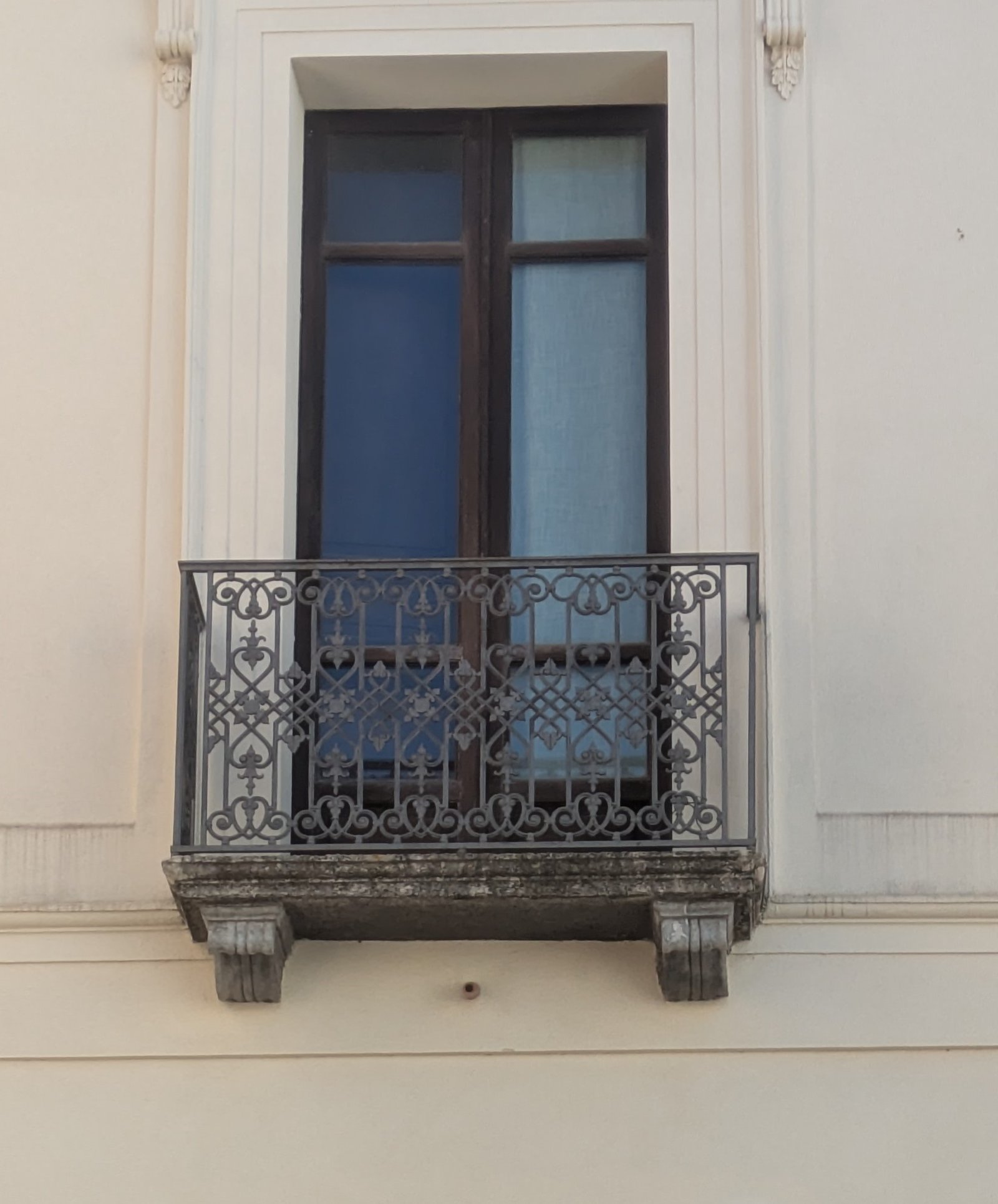
Cataloguing these pieces recovers the working memory of the smiths and their techniques, and helps safeguard what remains. Two things deserve more attention: buildings in Italy’s historic centres, where oversight during renovation should be strict enough to prevent the loss or dispersal of these works, and tourism, where guides could do more to highlight this ironwork as part of a building’s full historic, artistic and cultural value. Historic town centres are, in effect, open-air museums, given how much of this craftsmanship survives on nearly every corner and facade — a body of work that risks staying hidden from residents and visitors alike, noticed only in passing and rarely valued as it deserves.
Ortensio Mendicino is an art historian (Pisa, 1986) and the author of Manifatture in ferro a Pisa e fuori Pisa (2006). He was a speaker at the Biennale d’Arte Fabbrile of Stia in 2007, and is co-author, with Carmela Riga, of Iconografia dei manufatti in ferro dal tardo XVI al XX secolo nel centro storico di Catanzaro (2025). He has documented two pieces of Catanzaro’s own wrought-iron heritage for Cultural Heritage Online: the garden gate of Villa Margherita and the balcony railings of Palazzo Alemanni.
Related on CHO
- Where to See Alessandro Mazzucotelli’s Ironwork in Milan: a Walk Through Thirteen Facades
- Villa Margherita, Catanzaro
- Palazzo Alemanni, Catanzaro
Sources
- S1 — Pedrini, Augusto. Il ferro battuto e cesellato nell'arte italiana dal secolo XI al XVIII. Hoepli, 1968. ISBN 978-88-203-0120-0.
- S2 — Belluzzi, Amedeo. L'arte del ferro battuto in Italia. Bramante Editrice, 1981. ISBN 978-88-7014-210-5.
Spotted an error? Write to editorial@culturalheritageonline.com and we correct it the same day.


