Aksum, inscribed in 1980, is the heartland of Ethiopian civilization — the capital of the ancient Kingdom of Aksum (100–940 CE), one of the four great empires of the ancient world alongside Rome, Persia, and China, and the site of the world’s tallest ancient obelisks, the Church of Our Lady Mary of Zion (the claimed resting place of the Ark of the Covenant), and the first country in Sub-Saharan Africa to adopt Christianity as a state religion (c. 330 CE).
The Kingdom of Aksum: One of the Ancient World’s Great Empires Tigray Region, northern Ethiopia, altitude 2,131 m
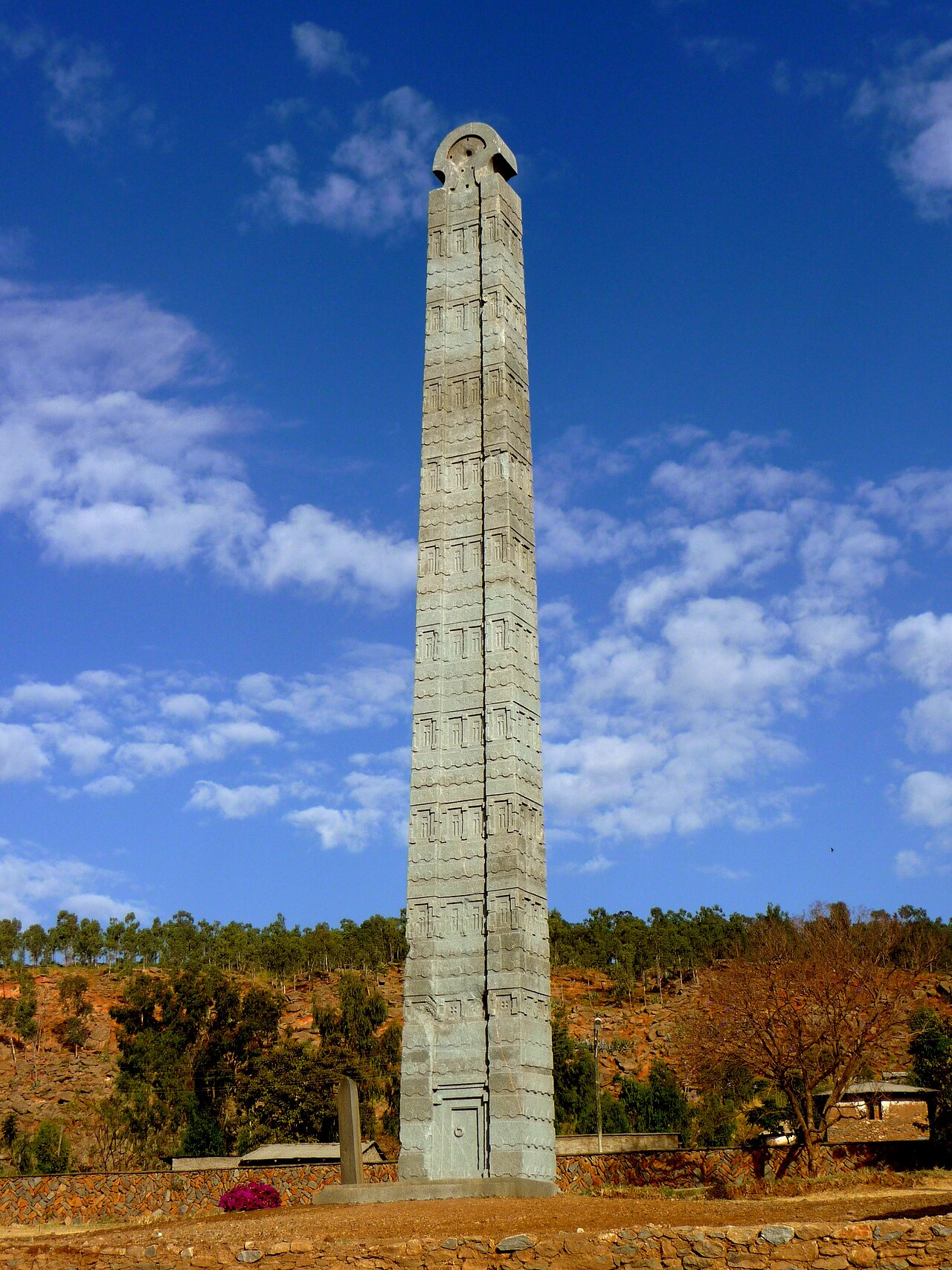
Aksum (inscribed in 1980 under criteria (i), (ii), (iii), (iv), (vi)) was the capital of the Aksumite Empire from approximately 100 CE to 940 CE — a state that controlled the Red Sea trade between the Roman Empire, Arabia, and India, issued its own gold, silver, and bronze coinage (making it one of only four states in the ancient world to issue all three metals), and was described in a third-century Manichaean text as one of the four greatest powers in the world alongside Rome, Persia, and China. The Aksumite Empire extended from modern Ethiopia and Eritrea across the Red Sea into Yemen (then called Himyar), controlling the straits of Bab-el-Mandeb — the vital chokepoint through which virtually all trade between the Mediterranean and India passed. The empire’s decline began in the seventh century CE when Arab Muslim expansion blocked Aksumite access to Red Sea trade; by the tenth century the capital had shifted south and the ancient city was abandoned. The archaeological site of Aksum preserves the most remarkable concentration of ancient monuments in Sub-Saharan Africa: the field of granite monolithic stelae (obelisks) — 75 surviving stelae of which the largest (the Obelisk of Aksum No. 1, now fallen) would have stood 33 metres tall, making it the tallest stone monument ever erected in the ancient world (it fell, possibly during erection); the Stele of Axum No. 2 (24 metres, currently standing) was removed to Rome by Mussolini’s forces in 1937 and returned to Ethiopia in 2008 after decades of diplomatic negotiations — its return was managed by the UNESCO and Italian government.
The Ark of the Covenant and the Church of Our Lady Mary of Zion Central Aksum, Tigray
The Church of Our Lady Mary of Zion (Maryam Tsion, multiple construction phases; the current Old Cathedral dates from the 17th century CE, rebuilt by Emperor Fasilides; a New Cathedral was added by Emperor Haile Selassie in 1964) is the holiest church in Ethiopian Orthodoxy and the claimed resting place of the Ark of the Covenant (Tabot) — the chest containing the two tablets of the Ten Commandments given to Moses on Mount Sinai, according to the Hebrew Bible. Ethiopian Orthodox tradition holds that the Ark was brought to Aksum by Menelik I (the son of King Solomon and the Queen of Sheba, according to the Ethiopian royal chronicle Kebra Nagast, “Glory of Kings”) and has been kept in Aksum continuously since the 10th century BCE. The Ark is housed in the Chapel of the Tablet (a small building adjacent to the Old Cathedral, built in 1965 CE); it is guarded by a single monk chosen for life (the “Ark Guardian”), who is the only person permitted to see it and who cannot leave the chapel’s enclosure for the remainder of his life. The Ark is not available for public viewing; no independent verification of the claim has been possible. Regardless of the historical truth of the claim, the Ark tradition makes Aksum the most sacred site in Ethiopian Orthodox Christianity (one of the world’s oldest continuous Christian traditions, pre-dating most European Christianity) and draws Ethiopian Orthodox pilgrims from across Ethiopia, Eritrea, and the Ethiopian diaspora.
Practical information
Aksum Airport (AXU) has daily flights from Addis Ababa (Ethiopian Airlines, approximately 1 hour 30 minutes). Aksum is also accessible by road from Adwa (22 km) and Shire (90 km). The principal monuments are concentrated in a compact area of approximately 1 km² around the Northern Stelae Field: the Stelae Field, the Dungeon of King Kaleb, the Church of Our Lady Mary of Zion (women are not admitted to the Old Cathedral; the new cathedral admits all visitors), the Archaeological Museum of Aksum, and the ancient cisterns (May Shum, the bath of the Queen of Sheba). The best season is October–March (dry season; altitude makes temperatures pleasant, 20–25°C). The Festival of Maryam Tsion (November, the feast of the Virgin Mary) is the largest annual pilgrimage to Aksum, with tens of thousands of Ethiopian Orthodox pilgrims attending.
Frequently Asked Questions
Is Aksum a UNESCO World Heritage Site?
Yes. Aksum was inscribed in 1980 under criteria (i), (ii), (iii), (iv), and (vi). Ethiopia has 9 UNESCO World Heritage Sites (as of 2024): Simien National Park (1978, natural), Rock-Hewn Churches, Lalibela (1978), Fasil Ghebbi / Gondar monuments (1979), Aksum (1980), Lower Valley of the Awash (1980), Lower Valley of the Omo (1980), Tiya (1980), Harar Jugol (2006), and the Konso Cultural Landscape (2011). Ethiopia has more UNESCO World Heritage Sites than any other country in Sub-Saharan Africa.
What are the Aksumite stelae and how were they carved?
The stelae of Aksum are monolithic granite obelisks carved from single blocks of granite quarried approximately 4 km from the stelae fields — the largest surviving example (Stele 2, 24 metres, now returned from Rome) weighs approximately 150 tonnes. The stelae were carved in relief to represent a multi-storey building: the main face shows a series of false windows and false doors (representing the floors of a building), a false beam header, and sometimes a carved metal plate at the apex. The function of the stelae was funerary: the largest stelae marked the tombs of the Aksumite kings (and possibly the royal court), with underground tomb chambers excavated in the granite beneath the stelae. How the ancient Aksumites transported and erected stelae of 150+ tonnes without written records of their technology remains unclear; the most commonly proposed mechanism is a system of sledges, ramps, and levers — similar to the Egyptian obelisk-erection process documented in ancient images. The largest stele (Stele 1, approximately 33 metres estimated height when standing) fell during or shortly after erection, possibly because the foundation was insufficient for its weight.
Why was the Obelisk of Aksum in Rome for 68 years?
The Stele of Aksum (also called the Rome Stele or the Obelisk of Axum) was removed from Aksum by Italian colonial forces under Mussolini in 1937 — one year after Italy’s invasion and occupation of Ethiopia — and erected in Rome near the Palazzo della Farnesina (the Italian Ministry of Foreign Affairs) as a trophy of imperial conquest. The removal was internationally condemned but not reversed during the Italian colonial period (1936–1941) or during the post-war Italian Republic. Ethiopia repeatedly requested the stele’s return after the end of Italian colonialism; the request was initially agreed by Italy in 1947 (the Peace Treaty with Italy included a clause requiring the return of “works of art, historical objects, and documents taken from Ethiopia”), but Italy argued technical difficulties in dismantling and transporting the 150-tonne monument for over 50 years. The stele was finally dismantled in 2005 and returned to Ethiopia in three sections by Italian Air Force cargo planes, at a cost of approximately €8 million paid by Italy; it was re-erected at Aksum in 2008. The return of the Aksum obelisk is one of the most significant repatriations of colonial-era cultural property in history.
Sources
- S1 — Phillipson, David W. Ancient Ethiopia: Aksum, Its Antecedents and Successors. British Museum Press, 1998. ISBN 978-0-7141-2763-7.
- S2 — Munro-Hay, Stuart. Aksum: An African Civilisation of Late Antiquity. Edinburgh University Press, 1991. ISBN 978-0-7486-0106-6.
Spotted an error? Write to editorial@culturalheritageonline.com and we correct it the same day.