

Between the eighteenth and the twentieth century, Venice may be the most painted subject in Europe: calli and canals, façades dissolving in the light, water that reflects everything and distorts everything. But the city was never described only by men. Emma Ciardi and Antonietta Brandeis, painters of two different generations and two different training grounds, each looked at Venice on her own terms — and left two images of the city as different from one another as they are recognisable.
Emma Ciardi: a luminous, worldly Venice
Emma Ciardi was born in Venice in 1879, the daughter of Guglielmo Ciardi, one of the city’s most important nineteenth-century view painters, and the sister of Beppe Ciardi. She grew up, then, in a household where the lagoon landscape was not a subject to discover but a family language, absorbed before it was ever taught. She started from that inheritance and did not stay inside it: her painting takes her father’s lesson and bends it toward a more restless, more coloured sensibility, more attentive to the glint of a passing moment than to the solidity of a monument.
In her paintings Venice often appears in a vibrating light, sometimes gilded, that breaks up the outlines of the architecture and sets them trembling on the water. Squares and canals fill with barely sketched figures, gondolas sliding past, flags moving in the wind: a living, elegant city, frequented by an international society that in the early twentieth century was rediscovering the lagoon’s charm.
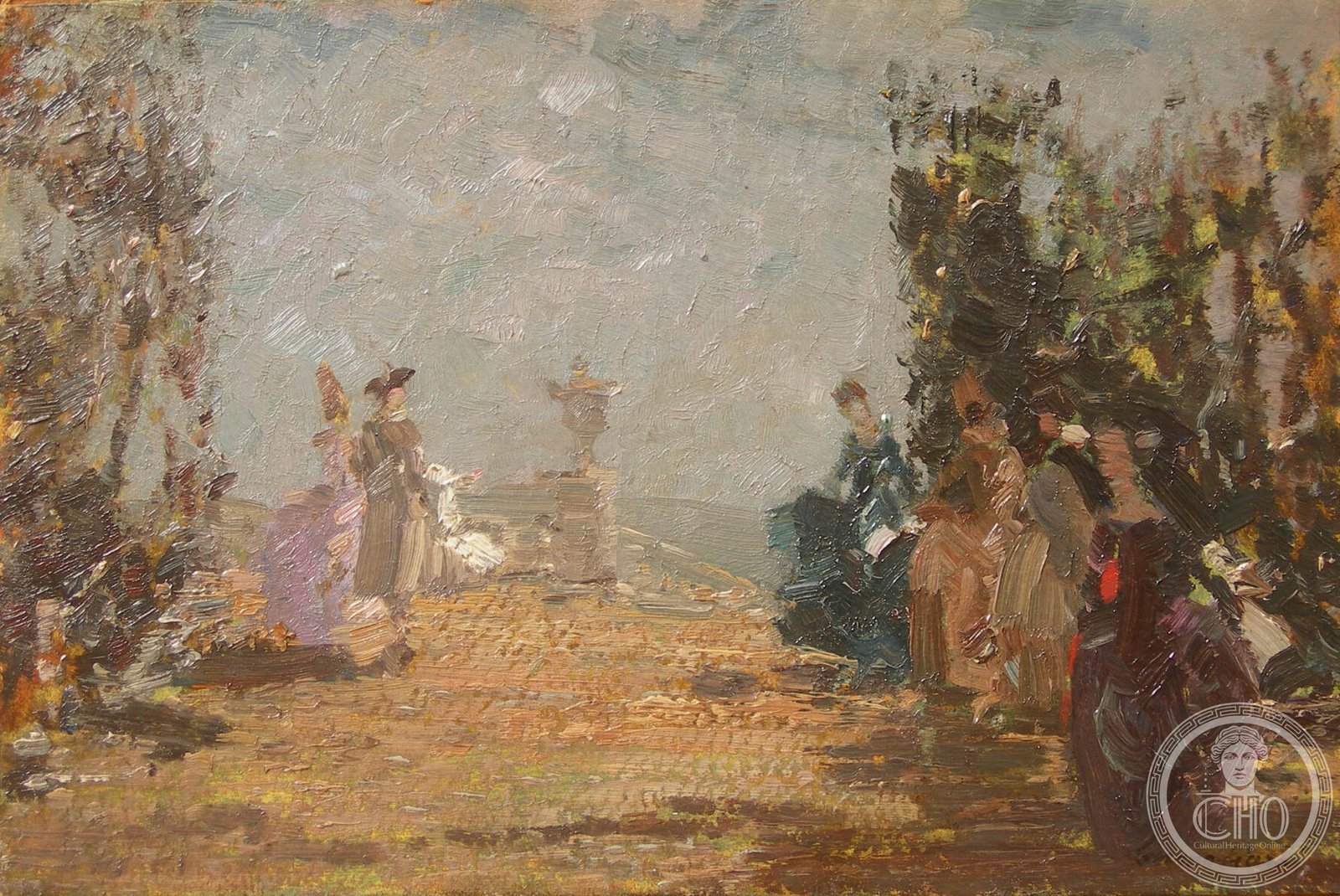
Ciardi does not describe Venice as a monument fixed in time, but as a scene in motion, caught at the instant when light reflects off the palazzi and the lagoon water. There is an echo here of the eighteenth-century vedutisti, filtered through a freer pictorial sensibility that leans toward the rendering of light and colour and absorbs something of the Macchiaioli and the Impressionists. Her international success grew steadily: from 1923 a New York gallery held the exclusive rights to sell her work in the American market.
Antonietta Brandeis: a more intimate, atmospheric Venice
Antonietta Brandeis was born in Bohemia, at Miskovice, on 13 January 1848 — a generation before Emma Ciardi, and out of a very different world. She trained first in Prague and then in Venice, where from 1867 she attended the Accademia di Belle Arti, one of the first women to receive academic training in the fine arts in Italy, studying life drawing, landscape and perspective under Michelangelo Grigoletti, Napoleone Nani and Domenico Bresolin among others. Her Venice grows out of different premises: closer to the precision of detail, to the luminosity of the view, and to a nineteenth-century landscape sensibility.

In her paintings attention often settles on a fragment where architecture, water and light hold each other in a measured balance: a rio, a bridge, the corner of a calle, but also wider squares and views. She studies the architecture closely, along with the damp-worn tones of the masonry and the reflections in the water. It remains a Venice that keeps the scenographic dimension of the veduta, but one that can turn intimate and contemplative too, inviting the eye to linger over detail. Brandeis worked for decades in Venice and later in Florence, where she died in 1926; for a time she exhibited under the name “Antonio Brandeis,” a choice she explained by saying she found praise as a woman as tiresome as criticism.
Two artists, two Venices
To set Emma Ciardi and Antonietta Brandeis side by side is not to oppose them, but to see how the same city could generate different pictorial languages, and how Venetian vedutismo changed between the nineteenth and twentieth centuries. In Ciardi a greater pictorial freedom prevails: the light is dynamic, the subjects often animated by a human presence, the composition built to capture a fleeting impression. In Brandeis a greater attention emerges to the precision of the view, to architectural detail and to the overall luminosity of the scene. Ciardi looks at a worldly, more dynamic Venice; Brandeis at a Venice observed with a landscape painter’s patience for particulars.
Both, working from different premises and belonging to different generations, contributed substantially to the pictorial image of the lagoon city — and it is worth noting that they did so as women, in a field where the names usually cited, starting with the great eighteenth-century masters, are almost always men’s: Canaletto, Guardi, Grubacs, Caffi, Guglielmo Ciardi himself, and later Santoro, Fragiacomo and many others. The female contribution to Venetian view painting was real and continuous, if less often told. Emma Ciardi and Antonietta Brandeis are two particularly interesting witnesses to it, not least for the different ways in which each of them read the city.
About these images. The two paintings by Emma Ciardi were photographed by Alvise Ponti, in whose collection they were formerly held, and are published here with his permission. The Brandeis painting is reproduced from a public-domain photograph on Wikimedia Commons (Dorotheum); Brandeis died in 1926.
Alvise Ponti writes for Cultural Heritage Online from his own author page, and is the founder of acquistoarte.it, an Italian art-market resource.
Sources
- S1 — Pavanello, Giuseppe. La pittura nel Veneto: L'Ottocento e il Novecento. Electa, 2002. ISBN 978-88-435-7435-3.
- S2 — Stringa, Nico. Emma Ciardi: 1879-1933. Skira, 2009. ISBN 978-88-572-0122-1.
Spotted an error? Write to editorial@culturalheritageonline.com and we correct it the same day.


