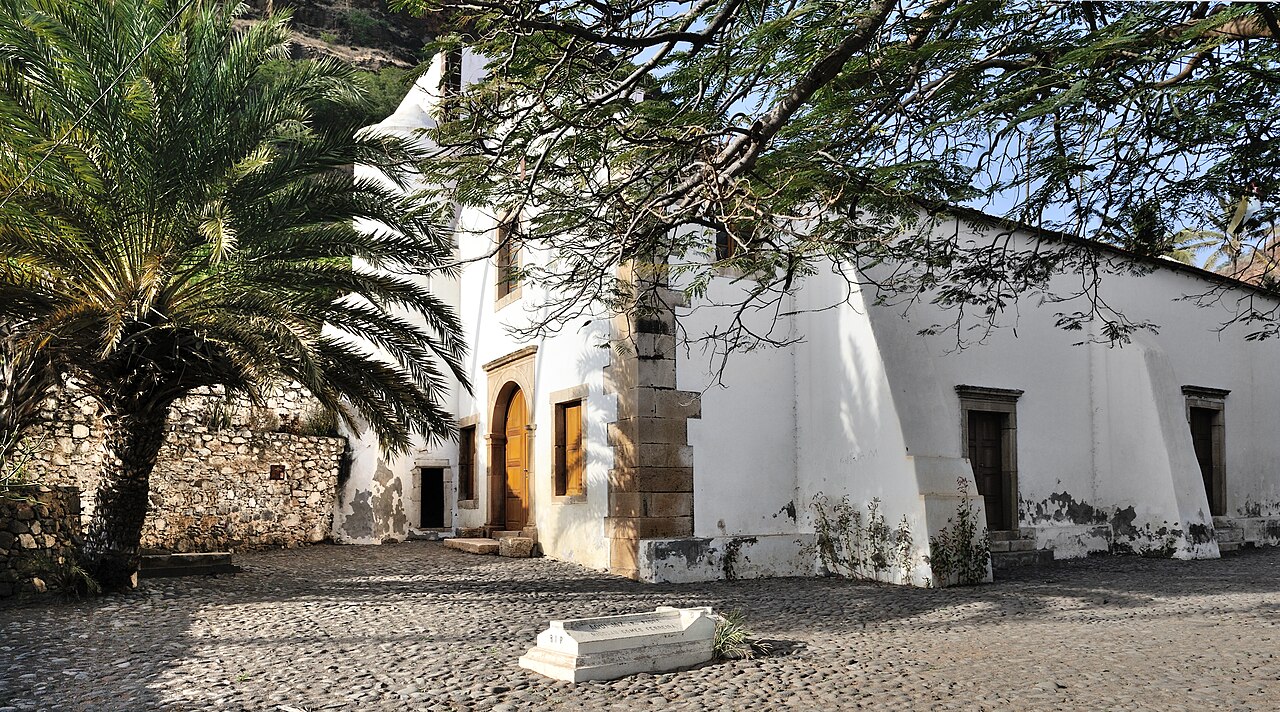
Cape Verde’s only UNESCO World Heritage Site — Cidade Velha, Historic Centre of Ribeira Grande — sits 15 km west of the capital Praia and holds the remains of the oldest European colonial settlement in the tropics and a founding node of the Atlantic slave trade. From Cultural Heritage Online.
Cidade Velha, Historic Centre of Ribeira Grande 15 km west of Praia — 20 min by road
Ribeira Grande — now known as Cidade Velha (“Old City”) — was founded by Portuguese settlers in 1462, making it the oldest permanent European colonial settlement in the tropics and the first European town established in Sub-Saharan Africa. The Cape Verde islands were uninhabited when the Portuguese arrived; the settlement at Ribeira Grande grew from a staging post for Atlantic navigation into the principal trans-shipment point for enslaved Africans crossing the Atlantic during the fifteenth and sixteenth centuries. Between approximately 1460 and 1600, nearly all enslaved Africans transported to the Americas passed through or were processed at Ribeira Grande — making the town’s history inseparable from the origins of the Atlantic slave trade.
The most intact surviving structure is the Igreja de Nossa Senhora do Rosário (1495), the oldest church in Sub-Saharan Africa, built in simple late-Gothic Portuguese style with a Renaissance doorway added in the sixteenth century. The church retains its original masonry and is still in liturgical use. On the hillside above the town, the Forte Real de São Filipe (1590s), built to defend the town against pirate raids after the British privateer Francis Drake sacked the settlement in 1585, is largely intact and provides panoramic views over the valley and the Atlantic.
The site also contains the Pelourinho (pillory), a sixteenth-century octagonal column that served as the public punishment post where enslaved people were whipped and publicly disciplined — one of the most direct physical remnants of the slave trade’s violence in any surviving colonial settlement. The town’s population declined from approximately 1,500 to fewer than 100 between the seventeenth century (when the slave trade moved to other West African ports) and the twentieth century; Cidade Velha is now a small village of approximately 1,200 people. UNESCO inscribed the site in 2009.
Getting there: 15 km west of Praia by road; approximately 20 minutes by aluguer (shared taxi) from Praia city centre. A local guide is recommended for the fort and church. Allow: 2–3 hours for the main sites; half day with the fort. Best for: Portuguese colonial history; Atlantic history and slavery heritage visitors.
Frequently Asked Questions
How many UNESCO World Heritage Sites does Cape Verde have?
One: Cidade Velha, Historic Centre of Ribeira Grande, inscribed in 2009. It is located on Santiago Island, approximately 15 km west of the capital Praia. It is the only UNESCO World Heritage Site in Cape Verde.
What is the significance of Cidade Velha in the history of the Atlantic slave trade?
Cidade Velha (Ribeira Grande) was the primary trans-shipment point for enslaved Africans during the early Atlantic slave trade, from approximately 1460 to 1600. Portuguese traders used the islands as a collection and processing centre where enslaved people from the Guinea coast were held before transportation to São Tomé, Brazil, and the Caribbean. The Pelourinho (pillory) in the town centre is one of the most concrete surviving monuments to the institution of slavery anywhere in the Atlantic world. The UNESCO inscription explicitly recognised the site’s role in this history as part of its outstanding universal value.
What is the Forte Real de São Filipe?
The Forte Real de São Filipe is a Portuguese fort built in the 1590s on the hill above Cidade Velha, following Francis Drake’s sack of the settlement in 1585 during the Anglo-Spanish War. The fort is largely intact and commands a panoramic view over the valley, the town, and the Atlantic. It is one of the best-preserved examples of early Portuguese colonial defensive architecture in Africa. The interior contains a small exhibition on the history of the settlement.
Why did Cidade Velha decline after the sixteenth century?
The decline was primarily due to the shift of the slave trade to other West African ports, particularly those in the Gulf of Guinea, that were closer to the supply sources and offered better anchorage conditions than Ribeira Grande. By the seventeenth century, most trade had bypassed Cape Verde. The town was also repeatedly raided by pirates — Drake’s sack in 1585 was the most famous but not the only such attack — which reduced its commercial viability. The capital of Cape Verde was moved to Praia in the eighteenth century, and Cidade Velha declined to a small village.
Sources
- S1 — Carreira, António. The People of the Cape Verde Islands: Exploitation and Emigration. C. Hurst & Co., 1982. ISBN 978-0-905838-68-7.
- S2 — Boxer, Charles R. The Portuguese Seaborne Empire: 1415-1825. Hutchinson, 1969. ISBN 978-0-09-131071-4.
Spotted an error? Write to editorial@culturalheritageonline.com and we correct it the same day.