The State Historical and Cultural Park “Ancient Merv,” inscribed in 1999, is the most significant Silk Road oasis site in Central Asia — four millennia of superimposed urban civilizations on the Murghab River plain of Turkmenistan, from Bronze Age Margiana (c. 3000 BCE) through the Achaemenid, Hellenistic, Parthian, Sasanian, Islamic, Seljuk, and Mongol periods, all visible as a sequence of walled cities on a flat desert plain.
Ancient Merv: Four Millennia of Silk Road Civilization Mary (Mary, Merv), Turkmenistan, 380 km southeast of Ashgabat
The State Historical and Cultural Park “Ancient Merv” (inscribed in 1999 under criteria (ii), (iii), and (iv)) is one of the most significant archaeological landscapes in Central Asia — a concentration of five successive walled cities built on the same Murghab River oasis, each constructed by a different political power over four thousand years, whose ruins cover approximately 600 km². The sequence of cities (Erk Kala, the Bronze Age and Achaemenid citadel; Gyaur Kala, the Greek-Hellenistic and Parthian city; Sultan Kala, the early Islamic and Seljuk capital; Abdullakhan Kala, the Timurid city; Bayram Ali Khan Kala, the late medieval city) forms the most complete stratigraphic record of Central Asian urban development over the longue durée. At its peak (twelfth century CE, under the Seljuk Great Sultan Ahmad Sanjar, r. 1118–1157 CE), Merv was one of the largest cities in the world — with a population estimated at 200,000–500,000 (making it comparable to Hangzhou and Constantinople), the capital of the Seljuk Empire at its greatest extent, and the most important city on the eastern Silk Road between Samarkand and Baghdad. The Mongol invasion of 1221 CE under Genghis Khan’s general Tolui resulted in one of the most devastating single urban destructions in history: Persian chronicles record the death of 1.3 million inhabitants (a figure that modern historians view as an exaggeration but that reflects the scale of the catastrophe); the irrigation system (karez, underground aqueducts) was deliberately destroyed, and the city never recovered its pre-Mongol population.
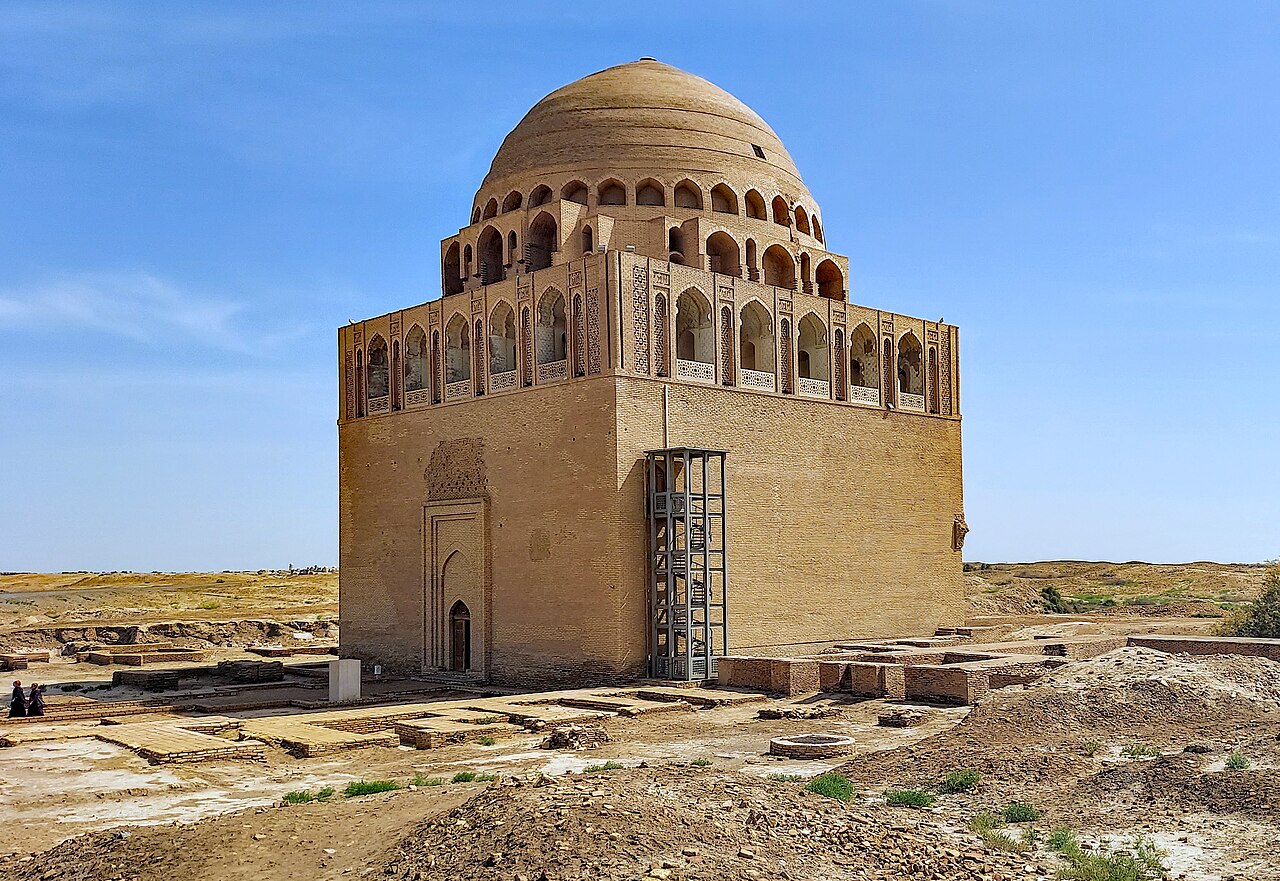
The Mausoleum of Sultan Sanjar and the Seljuk Heritage Sultan Kala, Ancient Merv site
The Mausoleum of Sultan Ahmad Sanjar (completed 1157 CE, shortly before or after the Sultan’s death in that year) is the most significant surviving Seljuk-era building in Central Asia and the outstanding monument of Ancient Merv. The building (27 × 27 × 27 metres — a perfect cube surmounted by a double-shell dome, the dome now 38 metres above the ground) was designed with a ribbed turquoise-glazed tile exterior (largely lost, but restored in the Soviet period) and an interior dome system that distributes the weight of the outer shell through squinches and an inner cornice in a structural innovation that influenced subsequent Islamic mausoleum architecture from the Timurid to the Mughal period. The mausoleum stands alone on the plain of Sultan Kala — the only standing structure among the foundations of what was the Seljuk imperial capital, giving the building an extraordinary desolate grandeur. Ahmad Sanjar himself was a tragic figure: the greatest Seljuk sultan, under whom the empire reached its maximum extent (from Anatolia to Transoxiana), he was captured and held prisoner by the Ghuzz Turks for three years (1153–1156 CE) after a military defeat, living as a puppet ruler surrounded by his captors, and died of depression and illness in 1157 CE.
Practical information
Ancient Merv is near the city of Mary (the administrative centre of Mary Province), 380 km southeast of Ashgabat (Turkmenistan’s capital). Mary Airport (MYP) has domestic flights from Ashgabat (40 minutes, several daily) and some international services. The site is 8 km east of Mary city by road. Turkmenistan requires an advance visa for virtually all nationalities; a Letter of Invitation from a registered Turkmen travel agency is required before visa application, and most foreign visitors travel on group tours with government-approved guides. Independent travel is technically possible but logistically difficult. Ancient Merv requires a full day to visit properly; the Sultan Sanjar Mausoleum, Erk Kala citadel, and the small on-site museum are the principal attractions. The best season is April–May and September–October (summer is extreme: 40–45°C).
Frequently Asked Questions
Is Ancient Merv a UNESCO World Heritage Site?
Yes. The State Historical and Cultural Park “Ancient Merv” was inscribed in 1999 under criteria (ii), (iii), and (iv). Turkmenistan has 3 UNESCO World Heritage Sites: Ancient Merv (1999), Kunya-Urgench (2005), and the Parthian Fortresses of Nisa (2007). All three are Silk Road sites of exceptional significance: Nisa was the capital of the Parthian Empire (c. 247 BCE–224 CE), the political entity that controlled the Silk Road between Rome and China for approximately 500 years; Kunya-Urgench (ancient Gurganj/Gurgan) was the capital of the Khwarazmian Empire, another city destroyed by the Mongols in 1221 CE (the same year as Merv).
What was the Seljuk Empire?
The Seljuk Empire (1037–1194 CE) was a Turkic state that conquered the Abbasid Caliphate’s eastern territories (Khorasan, Transoxiana) beginning in 1037 CE under Tughril Beg, and expanded rapidly to control Persia, Iraq, Anatolia (after the Battle of Manzikert in 1071 CE, which ended Byzantine control of Anatolia), and the Levant. At its peak under Ahmad Sanjar (r. 1118–1157 CE), the Seljuk Great Sultanate was the dominant power of the Islamic world — the effective rulers of the Abbasid Caliphate, the patrons of Persian culture and literature (Omar Khayyam’s Rubaiyat was written at the Seljuk court), and the first Turkish rulers to adopt Persian as their administrative language and Persian culture as their prestige model. The Seljuks were also the rulers who launched the First Crusade — their conquest of Jerusalem in 1073 CE and their restriction of Christian pilgrimage routes triggered the crusading movement in Western Europe. The Great Seljuk Sultanate fragmented after Ahmad Sanjar’s death in 1157 CE and was eventually absorbed into the Khwarazmian Empire, which was in turn destroyed by the Mongols in 1221 CE.
What was the Mongol destruction of Merv and why was it so catastrophic?
The Mongol destruction of Merv in 1221 CE was one of the most complete acts of urban annihilation in medieval history. The city was captured by Tolui Khan (the youngest son of Genghis Khan) after a siege of several days; the population was ordered to leave the city and assemble on the plain, where they were systematically killed by Mongol soldiers (a process that took several days, as the sources record soldiers assigned to kill fixed numbers of inhabitants). The destruction was not random: the Mongols specifically targeted the irrigation infrastructure (the karez underground aqueducts that sustained the Murghab oasis) to ensure that the city could not be rebuilt and repopulated. Without the karez, the agricultural base of the oasis collapsed; the city was never repopulated to its pre-Mongol scale. Persian historians record 1.3 million dead (a clear exaggeration — the city probably had 200,000–500,000 inhabitants), but modern historians accept that the death toll was in the hundreds of thousands and that the Mongol destruction of Merv in 1221 CE (along with Samarkand and Nishapur in the same year) represented the most catastrophic demographic event in the history of Central Asia before the twentieth century.
Sources
- S1 — Herrmann, Georgina. Monuments of Merv: Traditional Buildings of the Karakum. Society of Antiquaries of London, 1999. ISBN 978-0-85431-275-7.
- S2 — Knobloch, Edgar. Monuments of Central Asia: A Guide to the Archaeology and Architecture. I.B. Tauris, 2001. ISBN 978-1-86064-590-7.
Spotted an error? Write to editorial@culturalheritageonline.com and we correct it the same day.