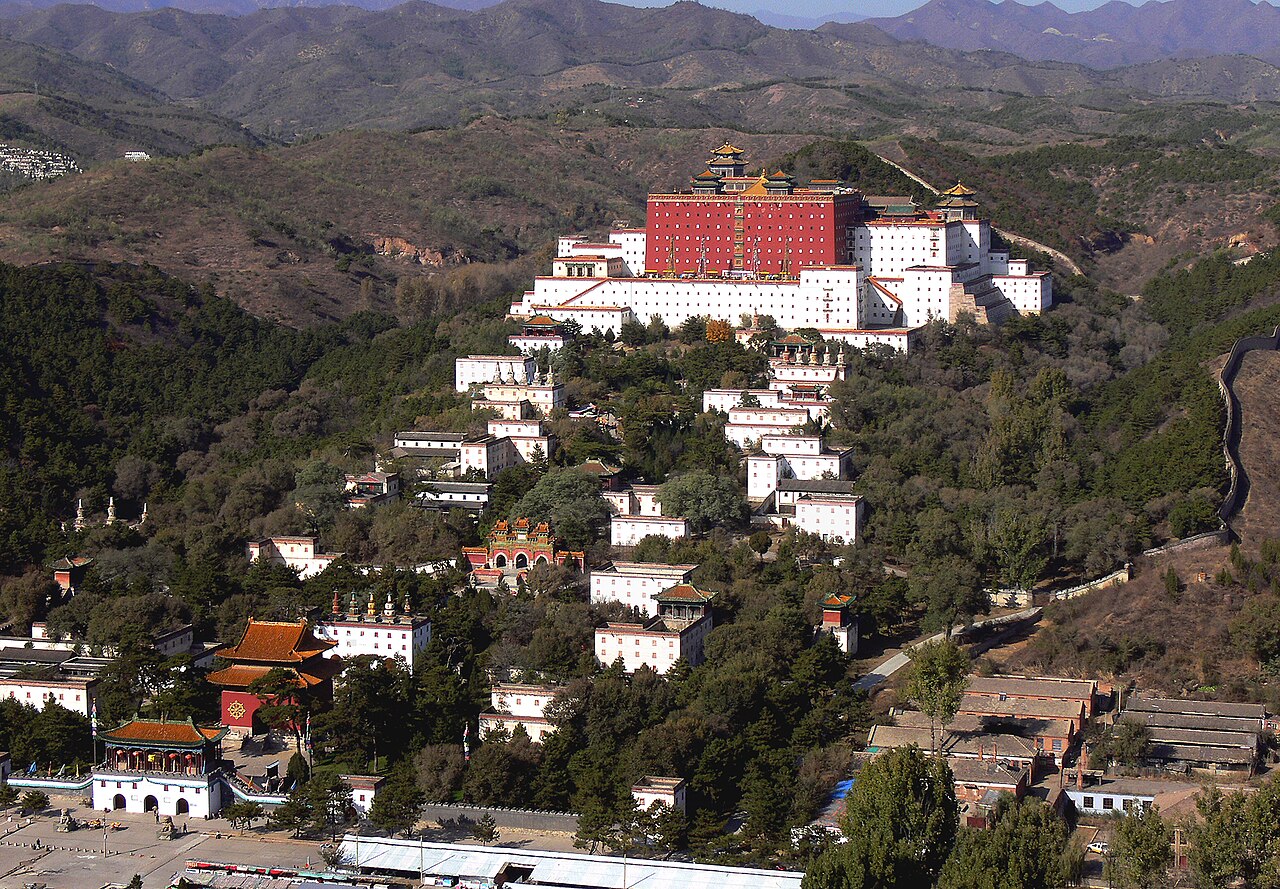
The Mountain Resort and its Outlying Temples in Chengde, inscribed in 1994, is the largest imperial garden in China — the summer palace of the Qing dynasty, built 250 km northeast of Beijing in the cool Rehe hills from 1703 onward, whose twelve Outlying Temples represent the architectural traditions of Tibetan, Mongolian, Uighur, and Han Chinese religious cultures assembled in one landscape as a symbol of Qing imperial authority over its multinational empire. The Temple of Putuozongcheng (the “Little Potala Palace”) is the most dramatic of these diplomatic buildings.
Mountain Resort, Chengde: The Qing Empire’s Summer Capital Hebei Province, 250 km northeast of Beijing
The Mountain Resort (Bishu Shanzhuang, “Mountain Resort for Escaping Summer Heat”) and its Outlying Temples, inscribed in 1994 under criteria (ii) and (iv), is the largest imperial garden complex in China — a walled park of 5,648 hectares (greater than the Summer Palace in Beijing by a factor of eight) built by the Kangxi, Yongzheng, and Qianlong emperors of the Qing dynasty as a summer residence and, crucially, as a diplomatic venue for receiving the rulers of the Mongol, Tibetan, Uighur, and other non-Han peoples who acknowledged Qing sovereignty. The resort was built in a deliberate setting of mountains, lakes, and forest designed to evoke the natural landscapes of the northern steppe — the homeland of the Manchu ruling house — while also accommodating the court in palaces, temples, and gardens appropriate to Chinese imperial aesthetics. The main palace complex (Zhengong, the Main Palace, where the Qianlong Emperor received the first British embassy under Lord Macartney in 1793, famously refusing to receive him without the prostration ritual kowtow) is relatively modest in scale compared to the Forbidden City; the gardens and lakes that occupy most of the resort are the primary experience.
The Outlying Temples: Diplomatic Architecture of Empire North of the resort, 2–5 km from the main gate
The twelve Outlying Temples (Waibamiao, “the Eight Outer Temples” — the term covers all twelve) built 1713–1780 north and east of the resort walls represent one of the most sophisticated acts of imperial image management in Chinese history: the Qianlong Emperor built temples in the architectural styles of the religious traditions of the peoples who attended the court at Chengde, so that Mongolian, Tibetan, and other Buddhist leaders would see their own sacred architectural forms reproduced at the imperial court — an expression of the emperor’s role as the patron of all Buddhist traditions in his empire. The Temple of Universal Peace (Puning Temple, 1755) is the most internally significant: it was built to celebrate the Qianlong Emperor’s defeat of the Dzungar Mongolian confederation and contains the world’s tallest wooden indoor Buddha statue — the Guanyin Bodhisattva of a Thousand Hands (Qianshou Qianyan Guanyin), 22.28 metres tall in carved and gilded wood, the largest wooden Buddha in the world. The Temple of Putuozongcheng (1767–1771) is the largest of the Outlying Temples: built to celebrate the Qianlong Emperor’s sixtieth birthday, it is a deliberate copy of the Potala Palace of Lhasa (which the emperor had not visited but knew from drawings), constructed as a symbolic statement that the Tibetan religious centre was reproduced at the Qing imperial court. The 42 m white platform mass of the temple, with its red palace on top (Wanfa Guiyizong), is the most photographed monument at Chengde.
The Jinshanling Great Wall: The Most Photogenic Section 🚗 ~1.5 hrs southwest
The Jinshanling section of the Great Wall of China (inscribed 1987 as part of the Great Wall inscription under criteria (i), (ii), (iii), (iv), and (vi)) is 100 km southwest of Chengde — the section most favoured by photographers for its combination of intact and ruined watchtowers, varied terrain (valleys, ridges, steep ascents), and relative accessibility from Beijing. The Jinshanling-to-Simatai section (10 km hiking route, 3–4 hours) passes through 67 towers; the Simatai end of the route has been closed to hikers since 2010 but remains viewable from a distance. Unlike the fully restored sections at Badaling (Beijing, crowded) and Mutianyu (Beijing, also restored), Jinshanling retains a significant proportion of its original Ming-dynasty masonry (c. 1570–1580, under the administration of Qi Jiguang, the military commander who oversaw the most extensive renovation of the Great Wall in history). The section is accessible by express bus from Beijing Dongzhimen station (2.5 hours) or by car from Chengde (1.5 hours).
Practical information
Chengde is 250 km northeast of Beijing; high-speed trains from Beijing Chaoyang station take 1.5–2 hours (multiple daily departures). The Mountain Resort is open 8 a.m.–5:30 p.m. (later in summer); the Outlying Temples have individual opening hours and tickets. A full day is needed for the resort and two to three temples; a second day covers the remaining temples. The Puning Temple (Guanyin statue) and the Temple of Putuozongcheng are the highest priority; the Temple of Haihaizongcheng Miao and the Pule Temple (with its circular hall modelled on Beijing’s Temple of Heaven) are second priority. Jinshanling is 100 km southwest by car or bus; the Beijing-Jinshanling bus from Dongzhimen is the most convenient option. The best season is April–June and August–October; the resort’s autumn colours (October) are especially beautiful. Chengde summers (July–August) are much cooler than Beijing — this was the original reason the emperors chose the site.
Frequently Asked Questions
Is Chengde a UNESCO World Heritage Site?
Yes. The Mountain Resort and its Outlying Temples in Chengde were inscribed in 1994 under criteria (ii) and (iv). The inscription covers the Bishu Shanzhuang imperial garden (5,648 hectares, the largest imperial garden in China) and eight of the twelve Outlying Temples — the most architecturally significant examples of Qing-dynasty diplomatic religious architecture, representing the Buddhist traditions of the Mongolian, Tibetan, and other non-Han peoples of the Qing Empire.
Why did the Qing emperors build a summer palace at Chengde rather than at Beijing?
The Qing rulers chose Chengde (then called Rehe, “Warm River”) for three primary reasons: the climate (the Rehe hills at 350 metres elevation are significantly cooler than Beijing in summer, which can exceed 40°C), the strategic position (on the main route north toward the Mongolian plateau, the homeland of the Manchu-allied Mongolian bannermen), and the landscape (forested mountains, clear rivers, and meadows that evoked the northern steppe environment of the Manchu and Mongolian ruling families). The resort also functioned as a diplomatic venue: Mongolian, Tibetan, and other vassal rulers who came to pay homage would travel north from Beijing to Chengde, where they found an environment that combined Chinese imperial grandeur with architectural forms (the Outlying Temples) designed to make them feel that their own religious and cultural traditions were honoured by the Qing court.
What is the world’s tallest indoor wooden Buddha at Puning Temple?
The Guanyin Bodhisattva of a Thousand Hands (Qianshou Qianyan Guanyin) at the Puning Temple (Temple of Universal Peace) is a carved and gilded wooden statue 22.28 metres tall — the world’s tallest indoor wooden Buddha. It was made in 1755–1764 to fill the Mahayana Hall (Dazheng Ge), a six-story timber building of 37 metres that is the largest surviving Tibetan-style timber building in China. The statue’s 42 arms (representing the Guanyin’s compassion for all sentient beings) each hold a symbolic object (vase, lotus, jewel, etc.); the face of the statue, 4.5 metres tall, is modelled on a Chinese rather than Tibetan aesthetic ideal, an example of the synthesis of Buddhist iconographic traditions that the Qianlong Emperor promoted as a policy of religious ecumenism within the Qing Empire.
Sources
- S1 — Forêt, Philippe. Mapping Chengde: The Qing Imperial Mountain Resort. University of Hawaii Press, 2000. ISBN 978-0-8248-2298-9.
- S2 — Rawski, Evelyn S. The Last Emperors: A Social History of Qing Imperial Institutions. University of California Press, 1998. ISBN 978-0-520-22837-5.
Spotted an error? Write to editorial@culturalheritageonline.com and we correct it the same day.