The Historic Monuments of Novgorod and Surroundings, inscribed in 1992, preserve the churches, monasteries, and kremlin of one of medieval Europe’s great trading republics — a democratic city-state on the Volkhov River that was Russia’s gateway to the Hanseatic League and the most powerful city in medieval Russia before Moscow’s conquest in 1478. Pskov’s medieval city extends the historic Russian republic heritage itinerary southwest.
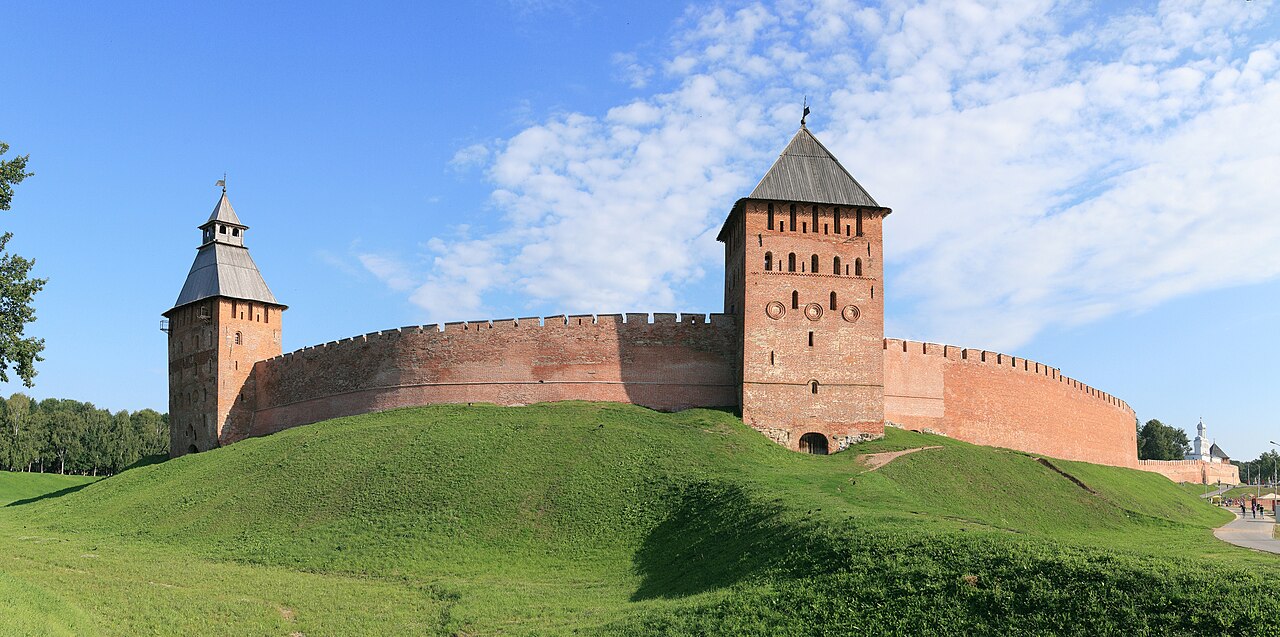
Novgorod Kremlin: Russia’s Oldest Cathedral and the Oldest Bell Kremlin Island, Veliky Novgorod
The Historic Monuments of Novgorod and Surroundings, inscribed in 1992 under criteria (ii), (iv), and (vi), encompasses 37 churches, monasteries, and civic buildings of the Novgorod Republic (1136–1478) in and around the city of Veliky Novgorod — the capital of the most important pre-Muscovite state in Russia. The Novgorod Kremlin (Detinets), rebuilt in its current brick form in the fifteenth century on fortifications that began in the late ninth century, contains the Cathedral of Saint Sophia (built 1045–1050) — the oldest stone building in Russia north of Kiev, constructed by Yaroslav the Wise simultaneously with the Hagia Sophia of Kiev to establish Novgorod’s equal status with the Kievan metropolitan see. The Cathedral’s Magdeburg (Sigtuna) Gates (c. 1153–1154, brought as war trophies from Sweden via Sigtuna in 1187), cast in brass with 48 bas-relief scenes of biblical and allegorical subjects by German craftsmen in Magdeburg, are the finest example of Western European bronze work in medieval Russia. The Millennium of Russia Monument (1862, 15.7 metres high, 129 historical figures in bronze on a granite pedestal), erected in the Kremlin grounds to commemorate the 1,000th anniversary of the Rurik dynasty’s founding, was temporarily occupied by the Germans during the Second World War as the site’s most prominent visual landmark.
Novgorod Republic: Russia’s Medieval Democracy Throughout the city
The Novgorod Republic (1136–1478) was the most politically unusual state in medieval Russia — a city-state governed by an assembly of free citizens (the Veche) that met in the courtyard of the Cathedral of Saint Sophia and had the power to hire and fire the prince (the city’s military commander, kept in a suburban palace and forbidden to own land or conduct trade within the city limits). The Novgorod system inverted the principle of Muscovite autocracy: the prince was a contractual employee, not a sovereign, and the Veche’s decisions were binding even on the Archbishop. Novgorod’s commercial wealth (furs, beeswax, amber, flax) and its membership in the Hanseatic League (the German trading confederation) gave the republic an economic independence that funded its extraordinary architectural programme — the 37 churches scattered across Novgorod’s five boroughs were funded by individual merchant families (the Church of the Transfiguration on Elijah Street, 1374, funded by the Ilin Street Quarter, contains the only surviving cycle of frescoes by Theophanes the Greek, whose expressive, painterly Byzantine style directly influenced Andrei Rublev) — each church representing a guild or merchant family’s assertion of piety, status, and territorial claim within the city fabric.
Yuryev Monastery: Russia’s Oldest Monastery in a Living Monastery 🚌 5 km south of city
The Yuryev (Saint George) Monastery, 5 km south of Veliky Novgorod on the Volkhov River, is the oldest monastery in Russia still functioning as a monastery — founded in 1030 by Yaroslav the Wise, with the Cathedral of Saint George (1119–1130) the principal surviving building of the original Novgorodian monastery complex. The Cathedral is one of the finest examples of Novgorodian Romanesque architecture: a six-pillar three-apsed basilica of exceptional proportions whose exterior blank masonry walls (the painted decoration was lost in the nineteenth century) document the form of twelfth-century Novgorodian church construction before the decorative elaboration that would characterise the later republic period. The frescoes painted in 1099 are being rerestored; the monastery has been an active functioning monastery since 1994, after its closure in 1921 and use as a museum, school, and warehouse during the Soviet period.
Pskov: The Sister Republic’s Medieval Heritage 🚌 ~3.5 hrs southwest
The Pskov Kremlin and Architectural Ensemble, inscribed in 2019 under criteria (ii), (iv), and (vi), is 190 km southwest of Novgorod — the other major medieval Russian republic, closely linked to Novgorod (sharing the same legal system, the same Pskov-Novgorodian architectural style, and the same Baltic trade network). The Pskov Kremlin (Krom) with its Cathedral of the Holy Trinity (1699, rebuilt multiple times on a site documented from the late twelfth century) and the Trinity Gates stands on the promontory where the Pskova and Velikaya rivers meet; the city walls of Pskov (9.5 km, the longest surviving medieval walls in Russia) surround a city of 22 medieval churches in the distinctive Pskovian white-limestone style — lower, more massive, and with distinctive belfries that sit directly on the apses rather than in separate towers. The Church of the Nativity of the Holy Virgin at Snetogorsky Monastery (1313) preserves the oldest surviving frescoes in Russia after the Mongol invasions — a style transitional between Byzantine and emerging Muscovite traditions.
Practical information
Veliky Novgorod is 185 km south of St. Petersburg; Sapsan high-speed trains from Moscow take 4.5 hours (changing at Tver or directly); from St. Petersburg, direct trains take 3 hours. The Kremlin and Saint Sophia Cathedral are on the Kremlin Island in the Volkhov; Yaroslav’s Court (the ancient market quarter on the east bank) and the major churches are within 15 minutes’ walk. The open-air Museum of Wooden Architecture at Vitoslavlitsy (4 km from the city) preserves 22 wooden buildings transferred from surrounding villages, representing the vernacular construction of the Novgorod region from the sixteenth to nineteenth centuries. Pskov is 3.5 hours from Veliky Novgorod by bus or car. The best season is May–September; the Hansa Days festival (June, every three years when Novgorod is host) recreates medieval Hanseatic market culture. The Sretenye fair at Yuryev Monastery (first weekend of February) is the traditional winter fair.
Frequently Asked Questions
Is Novgorod a UNESCO World Heritage Site?
Yes. The Historic Monuments of Novgorod and Surroundings was inscribed in 1992 under criteria (ii), (iv), and (vi). The inscription covers 37 architectural monuments including the Kremlin (Detinets), the Cathedral of Saint Sophia (1045–1050, Russia’s oldest stone building north of Kiev), and the network of medieval churches commissioned by Novgorod’s merchant families across the five boroughs of the republic.
What was the Novgorod Republic and how did it govern itself?
The Novgorod Republic (1136–1478) was a city-state in northwestern Russia governed by a popular assembly (Veche) of free male citizens who met in the Cathedral square to decide matters of war, peace, taxation, and the hiring and firing of the city’s military commander (the Prince). The Prince was a contractual employee who could be expelled by the Veche; he was forbidden to own property or conduct trade within the city, preventing him from accumulating the economic base for a coup. The Archbishop of Novgorod (elected by lot from three candidates proposed by the Veche) was the city’s effective head of government. This system — radically different from the autocratic principalities of Vladimir, Suzdal, and later Moscow — gave Novgorod its mercantile character and made it the wealthiest city in Russia before the Muscovite conquest of 1478.
Who was Theophanes the Greek?
Theophanes the Greek (c. 1340–1410) was a Byzantine painter who worked in Novgorod (from c. 1378) and later in Moscow (from c. 1395), where he collaborated with Andrei Rublev on the Annunciation Cathedral icons. His only surviving complete fresco cycle is in the Church of the Transfiguration on Elijah Street in Novgorod (1378) — a series of ascetic saints and Old Testament figures painted in a loose, expressive manner with white highlights creating an almost Impressionist quality unusual for Byzantine art of the period. Theophanes is considered the most significant painter in Russian medieval art before Rublev; his style, which he developed in Novgorod and Constantinople, became the direct precursor of the Muscovite school of icon painting.
Sources
- S1 — Birnbaum, Henrik. Lord rings Novgorod: A History of the Republic. Slavica Publishers, 1981. ISBN 978-0-89357-088-0.
- S2 — Brumfield, William Craft. A History of Russian Architecture. University of Washington Press, 1993. ISBN 978-0-295-97394-4.
Spotted an error? Write to editorial@culturalheritageonline.com and we correct it the same day.