
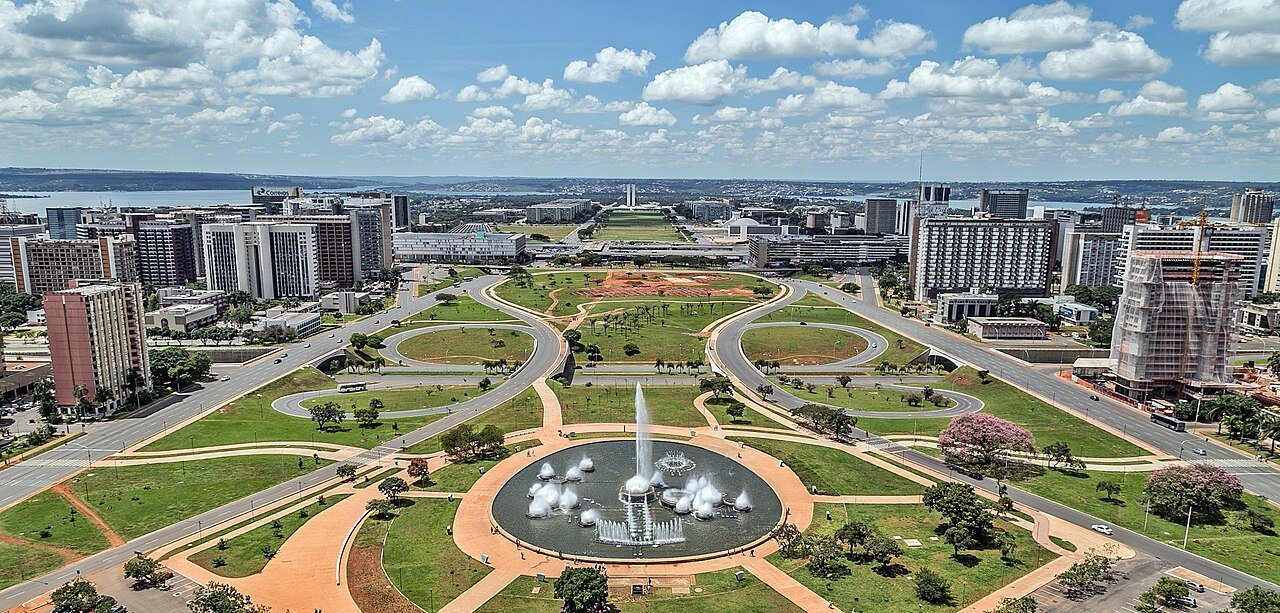
Brasília is the only city in the world to have been built in the twentieth century and inscribed as a UNESCO World Heritage Site: inscribed in 1987 for its monumental modernist architecture and innovative urban planning, the Brazilian capital is itself a heritage destination. The surrounding Cerrado savanna and, further afield, Brazil’s extraordinary natural UNESCO sites extend the visit.
Brasília: A City as World Heritage City centre
Brasília, inscribed in 1987 under criteria (i) and (iv), was built in 41 months on an uninhabited plateau — a decision that remains one of the twentieth century’s most audacious acts of urban planning. Lúcio Costa’s master plan shaped the city as a cruciform layout when seen from the air: the Monumental Axis runs east–west, the Residential Axis north–south. Oscar Niemeyer’s buildings line the Monumental Axis with a consistency of formal ambition unusual in any city at any scale: the twin towers of the National Congress, with their paired bowl forms — one convex for the Senate, one concave for the Chamber of Deputies — the Presidential Palace, the Supreme Court, and the National Museum of the Republic each demonstrate how a single architect working in partnership with a landscape architect and a planner can produce something coherent enough to deserve inscription as a whole. The city is still growing, and its heritage zone — the Plano Piloto — is tightly managed to preserve the original planning vision.
Chapada dos Veadeiros: Cerrado Highland Wilderness 🚗 ~2.5 hrs north of Brasília
Chapada dos Veadeiros National Park, inscribed in 2001 under criteria (vii) and (ix), protects the headwaters of the Tocantins River on the ancient Central Brazilian Plateau. The park’s landscape of quartzite rock formations, crystalline waterfalls, gallery forests, and open Cerrado grasslands represents one of the oldest and most biodiverse savanna ecosystems on earth. The Cerrado is the world’s most biodiverse tropical savanna — roughly 10,000 plant species, 935 bird species, and 300 mammals, the majority found nowhere else. Alto Paraíso de Goiás, the gateway town, is approximately 250 kilometres north of Brasília on paved road.
Serra da Canastra and Emas National Park 🚗 ~3.5–4 hrs from Brasília
Emas National Park in Goiás state, inscribed together with Chapada dos Veadeiros as part of the “Cerrado Protected Areas” serial property, protects a flat highland plateau where giant anteaters, maned wolves, giant armadillos, and pampas deer are commonly observed. The park is also remarkable for its termite mounds — millions of them across the open grassland — which emit a distinctive bioluminescence at night during the rainy season. The drive from Brasília takes roughly four hours south and west, passing through agricultural frontier landscapes that make the preserved Cerrado’s ecological significance immediately legible.
Goiás: A Colonial Town Preserved 🚗 ~2.5 hrs west of Brasília
The Historic Centre of the Town of Goiás (also called Cidade de Goiás or Goiás Velho), inscribed in 2001 under criteria (ii) and (iv), is a colonial gold-mining town that preserves the eighteenth-century landscape of the Brazilian interior nearly intact. Cobbled streets, whitewashed churches, the Palácio Conde dos Arcos, and the Museum of the Bandeirantes document a period of expansion and extraction that predates Brasília by two centuries. The contrast between the colonial town’s organic, accretion-built fabric and Niemeyer’s and Costa’s planned city 250 kilometres to the east is a productive comparison for anyone interested in how Brazil has narrated its own history through architecture.
Practical information
Presidente Juscelino Kubitschek International Airport (BSB) serves Brasília with direct connections to all major Brazilian cities and international routes to Miami, Lisbon, and other hubs. The Plano Piloto is best explored by car; the distances between Niemeyer’s buildings are significant. A guide is worthwhile for understanding the planning concepts. Chapada dos Veadeiros requires advance booking for park entry during peak season (July–September). The Cerrado rainy season (October–March) brings waterfalls to their fullest but can make dirt roads impassable; the dry season (April–September) is better for walking and wildlife.
Frequently Asked Questions
Why is Brasília a UNESCO World Heritage Site?
Brasília was inscribed in 1987 because it represents an outstanding example of urban planning and architecture — a complete twentieth-century city built in just 41 months to a unified design by Lúcio Costa (urban plan) and Oscar Niemeyer (buildings), inscribed under criteria (i) and (iv).
What are the must-see buildings in Brasília’s UNESCO heritage zone?
The National Congress (twin towers with Senate dome and Chamber bowl), the Palácio do Planalto (presidential palace), the Supreme Federal Tribunal, the Metropolitan Cathedral (a crown of hyperbolic concrete), and the National Museum of the Republic are the core Niemeyer buildings along the Monumental Axis.
How far is Chapada dos Veadeiros from Brasília?
About 250 kilometres north of Brasília, a two-and-a-half-hour drive on paved road. The park entry is near Alto Paraíso de Goiás town. Book park entry tickets in advance through the Chico Mendes Institute (ICMBio) website.
Sources
- S1 — Holston, James. The Modernist City: An Anthropological Critique of Brasília. University of Chicago Press, 1989. ISBN 978-0-226-35411-8.
- S2 — Niemeyer, Oscar. The Curves of Time: The Memoirs of Oscar Niemeyer. Phaidon Press, 2000. ISBN 978-0-7148-4007-9.
Spotted an error? Write to editorial@culturalheritageonline.com and we correct it the same day.


.jpg)