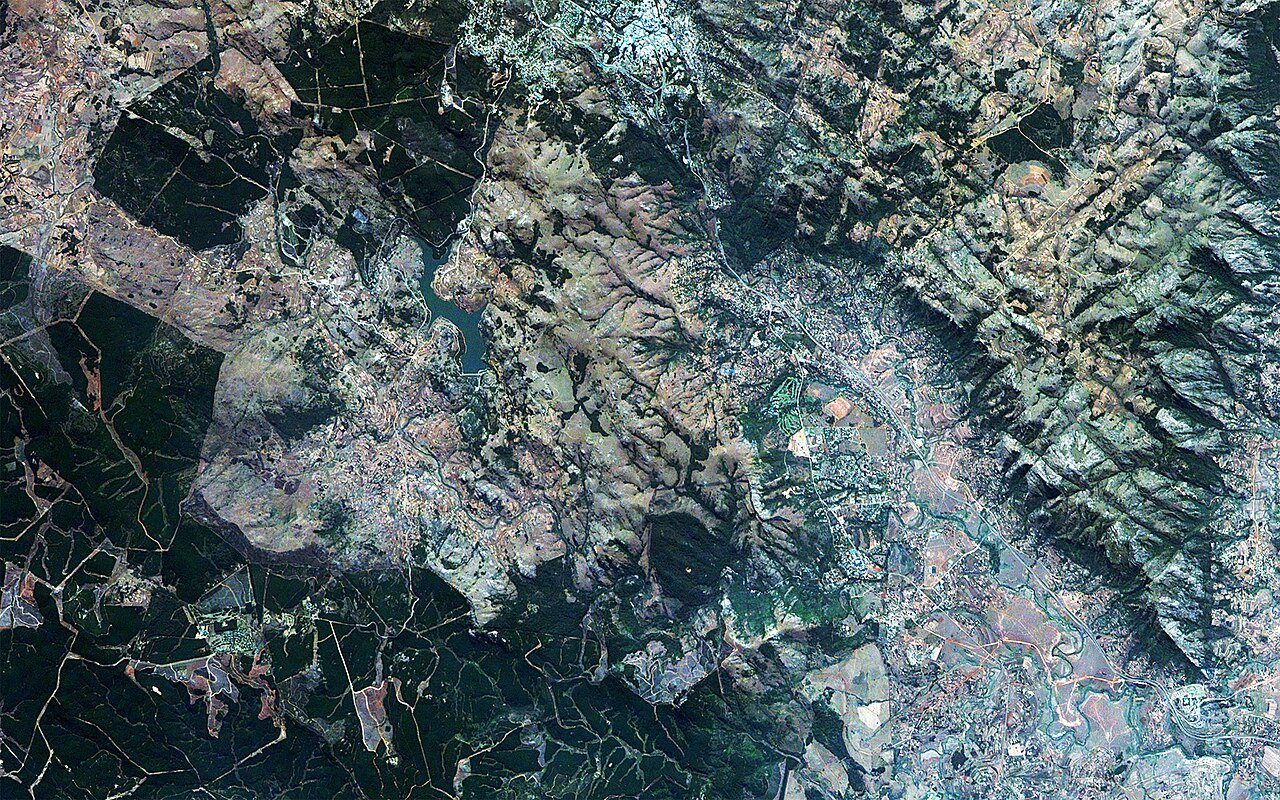
Eswatini (formerly Swaziland) has no UNESCO World Heritage Sites. The nearest inscribed sites are in South Africa: the uKhahlamba Drakensberg Park (a combined natural and cultural site, 200 km south) and the iSimangaliso Wetland Park (200 km east), Africa’s third largest estuary and a major marine and coastal heritage site. From Cultural Heritage Online.
uKhahlamba/Drakensberg Park, South Africa 200 km south — 2.5 hr by road via Piet Retief
The uKhahlamba/Drakensberg Park was inscribed as a UNESCO World Heritage Site in 2000 for both natural and cultural outstanding universal value — one of the relatively rare “mixed” nominations. The site covers approximately 2,430 square kilometres of the main Drakensberg escarpment and its associated plateau and foothills in KwaZulu-Natal province, rising from approximately 1,280 metres altitude to a highest point of 3,482 metres (Thabana Ntlenyana in Lesotho, on the park boundary). The escarpment is one of the most dramatic in southern Africa: basaltic cliffs rising hundreds of metres above the foothills, cut by numerous rivers that fall in spectacular waterfalls over the edge.
The cultural value for which the site was inscribed is the collection of San (Bushman) rock art found throughout the park — the largest and most concentrated collection of San rock paintings in Africa, with approximately 35,000 individual paintings in nearly 600 sites. The paintings depict hunting scenes, therianthropic figures (half-human, half-animal, linked to shamanic trance practices), eland and other antelope, and geometric symbols, and were created over a period of approximately 2,400 years by the San, the original inhabitants of the Drakensberg. The paintings have been extensively documented, protected, and interpreted. Access to individual rock art sites is via guided walks from the park entry points.
iSimangaliso Wetland Park, South Africa 200 km east — 2.5 hr by road via Mhlume
iSimangaliso Wetland Park, inscribed in 1999 as South Africa’s first UNESCO World Heritage Site, covers approximately 3,280 square kilometres along the northeastern coast of KwaZulu-Natal, including Lake St Lucia (Africa’s third largest estuary), the surrounding woodland, coastal forest, coastal dunes (some of the highest in the world at up to 200 metres), coral reefs, and the sandy beaches of the Maputaland coast. The site supports one of the highest concentrations of hippopotamus and Nile crocodile in South Africa, large populations of leatherback and loggerhead turtles nesting on the beaches, and extraordinary bird diversity in the estuary.
Getting there from Mbabane: uKhahlamba/Drakensberg is approximately 200 km south via the R570 to Piet Retief then south into KwaZulu-Natal (approximately 2.5 hours). iSimangaliso is approximately 200 km east via Mhlume and the Golela border crossing (approximately 2.5 hours). Allow: 2+ days for either site. Best for: San rock art; estuarine and coastal wildlife; hiking and dramatic mountain scenery.
Frequently Asked Questions
Does Eswatini have any UNESCO World Heritage Sites?
No. Eswatini (formerly Swaziland) has no inscribed UNESCO World Heritage Sites and has not submitted a Tentative List. The country’s cultural and natural heritage — including the royal palaces at Lobamba, the Sibebe Rock (one of the largest exposed granite outcrops in the world), and various nature reserves — has not been formally developed for UNESCO inscription.
What is the significance of the San rock art in the Drakensberg?
The San rock art of the Drakensberg constitutes the largest and most concentrated collection of San rock paintings in Africa — approximately 35,000 individual images in nearly 600 sites across the uKhahlamba/Drakensberg Park. The paintings are significant both archaeologically and anthropologically: they were created by the San (also known as Bushmen or Khoisan), the original inhabitants of southern Africa, over approximately 2,400 years. Contemporary research, informed by anthropological interviews with San communities in the Kalahari who retained knowledge of older shamanic traditions, has interpreted many of the paintings as records of trance experiences undergone by San shamans, who believed they could enter the spirit world and harness its potency for rain-making, healing, and control of game animals.
What makes iSimangaliso Wetland Park important for marine turtles?
The Maputaland coast within iSimangaliso Wetland Park is one of the most important nesting sites for leatherback turtles (Dermochelys coriacea) and loggerhead turtles (Caretta caretta) in the Indian Ocean. Leatherbacks arrive to nest on the beaches between October and January; loggerheads nest between November and February. A monitoring programme has operated on the Maputaland beaches since 1963, making it one of the longest-running marine turtle research programmes in the world. The high dunes (up to 200 metres) that back the beach protect the nesting area from development pressure and act as a buffer against storm erosion.
What is Sibebe Rock in Eswatini?
Sibebe Rock, 8 km northeast of Mbabane, is one of the largest exposed plutons (exposed masses of igneous rock) in the world and the second largest monolith in the world after Uluru in Australia — though the comparison requires qualification as “monolith” definitions vary. The granite dome rises approximately 300 metres above the surrounding valley floor, with a total elevation of approximately 1,489 metres above sea level. It is accessible on guided hikes and is a significant natural landmark in Eswatini, though it does not have formal UNESCO protection.
Sources
- S1 — Bonner, Philip. Kings, Commoners and Concessionaires: The Swazi State. Cambridge University Press, 1983. ISBN 978-0-521-24270-7.
- S2 — Lewis-Williams, J. David. San Spirituality: Roots, Expressions, Consequences. AltaMira Press, 2004. ISBN 978-0-7591-0432-7.
Spotted an error? Write to editorial@culturalheritageonline.com and we correct it the same day.