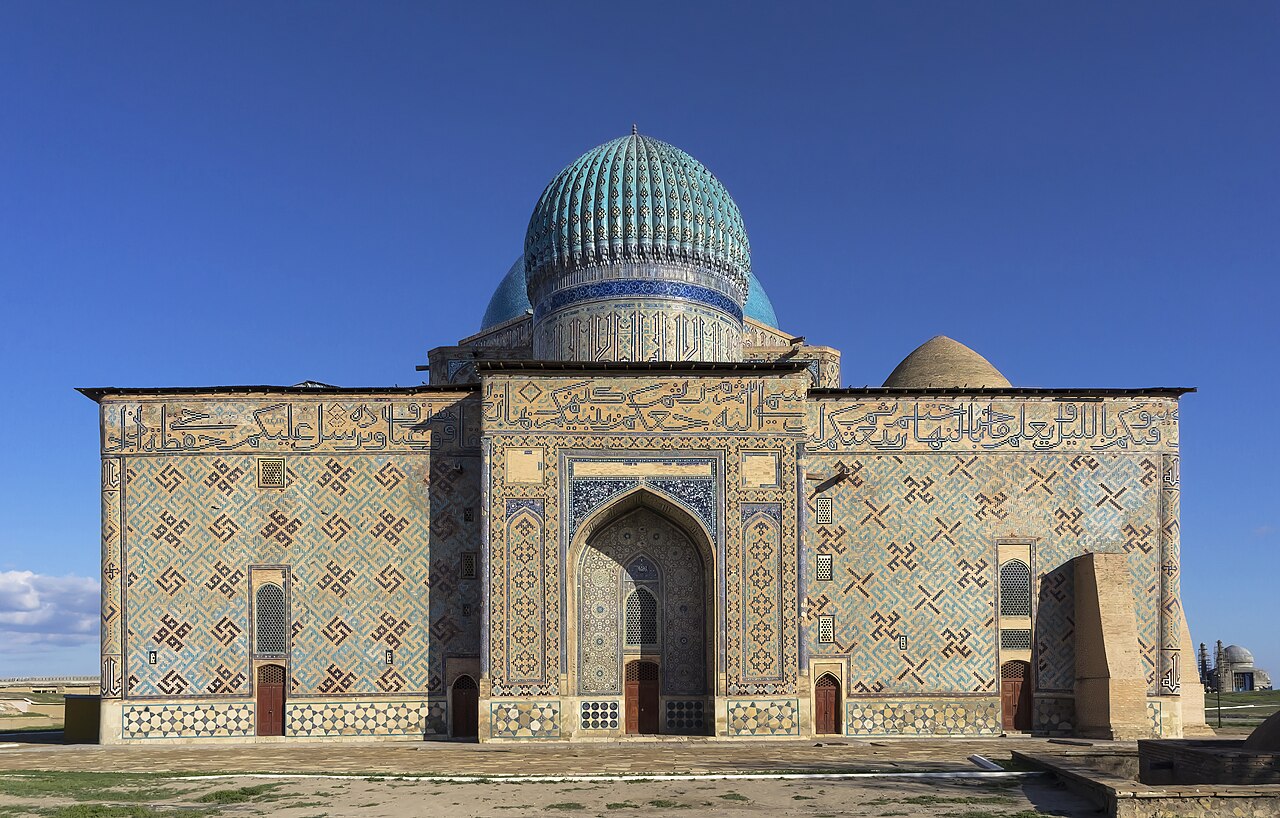
Two UNESCO World Heritage Sites are within reach of Astana, Kazakhstan’s capital: the Mausoleum of Khoja Ahmed Yasawi at Turkestan — one of the largest surviving Timurid buildings in the world — and the Saryarka Steppe, a critical staging post for millions of migratory birds on the Central Asian flyway. From Cultural Heritage Online.
Mausoleum of Khoja Ahmed Yasawi, Turkestan 700 km south — 1 hr domestic flight or 8 hr road
Khoja Ahmed Yasawi died in Turkestan in 1166, having spent his life writing Sufi poetry in the Turkic vernacular — verse that spread Islam through the steppe in a language ordinary people could understand rather than in the Arabic of the learned elite. His grave became a pilgrimage site immediately after his death, and Turkestan grew into one of the most important religious centres of the Kazakh steppe. Two and a half centuries after Yasawi’s death, Timur — the Timurid ruler based in Samarkand — ordered a mausoleum built at Turkestan on a scale that would express his own piety and his connection to the Sufi tradition of Central Asia.
Construction began around 1389 and continued until Timur’s death in 1405, at which point the building was left unfinished — the main entrance portal was never completed, the brickwork of the upper sections was never faced in tile, and several planned additions never progressed beyond foundations. The incompleteness is now a visual feature rather than a defect: the transition between finished Timurid blue-and-turquoise faience and bare brick is visible on the facade and communicates the building’s history without explanation.
The main hall — the khanaka — is 18.2 metres in diameter, covered by a ribbed dome 38.7 metres high, making it one of the largest domed interior spaces in Central Asia. The interior contains a massive bronze cauldron (kazan) commissioned by Timur himself, weighing approximately 2 tonnes and cast in seven sections, used to hold sacred water during Nowruz and other religious gatherings. The building was inscribed as a UNESCO World Heritage Site in 2003 for its exceptional Timurid architecture and its role as a major Central Asian pilgrimage destination.
Turkestan has received substantial investment from the Kazakh government since 2018 as part of a cultural tourism development project that includes new hotels, an archaeological museum, and infrastructure improvements around the mausoleum precinct.
Getting there: Domestic flights from Astana to Turkestan (Shymkent airport, then 1.5 hr road transfer); approximately 1 hour flight plus transfer. Long-distance rail and road also available (8–10 hours). Allow: Half day at the mausoleum and precinct; full day if combining with the archaeological museum. Best for: Islamic art and architecture visitors; Central Asian Silk Road itineraries.
Saryarka — Steppe and Lakes of Northern Kazakhstan 200 km south — 3 hr by road
The Saryarka inscription covers two protected areas in the northern Kazakh steppe — the Naurzum State Nature Reserve and the Korgalzhyn State Nature Reserve — both within the vast Eurasian grassland that stretches from Hungary to Mongolia. The site was inscribed in 2008 for its role as a critical staging post on the Central Asian flyway: between 15 and 16 million migratory birds pass through the steppe lakes each year, including Siberian cranes, white-naped cranes, Dalmatian pelicans, and several Central Asian raptor species. The Korgalzhyn area holds one of the northernmost flamingo breeding colonies in the world — pink in a sea of yellow steppe grass, on lakes that freeze solid for four months of the year.
Getting there: Korgalzhyn is 200 km south of Astana by road (approx. 3 hours on the M-36 highway). The nature reserve office in Korgalzhyn village provides permits and can arrange guided access to the flamingo breeding area. Allow: Full day minimum; best combined with an overnight stay in or near the reserve. Best for: Birdwatchers and natural heritage visitors; best in April–June for flamingo breeding and spring migration.
Frequently Asked Questions
How many UNESCO World Heritage Sites can be visited from Astana?
Two are conveniently accessible: the Mausoleum of Khoja Ahmed Yasawi at Turkestan (700 km south, 1 hr domestic flight) and Saryarka — Steppe and Lakes of Northern Kazakhstan, specifically the Korgalzhyn Nature Reserve (200 km south, 3 hr by road). Kazakhstan has five UNESCO World Heritage Sites in total; the other three (Petroglyphs of Tamgaly, Western Tien-Shan, and the Silk Roads) are more conveniently accessed from Almaty.
Why did Timur commission the Mausoleum of Khoja Ahmed Yasawi?
Timur was a deeply religious man who cultivated relationships with Sufi orders throughout his campaigns of conquest. Khoja Ahmed Yasawi was the most venerated Sufi figure in the Turkic world, and building a mausoleum at his grave site was both a religious act and a political one: it aligned Timur with the spiritual tradition most meaningful to the Turkic-speaking populations he ruled. The scale of the building — one of the largest Timurid structures outside Samarkand — reflected the importance Timur placed on this connection.
What is the best time of year to visit Saryarka for flamingos?
April through June is the prime season, when flamingos arrive at the Korgalzhyn lakes to breed. The breeding colony at Lake Tengiz within the reserve is one of the northernmost in the world; the birds arrive from wintering grounds in Iran and Central Asia in late March and April. Migratory bird numbers peak in April and May for spring passage. The steppe itself is at its most dramatic in May and early June when the feathergrass and tulip species bloom across the reserve.
Is the Mausoleum of Khoja Ahmed Yasawi still an active pilgrimage site?
Yes. The mausoleum receives hundreds of thousands of Muslim pilgrims annually, particularly during Nowruz (spring equinox) and other Islamic observances. Three visits to the Yasawi mausoleum are traditionally counted as equivalent to one pilgrimage to Mecca in Central Asian Sufi tradition, which has sustained pilgrimage traffic since the twelfth century. The site functions simultaneously as a UNESCO heritage site, an active religious monument, and one of Kazakhstan’s primary tourist destinations.
Sources
- S1 — Knobloch, Edgar. Monuments of Central Asia. I.B. Tauris, 2001. ISBN 978-1-86064-590-7.
- S2 — Golden, Peter B. An Introduction to the History of the Turkic Peoples. Otto Harrassowitz, 1992. ISBN 978-3-447-03274-2.
Spotted an error? Write to editorial@culturalheritageonline.com and we correct it the same day.