
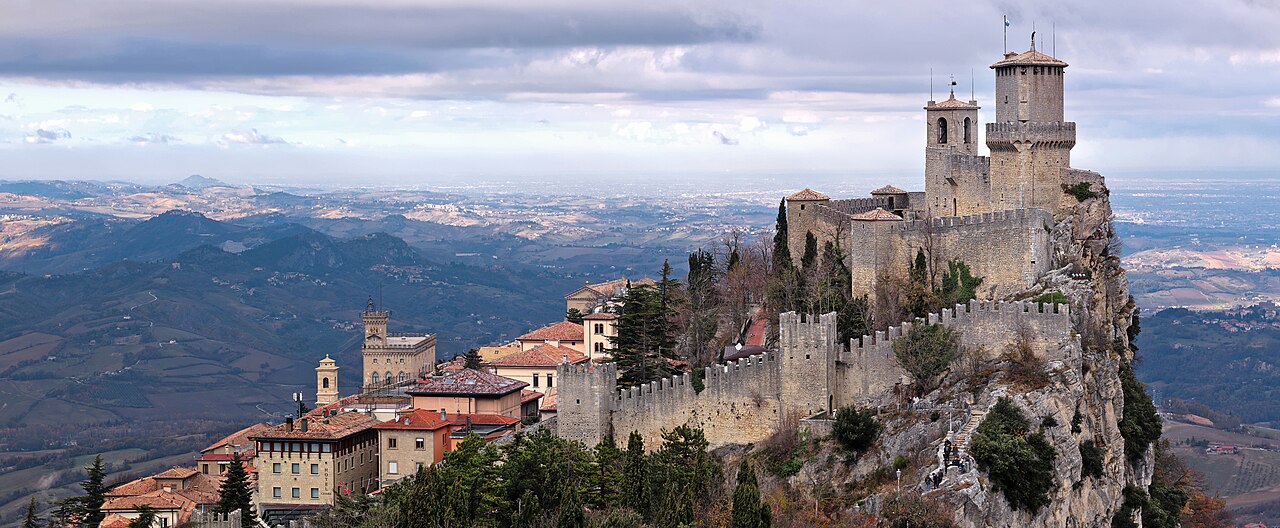
The Republic of San Marino is itself a UNESCO World Heritage Site: the entire historic centre and the ridge of Monte Titano, crowned by three medieval towers, were inscribed in 2008 as the seat of the oldest surviving republic in the world. From Cultural Heritage Online.
Historic Centre of San Marino and Monte Titano City centre — on site
San Marino claims foundation in 301 AD by a Christian stonecutter named Marinus fleeing Roman persecution on the Dalmatian coast. The claim cannot be fully verified, but the republic has maintained continuous self-government since at least the thirteenth century, making it the world’s oldest surviving constitutional republic. The capital, also called San Marino, sits at approximately 700 metres elevation on the ridge of Monte Titano — a 749-metre limestone peak that rises abruptly from the surrounding Emilian plain about 10 km inland from the Adriatic coast near Rimini.
The UNESCO inscription covers the historic centre and the three summit fortresses: Guaita (Prima Torre), the oldest of the three, built in the eleventh century and now housing a small prison; Cesta (Seconda Torre), on the highest summit at 756 metres, containing a museum of medieval arms; and Montale (Terza Torre), the smallest, which can be viewed from the outside only. The three fortresses are connected by a medieval walkway — the Passo delle Streghe, the “Path of the Witches” — which runs along the eastern escarpment of Monte Titano with views across the Adriatic plain and, on clear days, to the Adriatic coast and Croatia beyond it.
The historic centre below the towers retains its medieval street pattern, the Palazzo Pubblico (1894, but on the site of the original government building), several Romanesque churches, and the Piazza della Libertà with its ceremonial changing of the guard. The inscription acknowledged both the medieval fortifications and the political continuity they represent: San Marino is the only example of a city-state that has maintained its independence from the Italian unification of the nineteenth century to the present, preserving a form of government (the Captains Regent system, with two jointly-serving heads of state elected every six months) unchanged in its essentials since the thirteenth century.
Getting there: San Marino is accessible by road from Rimini (about 25 km, 30 min). Regular coach services from Rimini railway station; no railway reaches San Marino. The historic centre is pedestrianised. Allow: Half day for the towers and historic centre; full day to combine with the Museo di Stato. Best for: Medieval history and political heritage visitors; travellers on the Adriatic coast.
Frequently Asked Questions
Is San Marino itself a UNESCO World Heritage Site?
Yes. The Historic Centre of San Marino and Mount Titano was inscribed as a UNESCO World Heritage Site in 2008. The inscription covers the entire medieval city centre on the ridge of Monte Titano, including the three summit fortresses (Guaita, Cesta, and Montale), the Passo delle Streghe walkway, and the historic urban fabric below the fortifications.
What are the three towers of San Marino?
The Guaita (Primera Torre) is the oldest, built in the eleventh century and still containing a functioning prison. The Cesta (Seconda Torre), on the highest summit at 756 metres, houses a museum of medieval arms and armour. The Montale (Terza Torre) is the smallest and is viewable only from the exterior. An entrance ticket covers access to the Guaita and Cesta; the Montale is not open to visitors.
Why is San Marino considered the world’s oldest republic?
San Marino has maintained continuous self-government since at least the thirteenth century, with a constitution dating formally to 1600 and a governing system (the Captains Regent, two jointly-serving heads of state elected for six-month terms) that has operated without interruption since the medieval period. It also successfully maintained its independence through the Italian Risorgimento and both World Wars, never being absorbed into the Kingdom of Italy or the Italian Republic.
How do you get to San Marino from Italy?
Regular coach services operate from Rimini railway station to the historic centre of San Marino (approximately 45 minutes). By car, San Marino is about 25 km from Rimini and 30–35 minutes by road. There is no railway to San Marino. Most visitors arrive as a day trip from the Adriatic Riviera resorts (Rimini, Riccione) or from Bologna (90 min by road).
Sources
- S1 — Michelotti, Girolamo. Storia della Repubblica di San Marino. Giuffrè, 1978. ISBN 978-88-14-01991-3.
- S2 — Settis, Salvatore. Se Venezia muore. Einaudi, 2014. ISBN 978-88-06-21820-1.
Spotted an error? Write to editorial@culturalheritageonline.com and we correct it the same day.

.jpg)