
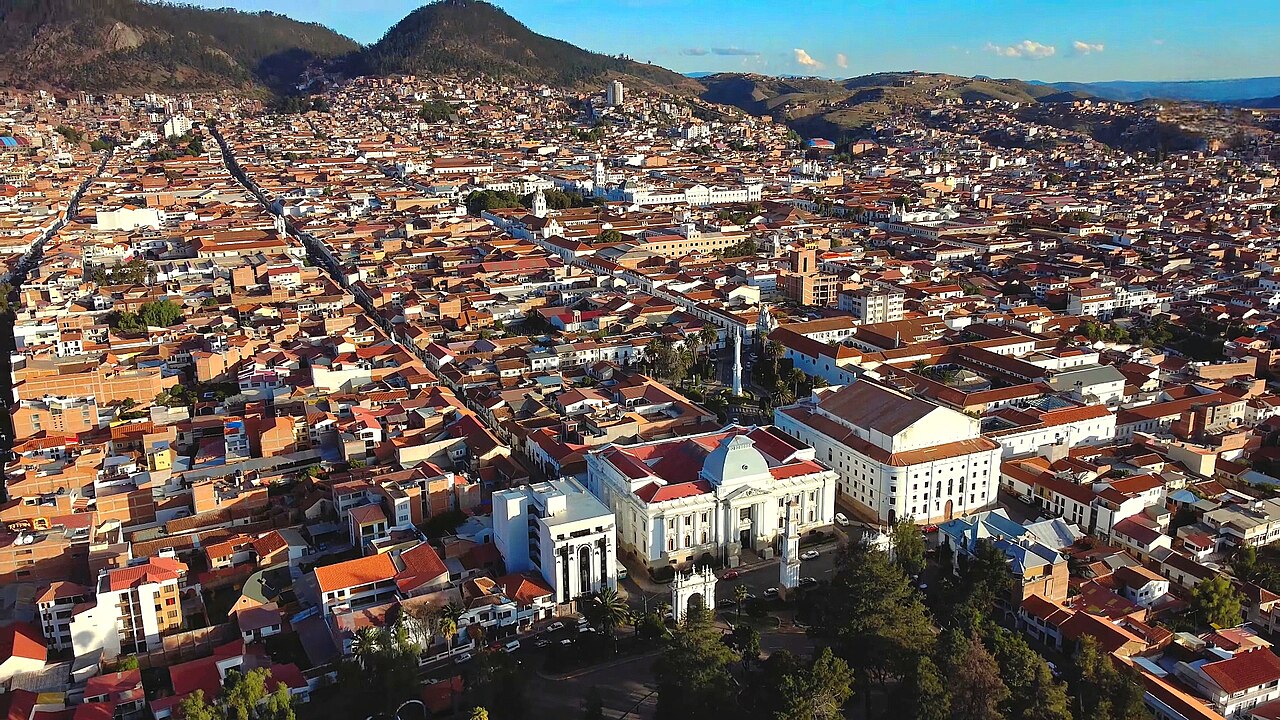
Bolivia’s constitutional capital holds three of the country’s seven UNESCO World Heritage Sites within reach: the inscribed colonial centre of Sucre itself, the pre-Columbian metropolis of Tiwanaku four hours northwest, and the extraordinary carved sandstone outcrop of Fuerte de Samaipata four hours north. From Cultural Heritage Online.
Historic City of Sucre City centre — on foot
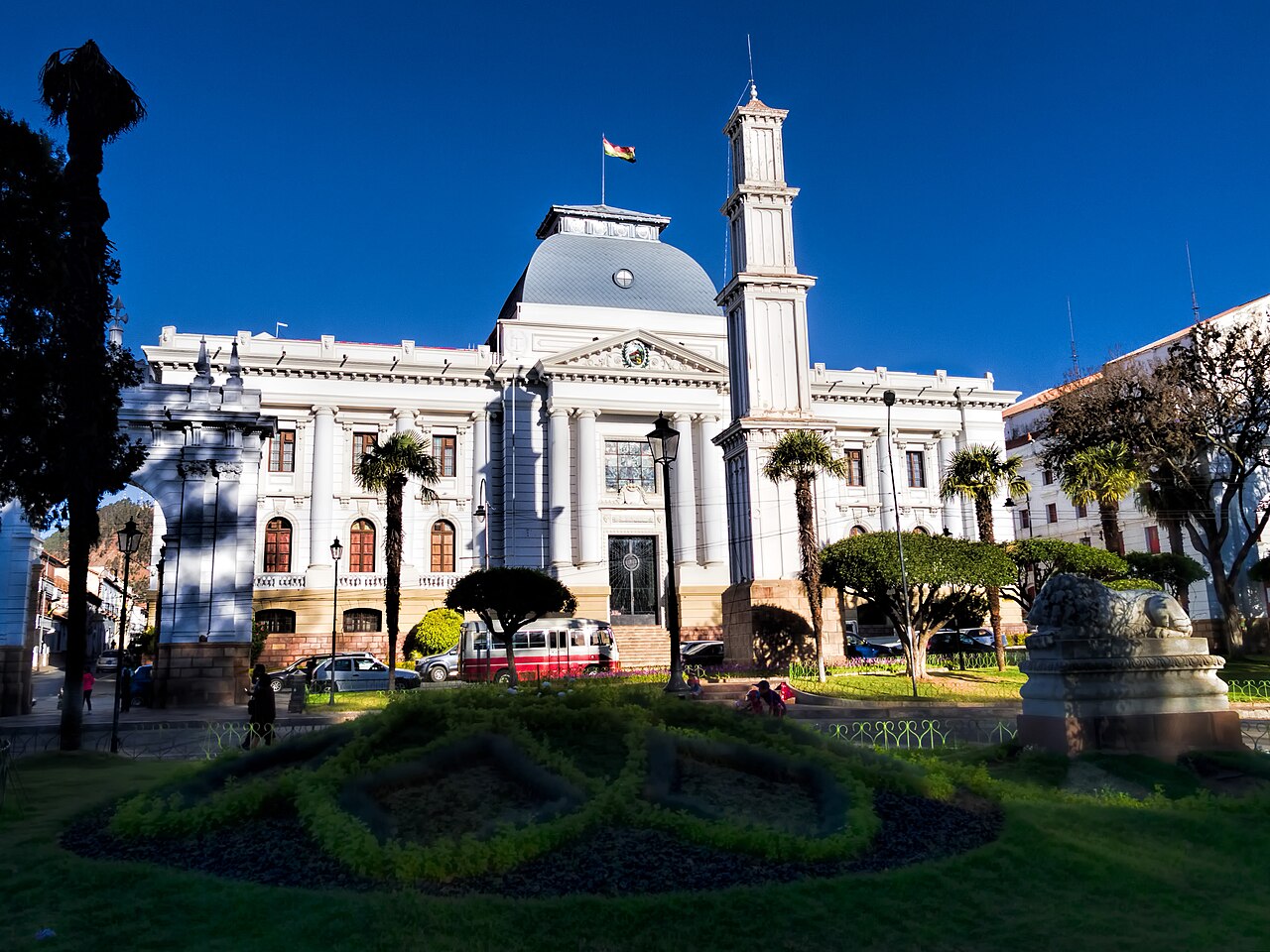
Sucre sits at 2,810 metres in the Bolivian highlands, and its inscribed historic centre is a rare example of Spanish colonial urban planning preserved almost intact since the sixteenth century. The grid of whitewashed buildings with terracotta roofs radiates from the Plaza 25 de Mayo, giving the city its enduring nickname La Ciudad Blanca. UNESCO recognised the ensemble in 1991 for its outstanding universal value as a repository of colonial architecture spanning three centuries.
The city was founded by Spanish colonisers in 1538 under the name La Plata and grew into the seat of the Audiencia de Charcas, the ecclesiastical and judicial capital of a vast territory covering present-day Bolivia, Peru, Argentina, and Chile. The Metropolitan Cathedral, built between 1553 and 1712, ranks among the finest examples of Spanish colonial baroque in South America. The Convent of San Felipe Neri (1795) pairs a neoclassical street front with a baroque interior; its open terrace offers an uninterrupted view over the tiled rooftops of the historic centre. The Casa de la Libertad — originally part of the Jesuit college founded in 1621 — is where Bolivia’s Declaration of Independence was signed on 6 August 1825. The Universidad San Francisco Xavier, established in 1624, is one of the oldest universities in the Americas and still operates within the historic zone.
Walking the inscribed area takes two to three hours at a comfortable pace. The Cathedral Museum houses a notable collection of colonial religious art, and the Natural Museum of Bolivian Ethnography and Folklore provides context for the indigenous cultures that coexisted with, and ultimately outlasted, the colonial administration.
Getting there: The inscribed area is the city centre; most sites are within ten minutes on foot from the Plaza 25 de Mayo. Allow: Half a day for the main monuments; a full day if visiting the Cathedral Museum and university. Best for: Travellers who want a walkable UNESCO site with strong café and accommodation infrastructure at mid-altitude.
Tiwanaku: Spiritual and Political Centre of the Tiwanaku Culture 425 km — 1 hr flight + 1.5 hr road
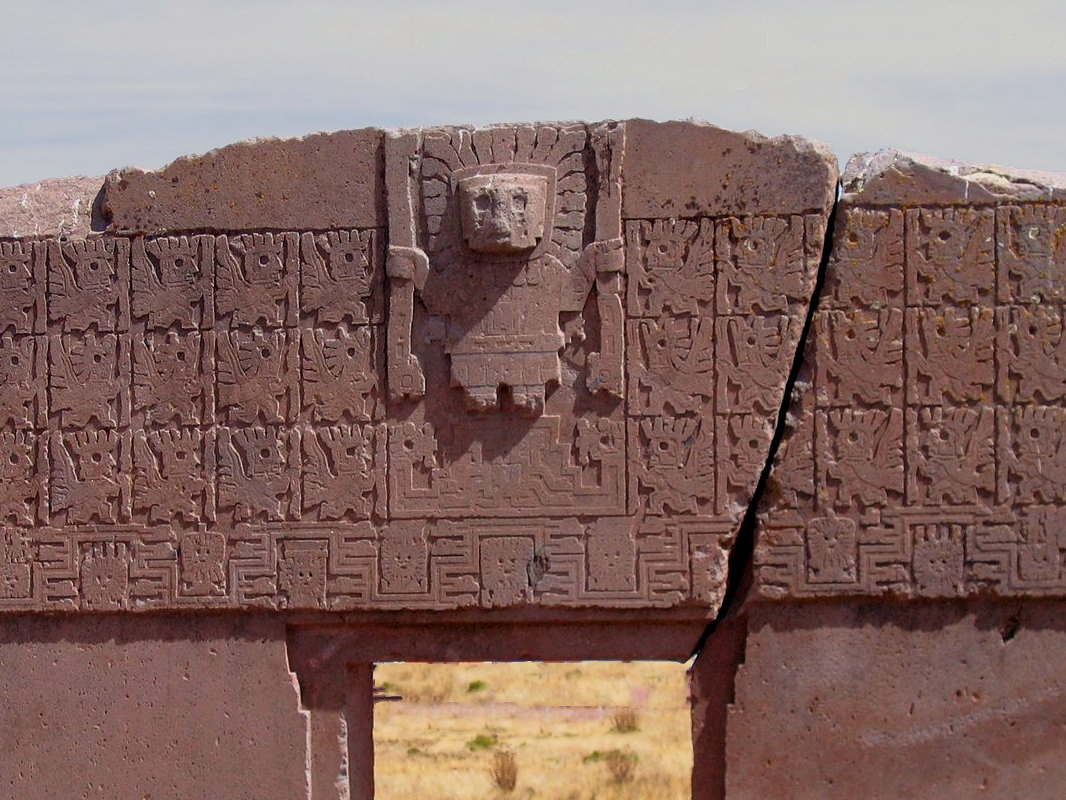
Tiwanaku stands on the altiplano near the southern shore of Lake Titicaca at 3,850 metres, roughly 70 kilometres west of La Paz. The site is the physical remnant of one of the most significant pre-Columbian civilisations of the Andes: a state that flourished between approximately 300 and 1000 AD, exercised political and cultural influence across a territory stretching from northern Chile to southern Peru, and preceded the Inca empire by several centuries. UNESCO inscribed the ruins in 2000.
The most photographed structure is the Gate of the Sun, a single monolithic slab of andesite standing three metres tall on the Kalasasaya ceremonial platform. Carved across its upper register are 48 winged figures flanking a central solar deity — a composition that has no precise parallel elsewhere in pre-Columbian art. The nearby Akapana is a stepped pyramid seventeen metres high; current archaeological evidence suggests it served as a ritual centre rather than a tomb. Pumapunku, a separate complex within the site, is remarkable for the precision of its stonework: interlocking H-shaped blocks cut to tolerances that challenge the tools available to the builders. The Semi-subterranean Temple is a sunken courtyard whose walls are studded with carved stone heads representing different ethnicities, interpreted as a gathering place for peoples from across the Tiwanaku sphere of influence.
From Sucre the practical route is a short domestic flight to El Alto (La Paz), then a road transfer of around ninety minutes to the site. Visiting independently or with a La Paz–based guide is straightforward; the site museum on-site provides stratigraphic context that the ruins alone cannot convey.
Getting there: Domestic flight Sucre–El Alto (BoA or Amaszonas, approx. 1 hr), then taxi or shared transport to Tiwanaku (1.5 hr). Day trips from La Paz are common. Allow: 3–4 hours at the site. Best for: Anyone interested in pre-Columbian civilisations; essential context for understanding the cultures that preceded the Inca.
Fuerte de Samaipata 225 km — approx. 4 hr by road
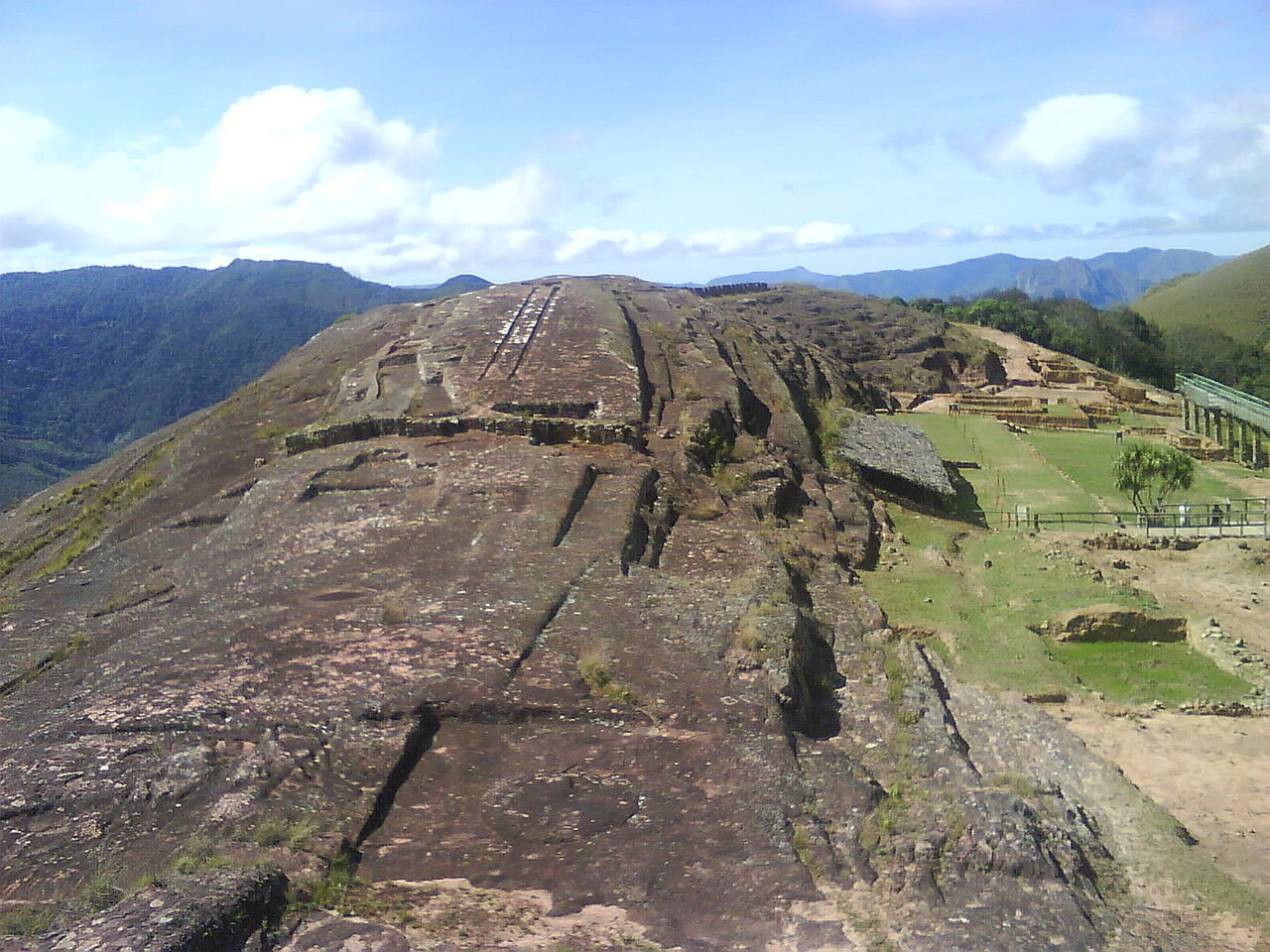
Fuerte de Samaipata lies in the transitional zone between the Andean foothills and the lowland plains, at an altitude of around 1,900 metres near the small town of Samaipata. The site consists of a single sandstone outcrop approximately 220 metres long and 50 metres wide that was carved over centuries by the Chané people and later reworked by the Inca as they expanded their empire eastward into the Bolivian lowlands. UNESCO inscribed it in 1998. What makes the site exceptional is not the individual elements — niches, channels, furrows, seats, animal figures, geometric motifs — but the cumulative density and variety of the carving across a single rock surface at a scale with no known equivalent in pre-Columbian South America.
Inca occupation of the site dates to the late fifteenth century; the carved rock was surrounded by an urban settlement whose remains — residential compounds, plazas, storage structures — are visible in the surrounding area and have been partially excavated. The town of Samaipata below the site developed as a colonial waystation on the route between the highlands and the lowlands, and retains some of that character today.
The road from Sucre heads north through Cochabamba or via Santa Cruz, making the journey practical as part of a circuit rather than a straight return. The on-site museum in Samaipata is small but well-curated and essential for orienting visitors before they walk the rock.
Getting there: By road from Sucre via Santa Cruz (approx. 4 hr) or from Santa Cruz directly (approx. 2.5 hr). No reliable public transport to the carved rock itself; a hired vehicle or organised tour from Samaipata town is standard. Allow: 2 hours at the site plus museum time. Best for: Travellers with a specific interest in pre-Columbian archaeology or those routing between Sucre and Santa Cruz.
Frequently Asked Questions
How many UNESCO World Heritage Sites are near Sucre?
Three UNESCO sites are accessible from Sucre: the Historic City of Sucre (inscribed 1991), which is the city centre itself; Tiwanaku (2000), reachable by a short domestic flight to La Paz followed by a road transfer; and Fuerte de Samaipata (1998), roughly four hours north by road. Bolivia has seven UNESCO World Heritage Sites in total.
How do I get from Sucre to Tiwanaku in a day?
The most efficient route is a morning domestic flight from Sucre’s Juana Azurduy de Padilla Airport to El Alto (La Paz) — the flight takes about an hour — followed by a taxi or organised transfer to the Tiwanaku site (approximately 70 km from La Paz, around 1.5 hours). Allow three to four hours at the ruins and museum, then return to La Paz for the night or catch an evening flight back to Sucre. Several La Paz–based operators run guided day trips that handle the logistics.
When is the best time to visit these sites, and can they be combined in one trip?
The Bolivian dry season runs from May to October and is the most comfortable period for visiting all three sites: clear skies at altitude, passable roads to Samaipata, and no risk of afternoon storms on the altiplano. A combined itinerary of four to five days from Sucre is feasible: spend the first day on the colonial centre, fly to La Paz for Tiwanaku on day two or three, then route back through Santa Cruz and out to Samaipata before returning to Sucre. The route works equally well in reverse.
What is the historical connection between Tiwanaku and the Inca?
The Tiwanaku state collapsed around 1000 AD, roughly four centuries before the Inca empire reached its greatest extent. Andean oral traditions and material culture suggest the Inca drew directly on Tiwanaku cosmology and architectural vocabulary — the Gateway motif, the use of precisely fitted megalithic stonework, and the organisation of ceremonial space around solar alignments all have Tiwanaku precedents. At Fuerte de Samaipata, Inca builders physically reworked an earlier Chané ceremonial site, integrating it into their expanding empire while preserving and reusing its carved rock surface — a pattern of cultural layering visible across the Andes.

.jpg)

