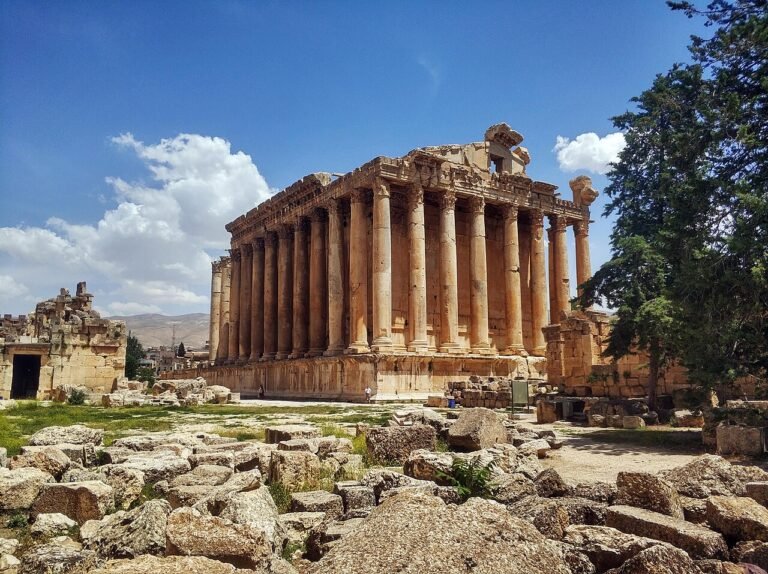
Isfahan sits at the centre of one of the world’s highest concentrations of UNESCO-inscribed heritage — from a 17th-century royal square that reshapes your sense of scale to Achaemenid ceremonial cities two and a half millennia old. Four World Heritage Sites lie within a half-day’s drive. From Cultural Heritage Online.
Meidan Emam (Naqsh-e Jahan Square) Within Isfahan · 0 km
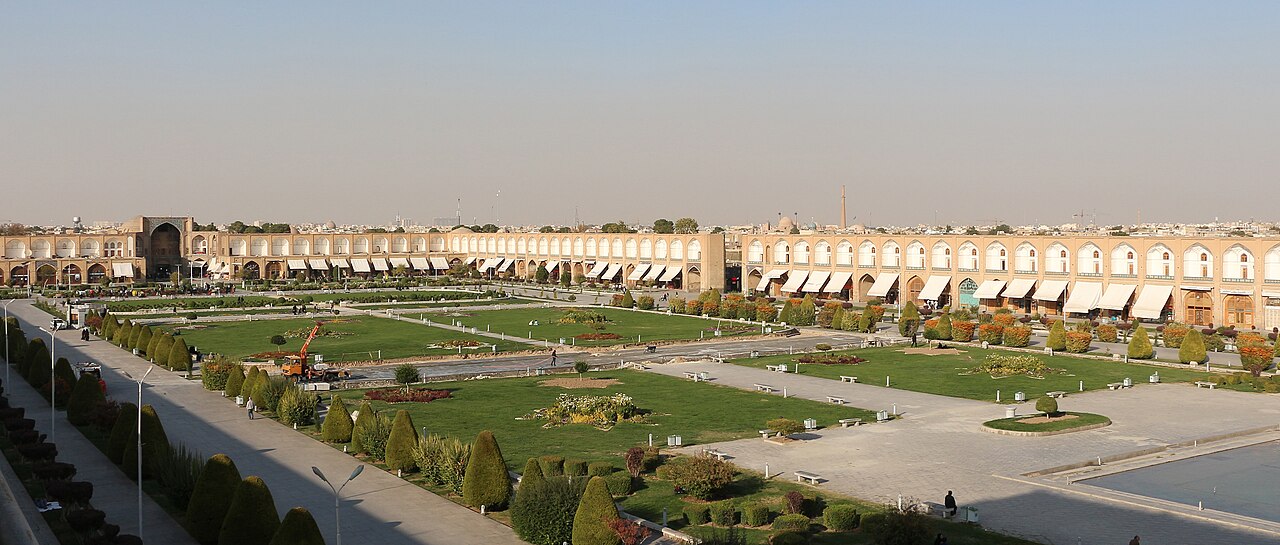
At 512 metres long and 163 metres wide, Naqsh-e Jahan Square — “Image of the World” — is one of the largest city squares ever built. Shah Abbas I commissioned the whole ensemble in the early 17th century as the centrepiece of his rebuilt Safavid capital, and it was inscribed by UNESCO in 1979. Standing at the centre, you read four sides of a single architectural argument: a palace, a mosque for the court, a mosque for the public, and the entrance to the royal bazaar.
The Sheikh Lotfollah Mosque (1603–19) anchors the eastern side. It was built as a private oratory for the Shah’s harem, which explains why it has no minaret and no courtyard. Its double-shell dome is faced in cream-coloured tiles that shift through amber and ochre as the light changes across the day; inside, concentric circles of calligraphy spiral inward toward the lantern like a slowly tightening coil. The Shah Mosque (Masjed-e Shah, 1611–29) faces it from the south: its entrance portal is rotated 45 degrees from the square’s axis so that the prayer hall within points accurately toward Mecca — a geometric resolution you feel physically when you step through the gate. The Ali Qapu Palace on the west side contains a Music Hall on its upper floor whose ceiling is honeycombed with niches cut into plaster in the shapes of vases and bottles — each hollow tuned to a specific resonance, absorbing echo and producing a chamber-music dryness still remarkable to stand inside.
The Royal Bazaar (Qaysariyya) extends north from the square into a covered network of caravanserais, workshops and merchants that has operated without significant interruption for four centuries. Arrive early to watch the goldsmiths at their benches before the day tours arrive.
Getting there: Meidan Emam is the centre of old Isfahan; 15–20 minutes by taxi from most hotels. Allow: Half a day for the square and the two mosques; a full day if you enter the bazaar. Best for: All visitors — this is the undisputed priority in Isfahan and one of the defining architectural experiences in the world.
Shushtar Historical Hydraulic System 100 km west · 1.5 hr by road
Inscribed in 2009, the Shushtar system is Iran’s engineering surprise: a 3rd-century AD complex of dams, tunnels, weirs, waterfalls and mill buildings built under the Sassanid king Shapur I, reportedly using Roman prisoners of war. The engineering principle is still audible — the channels divide the Karun river into multiple branches that drop through a cliff in a series of cascades before powering a row of watermills whose axles have turned, with varying degrees of continuity, for over 1,700 years.
The site is not polished for tourism in the way the Safavid monuments are. Stone pathways run along the tops of the weirs above the falls; the roar of water fills the air. The Gargar Canal, cut through solid rock, shows how precisely Sassanid engineers understood water pressure and flow distribution. A small museum in the complex holds Sassanid-era millstones and irrigation hardware. Shushtar itself is a quiet provincial city with little English spoken — bring a Persian phrasebook and time your visit for spring when the water levels are high enough to make the cascades dramatic.
Getting there: Shushtar is 100 km west of Isfahan via the Khorramabad highway; the drive takes around 1.5 hours. Intercity buses run from Isfahan’s West Terminal (Soffeh); allow extra time. Allow: 3–4 hours at the site. Best for: Travellers with an interest in engineering history or ancient infrastructure who want to avoid the standard Shiraz circuit.
Pasargadae 135 km south · 2 hr by road
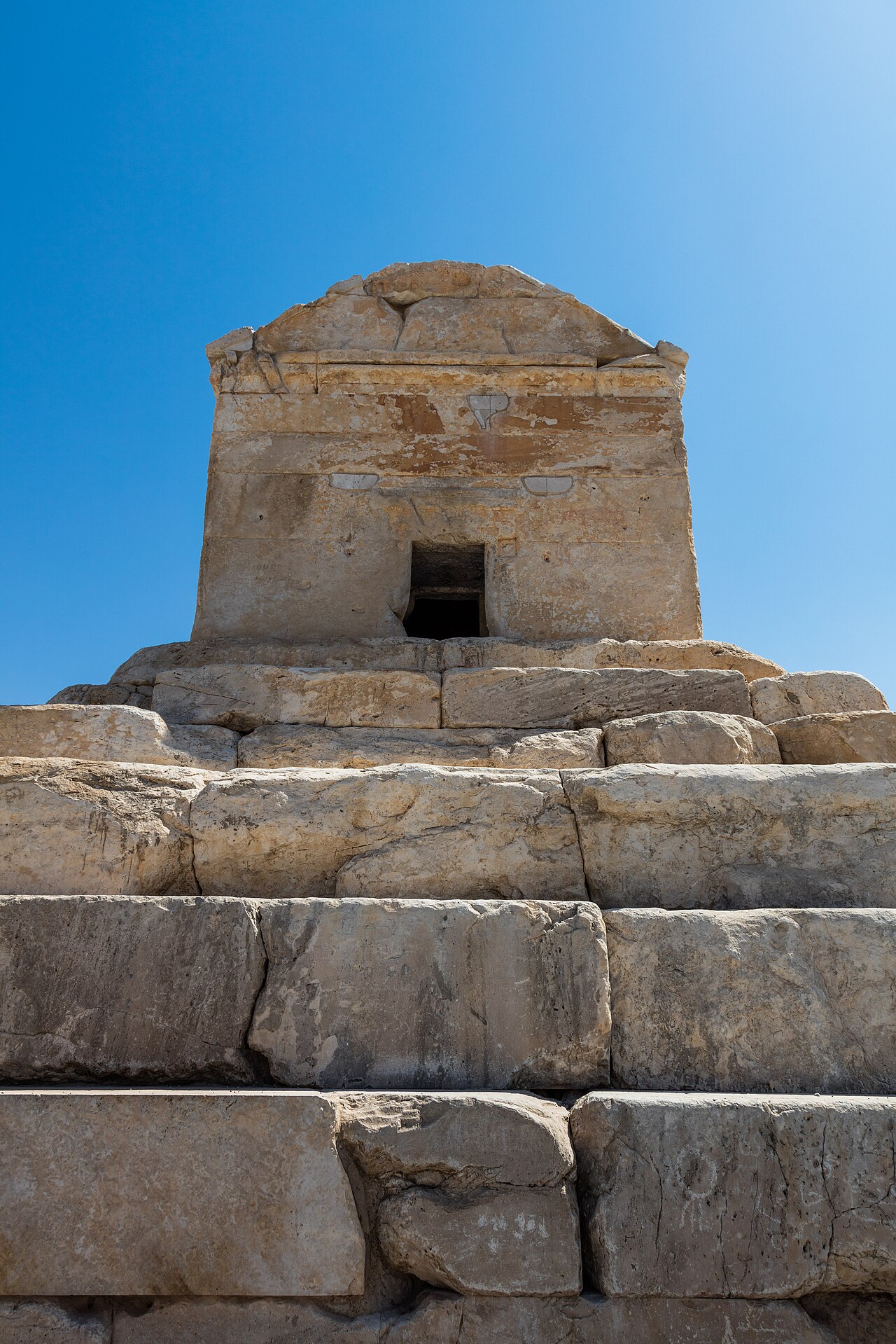
Pasargadae was the first capital of the Achaemenid Empire, founded by Cyrus the Great around 546 BC after his defeat of the Median king Astyages. It holds the Tomb of Cyrus — a plain limestone structure on a six-stepped pedestal, roughly ten metres tall — along with the remains of the Audience Hall, the Residential Palace, and a sacred precinct with fire altars. UNESCO inscribed the site in 2004.
What strikes visitors is the deliberate simplicity. The tomb chamber is small enough to hold perhaps four people; it sits in open parkland with no enclosing wall. Ancient sources, including Arrian and Strabo, record that Alexander the Great stopped here after burning Persepolis and ordered the tomb restored when he found it ransacked — an ambivalent act of conqueror’s respect. The carved reliefs on the Audience Hall columns show a four-winged figure believed to represent Cyrus himself, wearing an Egyptian crown: visual evidence of how consciously the Achaemenids absorbed and displayed the iconography of every culture they absorbed. The site is spread across several hundred hectares of dry plateau, and the isolation gives it a gravity that the more intact ruins at Persepolis do not quite replicate.
Getting there: Pasargadae is 135 km south of Isfahan and 87 km north of Shiraz; most travellers combine it with Persepolis on a day trip from Shiraz. Taxi or private car from Isfahan takes about 2 hours. Allow: 2 hours on site. Best for: History-focused travellers willing to engage with a site where the power lies in context rather than spectacle.
Persepolis 240 km south · 3 hr by road
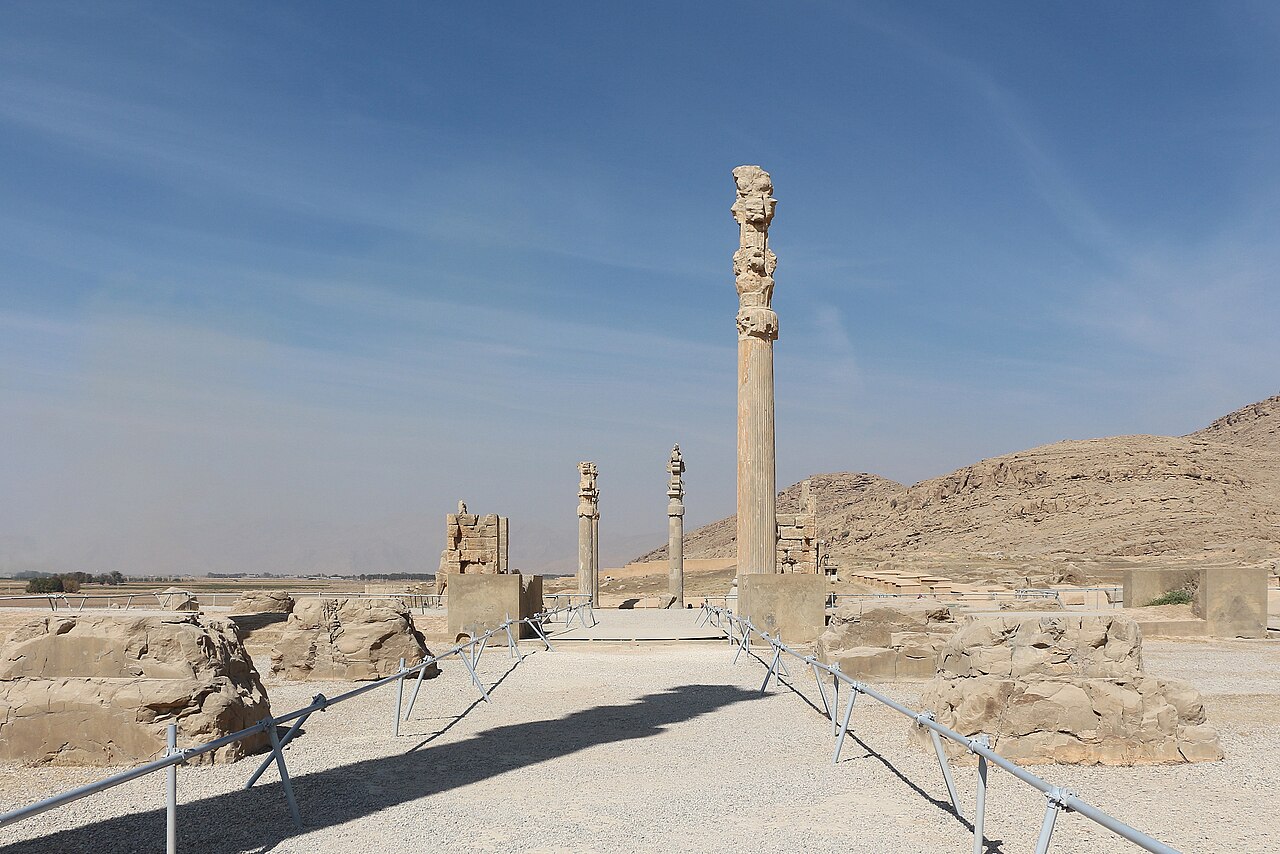
Darius I began building Persepolis in 518 BC as the ceremonial capital of the Achaemenid Empire — not a trading city or a military garrison but a stage for the annual Nowruz celebrations at which subject peoples brought tribute to the king of kings. The terrace, cut into the base of Kuh-e Rahmat mountain, measures 460 by 300 metres and holds what remains of the Apadana audience hall, the Gate of All Nations, the Hall of a Hundred Columns, and the treasury. UNESCO inscribed it in 1979.
The Apadana staircase reliefs are the site’s defining image: two identical panels show delegations from 23 subject nations in procession — Lydians carrying vases, Armenians with horses, Ethiopians with an okapi — each group separated from the next by a cypress tree. The carving is shallow but meticulous; even now, individual faces carry distinct expressions. The Gate of All Nations, built by Xerxes, features a pair of lamassu — bull-bodied guardian figures with human heads — flanking the western door, their surfaces worn smooth by two and a half millennia of wind. Alexander the Great burned the palace complex in 330 BC, reputedly as reprisal for the Persian burning of Athens 150 years earlier; the char marks are still visible on the column bases of the treasury.
The site is best visited in early morning, before the coach groups arrive and before the Iranian plateau sun climbs to its midday intensity. The view east from the Apadana terrace — over the plain where the ancient processional road ran — helps you read the site as a theatre of imperial choreography rather than simply a ruin.
Getting there: Persepolis is 240 km south of Isfahan and 57 km northeast of Shiraz. Most visitors base in Shiraz (3 hours from Isfahan by road or 1 hour by air) and take a half-day taxi excursion. Allow: 3–4 hours. Best for: All travellers to Iran; Persepolis is one of the essential archaeological sites in the world and should not be skipped regardless of itinerary constraints.
Frequently Asked Questions
How many UNESCO World Heritage Sites are near Isfahan?
Four UNESCO World Heritage Sites are within reach of Isfahan: Meidan Emam (Naqsh-e Jahan Square, inscribed 1979) in the city itself; the Shushtar Historical Hydraulic System (2009), 100 km west; Pasargadae (2004), 135 km south; and Persepolis (1979), 240 km south near Shiraz. Iran has 27 World Heritage Sites in total, and this region holds an exceptional share of them.
Can I visit Persepolis and Pasargadae as a day trip from Isfahan?
It is possible but long. The two sites are 240 km and 135 km south of Isfahan respectively, and most travellers instead spend a night or two in Shiraz (3 hours by road from Isfahan, or under an hour by domestic flight). From Shiraz, both Persepolis and Pasargadae are comfortable half-day excursions — many visitors do them back to back in a single full day by private taxi, driving Persepolis in the morning and Pasargadae in the afternoon on the return north. Hiring a car and driver for the combined excursion costs around 3–4 million rials (negotiate in advance).
What is the best time of year to visit the sites around Isfahan?
Spring (late March to mid-May) and autumn (September–October) are the most comfortable seasons for both Isfahan and the Persepolis–Pasargadae circuit. Spring brings green vegetation to the otherwise arid Pasargadae plateau and higher water levels at Shushtar’s cascades. Summer temperatures on the Fars Province plain — where Persepolis and Pasargadae stand — regularly exceed 40°C by midday; if you visit between June and August, arrive at the sites before 8 am. Isfahan itself sits at 1,590 metres elevation and is cooler than the southern sites year-round.
Why did Shah Abbas I build the Sheikh Lotfollah Mosque without a minaret?
The mosque was commissioned as a private oratory for the royal household — specifically, court sources indicate, for the women of the Shah’s harem — rather than as a congregational mosque open to the public. Because there was no call to prayer for a general population, a minaret served no liturgical function. Access to the mosque was originally through an underground tunnel connecting it directly to the Ali Qapu Palace across the square, bypassing the open space entirely. The absence of a minaret, combined with the mosque’s unusual single-chamber plan and the extraordinary refinement of its tile programme, gives it an intimacy unlike any other Safavid building.