

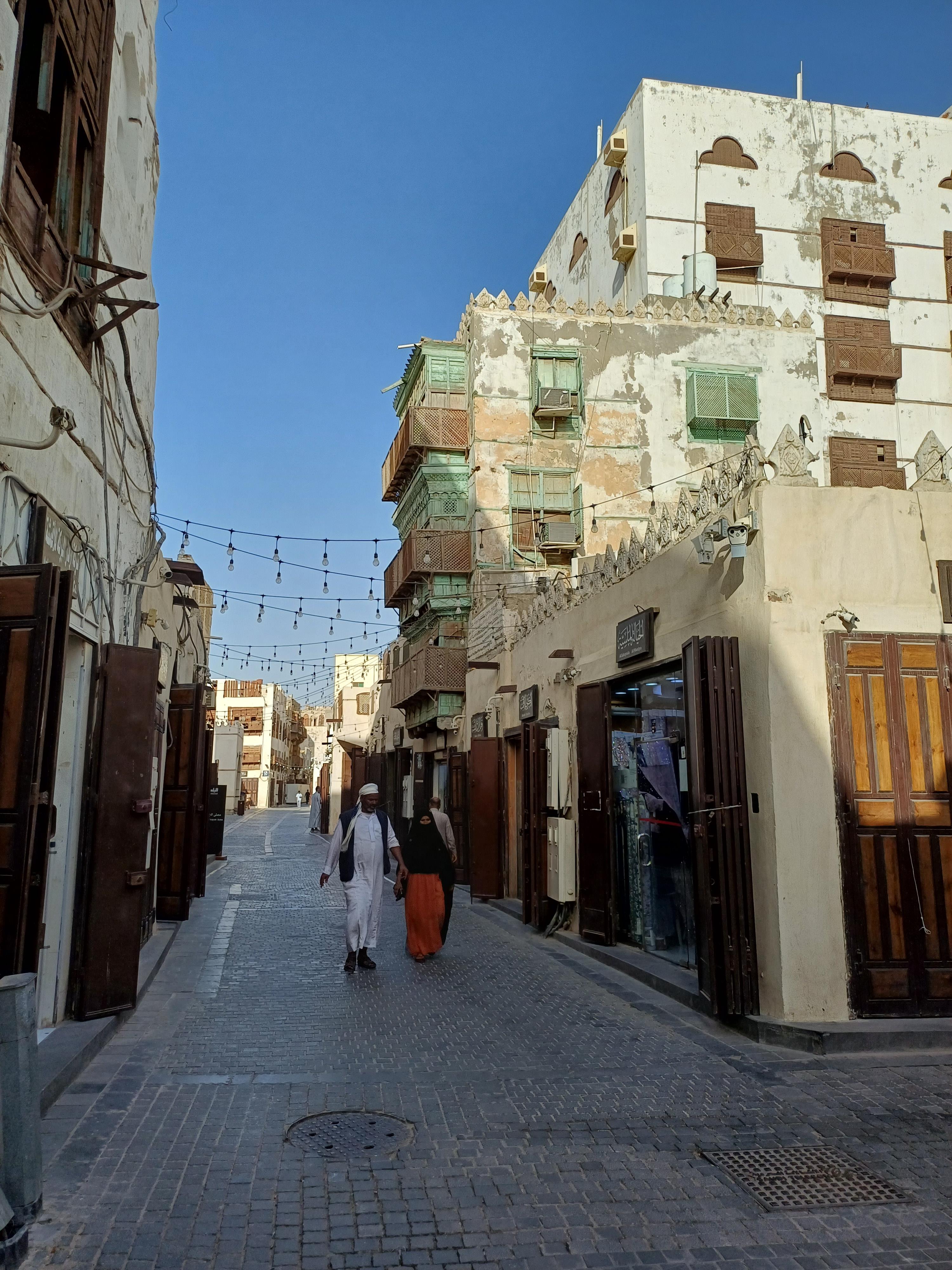
Jeddah sits at the edge of the Red Sea and at the threshold of two UNESCO World Heritage Sites: the coral-built lanes of Al-Balad within the city itself, and the Nabataean rock tombs of Hegra two hours north by air. From Cultural Heritage Online.
Historic Jeddah, the Gate to Makkah (Al-Balad) Within the city — walkable

Al-Balad is the old trading port that gave Jeddah its identity as the Gateway to Mecca. Since the 7th century, pilgrims disembarked here before making the journey inland to the holy city — and the merchant families who housed and supplied them built a skyline unlike anything else in Arabia. UNESCO inscribed the district in 2014, recognising its outstanding example of a Red Sea merchant urban culture that flourished across more than a thousand years.
The buildings are the story. Around 650 tower houses survive, constructed from blocks of fossilised coral harvested from the adjacent sea floor, then mortared with gypsum. The coral is alive to the light: it reads cream in the morning, shifts to amber through the afternoon, and burns deep orange at dusk. Above street level, roshan — elaborate projecting oriel windows of fretted wood — cool the interior air by drawing breezes while letting the women of the household observe street life unseen. The craftsmanship in those carved screens represents centuries of accumulated workshop knowledge, and it is still visible in structures such as the Jokhdar House and Nasif House, both restored and open to visitors.
Walking Al-Balad takes little more than two hours at a relaxed pace. Al-Alawi Street is the commercial spine; the side lanes open onto mosques, the 13th-century Al-Shafi minaret, and courtyard houses where cats occupy patches of afternoon shade. The waterfront corniche runs along the western edge of the district and offers the best views of the tower-house silhouette against the Red Sea.
Getting there: Al-Balad occupies the southern waterfront of central Jeddah, roughly 5 km from King Abdulaziz International Airport; taxi or ride-share takes 15–20 minutes. Allow: 2–3 hours on foot; half a day if you visit both Nasif House and the Al-Shafi Mosque. Best for: Architecture enthusiasts, anyone interested in Islamic merchant culture, and visitors combining a pilgrimage trip with heritage tourism.
Hegra Archaeological Site (Al-Hijr / Madain Salih) ~1,300 km north — 2 hr domestic flight to Al-Ula

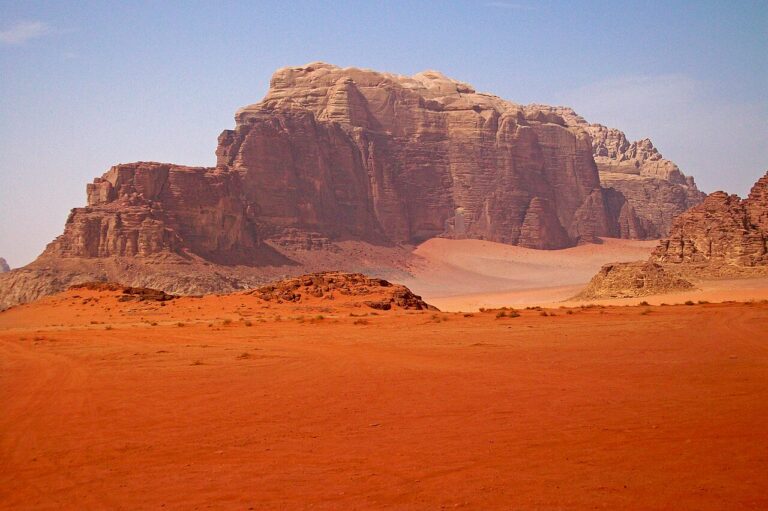
Hegra was Saudi Arabia’s first UNESCO World Heritage Site, inscribed in 2008 — a distinction that reflects the exceptional quality of what survives here. The Nabataean kingdom, which controlled the overland spice and incense routes between southern Arabia and the Mediterranean from roughly the 1st century BC to the 1st century AD, built their second great city at Hegra, after Petra in present-day Jordan. Where Petra was carved into rose-red stone, Hegra’s sandstone outcrops are amber and ochre, and the light on the facades at sunrise is something travellers describe for years afterward.
More than 100 monumental tombs survive with decorated facades, many in better condition than those at Petra because Hegra remained largely inaccessible to outsiders until recent decades. The facades follow a consistent vocabulary — crowstep battlements, Nabataean capitals, blind windows, niched alcoves — but each is distinct. Inscriptions in Nabataean Aramaic name the tomb owner, the year of carving, and in some cases the deity being invoked. Tomb 21 in the Qasr al-Bint necropolis carries an inscription dated to 28 AD, during the reign of King Aretas IV. These texts constitute one of the richest documentary records of Nabataean religious life anywhere in the world.
Al-Ula, the nearest town, has been transformed since 2020 into a full heritage tourism destination with a regional airport, boutique hotels, and a desert arts programme (Maraya concert hall is the largest mirrored building in the world). The Royal Commission for Al-Ula operates guided tours of the main necropolises; independent movement within the site requires a permit and is best arranged in advance through the Hegra ticketing platform.
Getting there: Fly Jeddah (JED) to Al-Ula (ULH), approximately 2 hours; several daily flights on Saudia and Flynas. Alternatively, drive 15–17 hours or take the Haramain High-Speed Railway to Madinah then continue by road (approx. 4 hours). Allow: A minimum of two nights in Al-Ula to visit Hegra, the Dadan archaeological site, and the old town. Best for: History and archaeology travellers, Petra veterans seeking the wider Nabataean world, desert landscape photographers.
Frequently Asked Questions
How many UNESCO World Heritage Sites are near Jeddah?
Two UNESCO World Heritage Sites are accessible from Jeddah. Historic Jeddah, the Gate to Makkah (Al-Balad), inscribed in 2014, is located within the city itself. Hegra Archaeological Site (Al-Hijr / Madain Salih), Saudi Arabia’s first UNESCO inscription in 2008, is approximately 1,300 km to the north near Al-Ula and reached by a two-hour domestic flight.
How do you get from Jeddah to Al-Balad?
Al-Balad is in southern central Jeddah, about 15–20 minutes by taxi or ride-share from King Abdulaziz International Airport. The district is compact and best explored on foot; the main entrance point is Al-Alawi Street near the corniche waterfront. Entry to the district is free, though some restored houses charge a small admission fee.
When is the best time to visit Hegra from Jeddah?
October through March is the most comfortable window, when daytime temperatures at Al-Ula range between 15°C and 25°C. Summer months (June–August) bring extreme heat that makes outdoor site visits physically demanding. The annual Hegra Season, typically running from autumn through spring, brings additional tours, evening light shows at the necropolises, and cultural programming in Al-Ula’s old town. Book flights and accommodation well in advance during this period.
What makes Hegra different from Petra?
Hegra and Petra were both major cities of the Nabataean kingdom, linked by the same caravan trade routes and sharing the same architectural language of rock-cut tomb facades. Hegra is the larger of the two in terms of preserved tombs — over 100 monumental structures survive — and the inscriptions here are often better preserved due to the site’s relative isolation until recently. The surrounding landscape differs markedly: where Petra sits within a canyon of rose sandstone, Hegra’s necropolises rise from a flat desert floor, the outcrops standing in isolation so that each tomb group is visible from a distance. Visitor numbers remain substantially lower than at Petra, which gives the site a different quality of quiet.
Sources
- S1 — Pesce, Angelo. Jiddah: Portrait of an Arabian City. Falcon Press, 1977. ISBN 978-0-906319-01-7.
- S2 — Nehmé, Laïla, ed. The Tomb of Hegra: Archaeological Survey of Madâ'in Sâlih. Académie des Inscriptions et Belles-Lettres, 2015. ISBN 978-2-87754-325-5.
Spotted an error? Write to editorial@culturalheritageonline.com and we correct it the same day.
.jpg)

,_the_kingdom%27s_second_Nabatean_capital_after_Petra,_Saudi_Arabia_-_53535092194.jpg)