Delhi alone holds three UNESCO World Heritage Sites, and two more — the Taj Mahal and the ghost capital of Fatehpur Sikri — are reachable from the city in a single day or a comfortable overnight trip. Together, they span eight centuries of Islamic and Mughal architecture, from a 73-metre minaret raised by a Delhi Sultanate general to a white-marble mausoleum that took 22 years and 20,000 workers to complete. From Cultural Heritage Online.
Qutb Minar and its Monuments 35 min by Metro
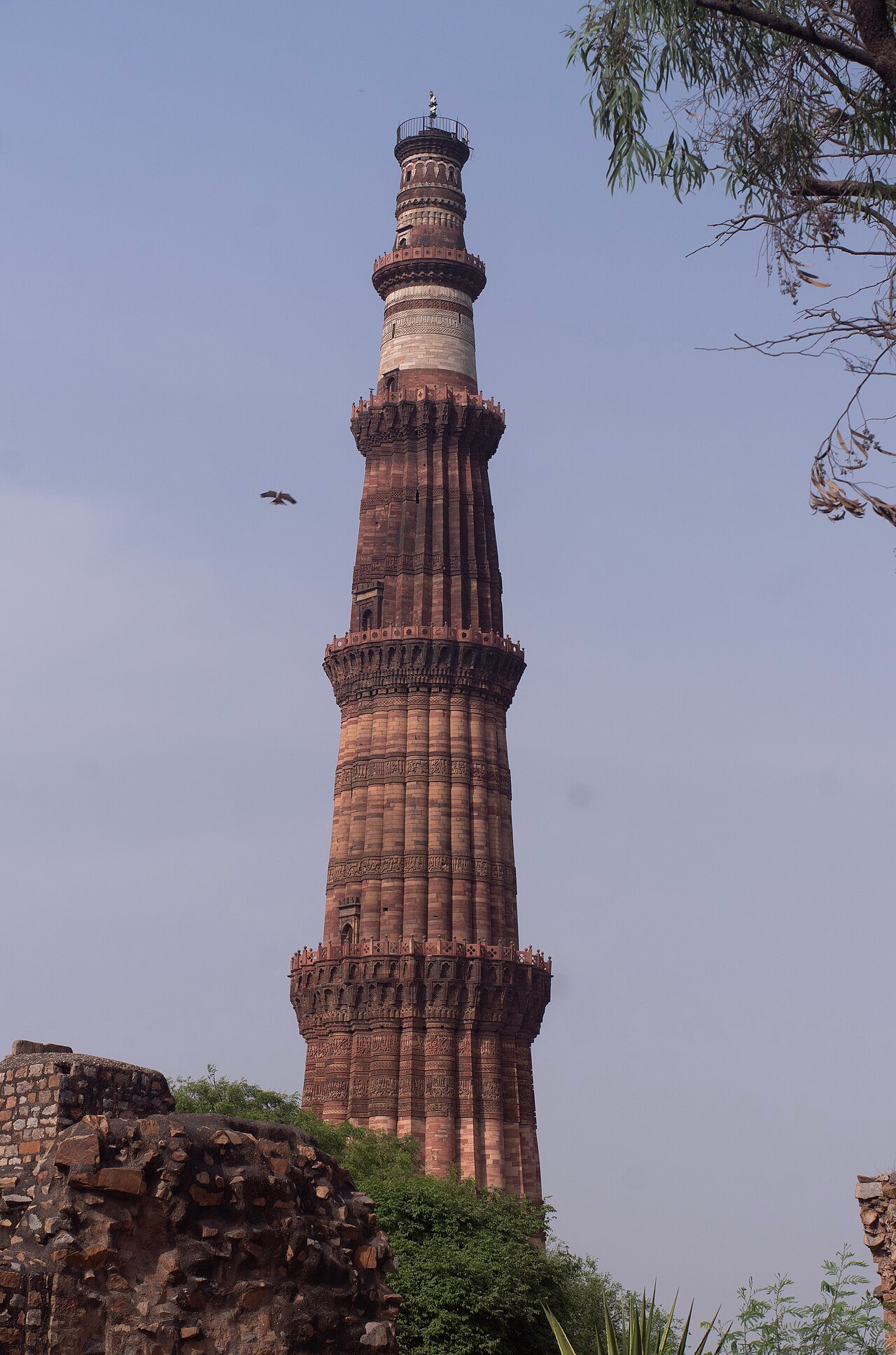
Inscribed in 1993, the Qutb complex in Mehrauli marks the beginning of Islamic rule on the Indian subcontinent. Construction of the minaret began around 1199 under Qutb ud-Din Aibak, the general who founded the Delhi Sultanate after defeating Prithviraj Chauhan. Work continued under successive rulers, with Firuz Shah Tughlaq rebuilding the upper sections and adding a cupola in 1368. The tower rises 72.5 metres through five tapering storeys, each defined by alternating angular and rounded flutes and bands of Quranic calligraphy in carved sandstone. At close quarters, the surface texture is remarkable: interlocking geometric patterns pressed into red and buff stone that still holds its edge after more than 800 years. The complex also contains the 4th-century Iron Pillar of Delhi, which has stood for over 1,600 years without significant rusting — a metallurgical puzzle that attracted attention long before the minaret was built. The 399 steps inside the tower are now closed to visitors, but the surrounding ruins of the Quwwat-ul-Islam mosque, Delhi’s oldest surviving mosque, reward a slow circuit.
Getting there: Yellow Metro line to Qutab Minar station (from central Delhi via Rajiv Chowk); approximately 35 minutes from Connaught Place. Allow: 2–3 hours. Best for: The most architecturally concentrated UNESCO site in Delhi, combining the minaret, mosque ruins, and the Iron Pillar in a single compact complex administered by the Archaeological Survey of India.
Humayun’s Tomb 25 min by Metro
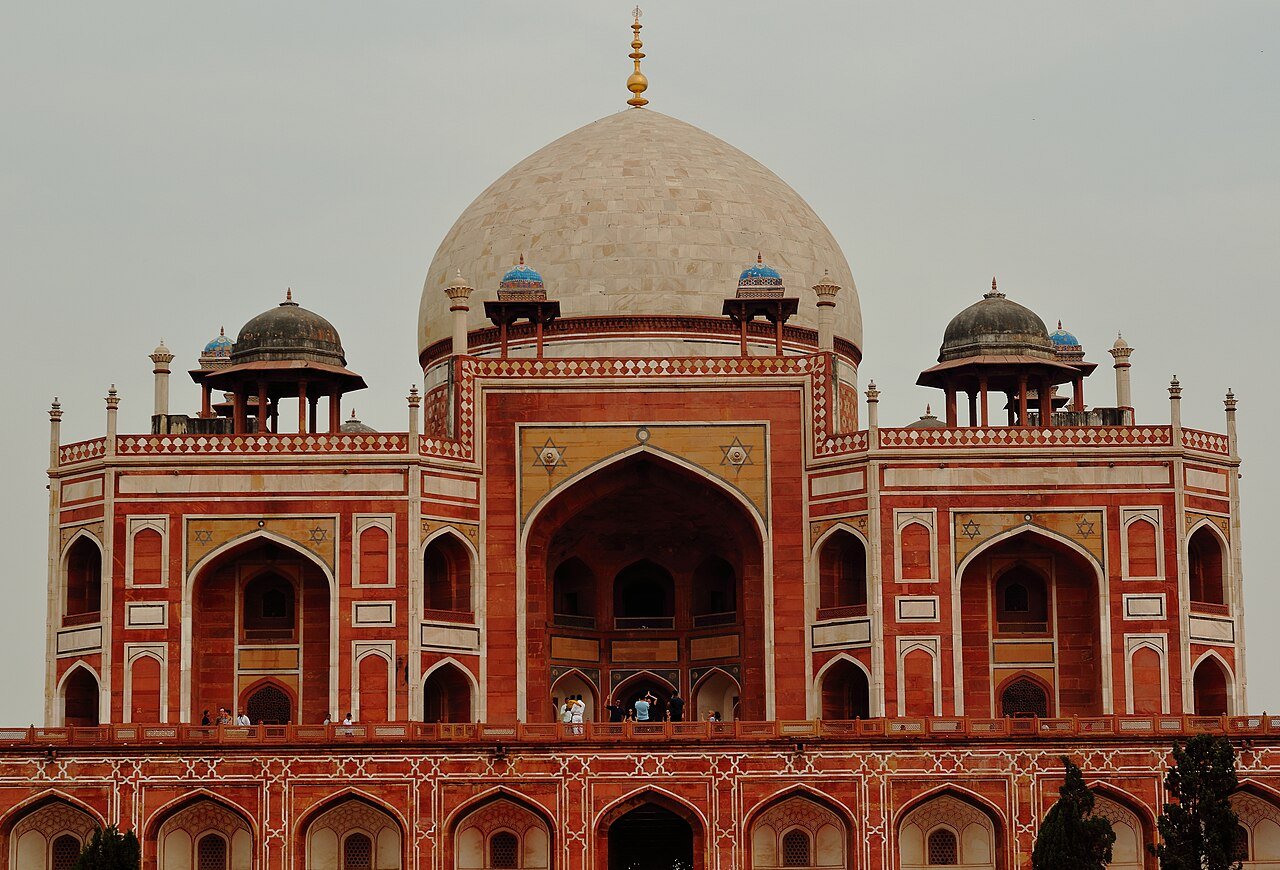
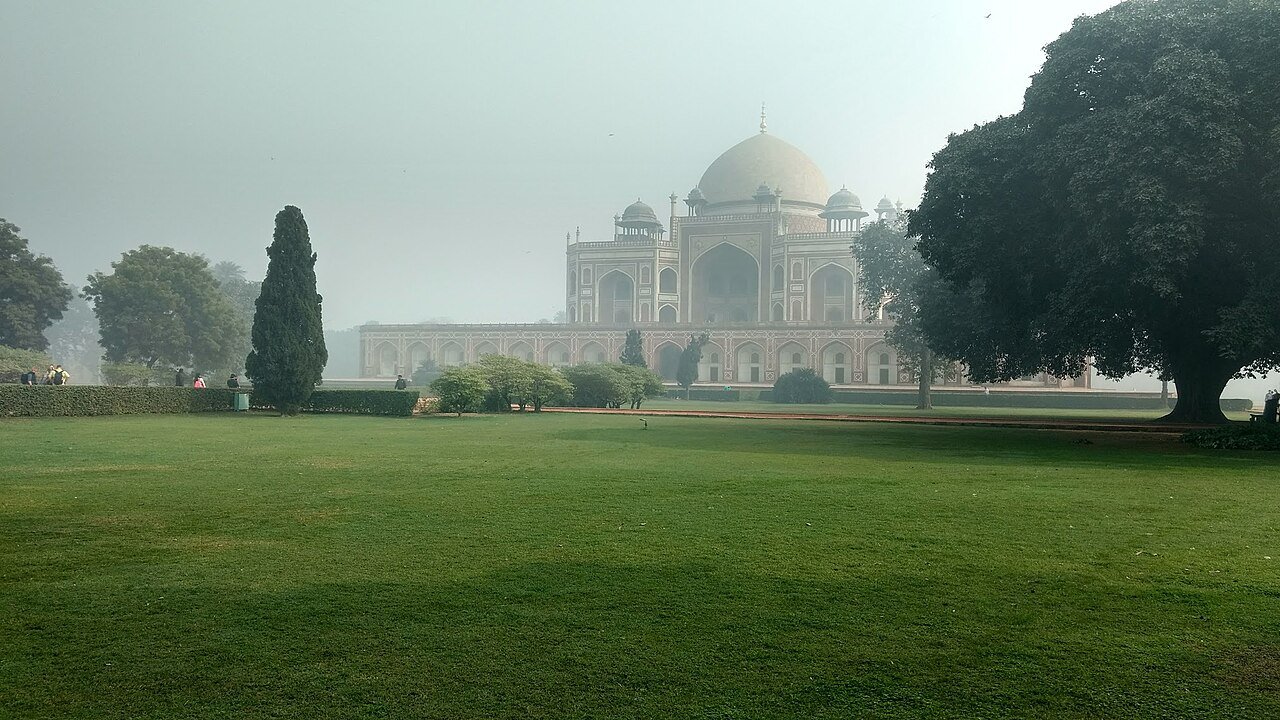
Commissioned in 1558 by Empress Bega Begum, the principal wife of the Mughal emperor Humayun, and designed by the Persian architect Mirak Mirza Ghiyas and his son Sayyid Muhammad, Humayun’s Tomb was the first garden-tomb on the Indian subcontinent. That distinction matters architecturally: the chaharbagh (four-part) garden layout and the double-shell dome of white marble over a red sandstone base established a formal vocabulary that reached its fullest expression 75 years later at the Taj Mahal. The complex was inscribed as a UNESCO World Heritage Site in 1993. The main tomb sits elevated on a broad platform, its octagonal chambers arranged so that eight arched alcoves frame the central cenotaph in near-perfect symmetry. Approaching along the garden’s central water channels in the early morning, when the sandstone catches low light and the lawns are still quiet, gives a clear sense of the intended processional effect. The complex also holds the earlier octagonal tomb of Isa Khan (1547), set in its own walled garden near the entrance.
Getting there: Violet Metro line to JLN Stadium, then a 10-minute auto-rickshaw; or auto-rickshaw direct from Nizamuddin railway station (approximately 25 minutes from central Delhi). Allow: 1.5–2 hours. Best for: Understanding the prototype of Mughal garden-tomb architecture and pairing with a visit to the nearby Nizamuddin dargah.
Red Fort Complex City centre — 20 min by Metro
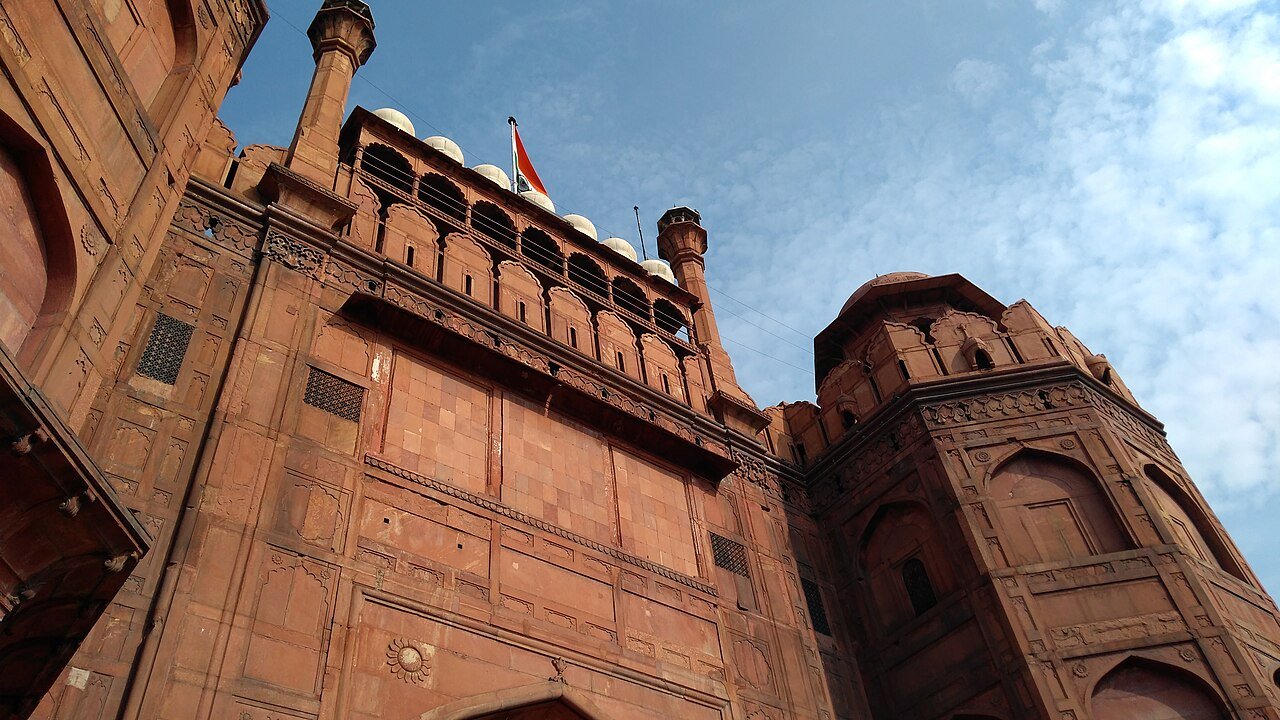
Shah Jahan commissioned the Red Fort on 12 May 1639, after deciding to move the Mughal capital from Agra to Delhi. The same architect responsible for the Taj Mahal, Ustad Ahmad Lahori, designed the complex, and construction took nine years. The fort served as the principal residence of Mughal emperors for approximately 200 years, until the British occupied it following the 1857 uprising. It was inscribed as a UNESCO World Heritage Site in 2007. The name comes from the massive red sandstone walls — originally adorned in red and white — that stretch for 2.4 kilometres around the perimeter. Inside, the Diwan-i-Aam (Hall of Public Audience) and the Diwan-i-Khas (Hall of Private Audience) display the refined Persian and Indian aesthetic that distinguished Shah Jahan’s building programme. The Lahori Gate, where India’s prime minister addresses the nation each Independence Day, remains the fort’s most recognisable façade. In the late afternoon, the sandstone walls take on a deep amber colour that rewards photographs and a slow walk along the exterior moat.
Getting there: Yellow Metro line to Chandni Chowk station; the fort’s Lahori Gate is a short walk east. Approximately 20 minutes from Connaught Place. Allow: 2–3 hours. Best for: Combining with a walk through the lanes of Old Delhi (Chandni Chowk) and lunch at one of the adjacent Mughal-era food establishments.
Taj Mahal, Agra 2 hrs 30 min by Gatimaan Express
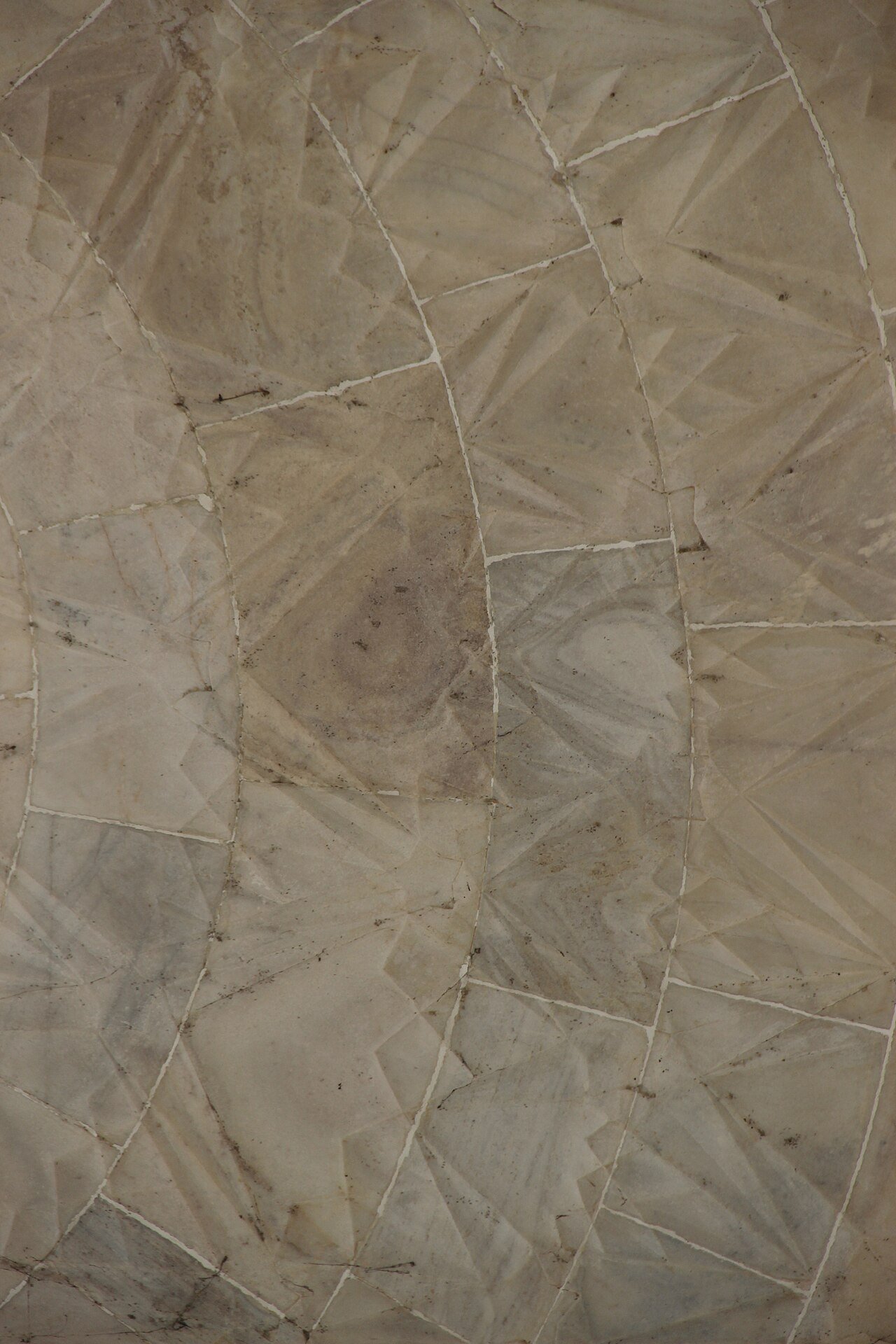
Shah Jahan commissioned the Taj Mahal in 1631 as a mausoleum for his wife Mumtaz Mahal, who died that year during the birth of their fourteenth child. Construction of the ivory-white marble complex — a 17-hectare site on the right bank of the Yamuna river in Agra — is generally dated to completion around 1653, roughly 22 years after work began. The principal architect is identified in Mughal sources as Ustad Ahmad Lahori, who also designed the Red Fort. UNESCO inscribed the Taj Mahal in 1983, making it one of India’s earliest World Heritage designations. The marble surface achieves a quality that changes perceptibly through the day: opaque and warm in early morning, almost luminous at midday, faintly pink at dusk. The formal chaharbagh garden, divided by marble-edged water channels leading to a central reflecting pool, frames the main dome at every point along the approach. The complex includes a mosque in red sandstone to the west of the tomb and a mirror-image guest house to the east, both built to achieve visual symmetry with the central structure.
Getting there: Gatimaan Express departs Hazrat Nizamuddin station (New Delhi) daily at 08:10, arriving Agra Cantonment at approximately 09:50 — a journey of 160 kilometres at up to 160 km/h, India’s fastest scheduled train service. Return departs Agra at 17:50. Book well in advance; tickets sell out. Allow: 3–4 hours at the site. Best for: A comfortable same-day trip from Delhi, ideally arriving at the Taj soon after the train and returning on the evening service; or as the first stop on an overnight trip that continues to Fatehpur Sikri.
Fatehpur Sikri 3 hrs 30 min by car from Delhi
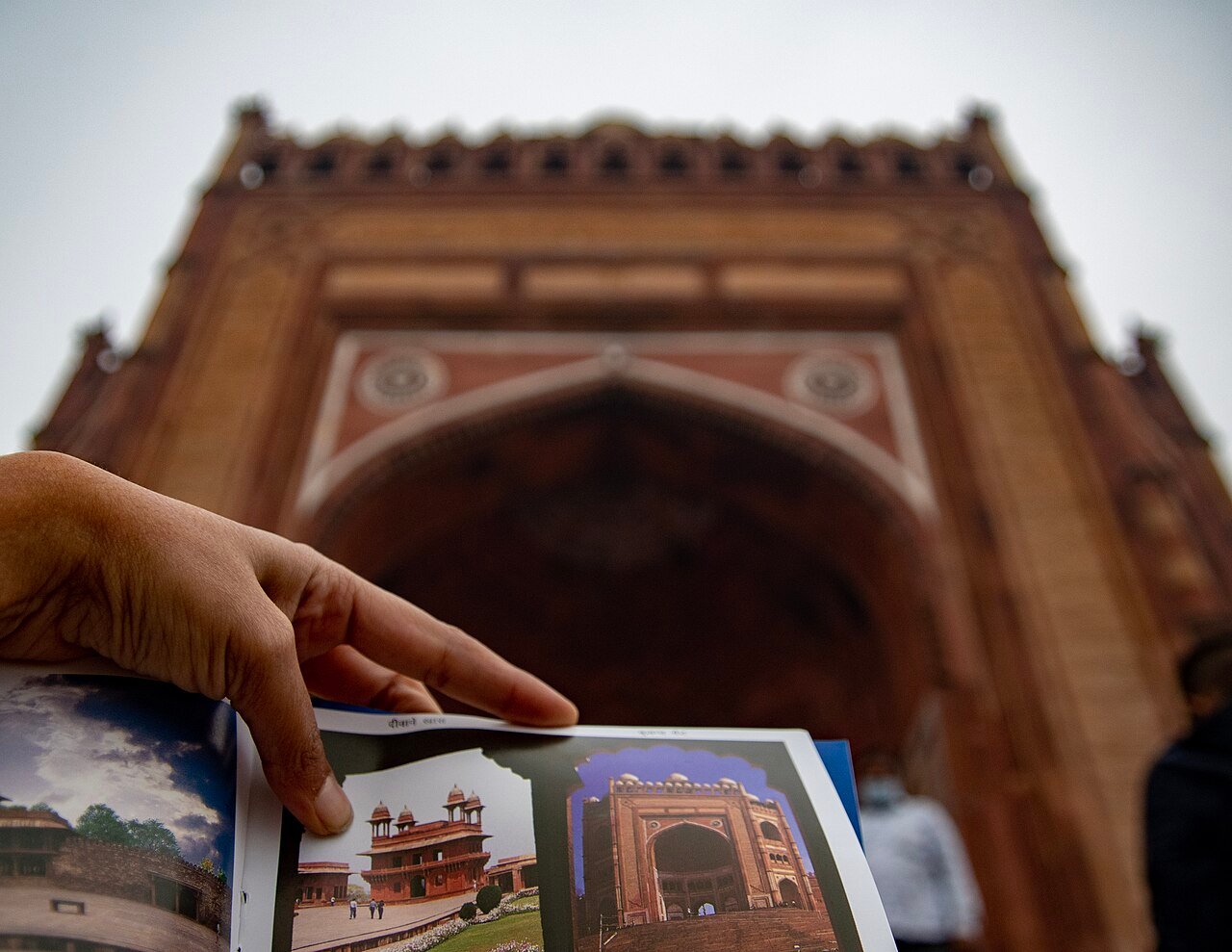
Emperor Akbar founded Fatehpur Sikri in 1571, building an entirely new Mughal capital on a sandstone ridge 37 kilometres west of Agra. He occupied the city as his administrative centre from 1571 to 1585, when a campaign in Punjab prompted relocation of the court. The city was largely abandoned by 1610 and has remained so since — which is precisely what makes it so legible today. UNESCO inscribed Fatehpur Sikri in 1986. The royal complex covers a hilltop plateau and includes the Jama Masjid, one of the largest mosques in India, and the Buland Darwaza (Gate of Victory), a 54-metre gateway built in 1601 to commemorate Akbar’s conquest of Gujarat. The Diwan-i-Khas, where Akbar held private audience, contains a single stone pillar supporting a circular platform connected to four walkways — an architectural arrangement that has no direct parallel in contemporaneous Mughal building. Walking the site in the afternoon, when the red sandstone glows against a clear sky and the plateau offers views over the surrounding plain, the scale of Akbar’s ambition becomes tangible in an unusually direct way.
Getting there: Fatehpur Sikri is best visited by road — approximately 3.5 hours by car from Delhi, or 45 minutes from Agra. The most practical approach from Delhi is to combine it with Agra: take the Gatimaan Express to Agra, visit the Taj Mahal, stay overnight, then hire a car or take a shared taxi to Fatehpur Sikri the following morning before returning to Delhi. A purely same-day trip from Delhi is possible but long. Allow: 2–3 hours on site. Best for: Travellers who want to understand Akbar’s reign and who have at least one night in Agra to split the journey sensibly.
Frequently Asked Questions
How many UNESCO World Heritage Sites are near Delhi?
Delhi has three UNESCO World Heritage Sites within the city: Qutb Minar and its Monuments (inscribed 1993), Humayun’s Tomb (1993), and the Red Fort Complex (2007). Two additional sites — the Taj Mahal (1983) and Fatehpur Sikri (1986) — are located near Agra, approximately 200 kilometres south of Delhi and reachable by train or road in under three hours.
What is the closest UNESCO World Heritage Site to central Delhi?
Humayun’s Tomb is the most centrally located, sitting in Nizamuddin East and reachable in around 25 minutes by Metro from the heart of the city. The Red Fort Complex in Old Delhi is similarly close for visitors staying in the north of the city. Qutb Minar is in Mehrauli, in South Delhi, and takes roughly 35 minutes by Metro.
Do foreign visitors need a visa to enter India, and are there separate tickets for the UNESCO sites?
Most foreign nationals require a visa to enter India; an e-Visa is available online for citizens of over 150 countries and is generally processed within 72 hours. Each UNESCO site charges a separate Archaeological Survey of India (ASI) entry fee, with higher rates for foreign visitors than for Indian nationals. Tickets for Qutb Minar, Humayun’s Tomb, Red Fort, and Fatehpur Sikri can be purchased at the site; Taj Mahal tickets are also available online and advance booking is strongly recommended during peak season (October–March).
What is the best season to visit Delhi and Agra, and are there dress code requirements?
October to March is the most comfortable period: daytime temperatures range between 15°C and 28°C, humidity is low, and most outdoor sites can be explored on foot without difficulty. April to June brings intense heat (often above 40°C), and July to September is the monsoon. There is no formal dress code at the Delhi archaeological sites, but the Taj Mahal and the Fatehpur Sikri Jama Masjid are active religious spaces: shoulders and knees should be covered, and shoes must be removed before entering the mosque precincts; shoe covers are provided at the Taj Mahal gate.
Sources
- UNESCO World Heritage List — whc.unesco.org/en/list/ (inscription years and site descriptions)
- Archaeological Survey of India — asi.nic.in (site administration and entry fees)
- Wikipedia: Qutb Minar, Humayun’s Tomb, Red Fort, Taj Mahal, Fatehpur Sikri
- Indian Railways — Gatimaan Express timetable and booking: irctc.co.in
- Wikimedia Commons — image sources credited inline throughout this article